
MAIN IDEA:
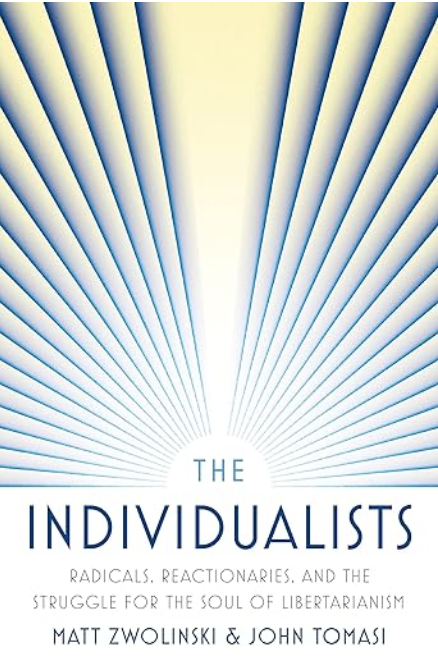
This book is about the history and content of libertarianism. The authors trace its origin to XIX century America, which started as a movement for freedom against slavery. Later, it developed into a mainly anti-socialist ideology, championing individual freedom against all forms of suppression of individuals in the name of the collective. Here is how the authors characterize this movement:
” Taken to their logical conclusion, libertarian principles entail that most existing political and economic institutions are deeply unjust. Libertarianism thus counsels not gradualist reform but a sweeping revolution. The system of welfare—whether social or corporate—is to be abolished. Unjustly acquired property is to be returned to its rightful owner. Restrictions on freedoms of movement and labor must be swept away. Militarism, in which states tax citizens to prepare to fight other states, is intolerable.
In terms of its theoretical foundations, libertarianism is uncompromising in its radicalism. In practice, however, not all libertarians were comfortable embracing the wholesale upheaval of existing institutions—and privileges. From its beginning, then, libertarianism has attracted a mix of radical and reactionary elements: those who were eager to follow the dictates of libertarian justice wherever they might lead, and those who saw in libertarianism a rationale for defending the status quo against change. The tension between progressive and reactionary elements, a tension within the very soul of libertarianism, is the major theme of this book.”
The author also offers a precise formulation of the intention of this book:” This book is a history of libertarian ideas. It offers neither a history of libertarian politics nor a history of the libertarian movement.1 It is an intellectual history. Further, this book offers an intellectual history of libertarianism and not a philosophical defense.”
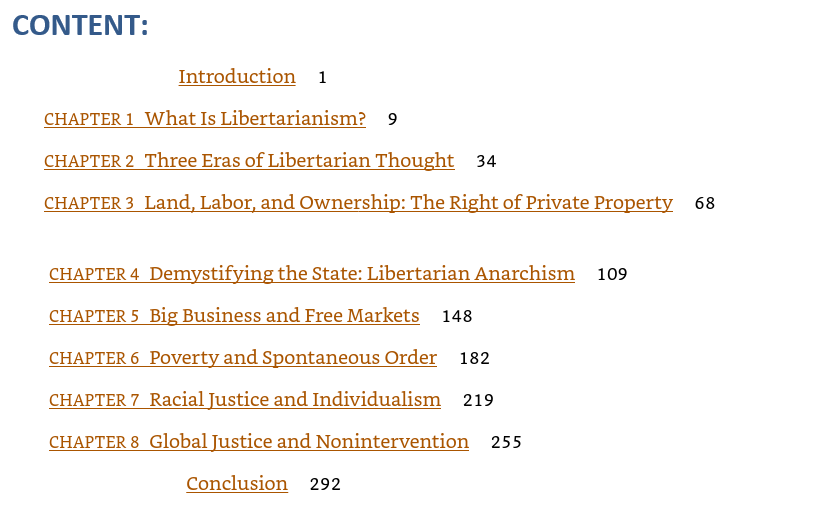
Finally, the authors describe their understanding of the nature of libertarianism in this way:” As we see it, libertarianism cannot be defined by any one set of necessary and sufficient conditions. Instead, libertarianism is best understood as a cluster concept. We see libertarianism as a distinctive combination of six key commitments: property rights, negative liberty, individualism, free markets, a skepticism of authority, and a belief in the explanatory and normative significance of spontaneous order. Chapter 1 introduces each of these six concepts, shows how libertarians interpret them, and explains how, when brought together into an integrated set, they form a distinct and recognizably libertarian approach.”
MY TAKE ON IT:
I consider myself a libertarian, and it is nice to see such a detailed analysis of the nature and historical development of libertarian ideas. However, libertarianism had never attracted the mass following that could be converted into electoral success, and consequently, libertarian participation in American politics is kind of a joke. I think the reason for this comes from human nature to support movements that bring or at least promise to bring some tangible benefits to the people. Since libertarianism promotes freedom based on property, for most people with no property to speak about there is little value in such abstract freedom. Therefore, these ideas are alien and could even be considered hostile to non-propertied people. It is possible to change this if the common informational inheritance of humanity: concepts, knowledge, and know-how is recognized as a formal property belonging to everybody equally, even if it is applied and benefited from by individuals depending on their individual abilities and circumstances, which means highly unequally. Such recognition would lead to the requirement for more effective users to compensate ineffective users of the common inheritance. It would be no different than three people commonly owning a car, with one using it four days per week, one for two days, and one only for one day. Obviously, two guys who use the car less would demand compensation. As soon as a property in common inheritance is recognized as unalienable and a compensation mechanism established, everybody would become supporters of property rights so that libertarian ideas would become viable drivers of electoral politics and, probably, even dominant ideas of society.
 Equal Rights Libertarian