
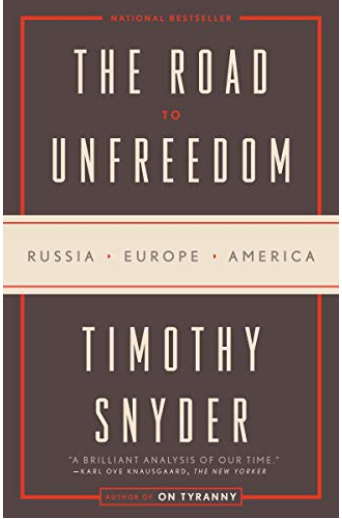
MAIN IDEA:
The main idea here is about two types of politics: one of inevitability and another one of eternity. The first relates to the notion of the “end of history” with the final victory of liberal democracy over its authoritarian competition. This politic failed. Per the author:” The collapse of the politics of inevitability ushers in another experience of time: the politics of eternity. Whereas inevitability promises a better future for everyone, eternity places one nation at the center of a cyclical story of victimhood. Time is no longer a line into the future, but a circle that endlessly returns the same threats from the past. Within inevitability, no one is responsible because we all know that the details will sort themselves out for the better; within eternity, no one is responsible because we all know that the enemy is coming no matter what we do. Eternity politicians spread the conviction that government cannot aid society as a whole, but can only guard against threats. Progress gives way to doom.
In power, eternity politicians manufacture crisis and manipulate the resultant emotion. To distract from their inability or unwillingness to reform, eternity politicians instruct their citizens to experience elation and outrage at short intervals, drowning the future in the present. In foreign policy, eternity politicians belittle and undo the achievements of countries that might seem like models to their own citizens. Using technology to transmit political fiction, both at home and abroad, eternity politicians deny truth and seek to reduce life to spectacle and feeling”.
The author then applies this framework to the contemporary realities of European and American politics. Here is the author’s description of the book’s structure: “Each chapter focuses upon a particular event and a particular year—the return of totalitarian thought (2011); the collapse of democratic politics in Russia (2012); the Russian assault upon the European Union (2013); the revolution in Ukraine and the subsequent Russian invasion (2014); the spread of political fiction in Russia, Europe, and America (2015); and the election and presidency of Donald Trump (2016–).”

MY TAKE ON IT:
This book provides a lovely review of the inherently totalitarian thinking of Russian ideologues of the XXth century, such as Ilyin, who created a philosophical foundation for contemporary Russian totalitarian nationalism, which finally expressed itself via direct military aggression against Ukraine after for years expressing itself via social, political, and communicational attack against Europe and USA. I believe the author is correct regarding the philosophy, ideology, and description of Russian aggression. However, his mixing of this ideology with Trump and anti-elitist movements in Europe demonstrates nothing more than typical leftist academicians’ lack of knowledge and understanding of their vast differences. Putin’s Russia is traditionally a fascistic state with territorial aggression, conquest, and claim of superiority over other countries. Its aggression was caused by the firm belief in its national superiority and the apparent reality of material inferiority in all essential areas, such as wealth, technology, and even military power. The same applies to contemporary China.
The anti-elitist movements, Trump included, are internal movements within democratic societies produced by the refusal of the middle class of these societies to submit to the dictates of their own elite, which is increasingly becoming a part of the global elite that gets rich via globalization. This process deprives these middle classes of the wealth created by the combination of hard work and belonging to populations of well-developed countries. The substitution of well-paying jobs that moved externally to relatively poor countries with low wages and internally to the legal, semi-legal, and illegal immigrants, with welfare checks supplemented by expressions of contempt for their culture, seems way too much for them to bear.
The proper way to deal with non-elite resurrection is to recognize and restore national unity by moving the production of goods and services back to developed countries and limiting immigration to individuals who clearly demonstrate intention and effort to become productive and loyal citizens of these countries.
There is a straightforward solution to the idea that it would not be possible for developed countries to compete on price with poor countries. Just make one very brief law: “All goods and services sold within the developed country X should be produced with full compliance with all environmental, labor, and other regulations of the country X, however idiotic these regulations are. The first violation of this law is punishable by confiscation of 50% of individual assets of the violator, the second by confiscating whatever assets left”.
As to the Russian and Chinese aggression, the proper way to deal with it is by cutting them off from contemporary technology, depriving them of the ability to obtain serious military power. In addition, democracies should initiate a massive attack on the ideology of these regimes in defense of the human rights of people in these countries, creating internal conditions for their change into somewhat more civilized entities.
 Equal Rights Libertarian