
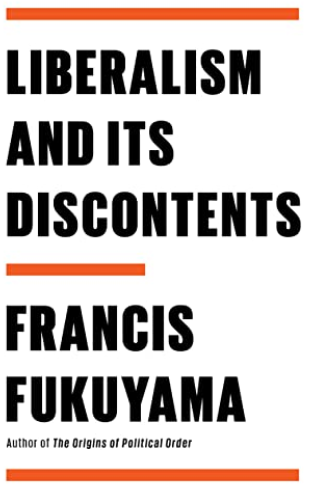
MAIN IDEA:
This book aims to defend “classical liberalism,” which the author understands as “the doctrine that first emerged in the second half of the seventeenth century that argued for the limitation of the powers of governments through law and ultimately constitutions, creating institutions protecting the rights of individuals living under their jurisdiction.”
The book reviews the history of liberalism, its foundational ideas, current condition, and challenges. It goes through such ideological developments as critical theories, especially critical race theory, various forms of identity politics, attacks against rationality, and the very foundation of Western society.
The book also looks at several alternatives: a conservative offer based on community and religious morality, a nationalist offer, also communalist, but based more on ethnic and cultural community. It accuses conservatives of authoritarian inclinations but describes leftist alternatives in such a way:” A more likely scenario for a progressive post-liberal society would be one which saw a vast intensification of existing trends. Considerations of race, gender, gender preference, and other identity categories would be injected into every sphere of everyday life, and would become the primary considerations for hiring, promotion, access to health, education, and other sectors.” In the economic area, the old ideas of socialism seem to have little support even among the left, so the alternative looks like this:” The government would provide generous social services, pay for higher education, fund health care, guarantee jobs and minimum incomes, regulate if not nationalize the financial system, and massively shift investment towards preventing climate change. All of this would be paid for by equally massive new taxes on the wealthy, or, as per modern monetary policy, through the time-tested printing mechanism.”
Finally, the author offers his own solution to the crisis of liberalism:” The urgent issue for liberal states does not have to do with the size or scope of government, which the left and right have been fighting over for decades. The issue rather is the quality of government. There is no way around the need for state capacity—that is, a government that has sufficient human and material resources to provide necessary services to its population. A modern state needs to be impersonal, meaning that it seeks to relate to citizens on an equal and uniform basis, and not on the basis of personal, political, or family ties to politicians wielding power at a given moment. Modern states have to deal with a whole range of complex policy issues, from macroeconomic policy to health to electromagnetic spectrum regulation and weather forecasting, and they need access to well-educated professionals with a strong sense of public purpose if they are to do their jobs well.

MY TAKE ON IT:
I fully agree that classical liberal ideas and their practical implementation in contemporary Western societies are in crisis. However, I disagree that it is the crises of left-right confrontation or cultural contradictions caused by globalization and the growing population diversity. I see the main cause in the underlying development of resources generating and distribution methods. The essential characteristic of these methods up until recently was the need to work for a living for the vast majority of the population. I mean productive work that creates goods and services necessary for survival, whether hunting and gathering in early stages or industrial agriculture and manufacturing in the later stages. The current level of productivity is such that just a few hours of work per year produce an abundance of food, so one person could feed hundreds. The same relates to manufacturing goods and services. So, over the last hundred years, most of the population has become redundant. This redundancy significantly decreases human needs in each other.
The super simple example: if there are only two people and one growing the apples and another growing the oranges, they need and have to tolerate each other if they want to eat both apples and oranges. The bulk of their activity would be directed at production, while distribution would be settled via trade with a ratio defined by their relative productivity. However, suppose machines are growing both: apples, and oranges. In that case, the bulk of activities will shift to distribution. Since resources are always limited, the bulk of activity would move from struggling with the environment to produce more to struggling between people to get more. Correspondingly, the distribution ratio could not be based any more on relative productivity; it will have to be based on something else, which could be an identity, whether racial or cultural or sexual or whatnot. Obviously, it is on condition that somebody else with a gun would prevent these two people from fighting each other with sticks and stones. This other guy with a gun, let us call him the government, will enforce the distribution according to some type of “justice.” And, since “justice” is always in the eyes of the beholder, the authoritarian form of government becomes a necessity reversing society back to a situation when a man with a gun was needed to ensure that producers were robbed moderately enough to survive and keep producing.
I see a much better solution in creating formal property rights on all resources for everybody, albeit in such a form that it would be unequal depending on individual abilities to do something, even if nobody else requires it. I also think that people could defend such property rights only if they were all armed, making violations extraordinarily costly or even deadly for the violators.
 Equal Rights Libertarian