
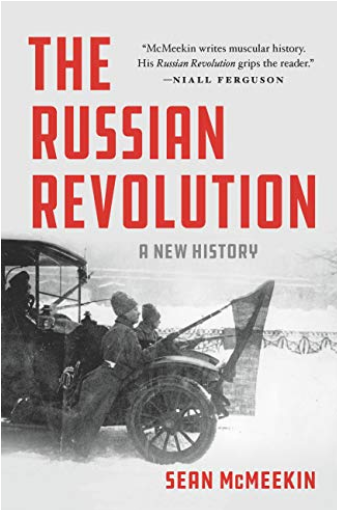
MAIN IDEA:
This book is a very unusual history book about the Russian Revolution because it breaks away from a typical narrative of the inevitability of this revolution. The author provides convincing evidence based on newly available data demonstrating that the Marxist deterministic interpretations of this event are way too far from reality. In reality, it was a close affair in which a small group of revolutionaries supported by German General staff and intelligence that provided money and other help could use internal divisions in Russian society to take power and keep it for 70 years using mass violence and propaganda. The author’s summary is:” After a quarter-century of exhilarating discoveries from the archives, it is time to take stock of what we have learned. Russia in the last days of the tsars was a land of contradictions, of great wealth and extreme poverty and the myriad social and ethnic tensions of a vast multiethnic empire; but there was nothing inevitable about the collapse of the regime in 1917. Nearly torn asunder by the revolution of 1905, which came in the wake of a humiliating defeat in the Russo-Japanese War, the Russian Empire made a remarkable recovery over the following decade, owing to the tsar’s concessions that allowed the creation of the Duma, the formation of labor unions, and the far-sighted land reforms of Peter Stolypin. The tragedy of Russian liberalism is that it was the country’s most dedicated reformers and constitutionalists who, by embracing the fashionable ideas of pan-Slavism, convinced Nicholas II that he needed to mobilize in July 1914 to appease public opinion—and then spent the war plotting against him anyway, in spite of his foolish decision to follow their advice. It was the tsar’s fateful decision to go to war, despite the pointed warnings of Rasputin and other conservative monarchist advisers he usually trusted more than the liberals, which brought an end to an era of great economic and social progress in Russia, and ultimately cost him his throne. In this way an empire founded on the autocratic principle foundered on the feeble will to power of its last autocrat, who lacked the courage of his own convictions. Once he had the upper hand, Lenin would not make the same mistake.”

MY TAKE ON IT:
I think the real reasons were only partially fundamental, mainly due to overall tensions in Russian society resulting from rapid industrialization changes that existed everywhere in the world. The particular Russian case was that it had the combination of a general rejection of the regime by the middle to upper-class educated elite, which was looking up to the elite of Western societies, displacement of people, economic and psychological tensions of the war, and massive financial and other help from hostile power (Germany) aimed to undermine country’s military effort. This story has an essential lesson because it looks a lot like what we see now in USA and other advanced Western countries. There are increasing social tensions due to economic changes of globalization, automation, and poorly controlled immigration. There is a massive rejection of societal norms and mores by an educated elite, which, quite similar to the Russian intellectual elite of the early XX century, wants to remake society along Marxist ideas of super big government. In the dreams of this elite, which includes mainly educational, governmental, and corporate bureaucracy, such a remake would put society under the control of “experts” and free them from dependency on the middle class of entrepreneurs, small business owners, professionals, and their elected representatives.
At this point, we do not have a well-organized group of professional revolutionaries, and the Chinese communist party is not as effective as the German General staff of WWI. Even more important is that the democratic form of Western societies allows this elite periodically win elections, take control of the government, and consequently demonstrate its fundamental incompetence. The USA now conducts this kind of testing in California, where the elite has nearly absolute power, and in Florida, where the middle class has control over state power, even if it is heavily restricted by federal government bureaucracy from the top, local bureaucracy from the bottom and corporate bureaucracy from all sides. The results are pretty obvious, but we’ll see if it will be enough to activate the political participation of the middle class or if people need more pain and suffering to get triggered.
 Equal Rights Libertarian