
MAIN IDEA:
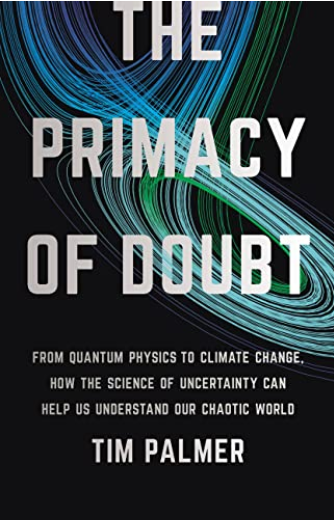
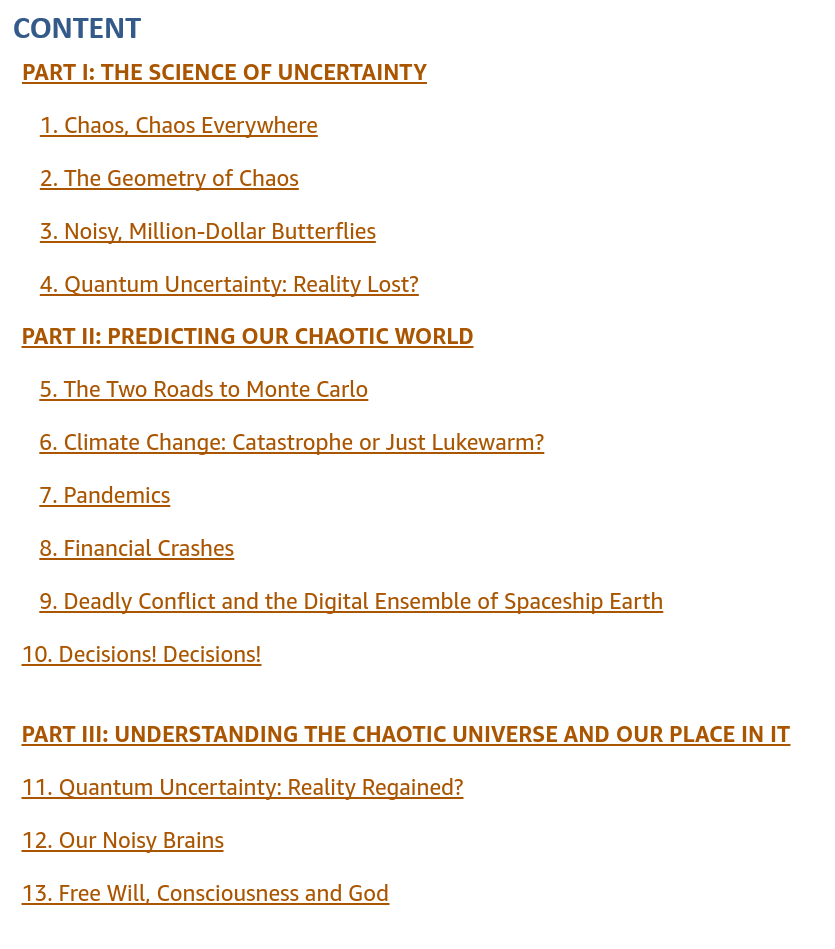
This book is about the chaos and unpredictability of the future. The two most important ideas in this book are the idea that “the butterfly effect is profoundly intermittent” and the second is that the way to handle this unpredictability is to run multiple models of the future and assembly “what is called an “ensemble prediction.” The author provides examples of this process in various areas, from weather forecasts to economic projections. Finally, the author suggests a general way of achieving the necessary diversity of models required to cover a variety of future outcomes. The author characterizes his approach this way:” I challenge this consensus view of quantum uncertainty using ideas based around the geometry of chaos.”
MY TAKE ON IT:
It is interesting to discuss future predictability in multiple areas including climate, pandemics, economics, etc. I generally agree that various models covering a range of future parameters are much better than one rigid model that tries to explain everything and predict the future in some detail. It is also quite apparent that using noise in initial parameters is a decent way to achieve the necessary diversity of results. However, I think a relatively close cluster of effects is bound to miss severe outliers. And, since outliers make the difference, the future with significant dramatic changes will always remain unpredictable. That is the reason to avoid the prediction of such dramatic events and concentrate on what humans can predict at least somewhat reliably: small changes that incremental actions could correct.
A good example would be global warming. Neither claims of alarmists that colossal change is already at the gates nor wholesale rejection of change are supported by data, especially if wide-ranged data distortion aimed to get grants and promote one’s career, are considered. The reasonable approach would be to limit CO2 emissions not as an emergency measure but as long-term objective, parts of building a human-controlled global sustainable environment while assuring economic growth that would provide enough wealth to handle changes as needed. In short, the chaos and unpredictability make it imperative to be cautious and implement change incrementally, preferably on a small scale so, to avoid such cataclysmic events as building communism, socialism, national socialism, big imperial entities, and so on: all being “good ideas” that never work in reality.
 Equal Rights Libertarian