
Home » Posts tagged 'education'
Tag Archives: education
20250202 – Co-Intelligence
MAIN IDEA:
GROK:
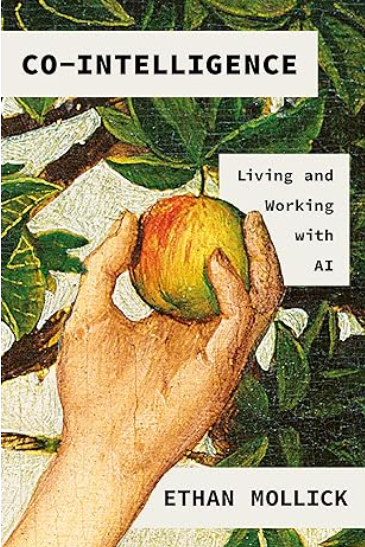
The main idea of Ethan Mollick’s book “Co-Intelligence: Living and Working with AI” is centered around the concept of humans and artificial intelligence (AI) collaborating to enhance productivity, innovation, and creativity. Mollick emphasizes that AI should not be seen as a replacement for human intelligence but rather as a complement, creating a synergy he terms “co-intelligence.”
Here are some key points:
- Collaboration Over Replacement: Mollick advocates for engaging with AI as a co-worker, co-teacher, and coach, suggesting that AI can augment human capabilities in various professional and educational settings. This includes using AI for tasks like idea generation, writing, and problem-solving, where AI can handle repetitive or data-intensive tasks, freeing humans to focus on more strategic or creative endeavors.
- Practical Use and Impact: The book provides practical advice on how to integrate AI into daily work and learning processes. Mollick discusses real-world examples of AI in action across different sectors, illustrating how AI can lead to significant transformations in business, education, and personal productivity.
- Ethical and Strategic Considerations: Mollick addresses the ethical dimensions of AI use, including concerns about bias, privacy, and the potential for over-reliance on AI. He stresses the importance of maintaining human oversight to ensure AI systems serve human interests and values, and he explores how AI affects job roles, potentially leveling the playing field for junior workers while challenging traditional hierarchies.
- Future Scenarios: The book also speculates on various future scenarios where AI might evolve, ranging from minimal to exponential growth in capabilities, and what this might mean for human society, work, and identity.
- Educational Implications: In education, Mollick suggests AI could serve as a tool for personalized learning, providing feedback, and simulating real-world scenarios for students, thus democratizing education by making high-quality learning experiences more accessible.

MY TAKE ON IT:
It is a nice review of AI development’s current status and understanding. One thing should be clear: AI will be able to do better everything that humans can do, including all kinds of creative stuff like art, science, and so on. So, the idea of co-intelligence is not really viable. A good initial test was the game of chess. Back in 1996, the specially designed computer won a match against the human champion of the world. For a while after that, a combination of humans and computers did better than either humans or computers alone. However, by now, AI consistently wins all games, so in terms of playing to win, humans have no place. Nevertheless, the game did not die, and human tournaments continued. We still have human chess champions, and we will probably have one for a long time in the future. The only difference is that the game is played for the joy it produces for human participants rather than anything else.
A similar process will occur in all other human activities except one: initiating productive activities by setting objectives to achieve and defining priorities for resource allocation. The reason is simple: only humans know what they want, and since it is changing constantly, no AI could do it for them. Certainly, it is conceivable that humans replicate the process of human development with AI and create superintelligent conscientious creatures. Still, I see no reason for doing it beyond strictly limited research into the nature of conscience.
I think that we already have the template for dealing with it in the form of activities of a few individuals who control vast amounts of resources and apply these resources to satisfy their creativity, curiosity, and visions, whether it is the colonization of Mars or automated transportation, or something else. The difference is that today, there are a few individuals who direct the activities of thousands of people, but tomorrow, all people will be controlling equally productive AI-directed robotic activities.
The only problem to be resolved is resource allocation, and I am convinced that it could be done effectively and efficiently only via a mechanism of private property because only this mechanism prevents the creation of hierarchical structures of humans when individuals at the top use individuals at the bottom as means to their ends. One solution would be extending private property to include a common inheritance of humanity, such as language, culture, know-how, and such, equally to everybody. In this case, individuals that, for whatever reason: inheritance, superior productivity, luck, or whatever else, regenerate resources more efficiently than others will have to provide those others with market-defined returns. This would turn everybody into a capitalist, sending hate of have-nots to have-lots to the dustbin of history.
20241208 Khan, Salman -Brave New Words
MAIN IDEA:
This book presents some of Khan Academy’s history, but it is mainly about how the AI tool ChatGPT is used to improve its online courses. Based on this experience, the author defines the opportunity provided in this way:” What might it be like if every student on the planet had access to an artificially intelligent personal tutor: an AI capable of writing alongside the student; an AI that students could debate any topic with; an AI that fine-tuned a student’s inherent strengths and augmented any gaps in learning; an AI that engaged students in new and powerful ways of understanding science, technology, engineering, and mathematics; an AI that gave students new ways of experiencing art and unlocking their own creativity; an AI that allowed for students to engage with history and literature like never before?”
The author clearly understands that the old structure of labor and management as a pyramid is going away due to the automatization of everything everywhere with AI tools and envisions a solution in reforming education:” The real solution is to invert that labor pyramid so that most people can operate at the top and use AI and other technology for their own productivity and entrepreneurship. The only way we have a hope of doing this is to use the same AI technology to lift the skills of a large chunk of humanity in the coming decades.”

MY TAKE ON IT:
This is a very good report from the trenches of the fight for real education vs indoctrination. The author is absolutely correct that only switching to an AI-supported education process could provide the knowledge and skills necessary to maintain competitiveness in the labor market. However, if one rises above the narrow field of education and looks at the bigger picture of the economy, it would be obvious that the very need for human labor becomes obsolete, similar to the need for animal muscles for transportation. All human activities necessary to produce goods and services will become automated within the next 50 to 100 years because no human can compete with machines in producing goods and services, regardless of how complicated the production process is. So, the objective of education should switch from molding human beings who are good, reliable, and effective pieces of business or government hierarchy into individuals possessing the knowledge and skills necessary for self-fulfillment and the pursuit of happiness. It does not mean there will be nothing to do for individuals with scientific curiosity or entrepreneurial drive. It just means that such people will be able to satisfy their needs without other people spending their lives doing soul-killing routine jobs. Just imagine Henry Ford without the need for assembly line workers and engineers because AI-controlled automated tools can not only manufacture cars but also design these cars and do everything else necessary. In this case, we can have a wide variety of ideas for transportation that could be analyzed and processed in cyberspace, with actual production implemented only as needed. Obviously, it will require restructuring of society’s organization and resource allocation, which I believe will move in the direction of increasing individual freedoms via the expansion of private property in such a way that it would be available to everybody without diminishing rewards for the individuals most effective in creating something that other people need.
20241020 – The Identity Trap

MAIN IDEA:
This is the book of a leftist professor who is nevertheless disgusted with identity politics, especially with its racist implementation, such as the segregation of children at school into different groups by race, preferential medical treatment by race, and so on. The author does not like the term “identity politics,” so he suggests a new one:” This body of ideas draws on a broad variety of intellectual traditions and is centrally concerned with the role that identity categories like race, gender, and sexual orientation play in the world. So I will, for the most part, refer to it as the “identity synthesis.” The author generally accepts the narrative of oppressors and victims but has serious concerns: “But sadly, the identity synthesis will ultimately prove counterproductive. Despite the good intentions of its proponents, it undermines progress toward genuine equality between members of different groups. In the process, it also subverts other goals we all have reasons to care about, like the stability of diverse democracies. Despite its allure, the identity synthesis turns out to be a trap.”
The author reviews the history of the development of identity ideology and its road to dominance in leftist thinking and, consequently, in all institutions controlled by the left: education, the legal profession, and government bureaucracies. He then analyses many flaws of this ideology, problems, and grievances it causes to the majority of the population that does not belong to the preferred identities and does not like to be inferior and discriminated against. The author understands that this could lead to an explosion, which could wipe out the existing bureaucratic state together with all the parasitic milieu that feeds off it: pseudo-educators, pseudo-scientists, and pseudo-intellectuals. So, the author offers a detailed plan for how to escape the identity trap without becoming “reactionary.”

MY TAKE ON IT:
It is interesting to observe the author who understands the dangers of identity ideology and its implementation in identity politics for the overall project of the Left to remove the independence of individuals by eliminating private property and placing everybody into some kind of governmental or quasi-governmental structure where their lives will be defined by decisions made by “intellectual” elite. The author obviously has difficulty understanding that it necessarily requires a totalitarian society and identity ideology, without which such a society cannot function. It does not really matter whether the identity is based on race, ethnicity, class, or education; the point is to divide the population into superior and inferior groups that will be too busy fighting for resource leftovers to notice that the lack of resources caused by elite’s waste of resources on multiple meaningless projects and elite’s preventing creation of resources by eliminating incentives for productive individuals. I guess the author, like many others before him, is on the road from left to right when he understands that individual freedom and society’s prosperity are possible only on the foundation of private property when resources are distributed, and their successful application provides a huge incentive for everybody capable of making such an application effectively and efficiently.
20240929 – The Genetic Lottery

MAIN IDEA:
The main idea of this book is to demonstrate that success in life, or lack thereof, is highly dependent on an individual’s DNA and family wealth. To evaluate the impact of DNA, the author relies on the polygenic index for traits positively correlated with high levels of education. Here is the graphic representation:

The book’s first part is quite scientific, and the author clearly states what she was expecting to achieve:” By this point in the book, I hope I have convinced you of three things. One, genetic research has developed an array of methods, using family members, measured DNA, and combinations of both, that estimate the effects of genes on complicated human outcomes. Second, the overwhelming consensus of that research is that genetic differences between people matter for who succeeds in formal education, which structures many other forms of inequality. Third, while the biology of these genetics is still largely a mystery, progress is being made on understanding the psychological and social mediators of genetic effects on educational success.”
The book’s second part discusses the social environment, especially equity vs equality, and makes an interesting proposition that increases in resource availability actually increase the difference in outcomes:


MY TAKE ON IT:
It is a very interesting book. I enjoy watching how the author turns herself into a pretzel trying to reconcile somehow the knowledge she obtained as a scientist with leftist dogmas that she was brainwashed into via higher quasi-education and the liberal environment she lives in. There are many funny examples, such as diatribes against Charles Murray and Richard Herrnstein’s work, that demonstrate a clear lack of understanding of this work. The same applies to the author’s hate of eugenics and a few other similar things.
However, I fully agree with the author’s conclusions and overall direction of this book. It is just ridiculous to divide the environment into nature vs. nurture. It is all combined into one indivisible system with a multitude of positive and negative feedback loops that make it all but impossible to isolate them from each other.
As to eugenics, it is just the application of scientific methods developed in agriculture to human beings. The problem is not that it is scientifically wrong. Since humans are biological objects, one can produce tall blond people using the same methods as were successfully used to create more productive milk cows. The attitude of eugenics is wrong because humans are not cows; they exist for their own sake, not to satisfy some collectivistic ideologues of Nazism or Communism. Therefore, a decent society should provide people with resources sufficient to pursue happiness, protect them from individuals whose perceived happiness demands the misery of others, and leave it at that.
20240707 – Values, Voice and Virtue
MAIN IDEA:
This book is about changes in British society, including the rise of populism, Brexit, and the overall collapse of politics as usual. The author sees these changes as a result of the reconfiguration of British society when the old aristocratic and business elite faded, and the new elite of educated bureaucrats and managers rose. One serious consequence of this is the nearly complete disappearance of the old noblesse oblige attitude of the old elite to non-elite and the commonality between them as parts of one nation. The new elite sees no difference between British workers and immigrants, whether legal or illegal, and prefers those who provide cheaper labor. The new elite is also multicultural and is educated in contempt of the British and overall Western culture and history. The non-elite is still mainly British, and its values are still based on the British nation-state and culture. This creates the dynamics of revolution vs. counter-revolution, and the author expects the ongoing fight to continue for a while.

MY TAKE ON IT:
I think that the diagnosis of the situation is, in general, correct and that it relates not only to Britain but to the whole Western world. Humanity is currently in the process of moving from being divided into separate nation-states and cultures competing between themselves into one unified global entity with one dominant culture all over the world. The question is what kind of culture and economic system will become dominant. The competitors are:
- The Western Enlightenment tradition, with its individualistic ideology and freedom, capitalist economy, and limited government divided into separate powers. The limited hierarchical control and distribution of resources provide individuals at the bottom with the opportunity to pursue their objectives the way they see fit.
- The pre-Enlightenment tradition, with its collectivistic ideology, hierarchical control from the top down, and complete subordination of individuals at the bottom to the will of individuals at the top.
Right now, the struggle between these competitors has taken the form of elite vs. non-elite at the national level, but often over global issues such as climate alarmism, top-down behavioral control, resource allocation, and similar issues. However, it is bound to consolidate into the worldwide struggle of elite vs. non-elite that will last for a while.
20240602 – Psych

MAIN IDEA:
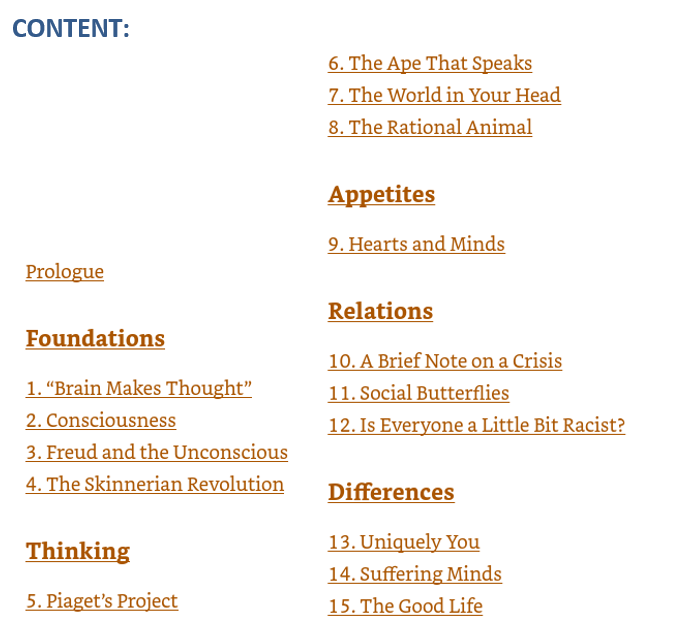
This book was built from the Introduction to Psychology course at Yale. Here is how the author defines his approach:” We’ll see that modern psychology accepts a mechanistic conception of mental life, one that is materialist (seeing the mind as a physical thing), evolutionary (seeing our psychologies as the product of biological evolution, shaped to a large extent by natural selection), and causal (seeing our thoughts and actions as the product of the forces of genes, culture, and individual experience).” However, the author also adds a qualifier:” I think the scientific perspective at the core of modern psychology is fully compatible with the existence of choice and morality and responsibility. Yes, we are, in the end, soft machines—but not just soft machines.”
MY TAKE ON IT:
I think it is a pretty good review of psychology’s history and contemporary condition. I agree with the author’s main positions: materialistic, evolutionary, and causal. From my point of view, what is usually called the mind is the product not only of a specific organ called the brain but also of the totality of the human body in which lots of necessary informational processing occurs at the peripheral level. The signals from peripheral subsystems have a huge impact on the functioning of the brain, as described by psychology methods. The most important thing, which is somehow poorly understood, is that the mind is the communication and information integration system that evolution developed to reconcile two levels of multilevel selection: individual survival and survival of the group that individual belongs to. There is a constant tension between the goals of these two levels, sometimes even direct contradiction, so the hugely complicated and biologically very costly brain is not a luxury but a necessity for survival. The human consciousness is also a necessary product of the brain because the complex system designed to solve complex problems has to have some top-level organizational and co-ordinational tool to synchronize multiple processes occurring in both conscious and unconscious parts of the system and even externally at the level of group and overall environment. The complexity also requires flexibility and delegation of controls to the levels where such control is most effective. This is seldom at the top when our conscious self perceives existing conditions and makes actionable decisions. Contemporary Psychology provides some level of understanding of how these processes work, but a lot less than is needed to obtain a good practical understanding, even if some bits and pieces of such understanding are applied immediately to the manipulation of people to achieve the objectives of others. Humanity is now in the process of moving from a multigroup environment with competition for resources to the formation of one group with a general abundance of resources when the focus will turn to the achievement of individual happiness when the most challenging part would be to assure such changes in human psychology that would make it inconceivable attempting to achieve it at the expense of others. I believe we’ll get there eventually, but it will take lots of time, pain, and suffering before it happens.
 Equal Rights Libertarian