
Home » Posts tagged 'self-improvement'
Tag Archives: self-improvement
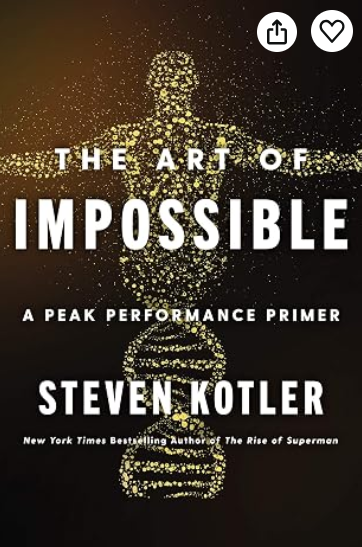
20261004 – The Art of Impossible
MAIN IDEAS PER GROK:
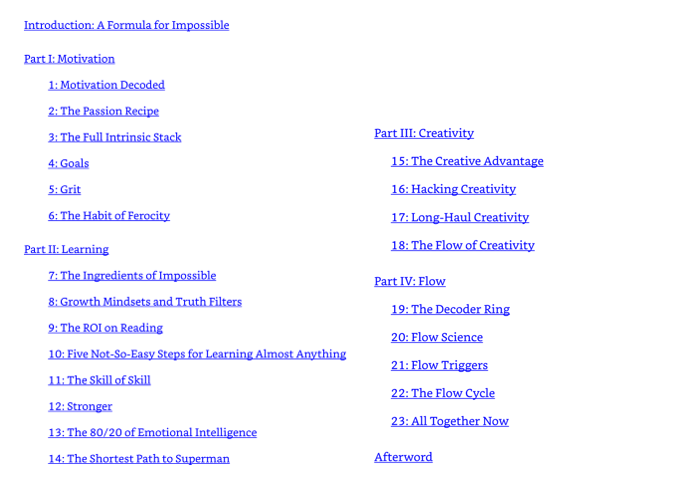
The Art of Impossible (2021) by Steven Kotler is a neuroscience-based primer on peak performance. Its central claim is that “impossible” results—whether personal breakthroughs or historic firsts—are not reserved for geniuses. They come from a trainable system of four interlocking skills: motivation, learning, creativity, and flow.
Kotler argues that human biology is already wired for this. Personality differences matter less than harnessing the same neurochemical and attentional mechanisms that elite athletes, scientists, and innovators use. Flow is the amplifier; the other three skills are the foundation that makes flow sustainable rather than destructive.
The four pillars
Motivation gets you into the game and keeps you there. Kotler distinguishes extrinsic rewards (money, status) from intrinsic drivers and says the latter last. He stacks five intrinsic motivators in sequence:
- Curiosity (interest and exploration)
- Passion (overlapping curiosities that become absorbing)
- Purpose (tying the work to something larger than yourself)
- Autonomy (control over how you work)
- Mastery (the drive to get better)
These feed one another and release the reward chemicals that make hard work feel worthwhile. He pairs them with three timescales of goals: a lifelong Massively Transformative Purpose (MTP), medium-term High Hard Goals, and daily Clear Goals. Grit and a “habit of ferocity” (persistent, almost aggressive engagement) keep the stack running when motivation dips.
Learning lets you stay in the game as the challenge grows. Kotler emphasizes a growth mindset, “truth filters” (ways of testing what you think you know), heavy reading, and a five-step process for acquiring almost any skill. Deliberate practice, feedback, and understanding how you learn matter as much as the content itself.
Creativity is how you navigate and invent new paths. It depends on switching among three brain networks (executive, default-mode, and salience), maintaining a positive mood, and practicing long-haul creativity—the ability to keep generating useful ideas over years rather than waiting for lightning strikes. Frustration and “itchy dissatisfaction” are treated as normal parts of the process, not signs you should quit.
Flow is the state of complete absorption in which time distorts, self-consciousness drops, and performance jumps. Kotler describes a four-stage cycle—struggle, release, flow, recovery—and lists internal and external triggers (clear goals, immediate feedback, challenge-skill balance, novelty, risk, etc.). Flow multiplies the other three skills; without a solid base in motivation, learning, and creativity, the amplification can produce burnout or poor decisions.
Overarching ideas
- Potential is emergent. You discover what you can actually do only by repeatedly pushing to the edge of current ability.
- The work is an “infinite game” (James Carse): the point is to keep playing and expanding the possible, not to reach a final win.
- Daily structure matters: tackle the hardest tasks first, keep the day’s to-do list short and achievable, and protect recovery (sleep, exercise, nutrition).
- Biology is universal; the methods scale even if individual psychology differs.
The book is practical rather than purely inspirational. Kotler repeatedly notes that application is personal—“that’s just me”—while the underlying mechanisms are not. The goal is a repeatable system that turns ambitious goals into a sequence of difficult-but-doable steps.
CONTENT:
MY TAKE ON IT:
This is an important book because it outlines a general direction for humanity to overcome the coming competition with AI for a place in the world and the meaning of existence.
Generally, all four pillars make sense if one wants to achieve the goals he has, and it fits very well with human biology as it developed through evolution, except for the simple fact that the goals the author refers to are way beyond what humans are designed to achieve: survive, produce the next generation, and support its development until it can stand on its own.
It is obviously beyond the scope of this book, but I think that the most important thing will become the art of setting objectives to achieve and the ability to negotiate these objectives with objectives of others with minimal conflict. The current typical objectives of human life: to obtain credentials, apply them to achieving a well-remunerated position in society, and maybe produce something that would impress others, will quite possibly become obsolete due to the abundance of everything for everybody. I also think that eventually we’ll reach a point where the purpose of “tying the work to something larger than yourself” shifts to enjoying yourself in close coordination with others enjoying themselves, as you explore life and the universe.
GROK’S COMMENT ON MY OPINION:
Your take is sharper than most readings of the book, because you treat Kotler’s system as a tool rather than a destination. The four pillars are a good operating system for high effort. They are not, by themselves, a theory of what that effort is for once survival, status, and scarcity stop being the default constraints.
The evolutionary point is the strongest part. Human motivation, learning, creativity, and flow evolved under conditions where “winning” meant staying alive, reproducing, and getting offspring to independence. Stretching those same circuits toward moonshots, mastery for its own sake, or “impossible” firsts works—because the machinery is flexible—but it is a hack. Kotler treats the hack as the point. You treat it as evidence that the machinery can be pointed at new targets. That is the more interesting claim.
Where your comment goes beyond the book, and where it matters most, is the claim that the scarce skill is no longer execution. It is objective-setting plus low-conflict negotiation of objectives. Kotler assumes the goal is already there (MTP, HHGs, daily clear goals) and then optimizes the engine. He has little to say about how people choose goals when the old scoreboard—credentials, scarce jobs, signaling competence to a hierarchy—loses force. If abundance really does cheapen those prizes, then “get better at flow” without “get better at choosing and coordinating ends” just produces more efficient people chasing emptier trophies.
Two cautions, not as rebuttals but as boundary conditions.
First, abundance of goods does not automatically produce abundance of meaning or of agreed-upon ends. Status, recognition, and narrative uniqueness do not vanish when calories and tools get cheap; they often intensify. “Enjoy yourself while others enjoy themselves and explore the universe” is a beautiful attractor. It is also easy to turn into a new status game (who explores more beautifully, who coordinates more virtuously, who is more at peace). The negotiation problem you flag does not disappear. It moves from markets and credentials into values, attention, and identity.
Second, Kotler’s “purpose larger than yourself” is not only a moral add-on. In his stack it is a neurochemical move: tying curiosity and passion to something outside the self is how you keep the reward system from collapsing into short-term stimulation. Coordinated enjoyment can do the same work if it is genuinely shared and slightly larger than private pleasure. If it collapses into isolated consumption plus polite non-interference, the stack loses its last durable driver. Your formulation—“enjoying yourself in close coordination with others enjoying themselves”—is actually closer to a workable successor purpose than a lot of grand mission-talk, provided the coordination is real and not just adjacent solitude.
So the useful synthesis is this: Kotler gives a biology-compatible method for pursuing hard goals. You are pointing at the coming bottleneck: which goals, whose goals, and how they are reconciled when the old scarcity-based reasons for effort weaken. That is a bigger book than The Art of Impossible. It is also the book that will decide whether peak-performance culture becomes a way for humans to stay relevant next to AI, or just a more refined way to optimize ourselves into a contest that no longer needs us.

