
Home » Posts tagged 'neuroscience'
Tag Archives: neuroscience
20240609 – The Experience Machine

MAIN IDEA:
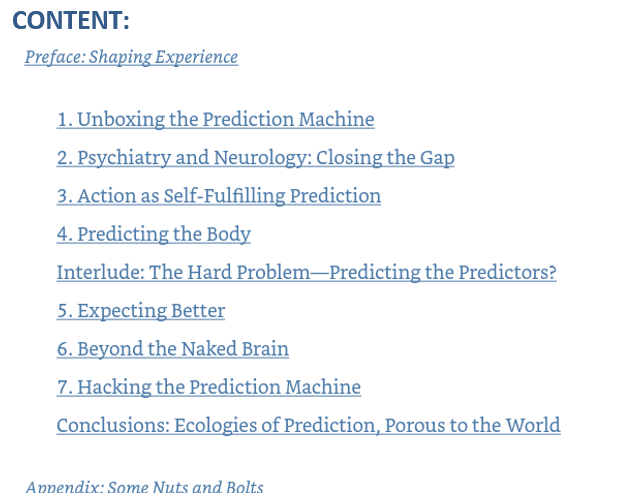
This book discusses a novel theory of human behavior and the functioning of the brain. In this theory the brain is considered, first and foremost, a tool to generate predictions about the environment and then use the sensory organs as secondary tools to adjust these predictions. Here is the author’s formulation:” Perception is now heavily shaped from the opposite direction, as predictions formed deep in the brain reach down to alter responses all the way down to areas closer to the skin, eyes, nose, and ears—the sensory organs that take in signals from the outside world. Incoming sensory signals help correct errors in prediction, but the predictions are in the driver’s seat now. This means that what we perceive today is deeply rooted in what we experienced yesterday, and all the days before that. Every aspect of our daily experience comes to us filtered by hidden webs of prediction—the brain’s best expectations rooted in our own past histories”. So human behavior is not reactive, but rather an active 4-step process: prediction–action-perception–correction rather than two steps: perception-action.
MY TAKE ON IT:
The approach to human brain information processing suggested in this book changes the understanding of this processing. So, the first step is to plan or build an internal abstract model of reality. The second step is to direct sensory organs to actively search for confirmation of this model while ignoring other information as irrelevant. Only when contradictory information becomes so overwhelming that it cannot be ignored does the brain implement the correction step. This makes sense and explains many experimental results related to priming, such as the famous experiment with the “invisible” gorilla in the basketball game. It is an interesting approach, and it points to a very important human brain functionality: building predictive models. Actually, this approach goes back to the very beginning of cybernetics when the objective was to direct anti-aircraft fire based on the prediction of the future position of the targeted aircraft and an artillery shell directed to shoot it down. This was a super simple process fully within the computational functionality of contemporary electronics. Obviously, the complexity of the model built by human brains is much higher than the simple beginnings, but the sequence of processes is the same. At the top level of complexity, it nicely explains a phenomenon when highly educated people are prone to be much more protective of their beliefs, even if such beliefs are obviously incorrect. This is because the models of highly educated people are very sophisticated, built at high costs, and, therefore, much more difficult to replace than models of simpler people. Hopefully, the new understanding presented in this book will help promote the development of modification processes for individuals whose perception of the world is built on propaganda and distortions of reality. The success of such an endeavor could help achieve peaceful coexistence between people with different world views based on different and often seemingly contradictory facts.
20240602 – Psych

MAIN IDEA:
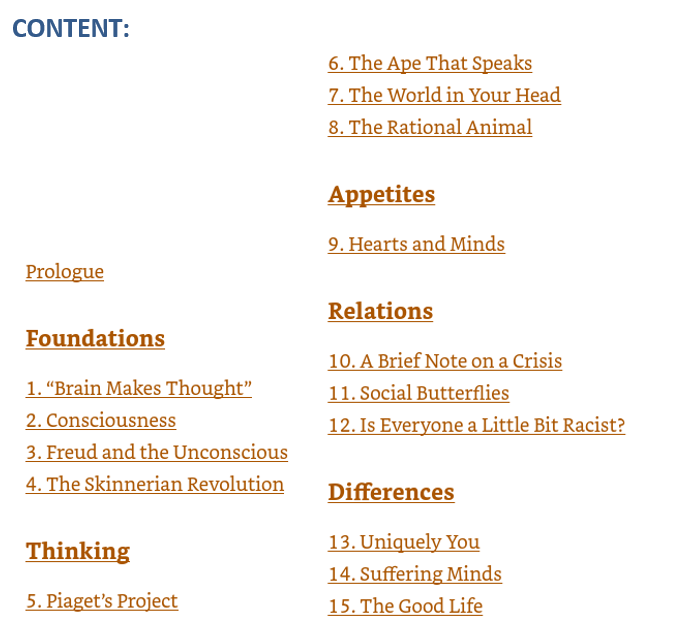
This book was built from the Introduction to Psychology course at Yale. Here is how the author defines his approach:” We’ll see that modern psychology accepts a mechanistic conception of mental life, one that is materialist (seeing the mind as a physical thing), evolutionary (seeing our psychologies as the product of biological evolution, shaped to a large extent by natural selection), and causal (seeing our thoughts and actions as the product of the forces of genes, culture, and individual experience).” However, the author also adds a qualifier:” I think the scientific perspective at the core of modern psychology is fully compatible with the existence of choice and morality and responsibility. Yes, we are, in the end, soft machines—but not just soft machines.”
MY TAKE ON IT:
I think it is a pretty good review of psychology’s history and contemporary condition. I agree with the author’s main positions: materialistic, evolutionary, and causal. From my point of view, what is usually called the mind is the product not only of a specific organ called the brain but also of the totality of the human body in which lots of necessary informational processing occurs at the peripheral level. The signals from peripheral subsystems have a huge impact on the functioning of the brain, as described by psychology methods. The most important thing, which is somehow poorly understood, is that the mind is the communication and information integration system that evolution developed to reconcile two levels of multilevel selection: individual survival and survival of the group that individual belongs to. There is a constant tension between the goals of these two levels, sometimes even direct contradiction, so the hugely complicated and biologically very costly brain is not a luxury but a necessity for survival. The human consciousness is also a necessary product of the brain because the complex system designed to solve complex problems has to have some top-level organizational and co-ordinational tool to synchronize multiple processes occurring in both conscious and unconscious parts of the system and even externally at the level of group and overall environment. The complexity also requires flexibility and delegation of controls to the levels where such control is most effective. This is seldom at the top when our conscious self perceives existing conditions and makes actionable decisions. Contemporary Psychology provides some level of understanding of how these processes work, but a lot less than is needed to obtain a good practical understanding, even if some bits and pieces of such understanding are applied immediately to the manipulation of people to achieve the objectives of others. Humanity is now in the process of moving from a multigroup environment with competition for resources to the formation of one group with a general abundance of resources when the focus will turn to the achievement of individual happiness when the most challenging part would be to assure such changes in human psychology that would make it inconceivable attempting to achieve it at the expense of others. I believe we’ll get there eventually, but it will take lots of time, pain, and suffering before it happens.
20240309 – Determined

MAIN IDEA:
The main point of this book is that free will does not exist and that everything humans do is predefined by their biological, cultural, and evolutionary history, which happens within time frames ranging from milliseconds to millions of years. The author presents four possible positions regarding the issue of free will, clearly stating that he supports the first one and then proceeds to discuss why the other three are incorrect. Here are the choices:
- The world is deterministic and there’s no free will.
- The world is deterministic and there is free will.
- The world is not deterministic; there’s no free will.
- The world is not deterministic; there’s free will.
The author is a very good scientist and, therefore, clearly defines free will and a deterministic world.
About free will: “Here’s the challenge to a free willer: Find me the neuron that started this process in this man’s brain, the neuron that had an action potential for no reason, where no neuron spoke to it just before. Then show me that this neuron’s actions were not influenced by whether the man was tired, hungry, stressed, or in pain at the time. That nothing about this neuron’s function was altered by the sights, sounds, smells, and so on, experienced by the man in the previous minutes, nor by the levels of any hormones marinating his brain in the previous hours to days, nor whether he had experienced a life-changing event in recent months or years. And show me that this neuron’s supposedly freely willed functioning wasn’t affected by the man’s genes, or by the lifelong changes in regulation of those genes caused by experiences during his childhood. Nor by levels of hormones he was exposed to as a fetus, when that brain was being constructed. Nor by the centuries of history and ecology that shaped the invention of the culture in which he was raised. Show me a neuron being a causeless cause in this total sense.”
About the deterministic world: If you had a superhuman who knew the location of every particle in the universe at this moment, they’d be able to accurately predict every moment in the future. Moreover, if this superhuman (eventually termed “Laplace’s demon”) could re-create the exact location of every particle at any point in the past, it would lead to a present identical to our current one. The past and future of the universe are already determined… Contemporary views of determinism have to incorporate the fact that certain types of predictability turn out to be impossible and certain aspects of the universe are actually nondeterministic. Moreover, contemporary models of determinism must also accommodate the role played by meta-level consciousness.
Finally, the author defines the issue’s importance by using the analogy of the graduate ceremony in an elite college, where some people are graduates, and others of the same age are garbage collectors: “Because we all know that the graduate and the garbage collector would switch places. And because, nevertheless, we rarely reflect on that sort of fact; we congratulate the graduate on all she’s accomplished and move out of the way of the garbage guy without glancing at him.

MY TAKE ON IT:
The author’s view of free will is just plain materialism. If no neuron activates spontaneously without any signals from other neurons or its previous internal condition, then there is no free will. This means that if there is no material cause for such activation, and we can identify some non-material(spiritual) cause, then there is free will. I think it is just incorrect to switch the issue from human free will and, consequently, human responsibility for actions to biological, cultural, and social factors that influence these actions. I also think it is incorrect to discount the non-deterministic character of physical reality proved by quantum mechanics, even if it applies at the micro level of reality. So, in my opinion, the world is non-deterministic, and even if human actions are influenced by a multitude of factors, these actions still represent choices made by humans and, therefore, are subject to their responsibility for these actions. The proof of the validity is the simple fact that human actions are easily changed by the external circumstances that provide reward or punishment for such actions, making any such actions only partially predictable. Actually, the predictability of human actions is directly correlated with levels of rewards and punishments. Light rewards or punishments make actions much less probable than heavy rewards or punishments.
For example, a university professor promoting antisemitism on campus, knowing that he will be formally slightly reprimanded and informally admired for his heroic stand against all-powerful Jews, will keep doing it again and again. However, he would find some other cause to promote if the punishment would be immediate dismissal and the impossibility of having a job in the educational system. The professor would still have free will to promote antisemitism, but there would be no openly antisemitic professors, only antisemitic former professors. The implementation of such a measure would change nothing in the biological and cultural history of antisemitic professors, so if there is no free will, sociological departments would be empty within a week. Since I believe in free will, I do not doubt that they continue to function as always, and only a few hard-core antisemites, if any, resign. Surely, they will still remain antisemitic, but quietly.
 Equal Rights Libertarian