
Home » Posts tagged 'native-american'
Tag Archives: native-american
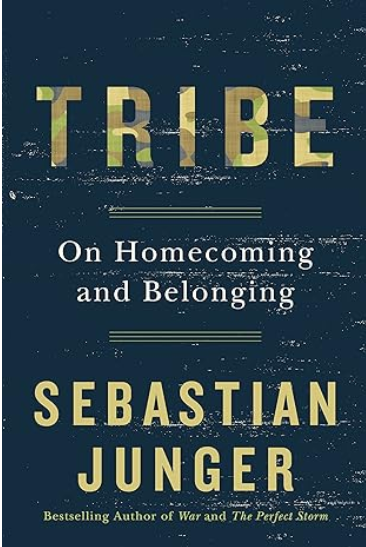
20240323 Junger, Sebastian-Tribe
MAIN IDEA:
This book is about the human need to belong to some group of humans – a tribe. The author defines it this way:” Robert Frost famously wrote that home is the place where, when you have to go there, they have to take you in. The word “tribe” is far harder to define, but a start might be the people you feel compelled to share the last of your food with.” The author describes how the evolutionary developed norms of the human tribe proved to be a much better environment for human thriving than norms developed by militaristic/agricultural civilization. The author uses the historical example of interaction between societies representing these two norms: American Indian tribes and American European Settlers. This example clearly demonstrates the superiority of the norms of American Indian tribes by retelling stories of individuals who moved between these societies. On many occasions when settlers, either children or adults, were captured by Indians and accepted into a tribe, there were very few cases when these individuals wanted to return back to European society. The tribal way of life was clearly preferable. After that, the author discusses why this is the case and concludes that humans feel uncomfortable or, as he put it in a postscript: “Just dead inside” without belonging to a tribe and correspondingly sharing resources with other members of the tribe.
MY TAKE ON IT:
I think that the description of human nature provided in
this book is correct – humans do need to belong to a tribe and are miserable
when they are on their own in life. However, a lot of human life is also
defined by attitude toward other tribes, which evolutionarily developed to be
hostile by default because another tribe nearby was always a competitor for
limited resources. So, humans need both other members of their own tribe to
give life for and people who belong to other tribes to fight and kill. Without
friends and enemies, humans feel a void inside. The sad history of the clash of
Indian tribes and European tribes is a very good illustration.
Indian tribes were better adjusted to human nature in an
environment of relative abundance of natural resources when the survival of
individuals and groups was mainly dependent on effective interaction with the
environment. The European tribes were better adjusted to military competition
between groups when survival was obtained at the expense of the misery of
individual lives. As a result, the European tribes nearly completely eliminated
Indians, as it happened many times before when militaristic/agrarian societies
eliminated hunter/gatherers despite providing an inferior quality of life for
individuals.
On the bright side, humanity is now moving to form a global
tribe when all humans are included, and a superabundance of resources makes
military competition meaningless. It is not an easy process, which will take
decades or maybe even a century or two because one of the legacies of human
militaristic/agricultural societies is the psychological need to suppress
others and control them. Whether this need is expressed via the expansion of
the bureaucratic machinery of the big and deep state, via the religious
extremism of Islamists, or through activities of white or black supremacists,
it will have to be eliminated. Only after eliminating individuals who act
according to these views will humanity be able to move to a better place when
psychological comfort provided by tribes of hunter/gatherers will be combined
with the material comforts of technological civilization. Such elimination
could be psychological when individuals decide that they will be better off
without the ability to control others in exchange for the freedom of not being
controlled by others. However, for some, it would not be possible, so for these
cases, military and/or law enforcement options will become necessary. In either
case, it will take lots of time and struggle to get to this better place from
where we are now in human development.
 Equal Rights Libertarian