
Home » Posts tagged 'morality'
Tag Archives: morality
20240519 – Moral Origins
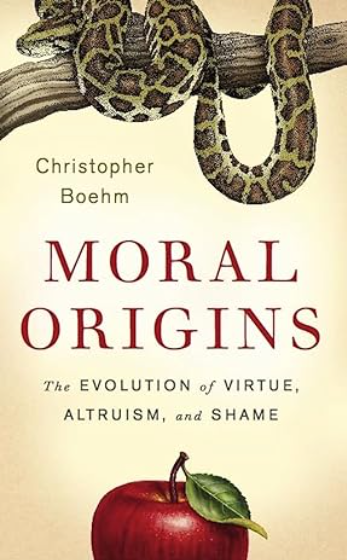
MAIN IDEA:
This book is about “the origination of moral behavior and
the human conscience.” The main idea is that morality and conscience are not
some kind of byproduct but rather logical and proper consequences of the
evolutionary development of humans as animals that survive in groups and,
therefore, need highly functional brains and effective sets of rules of
interactions within and without groups to maximize survival chances. Here is
how the author defines his hypothesis:” My idea will be that
prehistorically, humans began to make use of social control so intensively that
individuals who were better at inhibiting their own antisocial tendencies,
either through fear of punishment or through absorbing and identifying with their
group’s rules, gained superior fitness. By learning to internalize rules,
humankind acquired a conscience, and initially, this stemmed from the punitive
type of social selection I mentioned previously, which also had the effect of
strongly suppressing free riders. Later, I shall argue that a newly moralistic
type of free-rider suppression also helped us evolve our quite remarkable
capacity for extrafamilial generosity.”
MY TAKE ON IT:
My views on the subject are completely in sync with the author’s hypothesis about the evolutionary roots of human morality and conscience. It is nice to see such well-documented and thoroughly researched confirmation of these ideas. I only have a bit of a problem when the author, in his epilogue, moves to a discussion of world morality, global government, world public opinion, climate change, and other such topics. The combination of the desire for global top-down control combined with fear of nation-states does not provide a good foundation for the author’s hope for a “global moral community.” I agree that the evolutionary developed human morals could eventually become the foundation of a peaceful world, but only when all people are accepted as members of one group – humanity, with an exclusively voluntary combination of people in a variety of groups with resources distributed to individual levels as much as possible so, for example, to make territorial conflicts meaningless because the land does not belong one nation or another, but divided between millions of individuals so conflicts are resolved in courts, not on the battlefield.
20240224 – Systems of Survival

MAIN IDEA:
Here is the author’s definition of the main idea of this book:” This book explores the morals and values that underpin viable working life. Like the other animals, we find and pick up what we can use, and appropriate territories. But unlike the other animals, we also trade and produce for trade. Because we possess these two radically different ways of dealing with our needs, we also have two radically different systems of morals and values—both systems valid and necessary.” From here follows the definition of two syndromes: Commercial and Guardian. Then, the book explores various aspects of these two syndromes, including their morals and corresponding types of human behavior depending on the preponderance of one or another syndrome in the worldview of individuals. Here are the key points:


MY TAKE ON IT:
For me, it is extremely interesting that the author of this book came to the same conclusions that I did, only from a completely different point of view. I look at it from the point of view of goods and services production and distribution when processes are based either on the voluntary cooperation of individuals in possession of resources or on a violent hierarchy forcing individuals to cooperate whether they want it or not.
The author of this book looks at the same dichotomy from a moralistic point of view, going into the details about human behavior relevant to each Moral syndrome, which is a proper approach for the moral philosopher.
My approach is to look at what kind of a system could be implemented to obtain the best of both sides of this dichotomy, which is a proper approach for the systems engineer that I am. So, my conclusion is that such a system should be based on minimizing the use of violence (governmental hierarchy) and maximizing the use of voluntary actions of free individuals (ownership of self and resources).
By the way, I expressed my views in a small essay, and here is the link:
 Equal Rights Libertarian