
Home » Posts tagged 'leadership'
Tag Archives: leadership
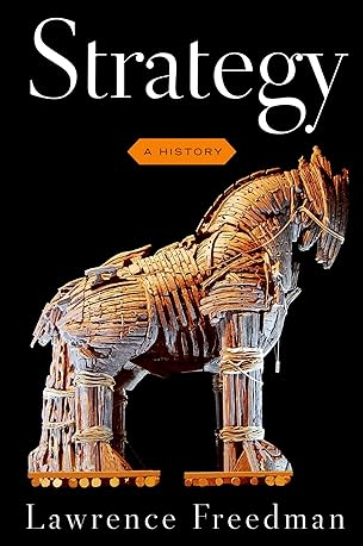
20241027 – Strategy
MAIN IDEA:
Here is the author’s definition of the theme and intentions of this book:
“So the realm of strategy is one of bargaining and persuasion as well as threats and pressure, psychological as well as physical effects, and words as well as deeds. This is why strategy is the central political art. It is about getting more out of a situation than the starting balance of power would suggest. It is the art of creating power.”
“This book describes the development of different approaches, from rigorous centralized planning processes at one extreme to the sum of numerous individual decisions at the other. It shows how in these distinct military, political, and business spheres, there has been a degree of convergence around the idea that the best strategic practice may now consist in forming compelling accounts of how to turn a developing situation into a desirable outcome. “
“As a history, this book aims to provide an account of the development of the most prominent themes in strategic theory—as they affect war, politics, and business—without losing sight of the critics and dissidents.”

MY TAKE ON IT:
It is a great and detailed review of the history of strategy in multiple domains, from organized violence in wars and revolutions to political actions directed either at changing society’s organization or maintaining an existing one. I disagree with the definition of strategy as “the art of creating power” because it does not sufficiently differentiate between strategy and tactics. In my opinion, the art of strategy consists of two parts: the first is to identify and articulate realistically achievable objectives with potentially available resources, and the second is to identify methods and processes required to generate and allocate resources over space and time to achieve these objectives reliably. The actual processes of resource generation, allocation, and application are the domain of tactics.
For example, consider a strategy of fighting off 30,000 Persian troops if one has only 300 Spartans. Historically, the chosen strategy was to use a narrow pass of Thermopylae, where only a few fighters could clash at a time. At first glance, such a strategy makes sense because it greatly diminishes the value of quantitative superiority. However, one step further in thinking would lead to understanding that it is not a valid approach because it does not consider the high probability that after a few hours of battle, the skilled but exhausted Spartans will be killed by less skilled but fresh Persian fighters. It also misses that there was a way around this narrow pass, which the Persians actually used. However, if the strategic decision were not to keep a narrow pass but to divide forces and engage in multiple encounters, each of which would guarantee local superiority of forces, Spartans could win after a hundred or so such engagements over some time sufficient for physical recovery after each engagement, providing tactical skills are sufficient to arrange such engagements.
Similar logic would apply to politics, business, or any other area of strategy, whether the fight is within people’s minds or in the marketplace.
20240414 -The Square and the Tower

MAIN IDEA:
This book is about the history of parallel development of two methods of organization used by human societies and their interaction. Here is the author’s statement of the purpose:” This book is about the past more than it is about the future; or, to be precise, it is a book that seeks to learn about the future mainly by studying the past, rather than engaging in flights of fancy or the casual projection forward of recent trends. There are those (not least in Silicon Valley) who doubt that history has much to teach them at a time of such rapid technological innovation. Indeed, much of the debate I have just summarized presupposes that social networks are a new phenomenon and that there is something unprecedented about their present-day ubiquity. This is wrong. Even as we talk incessantly about them, the reality is that most of us have only a very limited understanding of how networks function, and almost no knowledge of where they came from. We largely overlook how widespread they are in the natural world, what a key role they have played in our evolution as a species, and how integral a part of the human past they have been. As a result, we tend to underestimate the importance of networks in the past, and to assume erroneously that history can have nothing to teach us on this subject.”

MY TAKE ON IT:
I think both methods, networks, and hierarchies, are necessary components of human existence, always intertwined and codeveloped. However, they always have different weights and impacts on the conditions of human societies depending on the phase of human development we are looking at. Judging by what we know about great apes that had developed from a common ancestor some 4 million years ago in parallel with humans such as chimpanzees, we started with small hierarchical bands based on individual physical power and psychological aggressiveness. Chimpanzees are still there, maintaining hierarchy as the dominant method of organization. Humans, however, moved in a different direction by developing language and more complex brain structures that allowed for a high level of cooperation in hunting, mutual help, and building conspiracies to overthrow whatever megalomaniac attempted to build a hierarchy with self at the top. Over the period of tens of thousands of years, this produced highly egalitarian hunting-gathering societies of people with genotypical and phenotypical features that made them strive to obtain the optimal ratio between being a part of a network of cooperating individuals adjusting to each other needs and free agents taking care about one’s own needs. Then we had about 20,000 years of hiatus in the equality mode when human expansion all over the world forced transfer to militaristic/agrarian societies in which fights for territories and suppression of opposition made hierarchy the most appropriate form of society for individual survival, even if it more often than meant live in misery. Now, with the new technologies of resource acquisition and networking, stabilization of population, and soon disappearance of the need to work for a living, humanity could minimize the need for hierarchies and all this violence and coercion that are inevitable features of hierarchy. This process is not simple and will probably take a few decades, but I believe we will eventually get there.
 Equal Rights Libertarian