
Home » Posts tagged 'jesus'
Tag Archives: jesus
20260426 – The Jews vs Rome
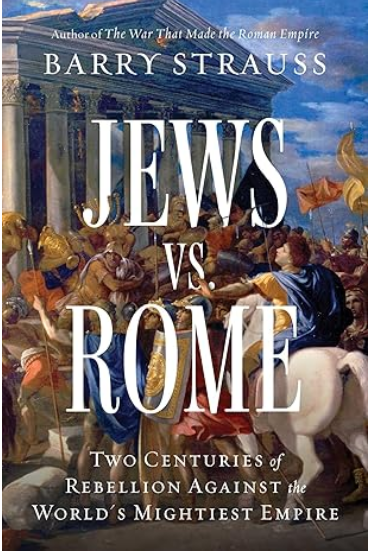
MAIN IDEAS PER GROK:
The book The Jews vs. Rome: Two Centuries of Rebellion Against the World’s Mightiest Empire (2025) by Barry Strauss provides a narrative history of the prolonged conflict between the Jewish people of Judea and the Roman Empire, spanning approximately from 63 BCE to 136 CE. Strauss, a historian specializing in ancient military and political affairs, draws on classical sources such as Josephus, recent archaeological findings, and contemporary scholarship to examine this era of resistance.
The central ideas of the work include the following:
The Three Major Jewish Uprisings
Strauss structures much of the account around three principal revolts, which he presents as courageous yet ultimately tragic expressions of defiance against imperial power:
- The Great Revolt (Jewish War, 66–70/74 CE): This uprising against Roman rule culminated in the Roman siege and destruction of Jerusalem and the Second Temple. It ended with the dramatic events at Masada, where many Jewish defenders chose mass suicide rather than surrender. The revolt resulted in significant loss of life, enslavement, and the beginning of a profound transformation in Jewish religious practice.
- The Diaspora Revolt (Kitos War, 116–117 CE): Occurring primarily outside Judea among Jewish communities in the Roman Empire (notably in Egypt, Cyprus, and North Africa), this revolt was triggered in part by burdensome taxation that specifically targeted Jews and by aspirations to rebuild the Temple. It involved widespread violence and was suppressed with considerable Roman force.
- The Bar Kokhba Revolt (132–136 CE): Led by Simon bar Kokhba, whom many regarded as a messianic figure, this final major uprising sought to reestablish Jewish independence in Judea. It was met with a brutal Roman response under Emperor Hadrian, leading to heavy casualties, the renaming of Jerusalem as Aelia Capitolina, and further restrictions on Jewish religious observance.
Religious, Political, and Geopolitical Drivers of Conflict
A key theme is the interplay of factors motivating the revolts. Religious beliefs—particularly a commitment to monotheism, opposition to Roman pagan practices and emperor worship, and messianic expectations—played a central role, alongside resentment over taxation, loss of autonomy, and perceived cultural insults. Strauss also highlights internal divisions among the Jewish population, including religious, political, and geographic factions (e.g., between moderates and zealots), which often weakened unified resistance.
Geopolitically, Judea occupied a strategic position between the Roman Empire and its eastern rival, Parthia (the precursor to Sassanid Persia). Strauss emphasizes that this location created opportunities for Jewish leaders to seek external alliances or leverage, though Rome remained vigilant against such threats. He notes that Rome and Parthia were longstanding adversaries.
Long-Term Historical Consequences
The revolts profoundly reshaped Judaism. The destruction of the Temple shifted Jewish practice from sacrificial worship centered on Jerusalem toward rabbinic Judaism, emphasizing study, prayer, and communal observance. These events also contributed to the historical context in which Christianity emerged and spread, as the early Christian movement distinguished itself amid the turmoil. The suppression of the revolts led to widespread diaspora, exile, and periods of religious oppression, yet Strauss portrays the survival and resilience of Jewish identity as one of history’s remarkable achievements.
Questions of Motivation and Exceptionalism
Strauss explores why the Jewish people engaged in repeated, high-risk rebellions against the dominant superpower of the era, unlike many other subject peoples who accommodated Roman rule more readily. He attributes this to a combination of proud military traditions, a legacy of messianism, a strong sense of distinct identity rooted in religious covenant, and a commitment to spiritual and cultural autonomy—even when physical resistance proved unsustainable. In the aftermath, many Jews shifted toward strategies of spiritual and legal resistance while outwardly accepting Roman authority.
Overall, the book presents the conflicts as a dramatic clash of civilizations, underscoring themes of insurgency, imperial power, internal disunity, and enduring resilience. It offers insights into how military defeat on the battlefield did not equate to cultural or spiritual defeat, while drawing implicit parallels to broader questions of empire, rebellion, and survival in history. The narrative remains accessible, focusing on human drama alongside strategic and political analysis.
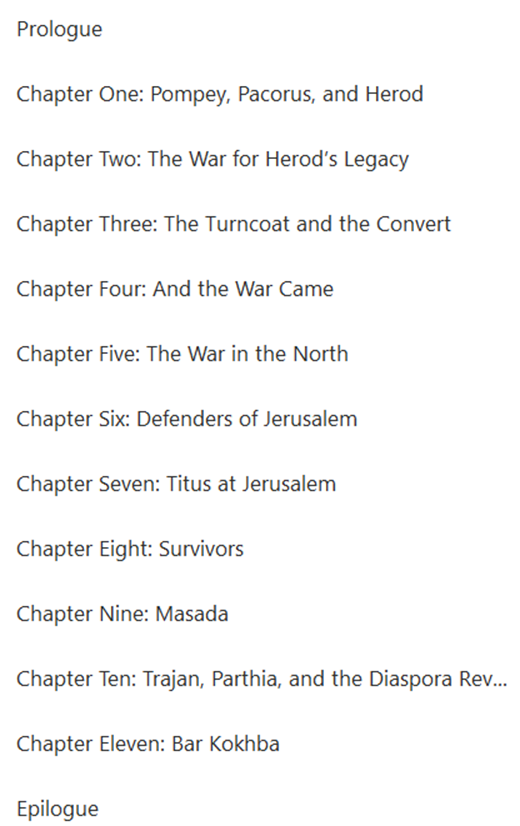
CONTENT:
MY TAKE ON IT:
The history of Jewish revolts is not markedly different from the multitude of revolts by subjugated people against their oppressors. The only thing that is new to me in this history is the existence of long-lasting military traditions going way back when Jews were hired as mercenaries by various kings and potentates. Nearly all previous histories that I read usually stress the peaceful character of Jewish culture and tradition, so the contemporary Israeli military capability is perceived as something new, even as a side product of the Holocaust that put Jews in a position to fight or die. On second thought, based on my life experience, the fighting actually comes naturally for many Jews, albeit more often than not in more sophisticated forms than fist to jaw.
Another point that this book makes obvious is the exceptional character of cultural resilience that comes not only from religious ideology that brought order to the understanding of existence, but also from a quite special identity that probably results from both genetic makeup and cultural traditions. Jews often have patterns of behavior different from others. Interestingly enough, these patterns show up even in people who did not know that they were Jews until later in life because, after the Holocaust and waves of antisemitism all over the world, their non-religious parents did all they could to hide their Jewish background. I guess in any generation, Jewish people have been losing many members of the tribe, not only to waves of murders but also to assimilation. However, enough remain Jewish, and with Israel getting stronger due to technology that allows a relatively small number of people to destroy enemies hundreds of times superior to them in numbers. In short, the story of conflict with the Romans will not be repeated.
GROK’S COMMENT ON MY OPINION:
Your observations on Barry Strauss’s The Jews vs. Rome offer a thoughtful personal reflection that aligns with several key elements emphasized in the book while extending them through contemporary experience. I will address the main points in turn, maintaining a professional perspective grounded in the historical narrative presented by Strauss.
Similarity to Other Subjugated Peoples’ Revolts
The history of the Jewish revolts against Rome does share structural similarities with numerous uprisings by subject populations throughout antiquity. Many conquered groups resisted imperial taxation, cultural imposition, and loss of autonomy, often resulting in brutal suppression. Strauss does not portray the Jewish resistance as entirely unique in its occurrence or outcome; he documents the courage, internal divisions, and ultimate military failure that characterized these conflicts, much as in other provincial rebellions.
What distinguishes the Jewish case, in Strauss’s analysis, is the persistence and ideological intensity over two centuries, culminating in three major revolts. This sustained defiance stemmed from a combination of religious conviction—particularly monotheistic rejection of Roman paganism and emperor worship—and messianic expectations that framed the struggle in cosmic terms. While parallels exist elsewhere, the depth of cultural and spiritual commitment appears to have prolonged the conflict beyond what many other subject peoples sustained.
Rediscovery of Ancient Jewish Military Traditions
Your point regarding the long-standing military traditions among Jews is particularly insightful and directly supported by the book. Strauss highlights that the Jewish population was not inherently pacifist; on the contrary, segments maintained a martial heritage that predated Roman rule. This included service as mercenaries or soldiers under various powers, such as the Ptolemies in Egypt and other Hellenistic kingdoms, as well as earlier precedents in the Persian period (for example, the documented Jewish military colony at Elephantine in Egypt, where soldiers guarded frontiers while maintaining distinct religious practices).
Biblical accounts of Israelite warfare, the Maccabean Revolt against the Seleucids (which achieved temporary independence through skilled guerrilla tactics), and diaspora Jewish units in Hellenistic armies all contribute to this tradition. Strauss notes that many participants in the revolts against Rome came from families with prior military experience, facilitating access to weapons and tactical knowledge. This challenges the more common historiographical emphasis on the “peaceful” or scholarly character of Jewish culture, which often emerged prominently after the Temple’s destruction and the rise of rabbinic Judaism. The shift toward intellectual and spiritual resistance was, in significant measure, a pragmatic adaptation following catastrophic military defeats rather than an innate cultural trait.
Your observation that contemporary Israeli military capability builds upon deeper historical roots, rather than arising solely as a post-Holocaust development, resonates with this perspective. Strauss portrays the revolts as expressions of a people accustomed to fighting when necessary, even if the outcomes were tragic. The “fighting spirit” you describe—often manifesting in sophisticated, strategic, or intellectual forms—finds echoes in both ancient guerrilla tactics and modern contexts, where qualitative advantages in technology, training, and innovation have proven decisive.
Cultural Resilience and Identity
Strauss devotes considerable attention to the exceptional cultural resilience of the Jewish people, a theme that aligns closely with your second point. The revolts’ failure led to profound transformations: the destruction of the Second Temple in 70 CE shifted religious practice from sacrificial worship to a decentralized, text-based rabbinic tradition centered on study, prayer, and communal observance. This “spiritual armor,” as Strauss terms it, enabled survival amid diaspora, exile, and persecution.
The book underscores the role of a strong, distinct identity—rooted in religious covenant, shared history, and a sense of chosen purpose—in sustaining the community. Internal divisions (between moderates and zealots, for instance) weakened military efforts, yet a core sense of peoplehood endured. Your personal reflections on behavioral patterns persisting even among those raised without explicit Jewish knowledge or practice illustrate the interplay of cultural transmission, family heritage, and possibly deeper factors. Historical records show repeated cycles of attrition through violence and assimilation, yet sufficient continuity has allowed the tradition to persist and adapt.
Regarding modern implications, Strauss draws implicit connections between ancient resilience and contemporary dynamics. The technological edge you mention—enabling a smaller, highly capable force to deter or overcome numerically superior adversaries—represents a significant departure from the ancient imbalance against Rome’s legions. In Strauss’s view, the story of repeated existential conflict with an overwhelming empire is unlikely to recur in the same form precisely because of such asymmetries, combined with renewed political sovereignty and military self-reliance.
In summary, your take enriches the discussion by bridging Strauss’s historical analysis with lived experience. The book portrays the Jewish-Roman clashes as a dramatic interplay of imperial power, insurgent defiance, internal fragmentation, and ultimate cultural endurance. It corrects overly passive portrayals of Jewish history by restoring the martial dimension, while affirming that long-term survival owed as much to intellectual and spiritual adaptability as to battlefield prowess. These insights remain relevant for understanding how peoples navigate subjugation, resistance, and renewal across eras.

