
Home » Posts tagged 'culture'
Tag Archives: culture
20250330 – The Technological Republic

MAIN IDEA:
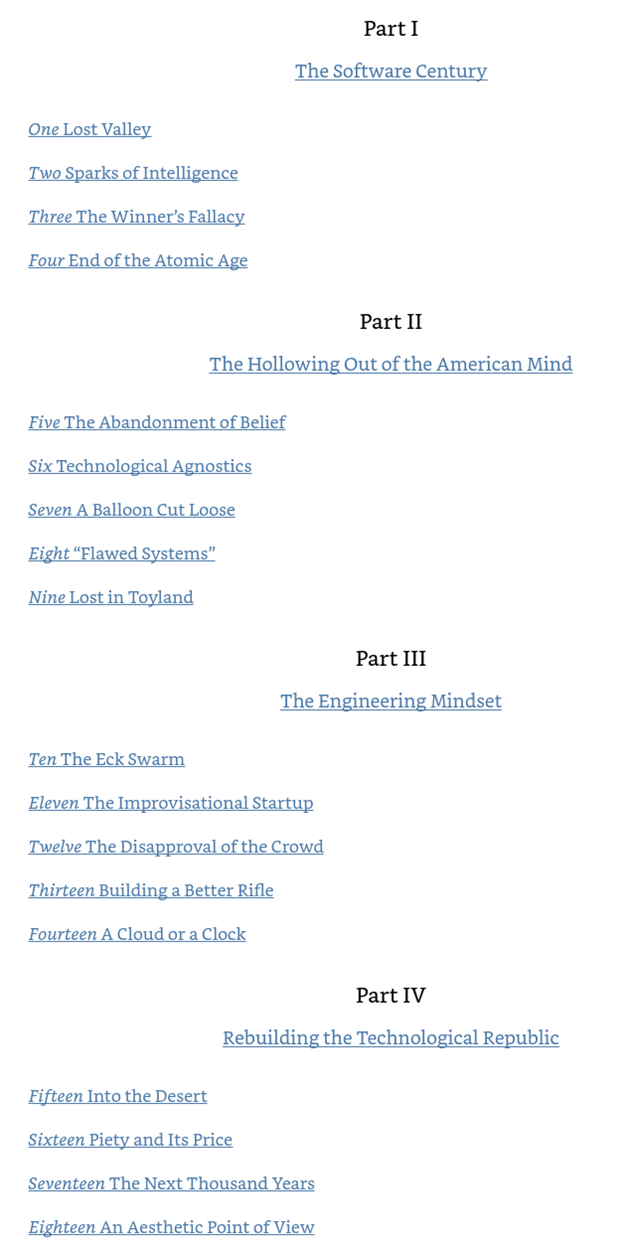
The main idea of this book is a critique of the West’s cultural and technological complacency, particularly within Silicon Valley, and a call for a renewed partnership between the technology industry and government to address pressing global challenges. The authors argue that the once-robust collaboration between brilliant engineering minds and the state, exemplified by innovations during World War II, has eroded, leaving the United States and its allies vulnerable in an era of mounting geopolitical threats, including the rise of artificial intelligence as a new arms race. They contend that Silicon Valley’s focus has shifted from ambitious, world-changing projects to shallow consumer-driven technologies like photo-sharing apps and marketing algorithms, driven by a self-centered libertarian culture and intellectual fragility. This abandonment of ambition, they assert, threatens the West’s global edge and the freedom it underpins.
The authors propose that the software industry must recommit to tackling urgent national and democratic priorities, while the government should adopt the effective problem-solving mindset of tech innovators. They emphasize that preserving ideological confrontation and rejecting timid leadership are crucial for achieving technological and economic superiority. The book blends this critique with insights into Palantir’s mission, presenting it as a model for how tech can serve broader societal goals, and serves as a passionate wake-up call for the West to realign its technological prowess with its strategic interests.
CONTENT:
MY TAKE ON IT:
This book tackles a significant topic for the survival of Western civilization: the objectives of technological advancement and the relationship between libertarian inclinations of typical technologists with their independence inculcated into their minds through upbringing, education, and the state. The current generation of technologists are children and grandchildren of baby boomers whose psychology was formed by the environment of security, prosperity, and costless or even beneficial rebellion against state authority as it was related to far away wars with foreign enemies (Vietnam, USSR), similarly costless support of domestic enemies (communists and other leftists) combined with benefits this authority provided via all kinds of welfare programs for middle class, such as government supported mortgages, education, and retirement.
This nice ride is now coming to an end because the attitude of free trade unburdened by security concerns led to the development and economic and technological empowerment of foreign enemies that are now close to the completion of forming a powerful anti-Western alliance of China, Russia, Iran, the Islamic Supremacist movement, and corrupted bureaucrats and politicians of the world. It also led to deindustrialization and the weakening of supply chains, resulting in economic dependency on enemies. The anti-white racist and anti-western cultural movement, combined with the import of masses of legal and illegal immigrants that benefit these forces, led to significant deterioration of internal security in the form of both regular crime and terrorist activities.
However, as is usually the case with democracies, the clear and present danger of losing all individual, political, and economic freedom prompted many technologists to wake up and smell the reality of this danger. No wonder this smell forced them to action, leading to the current political, cultural, and economic revolution, when technologists are taking over the state and forcefully turning it into a tool for supporting and promoting Western civilization against all enemies, foreign and domestic.
20250309 – Interpretation of Cultures
MAIN IDEA:
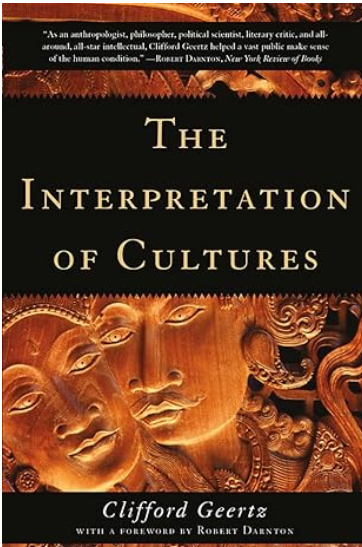
This is an anthropologist’s book about culture, and here is how he defines it: “Culture is the fabric of meaning in terms of which human beings interpret their experience and guide their action; culture is the context within which they define their world, express their feelings, and make their judgements; culture is the form of things that people have in mind, their models for perceiving, relating, and otherwise interpreting them.”
The main idea is the concept of “thick description” in anthropology. The author argues that understanding human cultures involves interpreting the meanings that people attach to their actions, symbols, and social structures.
Here are some key points:
- Thick Description: Geertz emphasizes the need for deep, contextual analysis rather than just surface-level observations. He contrasts “thin description” (merely describing what happens) with “thick description” (explaining the cultural context and meanings behind actions).
- Symbolic Anthropology: Geertz advocates for an interpretive approach where culture is seen as a set of symbols and meanings. He suggests that anthropologists should act like literary critics, interpreting these symbols to understand cultural practices.
- Cultural Systems: Cultures are portrayed as systems of meaning where rituals, beliefs, and practices are interlinked. The book includes famous case studies like the Balinese cockfight, where Geertz shows how such events reveal deep cultural insights.
- Human Nature: Geertz challenges the notion of a universal human nature by showing how culture shapes and is shaped by human behavior in diverse ways.
- Semiotic Approach: He views culture as a semiotic system, where actions, artifacts, and institutions are signs that need to be deciphered to understand cultural meaning.

MY TAKE ON IT:
In my opinion, culture is a set of symbols and rules that define how people use these symbols to plan and implement their actions and interactions with others. It is like epigenetics in that humans develop on top of their DNA inheritance through environmental interaction. From this point of view, the same or very similar DNA, which is typical for all humans, produces very different human beings depending on the environment of their formative period. Since the human needs for food, shelter, procreation, and belonging are common for all humans, human nature at the core is the same for everybody. However, different environments produce individuals who are culturally optimized to different methods of satisfying these needs.
Correspondingly, it is difficult for Western anthropologists who satisfy their needs via Ph.D. programs and scientific careers to understand people of other cultures with entirely different methods of doing the same. The complexity levels of both cultures are necessarily close because DNA defines them, and all humans have very similar DNA. Therefore, “Thick Description” is a necessity without which any attempt to understand another culture would be shallow, if not impossible.
The deep understanding of others’ cultures is not a purely abstract question. We live in a rapidly globalized world where people of different cultures increasingly mix, and the lack of understanding leads to sometimes deadly clashes. We can see it just about every day when individuals brought up in the militant, violent, and conquering culture of 7th-century Islam encounter individuals brought up in the contemporary peaceful, democratic, less-violent, but politically manipulative 21st-century West. It will probably take a few decades and millions of violent deaths before the much more technologically advanced West will return to its traditionally violent inheritance and force most Muslims to develop a peaceful and tolerant form of Islam while physically eliminating an uncompromising minority.
20250223 – The Middle Kingdoms
MAIN IDEA:
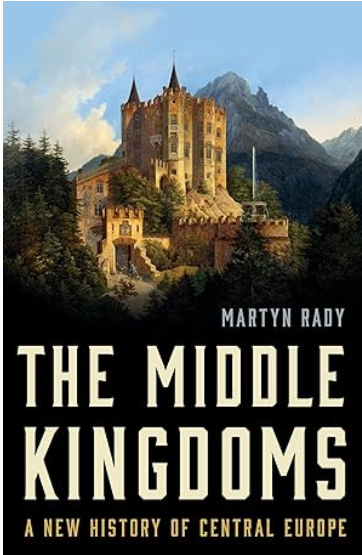
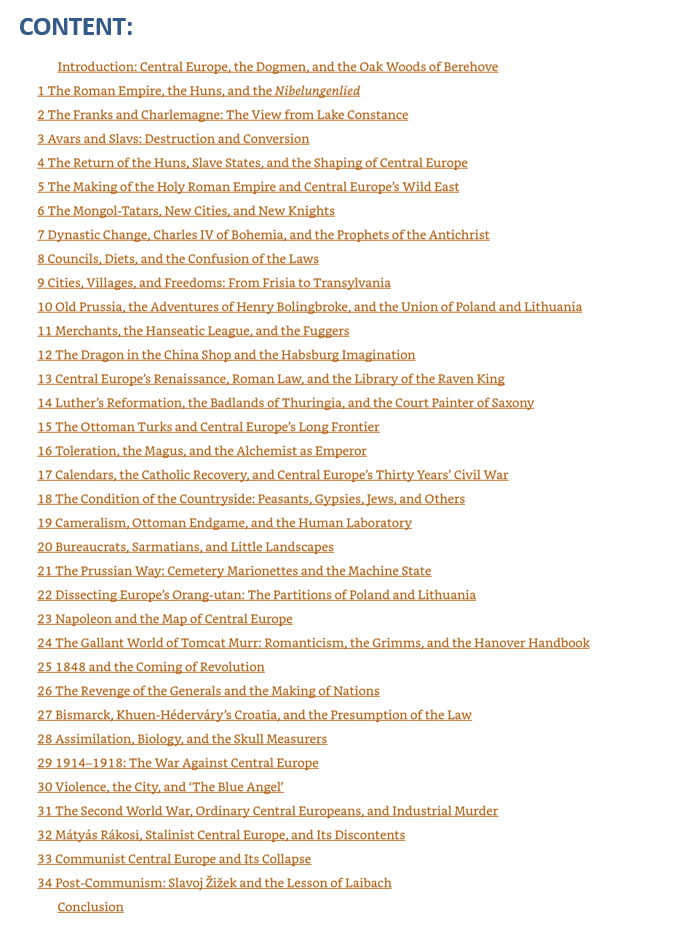
“The Middle Kingdoms: A New History of Central Europe” by Martin Rady explores the historical narrative of Central Europe, from its ancient beginnings to the modern era. The main idea of the book is to provide a comprehensive and nuanced understanding of this region, often overlooked or misunderstood in broader European histories. Here are key points of the book’s focus:
- Geographical and Cultural Definition: Rady challenges traditional views by defining Central Europe not just geographically but through its unique cultural, linguistic, and historical interactions. He includes countries like Poland, Hungary, the Czech Republic, Slovakia, and parts of Austria and Germany in this definition.
- Historical Complexity: The book delves into the complex history of the region, marked by numerous invasions, migrations, empires, and state formations. It covers the rise and fall of various kingdoms, the influence of the Habsburgs, the impact of the Ottoman Empire, and the tumultuous 20th century with its wars and shifts in power.
- Multiethnicity and National Identity: A significant theme is the multiethnic nature of Central Europe, where multiple nationalities, languages, and religions have coexisted, often leading to both rich cultural development and conflict. Rady explores how these identities have evolved, sometimes leading to nationalism and the reshaping of borders.
- Political and Social Transformations: The narrative includes how Central Europe has been a battleground for ideologies, from feudalism to communism, and then to democracy. It examines pivotal moments like the Reformation, the Thirty Years’ War, the Austro-Hungarian Compromise of 1867, the interwar period, World War II, and the fall of communism.
- Cultural Contribution: Beyond the political and military history, Rady highlights the cultural contributions of Central Europe to the world, including literature, music, art, and science, providing a cultural context to the political history.
- Modern Context: The book also considers how historical legacies continue to shape current political, social, and economic realities in Central Europe, providing a backdrop for understanding contemporary issues in the region.
In summary, Martin Rady’s “The Middle Kingdoms” aims to give readers a deeper, more layered understanding of Central Europe, emphasizing its pivotal role in European history while correcting misconceptions and celebrating its unique cultural tapestry.
MY TAKE ON IT:
“Central Europe—the Middle Kingdoms—is a relentless churn of chaos, unlike the West’s democracies like Britain and the Netherlands, which stumble along in their own messy way, or Russia’s unyielding autocratic grip. It’s a fractured mess of small nations—squabbling, splintering, or grudgingly banding together to scrap for dominance. I pin it on a toxic overdose of diversity: cultures, languages, and stubborn attitudes that can’t align on anything lasting. The EU’s heavy-handed dream of a unified superstate only fans the flames, proving top-down control is a delusion here. And the elite’s wild scheme—swamping the region with Muslim immigrants to smother the old Christian-national soul and shore up a loyal voting base—is imploding. Islam doesn’t settle for a seat at the table; it wants the whole damn stage. Even in the West, where democracy’s supposed to be stable, the same Islamic influx exposes the cracks—hardly orderly when borders dissolve and identity erodes. No central authority can brute-force this patchwork into unity without bloodshed; history screams that lesson. Rady’s Middle Kingdoms has me convinced: the only fix is a sharp break from suffocating oversight. Go for a rugged federalism—beyond America’s tame version—where each nation grabs real power over its economy, borders, and who crosses them. Let these jagged pieces trade and coexist, free from Brussels’ overreach. Otherwise, Central Europe stays what it is: a volatile, shattered core, forever lurching toward the next rupture.”
20250105 – Revolutionary Spring: Europe Aflame
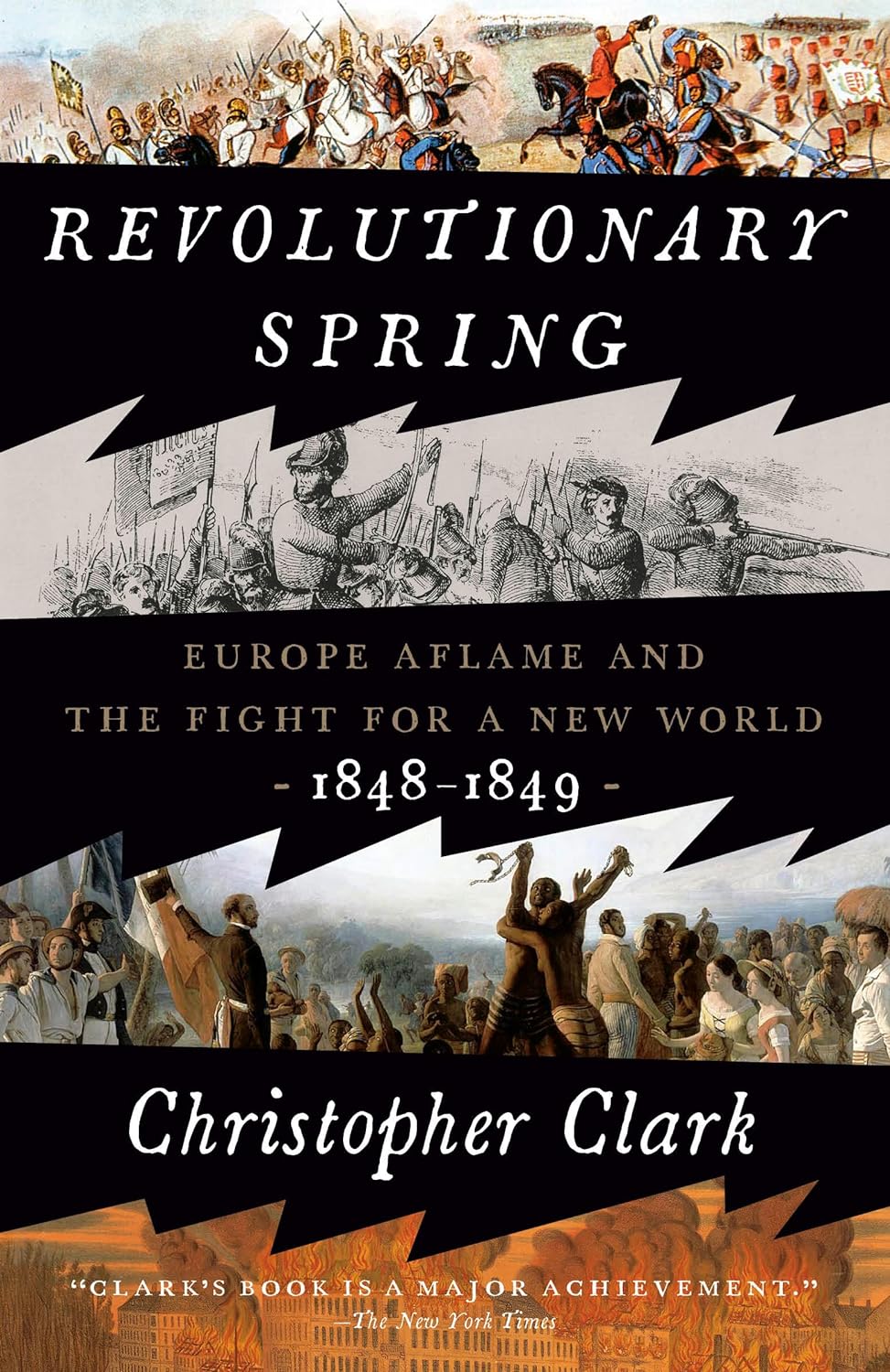
MAIN IDEA:
This book describes in great detail the events of the European Revolution of 1848, which, despite failing, nevertheless initiated the dissolution of the World order established after the Napoleonic Wars. Here is the author’s description of the overall sequence of events:
“There were three phases to the events of 1848. In February and March, upheaval spread like a brush fire across the continent, leaping from city to city and starting numerous spot-fires in towns and villages in-between. The Austrian Chancellor, Metternich, fled from Vienna, the Prussian army was withdrawn from Berlin, the kings of Piedmont–Sardinia, Denmark and Naples issued constitutions – it all seemed so easy.”
“Yet the divisions within the upheaval (already latent in the first hours of conflict) soon became glaringly apparent: by May, radical demonstrators were attempting to storm and overthrow the National Assembly created by the February Revolution in Paris, while, in Vienna, Austrian democrats protested at the slowness of liberal reforms and established a Committee of Public Safety. In June, there were violent clashes between the liberal (or in France republican) leaderships and radical crowds on the streets of the larger cities. In Paris, this culminated in the brutality and bloodshed of the ‘June Days’, which killed at least 3,000 insurgents.”
“In September, October and November, counter-revolution unfolded in Berlin, Prague, Vienna and Wallachia. Parliaments were shut down, insurgents were arrested and sentenced, troops returned en masse to the streets of the cities. But, at the same time, a second-phase, radical revolt dominated by democrats and social republicans of various kinds broke out in the central and southern German states (especially Saxony Baden and Württemberg), in western and southern France, and in Rome, where the radicals, after the flight of the Pope on 24 November, eventually declared a Roman Republic. In the south of Germany, this second-wave upheaval was only extinguished in the summer of 1849, when Prussian troops finally captured the fortress of Rastatt in Baden, last stronghold of the radical insurgency. Shortly afterwards in August 1849, French troops crushed the Roman republic and restored the papacy, much to the chagrin of those who had once revered France as the patroness of revolution across the continent. At about the same time, the bitter war over the future of the Kingdom of Hungary was brought to an end, as Austrian and Russian troops occupied the country. By the end of the summer of 1849, the revolutions were largely over.”

MY TAKE ON IT:
Without understanding the revolutions of 1848, it is impossible to understand the events of the following nearly 200 years that featured the development of socialist and communist ideas that practically conquered the world before fully demonstrating their complete inadequacy for rearrangement of society in any workable and humane way. These ideas produced wars, starvation, and misery on a scale unimaginable before, in the process, killing hundreds of millions of people. These ideas came as a reaction to the development of the capitalist industrial economic system, which, while removing limitations on population growth and providing material prosperity, came with lots of inhuman hurdles for a significant part of the population that was moved away from low productivity agricultural system to the bottom of much higher productivity industrial system. It took considerable time before the new arrangement had produced a dynamically adjustable combination of private control over capital, individual and sometimes group control over one’s labor and consumption, and violent interference of the state striving to smooth conflict of interest between different parts of this arrangement.
We are now witnessing the final period of this arrangement, when the implementation of AI systems will result in the automation of all productive activities, making human labor redundant. Over the next 50 to 100 years, a new resource creation and allocation arrangement will have to be developed to provide stability for human existence. Whether this new arrangement will be a freedom-based society that uses technology to provide resources for individuals to pursue their own happiness or it will be a strict hierarchy-based society where psychopaths at the top of the hierarchy pursue their happiness at the expense of the misery of individuals at the bottom remains to be seen.
20241013 – The Nocebo Effect
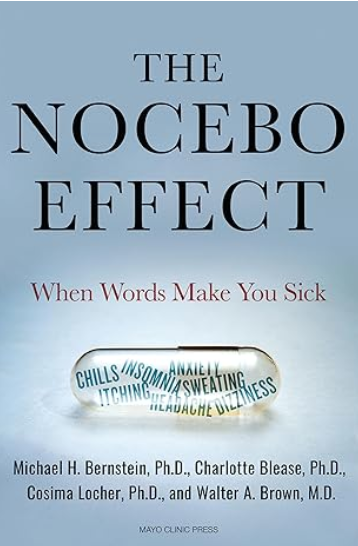
MAIN IDEA:
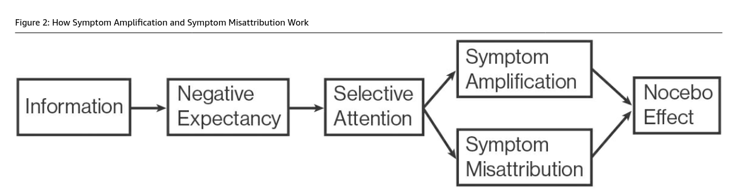
This book is about the nocebo effect, which is the opposite of the placebo when clearly inactive treatment works because of a patient’s psychological conditions. Here is the authors’ definition: “In our view, the nocebo effect can be summarized as “the occurrence of a harmful event that stems from consciously or subconsciously expecting it.” The core of the nocebo effect is that adverse health effects occur as a result of negative expectations.”. The authors present the history of research in this area since the early 1950s, the mechanics of its working, and its impact not only on the outcomes of medical treatments and the well-being of patients but also on healthcare costs. They also provide recommendations for minimizing this effect’s negative impact. Finally, the authors present their view on the nocebo effect’s impact on society overall and its ability or inability to handle various challenges from the environment to various political, economic, or personal risks.
Here is a nice diagram of how the nocebo effect works:
MY TAKE ON IT:
For me, the analysis in this book presents an interesting demonstration of the interconnection between the reality of life, human perception, and modeling of this reality, which leads to conscious or unconscious actions that, in turn, change reality. This topic goes way beyond the medical side of the placebo/nocebo effect. It could be used to understand human actions in all areas of life, including the economy and politics.
From this point of view, the currently popular contentions of information vs. disinformation, fake news, DEI, and such are just attempts to use the psychology of the nocebo effect to achieve specific population behaviors. In a democracy, even if flawed, such attempts usually fail because of the difficulty of isolating people from accurate information. That’s why people benefiting from COVID and Climate alarmism distortions of resource allocation fail to achieve complete dominance despite mass propaganda efforts and relatively limited violent actions such as the cancelation of non-compliant individuals.
Their ideological peers of the Communist and Nazi variety were more successful because the concentration camps and outright executions were much more effective than losing jobs and prestige. However, even their success was limited in time due to the nasty habit of reality to undermine any ideology that deviates too much from this reality.
The problem for individuals is that they do not have enough time and ability to recover from mistakes to afford too much of a nocebo effect impacting their lives. The solution is to control one’s perception of reality by seeking a variety of views and, most importantly, evaluating these views based on their ability to predict future events rather than the authority of their presenters, how much good feeling of virtue they provide, or even how logically consistent these views are.
20240428 – Homelands

MAIN IDEA:
This is a book on European history after the end of WWII. It covers the Cold War with its division into West and East, traced via a narrative about people’s lives on both sides of the Iron Curtain. It also covers the dissolution of the East, sometimes with its peaceful divisions, such as in Czechoslovakia, and, at other times, with violent divisions, such as Yugoslavia. It also covers the process of European Unification into a quasi-federal state of the EU and the later disappointment that resulted in Brexit. It ends with the current state of affairs when the Semi-democratic West has to face invasion by invitation by the fundamentalist Islamic population from failed states frozen in medieval intellectual milieu, seeking to destroy Western civilization and substitute it with an Islamic caliphate and the invasion from outside by revanchist Russia seeking to restore the great Russian empire and make it the dominant force in Europe. A little bit further is lurking another revanchist power – China that is seeking to restore the proper order of the world, which in the minds of Chinese leaders is the absolute dominance of China with everybody else happily accepting the roles of vassals. The author, being a moderate leftist, seems to be unhappy with these developments, but he is also quite scared by the growing resistance to the destruction of the West that comes mainly from the right. The author ends with the description of his encounter with a representative of such right in Normandy and how he managed to bring it to this semi-happy conclusion:” Finally, after long resistance, he yields, raising his last glass with a half-reluctant, half-cheerful shrug. ‘L’Europe!’”

MY TAKE ON IT:
This book is a good illustration of how we all live now in
“Interesting Time.” I believe that we
are now in the process of restructuring society, brought about by technological
developments that, for all practical purposes, eliminate barriers between
countries, cultures, and individuals. These barriers limited the exchange of
goods, services, cultural artifacts, and ideas. Still, they provided security
to all these entities, from reliable, clearly defined territory and homogeneity
of the population for countries to privacy and secure place within society for
individuals. This will all be gone within 50 to 100 years, and a unified
society will be created covering all humans worldwide. The question is whether
it will be a top-down hierarchical society with a rigid elite controlling
everything and everybody via AI technology or it will be a flexible network in
which individuals are in possession of sufficient resources to conduct their
lives any way they want it combined with the cultural and organizational environment
in which any attempt to establish dominance and control over other people’s
lives would be immediately suppressed either by soft methods like cultural
pressure or by violent methods. I believe that in the long run, the second
outcome is much more probable for two reasons. The first one is that it is much
more appropriate for human nature as it formed over the previous 200,000 years
when humans were hunter-gatherers and maintained their societies in such mode.
The second one is that any hierarchy with a rigid elite at the top inevitably
causes individuals to fight each other for power and control, causing all the
entertaining staff of history with its kings, barons, general secretaries,
presidents, and CEOs. In addition to entertainment, it also creates misery for
all, including members of the elite, making the system unstable overall. We
certainly could move directly to the global equivalent of the hunter-gatherer
community of generally happy people right away using emerging technology, but I
doubt that this would happen. Humanity possesses an uncanny ability to do everything
right, but only after it tries everything else, so I expect lots of misery to
occur during this trying.
 Equal Rights Libertarian