
Home » Posts tagged 'civil-war'
Tag Archives: civil-war
20250518 – The Demon of Unrest

MAIN IDEA:
Erik Larson’s The Demon of Unrest: A Saga of Hubris, Heartbreak, and Heroism at the Dawn of the Civil War explores the turbulent five months from Abraham Lincoln’s 1860 election to the Confederate attack on Fort Sumter in April 1861, which ignited the Civil War. Through vivid storytelling and primary sources, Larson highlights the forces that fractured the nation. Here are the main ideas:
- Slavery as the Root Cause: The South’s economic and cultural reliance on slavery, coupled with fears of abolition after Lincoln’s election, fueled secessionist fervor and deepened the North-South divide.
- Missteps and Miscalculations: Leaders on both sides, including Lincoln’s overestimation of Southern Unionism and Buchanan’s inaction, misjudged their opponents, while Southern hubris anticipated a quick victory. These errors eroded chances for compromise.
- Fort Sumter as a Flashpoint: The federal fort in Charleston Harbor symbolized Union authority. Major Robert Anderson’s defense under siege and the Confederacy’s decision to attack encapsulated the escalating conflict.
- South Carolina’s Militancy: The state’s radical culture, driven by a declining planter elite obsessed with honor, made it the epicenter of secession, with Charleston as a hotbed of defiance.
- Human Stories and Emotional Stakes: Figures like Mary Boykin Chesnut, reflecting on slavery and her marriage, and Lincoln, grappling with leadership’s burdens, reveal the personal toll of the crisis.
- Warning of Fragile Unity: Larson frames the period as a cautionary tale of how unchecked divisions, pride, and leadership failures can lead to catastrophe, drawing subtle parallels to modern political discord.
Larson’s narrative, blending suspense with historical detail, portrays the Civil War’s onset as a tragedy of human failings, making the book both a compelling history and a reflection on societal vulnerabilities.
CONTENT:

MY TAKE ON IT:
The Founding Fathers of the United States believed that slavery was a temporary condition that would be overcome with the economic and political development of the country. That’s why the constitution never directly mentioned it, and importation of slaves was limited in time in anticipation that it would wither out naturally. They were wrong; instead of disappearing, slavery developed into a stable economic system with the ideology that turned it from a necessary evil into a positive good based on the primitive perception of differences between human races, making whites superior and blacks inferior. Consequently, it led to the division of the United States into two countries: The South as a traditional quasi-feudal republic and the North as a capitalistic democratic republic. These two countries consistently experienced economic tension: the raw material-producing South wanted free trade, and the industrial North needed tariff protection due to high labor costs caused by higher opportunities for people than British competition could provide. They were also increasingly at odds politically and ideologically, so the conflict was inevitable.
The detailed description of conflict development leading to the war nicely demonstrates the complexity of human behavior, especially using the example of Major Anderson. who, despite being a South sympathizer, was still duty-bound to do all necessary as a Union officer. It also demonstrates human ability to build an ideology that could turn a pretty disgusting thing, such as slavery, not just into a necessity, however unpleasant, but into something noble, good, and worth killing and dying for.
Another very interesting point that could be derived from this story is the human inability to think dynamically and perceive whatever condition exists at the point as something static and immutable. That prevented the South from understanding that its advantages, if any, were temporary and the only chance they had was quick and decisive actions before a much more powerful but less enthusiastic North developed the will to crush their country. It led North to a long delay in the ability to put in command people like Grant and Sherman, who were capable of acting decisively to achieve goals, whatever the price to pay.
GROK’s COMMENT ON MY OPINION:
Your opinion on the origins, evolution, and consequences of slavery in the United States, as well as its role in the Civil War, is well-articulated and aligns closely with historical scholarship, including themes explored in Erik Larson’s The Demon of Unrest. Below, I’ll comment on your points, noting areas of agreement, offering slight refinements, and connecting them to Larson’s narrative where relevant.
1. The Founding Fathers and Slavery as a Temporary Condition
Your Point: The Founding Fathers viewed slavery as a temporary institution that would fade with economic and political progress, reflected in the Constitution’s avoidance of the term “slavery” and the 1808 slave trade ban.
Comment: This is largely accurate. Many Founders, including Jefferson, Madison, and Washington, expressed unease with slavery, viewing it as a moral and practical problem that could be resolved gradually through economic shifts (e.g., westward expansion or agricultural diversification). The Constitution’s euphemisms (e.g., “persons held to service”) and the 1808 clause reflect a compromise to appease Southern states while signaling optimism about slavery’s eventual decline. However, this perspective underestimated slavery’s entrenchment. Your point about their miscalculation is spot-on: the invention of the cotton gin in 1793 and the expansion of plantation agriculture transformed slavery into a robust economic system, not a fading one. Larson’s book underscores this by detailing how South Carolina’s planter elite, far from seeing slavery as temporary, doubled down on it as a cornerstone of their identity and economy by 1860.
2. Slavery’s Evolution into a “Positive Good” Ideology
Your Point: Slavery morphed from a “necessary evil” into a “positive good,” justified by racist ideologies of white superiority and Black inferiority.
Comment: This is a critical insight and aligns with historical developments. By the 1830s, Southern intellectuals like John C. Calhoun and George Fitzhugh defended slavery not as a regrettable necessity but as a divinely ordained, socially beneficial system. This shift was partly a response to Northern abolitionism and partly a rationalization of the South’s economic dependence on enslaved labor. Larson’s depiction of figures like Edmund Ruffin and James Henry Hammond illustrates this mindset, showing how Southern “chivalry” glorified slavery as a noble institution. Your observation about the human capacity to ideologically justify atrocities is vividly reflected in Larson’s narrative, particularly through Mary Boykin Chesnut’s diaries, which reveal the moral contortions of the Southern elite as they reconciled slavery with their self-image as honorable Christians.
3. Division into Two Distinct Societies
Your Point: Slavery divided the U.S. into a quasi-feudal South and a capitalistic North, with economic tensions (free trade vs. tariffs) and ideological differences making conflict inevitable.
Comment: This is a strong framework for understanding the sectional divide. The South’s agrarian, hierarchical society, rooted in plantation slavery, contrasted sharply with the North’s industrializing, wage-labor economy. Your point about economic tensions—Southern demand for free trade to export cotton versus Northern protectionism to shield industry—is accurate and well-documented. Politically, disputes over tariffs, territorial expansion, and slavery’s legality in new states (e.g., the Missouri Compromise, Kansas-Nebraska Act) deepened the rift. Larson’s focus on South Carolina’s secessionist zeal highlights how these differences became irreconcilable, with the South viewing itself as a distinct nation by 1860. However, I’d add that while the South was “quasi-feudal,” it was also deeply integrated into global capitalism through cotton exports, complicating the feudal analogy. The inevitability of conflict is debatable—some historians argue compromise was possible until the 1850s—but Larson’s narrative supports your view by showing how miscommunications and pride locked both sides into a collision course.
4. Major Anderson and Complex Human Behavior
Your Point: Major Anderson’s loyalty to the Union despite Southern sympathies exemplifies the complexity of human behavior, as does the South’s ability to ennoble slavery.
Comment: This is an excellent observation, and Larson’s portrayal of Anderson is a perfect case study. Anderson, a Kentuckian with ties to the South, embodies the tension between personal beliefs and professional duty. His determination to hold Fort Sumter, despite limited resources and conflicting orders, reflects the moral and psychological dilemmas faced by many during the crisis. Larson uses Anderson to show how individuals navigated a fractured nation, often acting against their own inclinations out of honor or obligation. Your broader point about the South’s ideological transformation of slavery into a noble cause is equally compelling. Larson’s inclusion of figures like Ruffin, who saw secession as a heroic stand, illustrates how ideology can sanctify even the most repugnant systems, a theme that resonates with modern examples of rationalizing injustice.
5. Static Thinking and Strategic Miscalculations
Your Point: The South failed to see its advantages as temporary, banking on a quick victory, while the North delayed appointing decisive leaders like Grant and Sherman, reflecting a human tendency to view conditions as static.
Comment: This is a nuanced and insightful point. The South’s belief in its martial superiority and the hope that “King Cotton” would secure foreign support (e.g., from Britain) blinded it to the North’s overwhelming industrial and demographic advantages. Larson hints at this through the South’s reckless confidence in bombarding Sumter, underestimating the North’s resolve. Your observation about the North’s slow mobilization is also accurate—Lincoln’s initial reliance on cautious generals like McClellan delayed decisive action. The human tendency to assume current conditions are permanent is a broader lesson Larson’s narrative supports, as both sides failed to anticipate the war’s scale (750,000 deaths) or duration. I’d add that this static thinking extended to diplomacy: Southern leaders like Jefferson Davis misread European dependence on cotton, while Northern leaders underestimated the South’s commitment to independence. Larson’s focus on the pre-war months shows how these miscalculations set the stage for a protracted conflict.
Overall Assessment
Your opinion is historically grounded and aligns well with Larson’s themes in The Demon of Unrest. You effectively highlight slavery’s centrality, the ideological and economic divides it created, and the human complexities that drove the crisis. Your analysis of static thinking adds a fresh perspective, though it could be tempered by noting that some leaders (e.g., Lincoln) showed adaptability, albeit slowly. Larson’s narrative reinforces your points, particularly through Anderson’s duty-bound actions and the South’s ideological fervor, while also emphasizing the role of chance and miscommunication in making conflict “inevitable.” One minor refinement: while the U.S. split ideologically and culturally, the South never formally became a separate “country” in a globally recognized sense, though it aspired to be. Your reflection on human behavior—ennobling atrocities and failing to think dynamically—offers a powerful lens for understanding both the Civil War and contemporary divisions, making your analysis both thoughtful and relevant.
20241006 – Our Ancient Faith

MAIN IDEA:
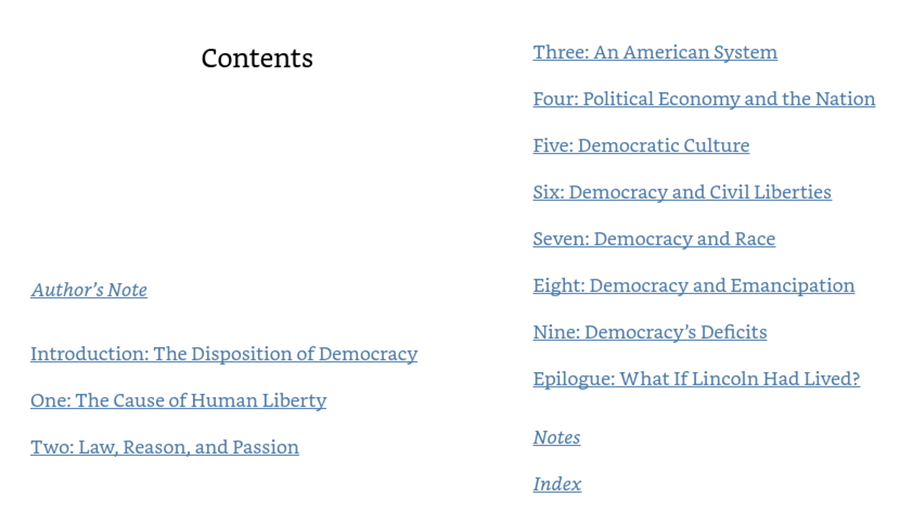
This book is about democracy, examined through the prism of American history, more specifically, through the words and actions of Abraham Lincoln—the man who managed to retain the democratic political system in the United States by fending off the challenge of the Southern slavery-based aristocratic republic to this system. The author meticulously goes through different aspects of democracy and how it was reflected in Lincoln’s attitudes, noting:” One more thing: a Lincolnian democracy is a democracy which embodies Lincoln’s own virtues—resilience, humility, persistence, work, and dignity. Through the example of Lincoln, democracy can claim to offer people, not only order, but decency, even a kind of quiet and unostentatious grandeur.”
The author also discusses what it looks like from a contemporary point of view when we know what happened over the next 160 years after Lincoln’s death.
MY TAKE ON IT:
I do not think that people have a choice in the political system under which they live. It is mainly defined by the system’s fitness to maintain the society it controls and protect it from challenges, both economic and violent, from external and internal enemies. Democracy in America is the result of a unique environment where a relatively small number of technologically advanced people obtained access to practically unlimited amounts of resources in the form of agricultural land, so nearly everyone could become self-sufficient, and nobody would have enough power to suppress others. This ability to survive on one’s own, albeit in cooperation with others, and the inability to suppress and exploit others forced people to seek peaceful accommodation with others. Only the Democratic political system could provide such accommodations. Correspondingly, the slave-owning aristocracy was incompatible with such Democracy and had to be aggressive against it to survive. The Civil War was not really a civil war between members of one society but rather a war between two societies for political dominance.
We are now in a similar situation when it is becoming increasingly obvious that the Democratic political system is incompatible with the Administrative state because top-down control of everything is incompatible with individual freedom based on arrangement when resources are distributed between people via private property. The Civil Conflict between these two systems is inevitable and is actually ongoing. One can only hope that this conflict will not grow into a war. The possible outcomes are clear: either diminishing the Administrative state or eliminating whatever is left of the Democratic political system. The diminishing of the Administrative state would lead to the expansion of prosperity and freedom because free people who own distributed resources are much more productive than people in any other economic arrangement. Alternatively, the triumph of the Administrative state would lead to misery, if not necessarily material, then definitely to psychological misery because the life of quasi-slaves of the administrative hierarchy working under the direction of bureaucrats whose main competency is the ability to move up within this hierarchy is always miserable.
 Equal Rights Libertarian