
Home » Posts tagged 'christianity'
Tag Archives: christianity
20240922 – Supercommunicators

MAIN IDEA:
This book is about communications, and here is the author’s definition of its main idea: “This book, then, is an attempt to explain why communication goes awry and what we can do to make it better. At its core are a handful of key ideas. The first one is that many discussions are actually three different conversations. There are practical, decision-making conversations that focus on What’s This Really About? There are emotional conversations, which ask How Do We Feel? And there are social conversations that explore Who Are We? We are often moving in and out of all three conversations as a dialogue unfolds. However, if we aren’t having the same kind of conversation as our partners, at the same moment, we’re unlikely to connect with each other.”
There is also a graphic representation:


MY TAKE ON IT:
I like the idea that there are different types of conversations, and communication difficulties often occur because participants perceive that they are in different types of communication than they really are. For example, one side believes it is in a Decision-making conversation and seeks a way to resolve a problem, while another is in a Social conversation and seeks to reaffirm its core beliefs. I think many problems, not only at the individual and small group levels but also at the international level, occur because people do not understand that the other side is in a completely different conversation.
A good example is the most enduring conflict of our time between representatives of contemporary secular Western Civilization and traditional theocratic Islamic Civilization. The leaders of the West believe that the conversation is about some specific problems, such as the Palestinian State, grievances from the history of colonialism, low level of economic development, or some other resolvable problem. They are in a Decision-making mindset conversation. The leaders of Islam believe that the issue is whether they are the one and only legitimate representatives of the true God or just one of many religions that different people come up with. If their beliefs are correct, their god should make them dominant in the world and give them the power to conquer and dominate over everybody else. If such conquest fails, they are wrong, and their core understanding of themselves is invalid. They are in a Social mindset conversation, seeking to assert their beliefs about who they are.
The possible outcomes of this conflict are either Islamic theocracy established all over the world or changes in the leadership of the Islamic populations, who eventually arrive at the same downgrading of their god that the Christian population went through in recent centuries regarding their god.
I think that the first outcome, Islamic dominance, is unfeasible, and the second is inevitable. However, due to Western leadership’s lack of understanding of what kind of conversation they are in, the road to this will be much more complex and bloody than it should have been.
20240519 – Moral Origins
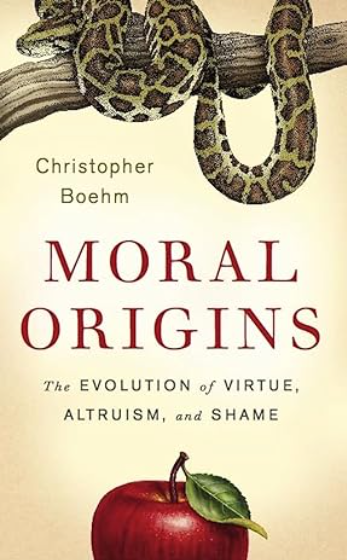
MAIN IDEA:
This book is about “the origination of moral behavior and
the human conscience.” The main idea is that morality and conscience are not
some kind of byproduct but rather logical and proper consequences of the
evolutionary development of humans as animals that survive in groups and,
therefore, need highly functional brains and effective sets of rules of
interactions within and without groups to maximize survival chances. Here is
how the author defines his hypothesis:” My idea will be that
prehistorically, humans began to make use of social control so intensively that
individuals who were better at inhibiting their own antisocial tendencies,
either through fear of punishment or through absorbing and identifying with their
group’s rules, gained superior fitness. By learning to internalize rules,
humankind acquired a conscience, and initially, this stemmed from the punitive
type of social selection I mentioned previously, which also had the effect of
strongly suppressing free riders. Later, I shall argue that a newly moralistic
type of free-rider suppression also helped us evolve our quite remarkable
capacity for extrafamilial generosity.”
MY TAKE ON IT:
My views on the subject are completely in sync with the author’s hypothesis about the evolutionary roots of human morality and conscience. It is nice to see such well-documented and thoroughly researched confirmation of these ideas. I only have a bit of a problem when the author, in his epilogue, moves to a discussion of world morality, global government, world public opinion, climate change, and other such topics. The combination of the desire for global top-down control combined with fear of nation-states does not provide a good foundation for the author’s hope for a “global moral community.” I agree that the evolutionary developed human morals could eventually become the foundation of a peaceful world, but only when all people are accepted as members of one group – humanity, with an exclusively voluntary combination of people in a variety of groups with resources distributed to individual levels as much as possible so, for example, to make territorial conflicts meaningless because the land does not belong one nation or another, but divided between millions of individuals so conflicts are resolved in courts, not on the battlefield.
20240512 – Manifesto of Evolutionary Humanism
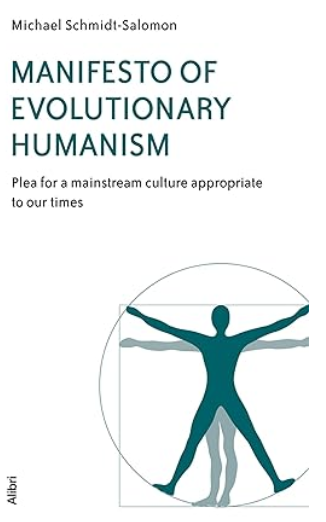
MAIN IDEA:
The main idea of this book is that humanity developed a huge
gap between its technological development and its philosophical and moral
understanding of reality. The author compares it to the situation when a
5-year-old child gets to control a jumbo jet with passengers, which could lead
to a disaster. So here is the author’s explanation of what it is all about:” The
present “Manifesto of Evolutionary Humanism” was commissioned by the Giordano
Bruno Foundation.4 It will attempt to formulate the basic positions of a
“contemporary enlightenment” appropriate to the modern world. The publication
of the manifesto serves the intention of supporting those who already feel
committed to a mainstream culture of humanism and enlightenment, as well as the
hope that some of the arguments presented here may yet reach those who, even
today, are of the opinion that they have to take their “wisdom” from archaic
myths.”
MY TAKE ON IT:
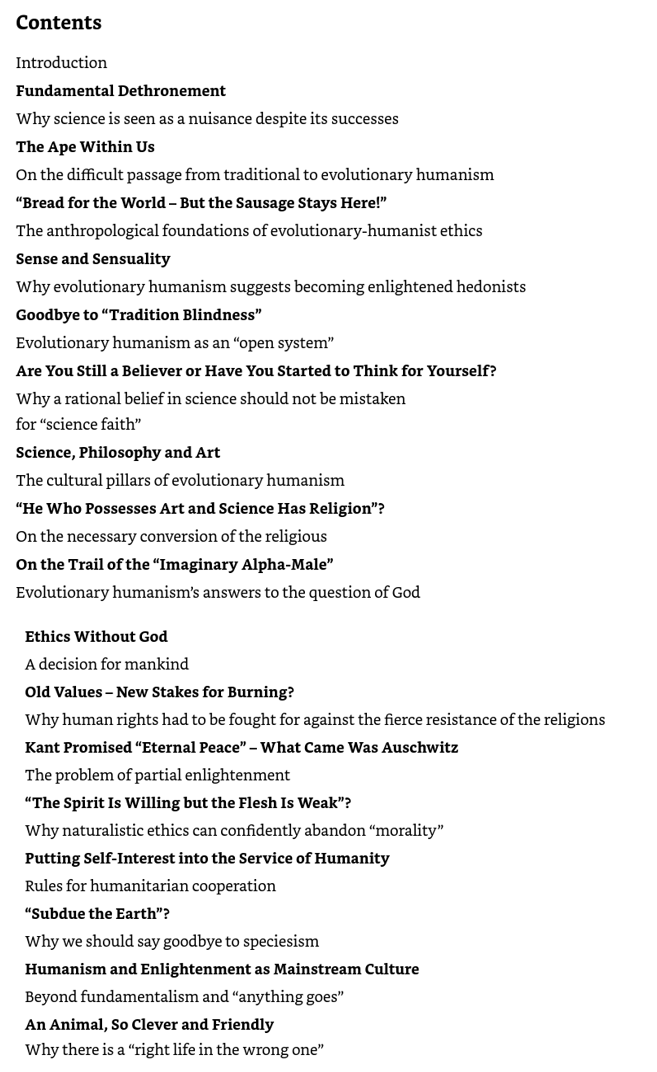
I probably agree with about 60% of the ideas in this manifesto, especially those regarding science and the unnecessity of a god for morality. However, I think that the author mixes two separate and unmixable things: knowledge and beliefs. Knowledge is a testable representation of reality in the human mind, enabling humans to act effectively and even somewhat efficiently. Belief is an untestable description of the world that provides psychological comfort and effective cooperation between individuals, all the way to true believers sacrificing themselves to protect this belief. There is nothing childish in believing, and the belief in science is no more justified than believing in God as long as these beliefs remain in the proper area of worldview combined with tolerance and acceptance of other worldviews as legitimate, however idiosyncratic. The problem emerges when people start moving their beliefs into the area of action, combined with intolerance. At the minimum, this could be somewhat deleterious to human well-being when resources are spent to build temples for God rather than housing for humans. Still, it is as bad, if not more so, when resources are spent to implement some “Great Leap Forward” or implement “collective farms-based agriculture according to principles of scientific communism.” The tolerance of the worldviews of others is absolutely necessary because otherwise, we are getting screwed, and it does not that much matter if it is by the Inquisition in the name of God or by the KGB in the name of a bright, scientifically defined communist future. Finally, morality is just an evolutionary developed set of rules for interaction between humans that assure that such interaction benefits all participants, preventing them from fighting and/or taking advantage of each other. A society without morality could not be stable and, therefore, will fail in competition with other societies.
 Equal Rights Libertarian