
Home » Posts tagged 'brain'
Tag Archives: brain
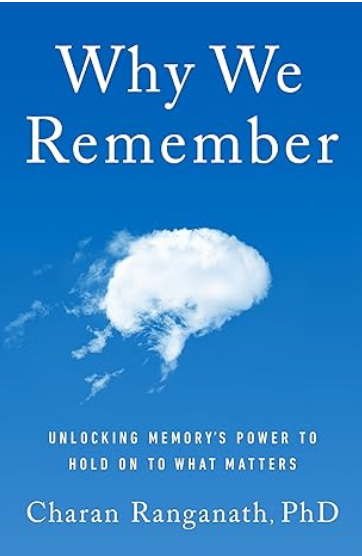
20241215 Ranganath, Charan – Why We Remember
MAIN IDEA:
This is the look at memory from the point of view of human evolution. The author’s main point is that memory is nothing like computer memory with write/read features, albeit not as reliable and photographic. Here are the two most important author’s definitions:
- Memory is much, much more than an archive of the past; it is the prism through which we see ourselves, others, and the world. It’s the connective tissue underlying what we say, think, and do.
- We forget because we need to prioritize what is important so we can rapidly deploy that information when we need it. Our memories are malleable and sometimes inaccurate because our brains were designed to navigate a world that is constantly changing: A place that was once a prime foraging site might now be a barren wasteland. A person we once trusted might turn out to pose a threat. Human memory needed to be flexible and to adapt to context more than it needed to be static and photographically accurate.
The author also provides an excellent technical description:” I think of memory as the process by which our brains change over time. As we go about our lives, connections between neurons are constantly formed and modified, resulting in cell assemblies that help us sense, interact with, and understand the world around us. These intricately connected neural networks give us the ability to weave together the threads of the past so that we may envision how the future will unfold.”

MY TAKE ON IT:
I fully agree with the author that human memory has developed as an effective tool for survival and, as such, provides not an accurate picture of the past but rather a presentation of reality compiled from a combination of previous presentations and current inputs from both the external environment and the body’s internal conditions. This presentation serves one and only one purpose: to prompt such action or inaction that in the past was beneficial for survival and procreation. For conscientious beings such as humans, memory defines the notion of self and where this self belongs in relation to other selves and within the universe.
From this, I’d like to draw the important conclusion that we cannot rely on human memory in many important areas, from witness evidence to a view of past events and interactions.
Luckily, we have technology that allows us to save audio and visual information in just about any conceivable circumstance, and this technology improves constantly. So, any review and analysis of past events, whether a crime or who said and did what and where, should be based not on witness evidence but on technical recordings. However, it also contains the danger of modifying the recording using AI. The only way it could be prevented is by continuing blockchain postings of everything from everybody. It would be absolutely inconceivable back in the 1970s when we saved 2 bytes on a timestamp of the year, but it is conceivable now when we can carry terabytes of data on keychains in our pockets.
20240609 – The Experience Machine

MAIN IDEA:
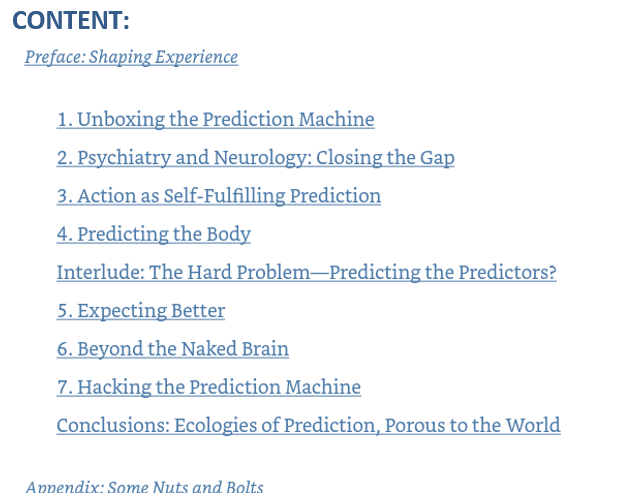
This book discusses a novel theory of human behavior and the functioning of the brain. In this theory the brain is considered, first and foremost, a tool to generate predictions about the environment and then use the sensory organs as secondary tools to adjust these predictions. Here is the author’s formulation:” Perception is now heavily shaped from the opposite direction, as predictions formed deep in the brain reach down to alter responses all the way down to areas closer to the skin, eyes, nose, and ears—the sensory organs that take in signals from the outside world. Incoming sensory signals help correct errors in prediction, but the predictions are in the driver’s seat now. This means that what we perceive today is deeply rooted in what we experienced yesterday, and all the days before that. Every aspect of our daily experience comes to us filtered by hidden webs of prediction—the brain’s best expectations rooted in our own past histories”. So human behavior is not reactive, but rather an active 4-step process: prediction–action-perception–correction rather than two steps: perception-action.
MY TAKE ON IT:
The approach to human brain information processing suggested in this book changes the understanding of this processing. So, the first step is to plan or build an internal abstract model of reality. The second step is to direct sensory organs to actively search for confirmation of this model while ignoring other information as irrelevant. Only when contradictory information becomes so overwhelming that it cannot be ignored does the brain implement the correction step. This makes sense and explains many experimental results related to priming, such as the famous experiment with the “invisible” gorilla in the basketball game. It is an interesting approach, and it points to a very important human brain functionality: building predictive models. Actually, this approach goes back to the very beginning of cybernetics when the objective was to direct anti-aircraft fire based on the prediction of the future position of the targeted aircraft and an artillery shell directed to shoot it down. This was a super simple process fully within the computational functionality of contemporary electronics. Obviously, the complexity of the model built by human brains is much higher than the simple beginnings, but the sequence of processes is the same. At the top level of complexity, it nicely explains a phenomenon when highly educated people are prone to be much more protective of their beliefs, even if such beliefs are obviously incorrect. This is because the models of highly educated people are very sophisticated, built at high costs, and, therefore, much more difficult to replace than models of simpler people. Hopefully, the new understanding presented in this book will help promote the development of modification processes for individuals whose perception of the world is built on propaganda and distortions of reality. The success of such an endeavor could help achieve peaceful coexistence between people with different world views based on different and often seemingly contradictory facts.
20240407 – The Indoctrinated Brain

MAIN IDEA:
The author is a German neuroscientist specializing in processes related to brain changes due to environment and aging and reviews recent events such as the COVID-19 pandemic. He concludes that these events, when the normal functioning of democracy was dramatically disrupted, are not random but rather part of the quite open process of changing the existing political and economic systems of the Western democracies to the new one characterized by complete dominance over society by the global technocracy: something represented by “Davos people.” Here is the author’s description of how it works using the example of vaccination based on the assumption that a natural immune system cannot handle the COVID-19 virus:” The proclaimed need to be vaccinated against it every three to six months was ultimately based on this false assumption. In the case of this pathogen, however, this meant that for the first time a largely experimental injection was being administered, the mode of action of which is in many cases similar to that of gene therapy (i.e., involving modified active genetic material). This was made palatable to people by a combination of media-generated fear of death (with the key word self-protection) and ethically sanctioned social pressure (protection of others). Thus, this lifelong injection subscription also fulfills the definition of psychosocial dependency, with the ministries of health worldwide having increased their influence on individual lifestyles and pharmaceutical companies having made high profits.”
The author refers to other works that describe the process of people’s indoctrination and then links it to his area of expertise:” An entirely new approach to explaining the increasing controllability of society and the astonishing response of little resistance emerges from this neurological insight. It goes far beyond the sociopsychological approach formulated by Desmet and, in a sense, forms its neuropathological basis. This profound explanation is, however, highly dramatic, for it will take much more than psychological insight and a change of mentality to halt or reverse this dangerous development. Trapped in zombie mode, it is impossible for victims to question their own precarious situation. Natural curiosity or interest in alternative explanations and courses of action is lost, opening the door to indoctrination. The underlying neuropathological process leads to a decrease in psychological resilience. The result is not only an increased fear of anything new but also a particular susceptibility to being controlled by fear.”
In the final chapter, the author presents the closing argument detailing a to-do list for achieving a “Healthier Brain, Healthier Decisions.” He also promises a nice result from implementing it:


MY TAKE ON IT:
I generally do not believe in any conspiracy theories, not because there are no conspiracies, but because the functioning of human societies is way too complicated for conspiracies to be functional. More often than not, great changes in societies, as well as in technology, happen unexpectedly as a result of long undercurrent development that conditions a small number of activists to capture a momentary disturbance of the system and move it to a qualitatively different state. At the same time, the vast majority of people remain passive, whether they support it or not. Such qualitative change could be for the best, as it happened with the Enlightenment and the Industrial Revolution, which led to prosperity and a huge improvement in quality of life, but it can also happen as it did with Fascism and Communism for the worst, which led to a massive decrease in quality of life and termination of millions of lives.
I think that humanity is at a crossroads now, with one road leading to an attempt to establish a dictatorship of a global elite and another one leading to the massive expansion of individual property rights to everybody. Either of these roads will
substitute the current method of resource generation and distribution based on control over most of the resources by the minority of members of the bureaucratic hierarchy of government and/or corporations and on the labor-based resource allocation for the majority. It will inevitably happen because technology makes all labor increasingly redundant, with make-believe jobs being a non-viable substitute due to the evolutionary-formed human psychology.
I also think that the road to complete dominance of bureaucratic hierarchy is a dead end because top members of the elite will always fight each other for power, causing pain and suffering for all in the process. So, eventually, humanity will come to an arrangement when everybody has property rights sufficient to obtain necessary resources via voluntary exchange, and the scale, role, and power of elite bureaucracy will be diminished to the absolute minimum required to maintain law and order.
 Equal Rights Libertarian