
Home » Posts tagged 'book-review'
Tag Archives: book-review
20241201 – A Theory of Everyone
MAIN IDEA:
The author claims that humans generally poorly understand themselves and their environment, analogous to fish that do not know what water is. So, here is the general description of the book per author:” This book is about the species called Homo sapiens…. From ancient bacteria-like life forms, humans have evolved through various laws that we shall explore in this book. But the forces that shape our thinking, our economies, and our societies have become invisible to us. And this leaves us with a deep, potentially existential problem. If we do not know who we are and how we got here, we cannot choose where we go next. If we cannot perceive the forces that shape us, we are impotent to shape these forces.”
Correspondingly, the author’s objective is to suggest what to do next:” It is about the future of humanity; about how each of our actions contributes to a collective brain. It’s about how Homo sapiens can reach the next level of abundance that leads to a better life for everyone and perhaps one day a civilization that spans the galaxy. And it’s about the things that stand in the way of getting where we need to be and what we can do to overcome them. Because today we stand on the shore of a sea of possibilities. We must be careful in how we address the coming waves ahead of us; waves that threaten our now precarious fossil-fueled civilizations.”
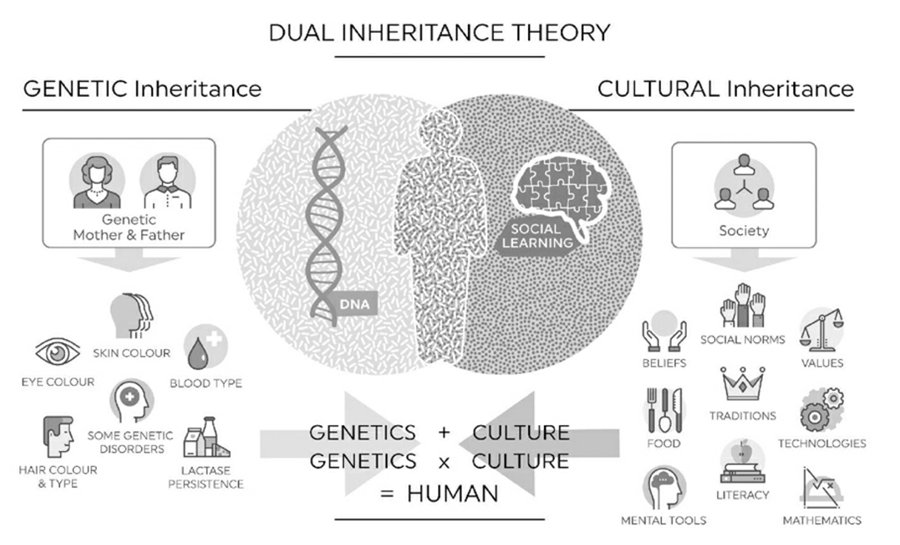
Here Is a nice graph presenting the author’s understanding of humanity:
The author concludes with this:” I hope this book has provided tools for how to advocate and what to advocate for. Not proximate solutions that patch problems and polarize groups, creating more problems, but instead permanent systematic ultimate solutions. I hope I have helped you realize that our problems and their answers don’t lie with any particular leader, any particular person, or any particular group. They require us to consider the rules of the system and what they inevitably lead to. Often, we cannot design the right rules, but we can create conditions for the right rules to evolve.
We have laws of life and a theory of everyone. We have a periodic table for people.
I hope you now know the answer to what Wallace’s older fish asked. I hope you can now see the water. We have the power to shape our societies, to influence our systems, and to determine our future. We can crack the next energy revolution to create a world that is not just sustainable, but thriving; not just efficient, but just; not just innovative, but transformative. The laws of life will go ever onwards. If we make the right decisions, so too will we”.
CONTENT:

MY TAKE ON IT:
I agree with the author’s characterization of humanity, except for the idea of the “collective brain.” I think that the most harmful mistake in human thinking is the neglect of human individuality and the attempt to simplify humans by grouping them into cultural, ethnic, religious, and other groups. In reality, every human being could be represented by a multidimensional Venn diagram of genotypic and phenotypic features changing dynamically and unpredictably. Technological development makes all humans increasingly powerful, so the only way to prevent using this power against others is to ensure maximal freedom of individuals supported by resource availability and combined with the strict cultural upbringing that makes any attempt to force one’s own will on others psychologically impossible. It is also necessary to ensure the development of such attitudes to interhuman interactions that any attempt to do so would prompt resistance. In other words, we should move as close as possible to the psychological environment consistent with humanity’s background as hunter-gatherers when resources are available to everybody more or less equally, cooperation is voluntary, and leadership is based on competence rather than some formal hierarchical structure. Since different people are competent in various areas, the leadership would be fluid depending on which area requires cooperative efforts. I would guess that with the development of AI tools, the need for cooperation in the way when one individual must be a tool for achieving the objectives of another, such as a general/soldier or an entrepreneur/hired hand, will be diminished all the way to non-existence. In this case, voluntary cooperation would be directed mainly at achieving happiness via interaction rather than survival via sacrifice.
20240616-Blunder
MAIN IDEA:
This book reviews all kinds of reasons, mainly psychological, that caused people to make blunders. Here is the author’s description of its main idea:” Blunder is a book about judgment calls. It is the story of how smart people like Edison get caught in cognition traps and wind up defeating themselves. Most complex problems have complex causes, and no single factor can explain it all. This book offers one possible explanation for why people blunder. I suggest that we all sometimes fall into “cognition traps”—rigid ways of approaching and solving problems.4 Cognition traps are inflexible mind-sets formed from faulty reasoning. They are the stolid ways in which people approach and solve problems based on preconceived notions and preset patterns of thought.
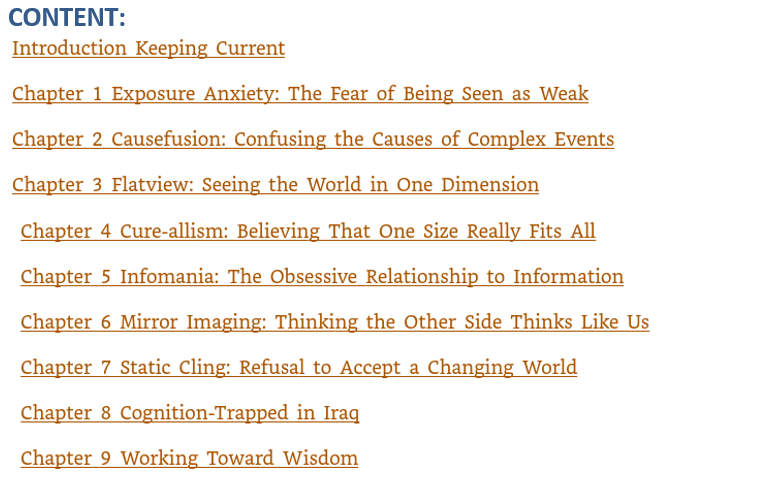
The author also defines three different types of problems that cause people to make poor decisions and implement actions that lead to failure: mistakes, blunders, and cognition traps: ” A mistake is simply an error arising from incorrect data, like believing that an electric wire is running direct current when it’s actually on AC. A blunder, in contrast, is a solution to a problem that makes matters worse than before you began, like attempting to discredit a potentially liberating technology rather than adapting to it. Finally, a cognition trap is the mental framework that led you to a blunder, like the one I call static cling, the refusal to accept that a fundamental change is under way.” The book allocates one chapter to each of the 9 most typical problems that cause blunders.
MY TAKE ON IT:
This is quite an interesting collection of cases in which human psychology caused behavior problems that resulted in negative and sometimes deadly consequences. The book is big on factoids but relatively low on proposed solutions. I am actually more interested in solutions. To a significant extent, I think these problems are caused by the lack of education. I do not mean formal education, which is often nothing more than a combination of indoctrination with low levels of technical skills, such as reading, writing, and doing some formalized algorithmic tasks. It would be much better to expand education to game-playing that emulates real-life situations and provides timely and effective feedback on individual actions, pretty much like it is done naturally by children when they are not disturbed. It is probably coming with massive implementation of AI tools and a shift to decision-making to AI models trained on the many situations relevant to skills and behavior patterns needed to avoid blunders.
20240526 – Humankind

MAIN IDEA:
This book is about human psychology, and here is the author’s definition of its main idea:” An idea that’s long been known to make rulers nervous. An idea denied by religions and ideologies, ignored by the news media and erased from the annals of world history. At the same time, it’s an idea that’s legitimised by virtually every branch of science. One that’s corroborated by evolution and confirmed by everyday life. An idea so intrinsic to human nature that it goes unnoticed and gets overlooked. If only we had the courage to take it more seriously, it’s an idea that might just start a revolution. Turn society on its head. Because once you grasp what it really means, it’s nothing less than a mind-bending drug that ensures you’ll never look at the world the same again So what is this radical idea? That most people, deep down, are pretty decent.”
The book includes a detailed review of many well-known experiments and events that are believed to demonstrate human culpability and show that, in many cases, these experiments were staged to prove preexisting conclusions or real events misinterpreted for similar purposes. At the end of the book, the author, based on the material discussed in the book, provides what he called:” TEN RULES TO LIVE BY.”
Here are the rules:
I: When in doubt, assume the best
II: Think in win-win scenarios
III: Ask more questions
IV: Temper your empathy, train your compassion
V: Try to understand the other, even if you don’t get where they’re coming from
VI: Love your own as others love their own
VII: Avoid the news
VIII: Don’t punch Nazis
IX. Come out of the closet: don’t be ashamed to do good
X. Be realistic

MY TAKE ON IT:
This book is very interesting to me because it describes the manipulation of data and context that leads people to believe all kinds of lies about human nature and behavior. The reality is pretty simple: humans are the product of multilevel evolution when change occurs at the individual level under evolutionary pressure at two levels: individual and group survival. Humans are selfish at both levels, sometimes prioritizing individual survival but sometimes group survival, which could mean self-sacrifices to save others in the group. However, humans are often nasty to outsiders, all the way to the genocidal level. It used to make lots of sense because resources were limited, and individuals and groups often could survive only at the expense of others. It does not make sense anymore because scientific achievements of the last few centuries provide sufficient resources for all. Now, we are at the beginning of the big adjustment, after which all humans will be included in one big group, and no individual will need to fight others for resources. We need to learn to tolerate others in exchange for being tolerated by others, which means getting rid of all kinds of hierarchical structures and attempts to impose on others our own beliefs, whether these beliefs are religious or behavioral or whatnot. It will not come easy and probably cost lots of blood, sweat, and tears, but self-annihilation is the only alternative. Humanity needs to change the paradigm from the survival of the fittest individuals and groups at the expense of the less fit others to the prosperity of all because the weapons available to the less fit could obliterate all.
20240224 – Systems of Survival

MAIN IDEA:
Here is the author’s definition of the main idea of this book:” This book explores the morals and values that underpin viable working life. Like the other animals, we find and pick up what we can use, and appropriate territories. But unlike the other animals, we also trade and produce for trade. Because we possess these two radically different ways of dealing with our needs, we also have two radically different systems of morals and values—both systems valid and necessary.” From here follows the definition of two syndromes: Commercial and Guardian. Then, the book explores various aspects of these two syndromes, including their morals and corresponding types of human behavior depending on the preponderance of one or another syndrome in the worldview of individuals. Here are the key points:


MY TAKE ON IT:
For me, it is extremely interesting that the author of this book came to the same conclusions that I did, only from a completely different point of view. I look at it from the point of view of goods and services production and distribution when processes are based either on the voluntary cooperation of individuals in possession of resources or on a violent hierarchy forcing individuals to cooperate whether they want it or not.
The author of this book looks at the same dichotomy from a moralistic point of view, going into the details about human behavior relevant to each Moral syndrome, which is a proper approach for the moral philosopher.
My approach is to look at what kind of a system could be implemented to obtain the best of both sides of this dichotomy, which is a proper approach for the systems engineer that I am. So, my conclusion is that such a system should be based on minimizing the use of violence (governmental hierarchy) and maximizing the use of voluntary actions of free individuals (ownership of self and resources).
By the way, I expressed my views in a small essay, and here is the link:
 Equal Rights Libertarian