
Home » Posts tagged 'art'
Tag Archives: art
20260607 – Burning the Books

MAIN IDEAS PER GROK:
“Burning the Books: A History of the Deliberate Destruction of Knowledge” (2020) by Richard Ovenden, Director of the Bodleian Libraries at the University of Oxford, examines the repeated, intentional attacks on libraries, archives, and recorded knowledge throughout history. It serves as both a historical survey and a passionate defense of memory institutions.
Core Thesis
Ovenden argues that the destruction of knowledge is rarely accidental but often a deliberate strategy by those seeking to consolidate power, erase inconvenient truths, suppress opposing views, or eliminate cultural identities. Libraries and archives function as essential “storehouses of knowledge” that underpin societal development, education, open discourse, and the rule of law. Their vulnerability reveals deeper threats to truth, memory, and democratic values.
Key Historical Themes and Examples
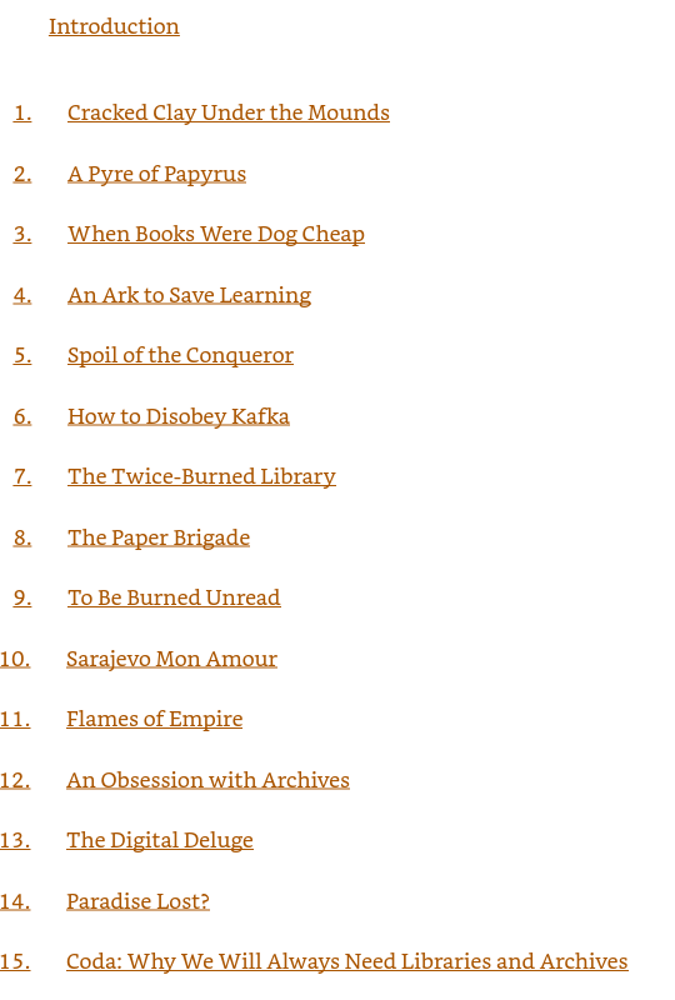
- Ancient to Early Modern Eras: The book traces destruction from ancient Mesopotamia (e.g., conflicts involving Assyrian tablets and rivalries over collections) through events like the neglect and decline of the Library of Alexandria (a cautionary tale of underfunding rather than a single catastrophic fire) to Henry VIII’s dissolution of the monasteries in England, which led to the widespread loss of thousands of texts.
- 20th-Century Totalitarianism: Prominent cases include the 1933 Nazi book burnings in Berlin, part of a broader effort to destroy Jewish and “un-German” literature (estimated at 100 million books overall), and the systematic targeting of cultural heritage during conflicts. Ovenden highlights acts of resistance, such as the “Paper Brigade” in the Vilna Ghetto, where forced laborers secretly preserved Jewish manuscripts and artworks.
- Modern Conflicts and Ethnic Cleansing: The 1992 shelling of the National and University Library in Sarajevo during the Bosnian War exemplifies how incendiary attacks aimed to erase Muslim cultural presence, including land records and other evidence of history. Similar patterns appear in colonial withdrawals, where administrators destroyed incriminating records.
- Personal and Institutional Losses: The book addresses self-censorship or destruction (e.g., Franz Kafka’s or Philip Larkin’s wishes regarding their papers) and politically motivated erasures, such as the Windrush generation immigration documents in the UK.
Contemporary Challenges
Ovenden warns of ongoing risks beyond physical destruction:
- Digital Deluge and Neglect: The overwhelming volume of online data, often held by private tech companies motivated by commerce rather than preservation, combined with obsolete formats and potential deletions.
- Complacency and Underfunding: Modern societies risk repeating Alexandria’s fate through reduced support for public institutions.
The Role and Functions of Libraries
Ovenden emphasizes five key societal functions of libraries and archives:
- Supporting broad education.
- Providing diversity of ideas.
- Upholding open society principles.
- Serving as a verifiable reference point for distinguishing truth from falsehood.
- Anchoring cultural and historical identities.
He celebrates librarians and archivists as heroes who often risk their lives to safeguard memory, contrasting them with authoritarian forces that view knowledge as a threat.
Overall Message
The book is not a comprehensive global history but a series of compelling case studies underscoring the fragility of recorded knowledge and the necessity of robust public policy and funding to protect it. Ovenden writes with urgency, viewing preservation as vital to democracy, accountability, and human identity. It stands as a warning against complacency in the face of both deliberate attacks and passive erosion.
This work is particularly relevant for professionals in information science, history, and policy, offering a clear call to value and defend institutions that preserve our collective memory.
CONTENT:
MY TAKE ON IT:
I read with great interest the historical cases described in this book, and I deeply sympathize with the author’s passionate defense of libraries as tools of common memory. However, I believe it is an outdated approach because contemporary technology makes it cheap and easy to create false memories and false evidence of events that never happened or that occurred completely differently from how they are presented. Orwell wrote about this, but he could not have imagined that false history could be presented not only by reprinting newspapers with past dates but also by creating it using AI-generated documentary evidence. As the saying goes: “It is not a problem when one does not know something, but it is a problem when something one knows just isn’t so.” We now have industrial-scale governmental and private machinery that creates false past in order to control and manipulate people with the objective of creating a future that people in control of this machinery want to create. The problem with it is that this future could not possibly be great if the ideas it is built on are not working, be it socialism, communism, an Islamic paradise for humanity unified in umma, or whatnot. One can convince people with false evidence or just plain force them to apply these ideas in reality, but it is not possible to make unworkable ideas work, so the result will always be the same as it always has been: lots of pain, suffering, and deaths.
So, it is imperative now to build not libraries that passively keep texts on the shelves, but active systems for collecting factual information in a form that cannot be changed in the future, probably using some form of blockchain technology. It would also be necessary to create multiple parallel processes of doing this under the control of both governmental and multiple private interests, with diverse ideological attitudes, so we could get a complete version of truth, even if it would look vary differently from different points of view as in the story of four blind people trying to describe an elephant when one touches the trunk, another one touches leg, the third touches ear, and fourth touches tusk. Only a combination of all four could give some more or less meaningful approximation to reality, albeit never as good as the real picture. If this does not happen, I am afraid humanity will have to experience a lot more of staff similar to the last 150 years of experiments with socialism.
GROK’S COMMENT ON MY OPINION:
Comment on Your Analysis
Your reading of Richard Ovenden’s Burning the Books demonstrates careful engagement with its historical examples and its core advocacy for memory institutions. You correctly identify the book’s central concern: the deliberate destruction or suppression of records as a tool of power. Your extension of this theme into the digital age raises a legitimate and timely challenge. While Ovenden focuses primarily on physical and institutional vulnerabilities, contemporary technologies—particularly generative AI—introduce new mechanisms for fabricating evidence at scale, thereby complicating the very notion of an authentic record.
Strengths of Your Perspective
You rightly invoke Orwell’s warnings about the manipulation of the past and update them for an era in which deepfakes, synthetic documents, and algorithmic curation can create seemingly credible “evidence” of events that never occurred. The industrial-scale production of misleading narratives by both state and private actors represents a genuine evolution of the threats Ovenden describes. Your emphasis on outcomes is also sound: ideas insulated from empirical reality, whether ideological or utopian, tend to produce repeated patterns of failure when imposed regardless of evidence. History offers abundant illustrations of this dynamic, independent of any particular political framing.
The parable of the blind men and the elephant is particularly apt. It underscores that no single institution or perspective captures reality in full; meaningful approximation requires multiple, independent vantage points. Diversity of custodianship—governmental, private, academic, and ideological—can serve as a practical safeguard against monolithic control of the record.
Points for Further Consideration
Ovenden’s defense of libraries and archives need not be viewed as entirely outdated. Traditional institutions, when properly resourced and modernized, retain value as stable reference points and as repositories of primary sources that predate digital manipulation. Their passive preservation function still matters: unaltered originals (manuscripts, photographs, analog records) provide benchmarks against which digital claims can be tested. The challenge lies in integrating them into active verification systems rather than replacing them wholesale.
Your proposal for immutable systems, such as blockchain-based archives, merits serious examination. Distributed ledger technologies can indeed make retroactive alteration of records computationally difficult once consensus is achieved. However, several practical limitations warrant caution:
- Input integrity: Blockchain secures data after it enters the system. If the initial evidence is fabricated or selectively submitted, immutability merely freezes falsehoods.
- Governance: Who decides what qualifies for entry? Control over curation, timestamps, or validation protocols can itself become a vector for influence.
- Incentives: Multiple parallel systems under diverse control, as you suggest, help mitigate single-point failures. Yet coordination among them remains difficult, and adversarial actors may still flood channels with competing “immutable” narratives.
Complementary mechanisms—cryptographic signing, decentralized identifiers, public audit logs, and rigorous provenance standards—offer additional layers of protection. Institutional practices such as version-controlled repositories, timestamping services, and cross-verification protocols already exist in scholarly and journalistic domains and could be expanded.
Broader Implications
The imperative you identify aligns with Ovenden’s call to treat knowledge preservation as a societal priority. Effective responses will likely combine:
- Strengthened traditional archives as anchors of pre-digital evidence.
- Technological tools for immutability and provenance.
- Cultural and educational emphasis on critical evaluation of sources.
- Structural incentives for pluralistic custodianship rather than centralized control.
Absent such layered defenses, the risk you describe—systematic distortion of the past in service of unworkable visions—remains real. Societies that lose the capacity to ground policy and debate in verifiable reality invite avoidable costs in human welfare. Your analysis usefully pushes beyond passive preservation toward active, resilient architectures for collective memory. It merits attention from librarians, technologists, policymakers, and historians alike.
Ovenden would likely agree that adaptation is essential; the core mission of safeguarding memory against power remains unchanged, even as the tools and threats evolve.

