
Home » Posts tagged 'africa'
Tag Archives: africa
20241222 – Theory of Irregular War

MAIN IDEA:
This book is about a specific way of conducting a war, and here is how the author defines the general meaning of war:” Whether those ways are conventional/unconventional, regular/irregular, symmetric/asymmetric, overt/covert, Napoleonic/Fabian, or any other diametric word pairing is irrelevant at the level of analysis dealing with war itself. War is a sovereign weapon expressed through organized violence between parties clashing over incommensurable policies.”. The author defines the objective of the book this way:” This book will accomplish two things: I will show that existing theoretical frameworks are insufficient to understand and explain irregular wars and I will present a novel theory that can. To do so, let us begin with a technical definition of irregular war. Irregular war is the apotheosis of conflict between the people and the state, a violent dialectic between a faction and a sovereign expressed outside existing political institutions.
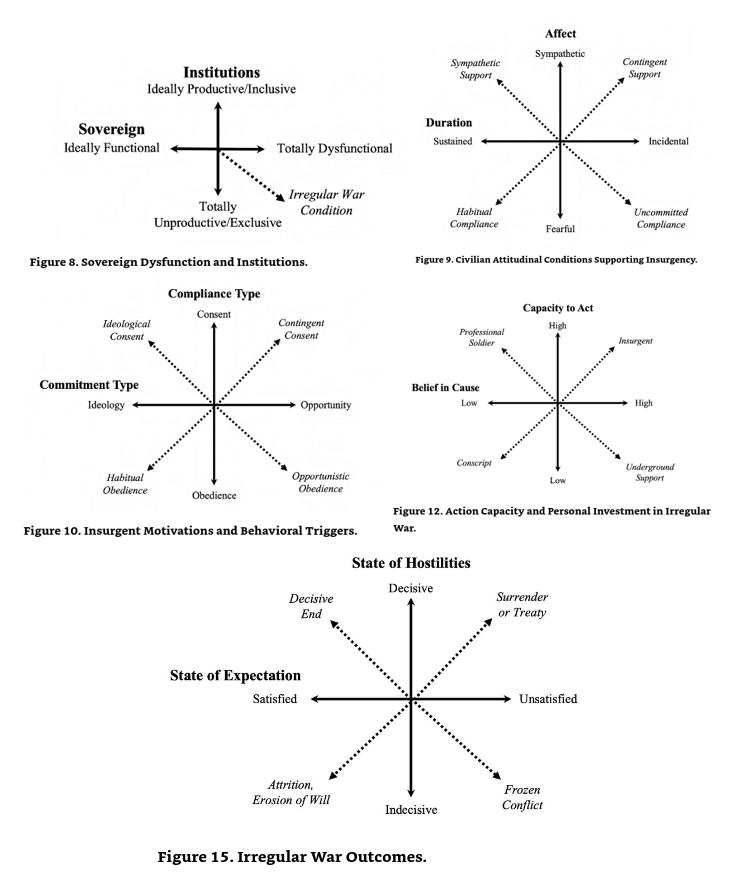
The author nicely summarizes his theory in a few graphic representations:

MY TAKE ON IT:
The author based the discussion of this book mainly on examples of colonial wars, such as the French in Algiers, or wars of external support for unpopular regimes, such as the American war in Vietnam. I think the author underestimates the role of external support for the irregular side of the war. There would be no serious resistance in Algiers or Vietnam without Soviet and Chinese support, which provided resources and save heavens for regrouping, rest, and resupply. When such support was weak or nonexistent, as was the case for Ukrainian and Baltic states’ resistance against the Soviet Union, the colonial power always won, even if it took a few years. The problem was that the Western powers tended to overcomplicate situations and overly rely on pseudo-expert opinion (pseudo because these “experts” often did not even know the local languages). Most importantly, they typically defined unrealistic objectives and tried to fit reality into the rigid framework, either turning Algier into France despite the huge cultural gap between populations or winning the hearts and minds of Muslim tribesmen in Afghanistan for American-style democracy. The realistic objective would be to eradicate whoever supports hostile, terroristic actions as quickly as possible and get out. If, after that, terrorist activities resume, come back, repeat, and get out. After a few repetitions, the normal evolutionary process would work out, leaving in place peaceful survivors who hate the very idea of terrorism and its inevitable consequences. There should be no attempts to impose on people values that are not acceptable to them, such as Western civilizational values of individual freedom and democracy.
20240421 – Coup dÉtat
MAIN IDEA:
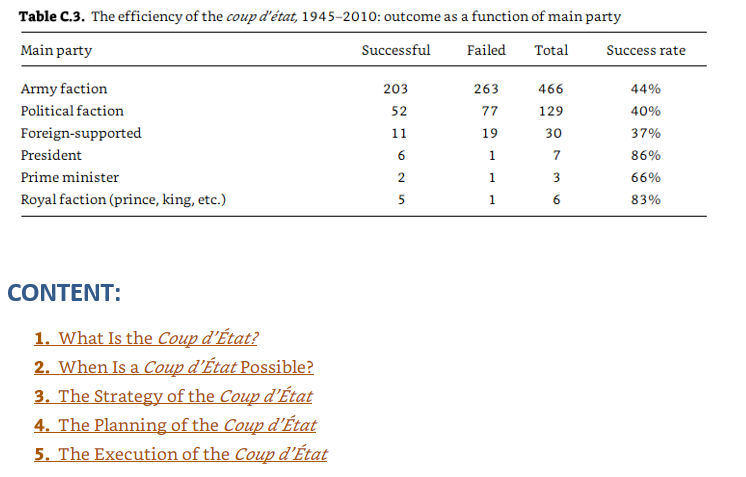
This is a very detailed manual on how to conduct a coup. It describes everything required to conduct a successful coup, from the political conditions of society that make a coup possible to the psychological preparation of participants and even tactical recommendations on force allocation and the sequence of objectives. It also provides very good statistical data about this form of political activity. Here is the table describing the overall results over the last historical period:
MY TAKE ON IT:
This book was first published in 1968 when coups were quite
common and in a very old-fashioned way: as military action. The author
correctly identifies preconditions for the coup:” The social and economic
conditions of the target country must be such as to confine political
participation to a small fraction of the population.” It seems to me that such
preconditions have become increasingly improbable because of widespread social
media and the availability of multichannel communications with high levels of redundancy.
There has also been a massive change in the requirements for legitimacy, which
now often includes at least some form of popular vote, whether real or
falsified. In short, the change of people in power is becoming much more dependent
on the manipulation of the political opinions of the population than on the
support of a small group of military men in the capital of a country. A
contemporary coup requires the ability to organize mass demonstrations in its
support, which then transferred into taking political power away from previous
rulers via some emergency election, however faked, rather than just getting a
small military detachment to arrest these previous rulers. With the world being
currently in turmoil unseen since the wave of dissolution of the communist
system in Europe, we’ll probably have the opportunity to see how the new,
qualitatively different generation of coups happens in the near future.
 Equal Rights Libertarian