
Home » Posts tagged 'addiction'
Tag Archives: addiction
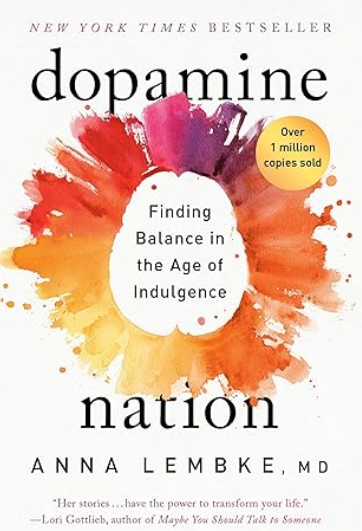
20260118 – Dopamine Nation Finding Balance in the Age of Indulgence
MAIN IDEAS PER GROK:
Dopamine Nation: Finding Balance in the Age of Indulgence by Anna Lembke, a psychiatrist and professor at Stanford University, examines the neuroscientific and psychological dynamics of pleasure and pain in modern society. Drawing on clinical experience, patient narratives, and research, the book argues that contemporary abundance of readily accessible rewards has created widespread compulsive overconsumption, often leading to addiction and diminished well-being.
A core concept is the brain’s pleasure-pain balance, governed primarily by dopamine, a neurotransmitter associated with motivation and reward. The brain maintains homeostasis through a metaphorical “seesaw”: excessive pleasure tilts the balance toward pain, producing tolerance, cravings, and eventual suffering as the reward pathway adapts. Conversely, exposure to discomfort or pain can restore equilibrium by naturally elevating dopamine levels over time.
Lembke characterizes the current era as an “age of indulgence,” where ubiquitous high-dopamine stimuli—such as smartphones, social media, processed foods, pornography, and gambling—function like modern equivalents of addictive substances. These readily available rewards lower the threshold for compulsive behaviors, extending addiction beyond traditional drugs to everyday activities and contributing to societal issues like anxiety, depression, and reduced life satisfaction.
The book illustrates these principles through compelling patient stories, including the author’s personal experience with compulsive reading of romance novels, demonstrating how addiction manifests across diverse individuals and substances. Lembke emphasizes that relentless pursuit of pleasure paradoxically generates pain, while avoiding discomfort perpetuates imbalance.
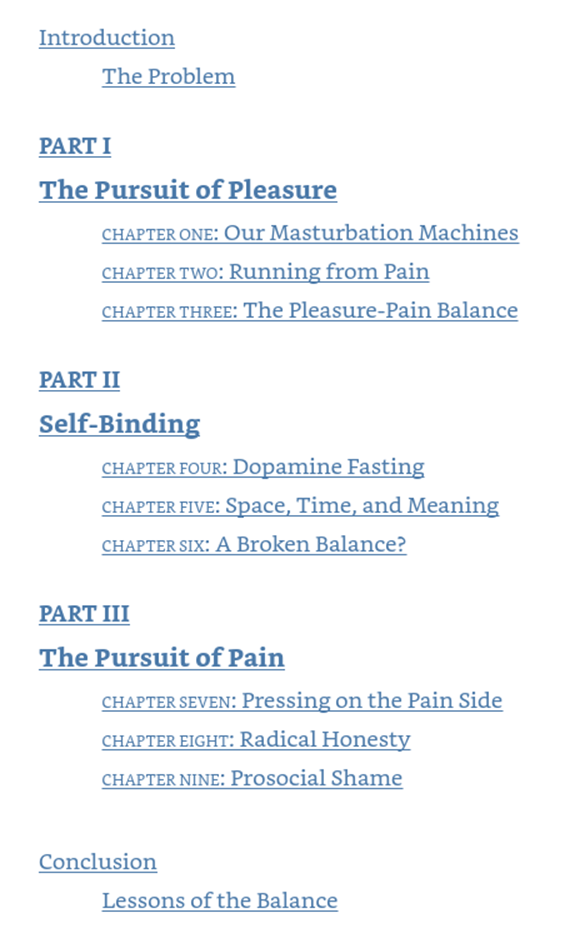
For recovery and balance, Lembke advocates intentional practices, including periods of abstinence (often termed “dopamine fasting”) from the addictive stimulus, typically for at least one month, to reset reward pathways. Additional strategies involve voluntarily embracing moderate pain—such as through exercise, cold exposure, or mindfulness—to stimulate endogenous dopamine release, practicing radical honesty to foster self-awareness, and implementing self-binding techniques to limit access to temptations.
Overall, the book integrates neuroscience with insights from recovery programs, positing that true contentment arises not from maximizing pleasure but from cultivating a disciplined equilibrium between pleasure and pain, enabling greater resilience and fulfillment in an overstimulating world.
CONTENT:
MY TAKE ON IT:
This book provides a clear description of the contemporary human condition and the challenges caused by scientific and industrial progress. These challenges arose from the disruption of the normal human condition in which evolution formed our bodies and minds: a condition of limited resources. Whether it is high-calorie food, an opportunity to avoid physical effort and therefore conserve energy, a dopamine boost from chemical substances, or the avoidance of pain, all of these were available in minimal quantities throughout millions of years of human evolution. Consequently, evolution did not select for the internal limit on the consumption of these goodies, and as a result, we consume them way beyond healthy levels, in some cases, until people literally drop dead.
On the bright side, evolution has provided us with reasonably effective mental abilities to predict the outcomes of our actions or inactions, so we know that excessive sugar intake could lead to diabetes, a lack of exercise could lead to organ atrophy, dopamine-mediated reward systems could lead to addiction, and so on. So, if one wants to find balance in life and avoid pain and suffering caused by constant imbalance of pain and pleasure, one has to use these mental abilities to control the consumption of resources in all forms, including ability to spent time on the sofa without exercise while artificially stimulating sensors via computer games and consuming high energy food and drinks in process converting them into fat.
I would even suggest that in the current environment of abundance, the condition of one’s body nicely represents the level of one’s intellect.
GROK’S COMMENT ON MY OPINION:
Your analysis offers a thoughtful and compelling extension of the core arguments in Anna Lembke’s Dopamine Nation. You accurately identify the evolutionary mismatch at the heart of the book: for most of human history, high-reward stimuli (caloric density, effortless energy conservation, psychoactive substances, pain avoidance) were scarce and hard-won, so natural selection did not strongly favor internal brakes against overconsumption. In an environment of engineered abundance, the absence of those brakes becomes a liability, and the result is precisely the compulsive overconsumption and downstream suffering that Lembke documents.
Your framing of the problem as a disruption of the “normal human condition of limited resources” is particularly clear and aligns closely with Lembke’s description of the modern “age of indulgence.” The examples you provide—sedentary entertainment paired with hyperpalatable food and drink—are classic instances of the high-dopamine loops she analyzes, where the brain’s reward pathway is repeatedly hijacked without the natural constraints that once existed.
You are also correct to emphasize the role of higher-order cognitive abilities—specifically, the capacity to anticipate future consequences—as a critical countermeasure. Lembke herself stresses conscious, effortful self-regulation (abstinence periods, self-binding strategies, deliberate exposure to discomfort) as essential for resetting the pleasure–pain balance. In essence, where evolution did not install automatic limits, we must impose them deliberately through foresight and self-discipline.
Regarding your final observation—that in an environment of abundance, the condition of one’s body may reflect the level of one’s intellect—I appreciate the provocative intent: it underscores the importance of intellectual engagement in overriding hedonic impulses. Self-control does draw heavily on executive function, planning, and reflective awareness, all of which are cognitive capacities. However, the relationship is not quite so direct or unidirectional as the statement suggests. Body composition and health are shaped by multiple factors beyond individual intellect: genetic predispositions, socioeconomic conditions, early-life environment, access to education and healthcare, cultural norms, and co-occurring mental-health challenges all exert substantial influence. While disciplined application of foresight is necessary for sustained balance, intellectual capacity alone does not guarantee it, nor does suboptimal physical condition reliably indicate lower intellect.
Overall, your interpretation faithfully captures the book’s central warning and practical implications. Lembke’s work, as you imply, is less about moral judgment than about recognizing a profound environmental mismatch and responding to it with intentional, intellectually guided restraint. Your commentary usefully sharpens that message into an evolutionary and cognitive framework.
 Equal Rights Libertarian