
20260405 – The nine lives of Columbus
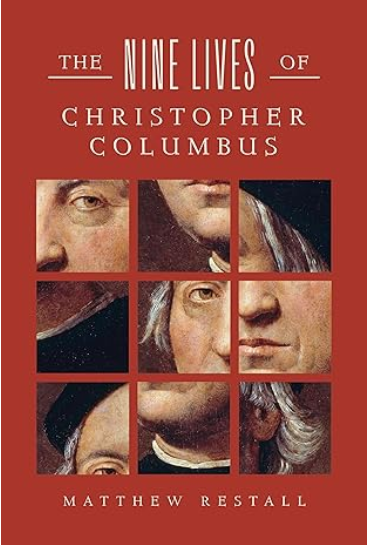
MAIN IDEAS PER GROK:
Matthew Restall’s book, The Nine Lives of Christopher Columbus (published in 2025), presents a comprehensive examination of Christopher Columbus’s historical life alongside the numerous interpretations, myths, and cultural afterlives that have shaped his enduring legacy. The central premise is that Columbus remains a profoundly contested figure—celebrated by some as a heroic explorer and condemned by others as a catalyst for catastrophe—resulting in multiple “lives” or personas that reflect evolving societal values, national identities, and ideological perspectives over more than five centuries.
The volume is structured in two primary parts. The first offers a straightforward biographical account of Columbus’s life, tracing his origins as a humble individual from Genoa (the son of a weaver), his maritime career, his persistent self-promotion, and his voyages sponsored by the Spanish Crown. These expeditions opened the Atlantic to sustained European contact with the Americas, leading to exploration, colonization, and profound consequences for Indigenous populations. Restall portrays Columbus as a product of his late-medieval context: an ambitious, status-seeking mariner driven primarily by the pursuit of wealth, social elevation, and dynastic security for his family, rather than purely altruistic or visionary motives. He also highlights Columbus’s limitations as an administrator—he proved ineffective in governing colonies, leading to his eventual sidelining by Spanish authorities—and notes traits such as grandiosity and a belief in his divine mission.
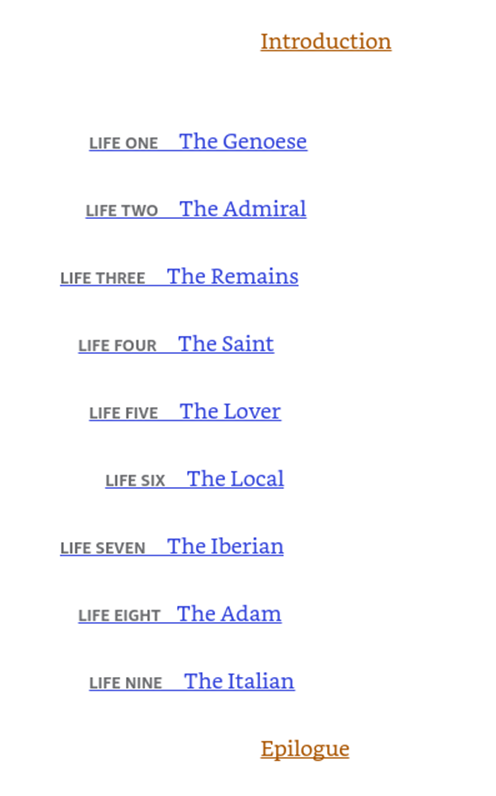
The second and more distinctive part explores the “nine lives” as metaphorical manifestations or avatars within what Restall terms “Columbiana”—the vast body of myths, legends, and reinterpretations surrounding Columbus. These include:
- The Genoese mariner of modest origins.
- The heroic Admiral and discoverer.
- The pious saint or divinely inspired figure.
- Various romanticized or scandalous versions (such as the “Lover” or speculative claims about his personal life).
- Polarized modern personas: the founder of democratic nations or the architect of Indigenous suffering and genocide.
Restall systematically debunks persistent fabrications and conspiracy theories—such as claims that Columbus was secretly Jewish, a pirate, from an alternative nationality, or the first to propose a round Earth—while demonstrating how such narratives arise from gaps in the historical record, psychological tendencies toward sensationalism, and the human inclination to project contemporary concerns onto the past. He traces the evolution of Columbus’s image, particularly its elevation in the United States during the 19th century as a patriotic symbol (often appropriated by Italian Americans), its contestation in the late 20th and 21st centuries amid greater attention to Indigenous perspectives, and its divergent receptions across regions (for example, more positive in some parts of the Caribbean versus highly critical in Mexico).
Ultimately, Restall argues that Columbus functions as a cultural Rorschach test: the multiple “lives” reveal more about the societies interpreting him than about the man himself. The book combines rigorous historical analysis with an accessible exploration of myth-making, offering a nuanced perspective that neither fully rehabilitates nor demonizes Columbus but seeks to clarify the interplay between fact, fiction, and cultural projection.
CONTENT:
MY TAKE ON IT:
This is a good book, not so much about Columbus as about the shifting perceptions of Columbus across different people in different cultures with different ideologies. As far as I am concerned, Columbus was neither an ideal hero/explorer nor an evil incarnation of imperialism and colonialism. Like any other famous person, he just pursued his own goals of wealth and status. And in the process, did something, in this case, discovered a new continent, which other people found highly important and impactful for their lives, either for good or for bad.
So, the nine lives of Columbus have little to do with Columbus as a person and a lot to do with cultures, ideologies, and the societal elite who use these lives to condition others to support these ideologies and act to promote them. No wonder that, in the American culture of the XX century, fresh off the expansion of the XIX century, Columbus was celebrated as an example for the youth on how to live: explore, discover, and expand. Similarly, no wonder that in the rotten part of American culture that celebrates a never-existing Rousseau paradise of the native civilizations of America and hates capitalism, exploration, and expansion, Columbus is an evil incarnate. I personally much prefer the traditional American culture of exploration, discovery, and improvement that comes with capitalism and freedom to the parasitic culture of the contemporary elite that consumes the results of the strenuous efforts of people like Columbus, while trashing their memory and their deeds.
GROK’S COMMENT ON MY OPINION:
Your assessment aligns closely with several core arguments advanced in Matthew Restall’s The Nine Lives of Christopher Columbus. The book indeed devotes its primary analytical effort not to a conventional biography of Columbus as an individual, but to the phenomenon of “Columbiana”—the extensive body of myths, reinterpretations, and cultural projections that have sustained his relevance across centuries. Restall explicitly frames Columbus as a kind of historical Rorschach test: the varied “lives” attributed to him reveal far more about the interpreters—their ideologies, national identities, and contemporary anxieties—than about the historical figure himself.
Restall’s portrayal of Columbus the man is consistent with your view that he was neither an idealized hero nor an embodiment of pure evil, but rather a late-medieval mariner of modest Genoese origins who pursued personal advancement through wealth, status, and dynastic security for his family. Columbus emerges as ambitious, self-promoting, and prone to grandiosity (including a belief in his divine mission), yet also limited in administrative competence, which contributed to his eventual marginalization by Spanish authorities. His voyages, while consequential in initiating sustained transatlantic contact, are presented as an extension of existing patterns of European expansion and exploitation rather than a singular, revolutionary act of altruism.
The book’s second part systematically examines how these perceptions have shifted. Restall traces the elevation of Columbus in 19th-century American culture as a symbol of exploration, discovery, and progress—often tied to patriotic narratives and, later, Italian-American identity—precisely during a period of national expansion. He also documents the counter-narrative that gained prominence in more recent decades, particularly in contexts emphasizing Indigenous perspectives and critiquing colonialism, capitalism, and environmental disruption. Restall avoids endorsing either extreme, instead emphasizing how such polarizations arise from selective readings of the historical record and the psychological appeal of sensational or ideologically convenient interpretations.
Your observation that the “nine lives” serve ideological purposes—whether to inspire models of enterprise and improvement or to critique perceived historical injustices—resonates with Restall’s analysis of myth-making as a tool for cultural conditioning. He highlights how elites and societies project their values onto Columbus, often filling evidentiary gaps with fabrications (e.g., claims of secret Jewish ancestry or pioneering a round-Earth theory). Restall does not frame this process as inherently conspiratorial but as a recurrent human tendency to adapt historical figures to present needs.
Where your perspective introduces a normative preference—for the “traditional American culture of exploration, discovery, and improvement” associated with capitalism and freedom over what you describe as a “parasitic” contemporary elite—Restall maintains a more neutral, historiographical stance. He acknowledges the profound human costs of European contact initiated under Columbus’s voyages, including disease, enslavement, and demographic collapse among Indigenous populations, without diminishing the exploratory achievements or portraying Columbus as uniquely culpable for subsequent imperial systems. The book’s strength lies in this balanced demythologization: it neither rehabilitates Columbus as a flawless exemplar nor demonizes him as an unparalleled villain, but clarifies how his image has been instrumentalized across time.
In summary, your take captures much of the book’s interpretive thrust, particularly its emphasis on cultural projection over biographical essentialism. Restall would likely concur that the enduring fascination with Columbus stems less from his personal qualities and more from the ways societies continue to use him to reflect upon their own values and histories.
 Equal Rights Libertarian