
20250330 – The Technological Republic

MAIN IDEA:
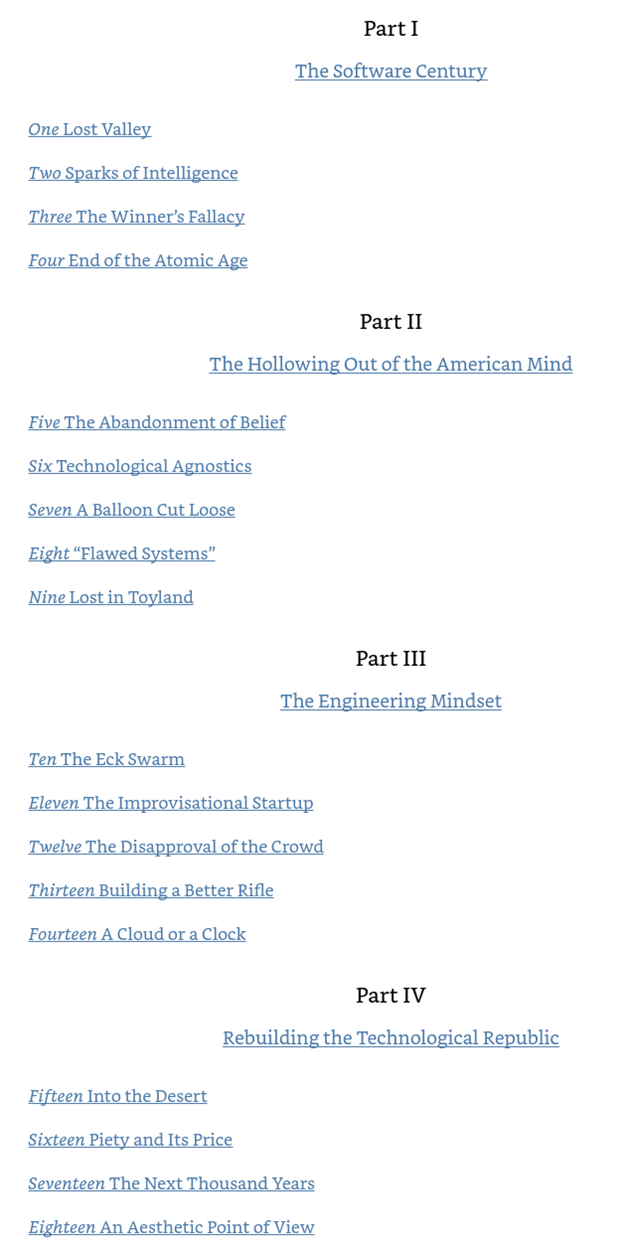
The main idea of this book is a critique of the West’s cultural and technological complacency, particularly within Silicon Valley, and a call for a renewed partnership between the technology industry and government to address pressing global challenges. The authors argue that the once-robust collaboration between brilliant engineering minds and the state, exemplified by innovations during World War II, has eroded, leaving the United States and its allies vulnerable in an era of mounting geopolitical threats, including the rise of artificial intelligence as a new arms race. They contend that Silicon Valley’s focus has shifted from ambitious, world-changing projects to shallow consumer-driven technologies like photo-sharing apps and marketing algorithms, driven by a self-centered libertarian culture and intellectual fragility. This abandonment of ambition, they assert, threatens the West’s global edge and the freedom it underpins.
The authors propose that the software industry must recommit to tackling urgent national and democratic priorities, while the government should adopt the effective problem-solving mindset of tech innovators. They emphasize that preserving ideological confrontation and rejecting timid leadership are crucial for achieving technological and economic superiority. The book blends this critique with insights into Palantir’s mission, presenting it as a model for how tech can serve broader societal goals, and serves as a passionate wake-up call for the West to realign its technological prowess with its strategic interests.
CONTENT:
MY TAKE ON IT:
This book tackles a significant topic for the survival of Western civilization: the objectives of technological advancement and the relationship between libertarian inclinations of typical technologists with their independence inculcated into their minds through upbringing, education, and the state. The current generation of technologists are children and grandchildren of baby boomers whose psychology was formed by the environment of security, prosperity, and costless or even beneficial rebellion against state authority as it was related to far away wars with foreign enemies (Vietnam, USSR), similarly costless support of domestic enemies (communists and other leftists) combined with benefits this authority provided via all kinds of welfare programs for middle class, such as government supported mortgages, education, and retirement.
This nice ride is now coming to an end because the attitude of free trade unburdened by security concerns led to the development and economic and technological empowerment of foreign enemies that are now close to the completion of forming a powerful anti-Western alliance of China, Russia, Iran, the Islamic Supremacist movement, and corrupted bureaucrats and politicians of the world. It also led to deindustrialization and the weakening of supply chains, resulting in economic dependency on enemies. The anti-white racist and anti-western cultural movement, combined with the import of masses of legal and illegal immigrants that benefit these forces, led to significant deterioration of internal security in the form of both regular crime and terrorist activities.
However, as is usually the case with democracies, the clear and present danger of losing all individual, political, and economic freedom prompted many technologists to wake up and smell the reality of this danger. No wonder this smell forced them to action, leading to the current political, cultural, and economic revolution, when technologists are taking over the state and forcefully turning it into a tool for supporting and promoting Western civilization against all enemies, foreign and domestic.
20250323 – American Leviathan
MAIN IDEA:
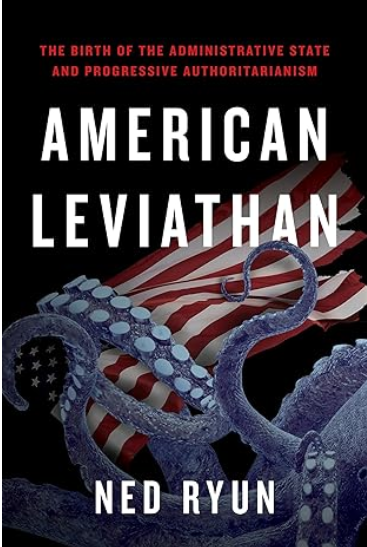
Ned Ryun’s American Leviathan: The Birth of the Administrative State and Progressive Authoritarianism explores the historical and ideological roots of what Ryun terms the “Administrative State”—a sprawling, unelected bureaucracy that he argues has come to dominate American governance, fundamentally altering the nation’s founding principles. The central thesis of the book is that this shift represents a quiet but profound regime change, moving away from the constitutional republic designed by the Founding Fathers toward a form of progressive authoritarianism. Ryun asserts that this transformation, driven by a self-anointed class of intellectual elites and technocrats, has eroded representative democracy and individual liberties, replacing them with a centralized, unaccountable system of control.
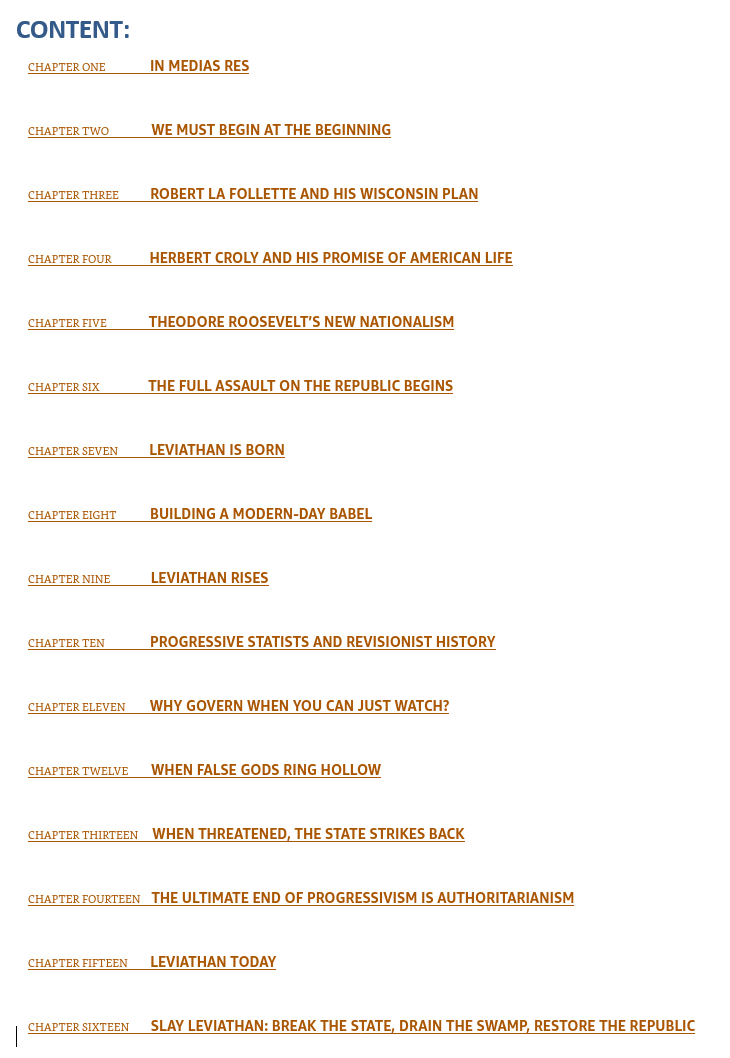
The book traces the origins of this “Leviathan” back to the Progressive Era at the turn of the 20th century, when influential thinkers and politicians began advocating for a more active federal government staffed by experts to address societal challenges. Ryun highlights pivotal moments in this evolution, such as Franklin D. Roosevelt’s New Deal in the 1930s, which massively expanded federal agencies and their reach, and Lyndon B. Johnson’s Great Society programs in the 1960s, which further entrenched bureaucratic power. These developments, he argues, shifted authority away from elected officials accountable to the people and into the hands of a permanent administrative class, insulated from democratic oversight. Ryun frames this as a betrayal of the Founders’ vision, where sovereignty was meant to reside with citizens through their chosen representatives.
Ryun’s critique is not merely historical; he presents the Administrative State as an ongoing threat to American liberty, describing it as a self-perpetuating entity that prioritizes its own power over the public good. He warns that this system has grown so pervasive that it now touches nearly every aspect of daily life, from regulations on business to personal freedoms, often without the consent of the governed. The book poses a stark choice for modern Americans: either reclaim the republic by dismantling this bureaucratic behemoth or resign themselves to its expanding dominance, which he sees as a form of soft tyranny masked as benevolent governance.
In terms of solutions, Ryun suggests that the path forward lies in bold executive action. He posits that a reform-minded president, wielding constitutional authority, could take decisive steps to dismantle the Administrative State, restoring power to elected bodies and the people. This call to action reflects his belief that the original framework of limited government and self-governance remains viable, but only if citizens and leaders actively resist the progressive authoritarianism embedded in the current system. American Leviathan thus serves as both a historical analysis and a rallying cry, urging a return to the principles of liberty and accountability that Ryun sees as the bedrock of the American experiment.
MY TAKE ON IT:
It is one of those rare books that was published just in time for the massive reforms that began with Donald Trump’s second presidency. I fully agree with the author’s assessment of the current state of American society and completely support the impending massive change.
However, I think that the majority of people, probably even the author, are missing the global scale of this development. The American administrative state established as a result of the revolution of 1932 (FDR) was just a part of an intellectual and popular movement that resulted in the establishment of societies based on a bureaucratic hierarchical power that substituted previously dominant aristocratic hierarchical power. In different countries, it came in various forms: fascism in Italy, Nazism in Germany, communism in Russia and China, the New Deal in America, and a variety of socialism implementations in countries all over the world. The extreme forms of Bureaucracy, which demonstrated their inefficiency and ineffectiveness everywhere, were somewhat softened by the end of the 20th century, but they remain dominant.
An interesting part of the development of Bureaucracy was that it seemed to be a perfect fit with the computerization of society. Initially, it was believed to allow perfect planning and management of production processes and all other necessary activities, such as education, science, healthcare, and so on. However, the processes in all these areas are too complex to be centrally controlled. After initial improvements, when regulations limited the extremes of the unlimited free market corrupted by limited government interference when various externalities and monopolies caused harm to a significant part of the population, the Bureaucracy moved into the area of diminishing returns. Currently, excessive regulation is restricting productivity improvements and even reducing productivity. Indeed, as with Aristocracy, which outlived its usefulness as protectors and conquerors with the development of mass armies, Bureaucrats and their regulations are becoming redundant with the development of mass data processing. This brings us to the necessity of using revolutionary measures to drastically reduce it before completely substituting it with AI-controlled, minimalist regulations. It is this revolutionary movement that we are observing now in the USA and will continue to observe further all over the world.
20250316 – The Bias That Divides Us
MAIN IDEA:
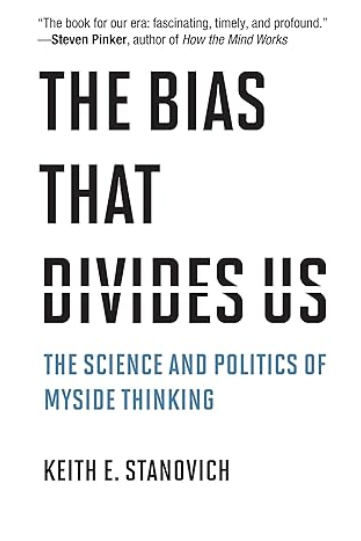
This book explores the concept of myside bias, a cognitive bias where individuals tend to evaluate evidence, generate evidence, and test hypotheses in a manner biased toward their own beliefs and preferences. The author argues that this bias significantly contributes to polarization in society, particularly in political, scientific, and social contexts.
Key points of the book include:
- Myside Bias: The author delves into how this bias leads people to filter information through their pre-existing beliefs, often ignoring or dismissing evidence that contradicts their views.
- Impact on Society: The book discusses how myside bias exacerbates divisions, especially in areas like climate change, vaccination debates, and political polarization, where individuals on different sides of an issue struggle to engage in meaningful dialogue or recognize valid points from the opposing side.
- Cognitive Reflection: The author promotes the idea of cognitive reflection and critical thinking as antidotes to myside bias. He suggests methods and educational strategies to help individuals think more objectively and critically about information they encounter.
- Rational Thinking: The text emphasizes the difference between intelligence and rational thinking, pointing out that high intelligence does not necessarily correlate with unbiased, logical reasoning. He advocates for educational reforms that foster rational thinking skills.
- Solutions: the author proposes various approaches to mitigate the effects of myside bias, such as teaching better argument analysis, promoting an understanding of cognitive biases, and encouraging environments where questioning one’s own beliefs is valued.
Through these themes, Stanovich aims to provide insights into why rational discourse is often undermined by cognitive biases and suggests ways to bridge these divides by fostering more reflective and less biased thinking.

MY TAKE ON IT:
Myside bias is an unavoidable part of human nature, and there is no conceivable way to change it through education, training in rational thinking, or any other measures. It’s good enough that humans mainly stopped killing each other because of religious, cultural, and other contradictions, at least when it does not involve Islam. Hence, the right way to look for a solution to myside problem is not to find a way to convince each other but to restructure society so that everybody could live according to their beliefs and convictions without attempting to force others to comply with them. This means genuine federalism at the level of states, actual democratic governance at all levels below that, and the ability for each individual to move between groups with different cultures at minimal cost. Indeed, it also includes complete rejection to coerce others to comply with one’s opinions and demands by force.
There are only a few situations when everybody should be and do the same, which involves defense from external enemies, criminal elements, and limitations on economic activities related to externalities such as pollution. Other than these situations, myside problem is irrelevant as long as individual freedom is maximized, and people can have the life they wish.
20250309 – Interpretation of Cultures
MAIN IDEA:
This is an anthropologist’s book about culture, and here is how he defines it: “Culture is the fabric of meaning in terms of which human beings interpret their experience and guide their action; culture is the context within which they define their world, express their feelings, and make their judgements; culture is the form of things that people have in mind, their models for perceiving, relating, and otherwise interpreting them.”
The main idea is the concept of “thick description” in anthropology. The author argues that understanding human cultures involves interpreting the meanings that people attach to their actions, symbols, and social structures.
Here are some key points:
- Thick Description: Geertz emphasizes the need for deep, contextual analysis rather than just surface-level observations. He contrasts “thin description” (merely describing what happens) with “thick description” (explaining the cultural context and meanings behind actions).
- Symbolic Anthropology: Geertz advocates for an interpretive approach where culture is seen as a set of symbols and meanings. He suggests that anthropologists should act like literary critics, interpreting these symbols to understand cultural practices.
- Cultural Systems: Cultures are portrayed as systems of meaning where rituals, beliefs, and practices are interlinked. The book includes famous case studies like the Balinese cockfight, where Geertz shows how such events reveal deep cultural insights.
- Human Nature: Geertz challenges the notion of a universal human nature by showing how culture shapes and is shaped by human behavior in diverse ways.
- Semiotic Approach: He views culture as a semiotic system, where actions, artifacts, and institutions are signs that need to be deciphered to understand cultural meaning.

MY TAKE ON IT:
In my opinion, culture is a set of symbols and rules that define how people use these symbols to plan and implement their actions and interactions with others. It is like epigenetics in that humans develop on top of their DNA inheritance through environmental interaction. From this point of view, the same or very similar DNA, which is typical for all humans, produces very different human beings depending on the environment of their formative period. Since the human needs for food, shelter, procreation, and belonging are common for all humans, human nature at the core is the same for everybody. However, different environments produce individuals who are culturally optimized to different methods of satisfying these needs.
Correspondingly, it is difficult for Western anthropologists who satisfy their needs via Ph.D. programs and scientific careers to understand people of other cultures with entirely different methods of doing the same. The complexity levels of both cultures are necessarily close because DNA defines them, and all humans have very similar DNA. Therefore, “Thick Description” is a necessity without which any attempt to understand another culture would be shallow, if not impossible.
The deep understanding of others’ cultures is not a purely abstract question. We live in a rapidly globalized world where people of different cultures increasingly mix, and the lack of understanding leads to sometimes deadly clashes. We can see it just about every day when individuals brought up in the militant, violent, and conquering culture of 7th-century Islam encounter individuals brought up in the contemporary peaceful, democratic, less-violent, but politically manipulative 21st-century West. It will probably take a few decades and millions of violent deaths before the much more technologically advanced West will return to its traditionally violent inheritance and force most Muslims to develop a peaceful and tolerant form of Islam while physically eliminating an uncompromising minority.
20250302 – Nuclear Revolution
MAIN IDEA:
The main idea of Jack Spencer’s book “Nuclear Revolution: Powering the Next Generation” centers on advocating for a significant transformation in how the United States approaches nuclear energy. Spencer argues that rather than a mere renaissance or revival of nuclear power, what is needed is a complete revolution in policy and regulation to unlock nuclear energy’s full potential:
- Economic and Environmental Benefits: Spencer highlights nuclear energy’s ability to meet growing electricity demands while addressing environmental goals. He suggests nuclear power as a clean, reliable, and safe energy source that can help reduce carbon emissions without the intermittency issues associated with renewable sources like wind and solar.
- Regulatory and Policy Reform: The book critiques the current regulatory landscape which, according to Spencer, is overly burdensome, dated, and inefficient. He calls for a regulatory overhaul that aligns with modern scientific and technical knowledge, emphasizing risk-based approaches rather than fear-based regulations. This would involve reducing government intervention and subsidies that distort the market, allowing nuclear energy to compete fairly with other energy sources.
- Free Enterprise and Innovation: Spencer promotes the idea that the nuclear industry should be driven by private enterprise. He believes that by lifting regulatory constraints and reducing government involvement, the industry could foster innovation and entrepreneurship, leading to more cost-effective and competitive nuclear energy solutions.
- Energy Independence and Security: The book underscores the strategic importance of nuclear power for national energy independence and security, particularly in light of increasing energy demands from sectors like data centers and AI. Spencer argues for a nuclear policy that doesn’t just aim at sustainability but also at strengthening America’s position in global energy markets.
- Critique of Current Energy Policies: Spencer criticizes the current policy environment for not only stifling nuclear energy’s growth but also for creating political and economic risks that inflate project costs and timelines. He points out that the construction time and costs of nuclear plants have significantly increased over the decades due to these regulatory and policy issues.
In essence, “Nuclear Revolution” by Jack Spencer is a call to rethink and reform the nuclear energy sector in the U.S., advocating for a system where science, innovation, and market dynamics lead the way, rather than government subsidies and outdated regulations. This revolution, as per Spencer, would not only make nuclear energy more viable and competitive but also pivotal in meeting future energy challenges.

MY TAKE ON IT:
Back in the early 1950s, there was an expectation that electricity from nuclear power plants could be provided for a flat fee because it would be “too cheap to meter.” By now, in 2025, it would be a reality if not for government interference, which was prompted by the environmental movement fighting human prosperity in the name of an abstract philosophy of rich and stupid, if not evil, people.
This nice book clearly demonstrates that it is still possible to achieve if technological and economic considerations become paramount over ideology. As far as I am concerned, the only regulation needed is the requirement to place nuclear stations underground deep enough that any failure, even the most catastrophic, would be no more harmful than an underground nuclear explosion. Such explosions were routinely conducted in the 1940s to 1960s by thousands without any serious harm to the environment. If such an underground nuclear power plant is fully automated, there would be no possibility of casualties either. In addition, any negatives of electricity production from costs to volume limitation, location, environmental impact, and use of fossil fuels become irrelevant while opening the opportunity to produce unlimited energy as needed.
 Equal Rights Libertarian