
20250126 – Indispensable Right

MAIN IDEA:
Grok::
The main idea of Jonathan Turley’s book “The Indispensable Right: Free Speech in an Age of Rage” is an exploration of the historical, legal, and political significance of free speech in the United States, emphasizing its role as a fundamental human right. Turley argues that free speech is not only essential for democracy but is at the core of human expression. The book traces the history of free speech from ancient times to contemporary America, highlighting how this right has been consistently challenged, particularly during periods of political and social upheaval.
Turley discusses how free speech has been under threat from various sectors including academia, media, and government, often through the guise of protecting from “harm” or managing “rage rhetoric.” He presents free speech as a right that has been historically contested, mentioning key historical moments like the Sedition Act of 1798 and various free speech battles throughout American history. The book serves as a defense of free speech, arguing against the modern trends towards censorship and the narrowing of public discourse due to political polarization.
He also examines the potential consequences of limiting free speech, drawing parallels with other nations where free speech has been curtailed. Turley advocates for a robust interpretation of the First Amendment, suggesting that free speech must be protected from both government overreach and societal pressures that seek to suppress dissenting or controversial viewpoints. Through this lens, Turley positions free speech as an “indispensable” right that underpins all other liberties and is crucial for human flourishing and societal progress.
CONTENT:

MY TAKE ON IT:
From my point of view, free speech is simultaneously an absolute necessity for individual freedom and a tool often used to deprive individuals of freedom. It is often done by providing false information about some people or organizing hate groups to suppress or even annihilate others. After all, historically, it was used in the democratic Weimar Republic by Nazis and in Russia by Communists to allow the formation of deeply anti-freedom regimes at the beginning of the XX century and the Neo-fascist regime of Putin in the early XXI century. Unlimited free speech in America in our time also caused problems by providing no real protection against falsehood and allowing the development of a deeply anti-freedom Woke movement, which, upon achieving sufficient power, immediately started to suppress the speech of others.
I think the value of free speech is far higher than the harm caused by it, but protection against such harm is necessary. Here is how I would deal with it:
- There should be no restriction on speech, but harmful speech should have consequences. For example, antisemites should be free to demand the annihilation of Jews. However, the moment somebody such as Hamas acted on this demand, starting the war of annihilation, the vocal antisemites should be treated as allies of Hamas, meaning taken as POWs in this war until the end of the war or eliminated if they do not surrender. It should not matter if they are in Harvard, not Gaza. They are Hamas’s propaganda soldiers all the same.
- The falsehood issue could be resolved through a supplemental quasi-judicial system that defines what is factual and what is not. The judgment should be provided not by some self- or government-appointed fact checkers but by a jury of self-appointed jurors who listened to the arguments of both sides: those who believe and those who deny the factual character of a statement in question. These jurors should pass the test provided by each side to ensure that they correctly understand the arguments. At current levels of technology, the number of jurors could be unlimited. The punishment for falsehood should not be prison or a fine, but rather something like forced publishing of correction in the same format and double the amount of space as the original falsehood. For example, if the New York Times 100 times published the front page in the biggest possible font, the lie about Trump being a Russian asset, the remedy could be to publish 200 times in the same font that Trump had never been a Russian asset, with actual text of correction approved by Trump’s representative.
The first remedy would make people think twice about hate speech due to potential consequences, so if someone hates insurance CEOs, he will restrain his urge to call for killing them because some idiot could actually do that. The second remedy would encourage much more careful fact-checking than any potential lawsuits for libel.
20250119 – The Genetic Book of Dead

MAIN IDEA:
The main idea of this book is to explore the concept of genetic archaeology. The key points are:
- DNA is a Historical Record, so one can study its sequences to trace the lineage of species back through time. This includes the functional parts of DNA and “dead” or non-coding DNA, remnants of past evolutionary events.
- Pseudogenes and Fossils: Some DNA sequences that once had a function but have since become inactive can tell us about extinct species or ancient functions that are no longer needed.
- Reconstructing Evolutionary History: These sequences show when certain traits appeared or disappeared, like chapters in the “Book of the Dead,” detailing the story of life.
- The Concept of Universal Ancestry: the author also uses this genetic evidence to support the idea that all living organisms on Earth have a common ancestry. He explores how far back we can trace this lineage, essentially looking at the “deep time” of biological history.
- Educational and Philosophical Insights: In addition to reviewing the scientific aspect, the author discusses the philosophical implications of understanding our genetic heritage, providing a sense of connection to all life forms and a deeper understanding of our place in the natural world.
CONTENT:
MY TAKE ON IT:
DNA is just a code of living objects, either plants or animals, that has evolved over millions of years. As such, it is not that different from the staff that I am very familiar with – computer code consciously developed over the last 80 years. It contains bits and pieces of stuff developed long ago; some are still active and some dormant, but they are still there because cleaning them up is difficult and meaningless. In both cases, it is useful for analyzing the history of development. Still, it is far from complete history because lots of DNA that used to be active just disappeared together with organisms that had it when these organisms were discontinued by evolution. All this creates a great opportunity for curious individuals to model history by using existing DNA and a multitude of data points derived from the history of environmental changes. The results will always remain speculative, but they could provide a very interesting outcome. Since we are getting closer to being capable of modifying DNA, including our DNA, the results of modeling historical development could generate not just a better understanding but also some good ideas of how to rebuild our DNA to help humans in their pursuit of happiness. It would require the massive application of AI, but unlike the current use of human labor that AI will completely substitute in the near future, this application will always remain just supplementary to human activities because only humans can judge their level of happiness, and no AI could do it for them.
20250112 – The Logic of Immunity

MAIN IDEA:
Here is Grok 2’s description:
“The main idea of this book is to demystify the complex workings of the human immune system. The book aims to provide a comprehensive yet accessible explanation of how the immune system functions, detailing the mechanisms of specialized cells and molecules that protect our health. It explores both the innate and adaptive aspects of immunity, explaining how these systems can malfunction and lead to disease. The author blends scientific knowledge with historical anecdotes to not only educate but also to introduce readers to the key scientists who have contributed to our understanding of immunology. The book also delves into strategies for harnessing the immune system’s potential to maintain good health, offering insights based on the latest research. “

MY TAKE ON IT:
From my point of view, the evolutionary developed immune system is by far superior to our contemporary medicine, which, in its most successful implementations, such as vaccination, does not do much more than priming the immune system to handle future encounters with known pathogens effectively. However, the logic of the immune system’s processing points to the direction that would probably be best for development. I think it should be able to decode the DNA of any harmful biological object rapidly and as rapidly produce something similar to T-cells and B-cells specific to both the organism that needs protection and pathogens that have to be eliminated combined with the delivery mechanism to the level of cells. By rapidly, I mean within hours of the problem recognition. The first and very crude attempts with mRNA were not that good. Still, nothing ever worked from the beginning, so with time and sufficient resource allocation, the problem of a universal external AI-based immune system will be resolved. Consequently, the very notion of being sick will move to the history of humanity somewhere next to the notion of being eaten by a sabretooth tiger.
20250105 – Revolutionary Spring: Europe Aflame
MAIN IDEA:
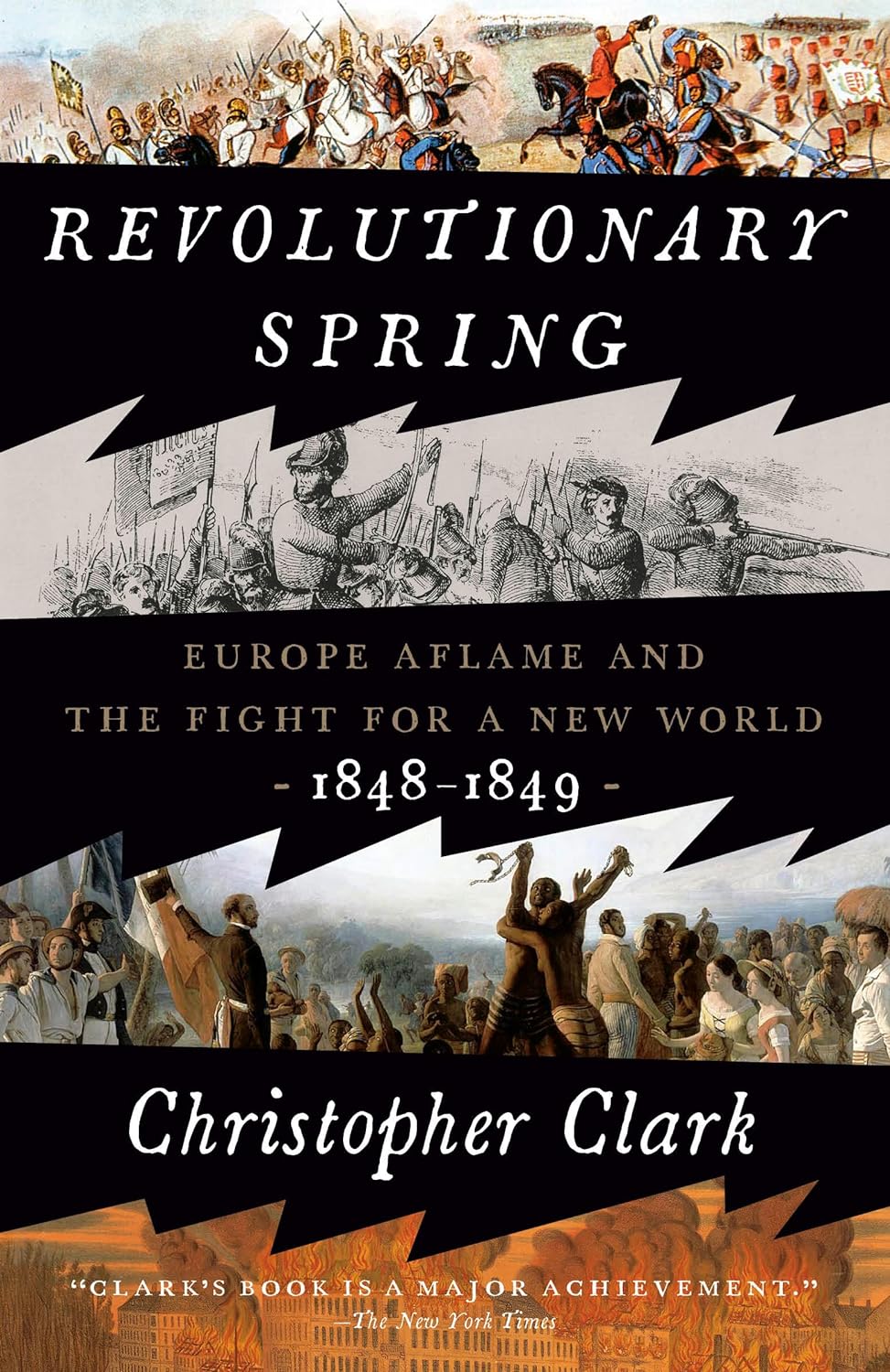
This book describes in great detail the events of the European Revolution of 1848, which, despite failing, nevertheless initiated the dissolution of the World order established after the Napoleonic Wars. Here is the author’s description of the overall sequence of events:
“There were three phases to the events of 1848. In February and March, upheaval spread like a brush fire across the continent, leaping from city to city and starting numerous spot-fires in towns and villages in-between. The Austrian Chancellor, Metternich, fled from Vienna, the Prussian army was withdrawn from Berlin, the kings of Piedmont–Sardinia, Denmark and Naples issued constitutions – it all seemed so easy.”
“Yet the divisions within the upheaval (already latent in the first hours of conflict) soon became glaringly apparent: by May, radical demonstrators were attempting to storm and overthrow the National Assembly created by the February Revolution in Paris, while, in Vienna, Austrian democrats protested at the slowness of liberal reforms and established a Committee of Public Safety. In June, there were violent clashes between the liberal (or in France republican) leaderships and radical crowds on the streets of the larger cities. In Paris, this culminated in the brutality and bloodshed of the ‘June Days’, which killed at least 3,000 insurgents.”
“In September, October and November, counter-revolution unfolded in Berlin, Prague, Vienna and Wallachia. Parliaments were shut down, insurgents were arrested and sentenced, troops returned en masse to the streets of the cities. But, at the same time, a second-phase, radical revolt dominated by democrats and social republicans of various kinds broke out in the central and southern German states (especially Saxony Baden and Württemberg), in western and southern France, and in Rome, where the radicals, after the flight of the Pope on 24 November, eventually declared a Roman Republic. In the south of Germany, this second-wave upheaval was only extinguished in the summer of 1849, when Prussian troops finally captured the fortress of Rastatt in Baden, last stronghold of the radical insurgency. Shortly afterwards in August 1849, French troops crushed the Roman republic and restored the papacy, much to the chagrin of those who had once revered France as the patroness of revolution across the continent. At about the same time, the bitter war over the future of the Kingdom of Hungary was brought to an end, as Austrian and Russian troops occupied the country. By the end of the summer of 1849, the revolutions were largely over.”

MY TAKE ON IT:
Without understanding the revolutions of 1848, it is impossible to understand the events of the following nearly 200 years that featured the development of socialist and communist ideas that practically conquered the world before fully demonstrating their complete inadequacy for rearrangement of society in any workable and humane way. These ideas produced wars, starvation, and misery on a scale unimaginable before, in the process, killing hundreds of millions of people. These ideas came as a reaction to the development of the capitalist industrial economic system, which, while removing limitations on population growth and providing material prosperity, came with lots of inhuman hurdles for a significant part of the population that was moved away from low productivity agricultural system to the bottom of much higher productivity industrial system. It took considerable time before the new arrangement had produced a dynamically adjustable combination of private control over capital, individual and sometimes group control over one’s labor and consumption, and violent interference of the state striving to smooth conflict of interest between different parts of this arrangement.
We are now witnessing the final period of this arrangement, when the implementation of AI systems will result in the automation of all productive activities, making human labor redundant. Over the next 50 to 100 years, a new resource creation and allocation arrangement will have to be developed to provide stability for human existence. Whether this new arrangement will be a freedom-based society that uses technology to provide resources for individuals to pursue their own happiness or it will be a strict hierarchy-based society where psychopaths at the top of the hierarchy pursue their happiness at the expense of the misery of individuals at the bottom remains to be seen.
 Equal Rights Libertarian