
20241124 – How the World Made the West
MAIN IDEA:
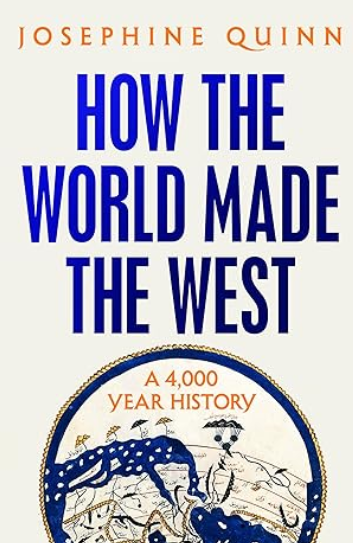
This book represents the approach to history quite different from traditional when the world is divided into civilizations and the contemporary West is based on Greek and Roman civilizations. The author rejects this traditional notion and offers another view of the history defined this way:” There is no privileged connection between ancient Greeks and Romans and the modern “West”: the nation-states of western Europe and their settler colonies overseas. The capital of the Roman empire moved in the mid-first millennium CE to Constantinople, and remained there for over a thousand years. Muslims in the meantime combined Greek learning with science from Persia, India, and central Asia as new technologies streamed around Africa, Arabia, and the Indian Ocean, while sailors on northern seas and riders on the Steppe channeled goods and ideas from China to Ireland. This is the huge world extending from the Pacific to the Atlantic that the rising nations of western Europe inherited in the fifteenth century CE, as they set out into a new one. These millennia of interaction have however largely been forgotten, drowned out by ideas developed in the Victorian period that organized the world into “civilizations,” separate and often mutually opposed. I want to tell a different story: one that doesn’t begin in the Greco-Roman Mediterranean and then re-emerge in Renaissance Italy, but traces the relationships that built what is now called the West from the Bronze Age to the Age of Exploration, as societies met, tangled, and sometimes grew apart. More broadly, I want to make the case that it is connections, not civilizations, that drive historical change”.

MY TAKE ON IT:
I like this approach to history because I also believe that the traditional division of humanity into civilizations distorts the reality in which different parts of humanity constantly interact via war and trade, exchanging their cultural and technological artifacts and everything else conceivable. Sometimes, these are good things, such as wheels or agricultural techniques, while sometimes, these are really bad things, such as communism or smallpox. In either case, the exchange is constant and unstoppable. This book is a pretty good narrative about what we know about what happened before us.
However, I disagree with the author that: “The idea of a European civilization could still be problematic”, even if she admits that:”…notion of “Western Civilization” characterized by democracy and capitalism, freedom and tolerance, progress and science.” I do not see it as problematic because “Western Civilization” is qualitatively different from “Non-Western Civilizations.”
“Western” means resource allocation via widely distributed private property (capitalism). “Non-Western” means resource allocation from the top down, either from one center of power (socialism) or multiple loosely related centers of power(feudalism). “Western” also means individual freedom of expression and actions supported by private property resources with collective action controlled by fairly elected officials. “Non-Western” means suppression of individual freedom of expression and actions with some rigid doctrines violently enforced on people. The consequences of “Western” are wealth and prosperity of people resulting from efficient resource allocation and progress of science and technology due to independent probing of unknown conducted by individuals with the freedom and resources to perform it. “Non-Western” means economic misery resulting from inefficient resource allocation based on the whims of the elite in power and stagnation in science, technology, and arts due to “politically correct” pseudo-science and art combined with the non-competitive development of technology.
We are now in the process of a global clash between this “Western”, represented by individuals supporting its values, which could be openly done only in the USA and its allies and its enemies represented by the Left within “Western” powers together with all these “Non-Western” powers from Islamic supremacists to Russian and Chinese nationalists that control most of humanity at this point. Whether the next couple of generations will live in prosperity or misery depends on the outcome of this struggle.
20241117 – Out of the Darkness The Germans

MAIN IDEA:
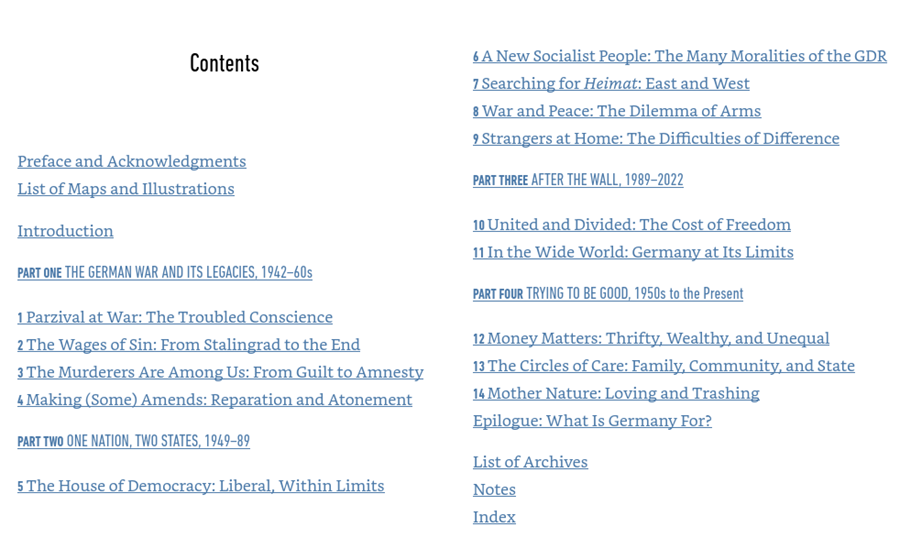
The main idea of this book is not just to provide a very detailed history of Germany from 1942 to 2022 but to concentrate on the moral and psychological remaking of Germany from a nation of Nazis into a nation of seemingly docile environmentalists barely capable of defending themselves from such aggressors as Putin’s Russia. There was a huge moral change in German attitudes toward themselves and their place in the world. In the author’s words:” It is my ambition to unpack and explain its complexity,”
MY TAKE ON IT:
In my view, the author’s approach to history as a morality tale is somewhat interesting but not very relevant to explaining what happened and why. The bottom line is that people are basically looking for two things: to have a good life and feel good about themselves. The difference between Germany in the 1930s and Germany in the 2020s comes from the change in understanding of the world, themselves, and human evolution. This understanding moved from the notion of races fighting for survival and prosperity that could be achieved only at the expense of others and, therefore, requires conquest and subjugating these others to the notion of the world of equals, both genetically and culturally, in which prosperity is achieved via accommodation with others and constant search for win-win settlement. In the framework of the former notion, feeling good about oneself comes from racial superiority over others and being a reliable part of the hierarchically structured nation of supermen. In contrast, in the framework of the latter notion, it comes from the ability to accept others with their habits and cultures as equal and comply with whatever requirements produced by the elite of experts who know better how everybody must live.
The interesting part of this narrative is that it demonstrates that, as with any other paradigms, these notions do not change in the minds and hearts of the same individuals. It takes the change of generations when the new generation is raised with the new notion after the old notion proves its ineffectiveness. In Germany’s case, as a result of defeat at war, the old ideology was severely suppressed. In other words, the old Nazis of 1920 died out in the 1990s, still remaining Nazis, but quietly so, while being unable to raise a new generation of Nazis. It is also interesting how it worked differently in semi-capitalist West Germany and communist East Germany.
Finally, we are watching how the second notion of equality of everything and everybody, with the expert elite deciding everything for everybody, comes to ideological and material bankruptcy, similar to the bankruptcy of the old notion of racial superiority/inferiority. Hopefully, something new and more adequate to the needs of human nature will come out of this ongoing cataclysm.
20241110 – Wicked Problems
MAIN IDEA:
The main idea of this book is to analyze two different types of problems: simple problems that could be fixed, such as problems with clocks, and complex problems, such as understanding cloud behavior or societal issues, that are not easily described or fixed and demonstrate the feasibility of applying tools developed by humanity for fixing simple problems such as engineering to manage the complex ones. Here is the author’s description: “This book is double stranded. One strand follows a forgotten engineer; the other examines forgotten uses for engineering. Together, they weave an engineering vision for civics and a civic vision for engineering. While nonfiction, the book’s aspiration may feel like fiction. Engineers, after all, aren’t commonly invoked as pillars of democracy. Yet as we’ll see, engineering does more than tech support. Engineering is a carrier of history, simultaneously an instrument and the infrastructure of politics. It’s among the oldest cultural processes of know-how, far more ancient than the sciences of know-what. And through engineering, civics can gain a more structured, systemic, and survivable sense of purpose. By applying engineering concepts in a civic context, engineering can usefully grow the policy lexicon and enhance its cultural relevance. The usefulness of civics and engineering is often realized only in their breakdowns, much like trust, most longed for in their absence.”
Probably the most important conclusion the author comes up with is that the engineering of “Civicware” should be conducted cautiously and incrementally because it is way too complex, vague, and wicked character to apply relatively rigid engineering solutions:” Two decades before presenting on clocks and clouds, Karl Popper wrote about “piecemeal” social engineering. He argued for open-ended reforms over utopian blueprints. A piecemeal approach is evolutionary and begins by realizing that facts are fallible and contexts change. Yet, such increments require caution. Piecemeal responses can cancel one another out when not coordinated by an overarching principle or guided by a standard set of concepts. And obviously, you cannot optimize a system by optimizing its parts separately. Because wicked systems cannot be planned from the top down, they require an evolutionary approach to selecting and replicating improvements to civic welfare. The concept set of efficiency, vagueness, vulnerability, safety, maintenance, and resilience can facilitate such conscious cultural evolution.”

MY TAKE ON IT:
Engineering is the application of science to real-life problems. As such, it applies only to situations where a set of actions applied to a defined environment always results in the same or statistically consistent outcome. Consequently, it is very difficult but still conceivable to apply it to complex problems such as global climate control despite its wide variety of variables. However, this is never the case with society because society consists of thinking and self-directing entities- human beings, which brings the complexity level to near infinity because of a multitude of feedback loops, which makes the consistent outcome of any experiment nearly impossible. Consequently, to build such an organization of society that would reliably provide opportunities for human flourishing, one should look not at engineering approaches, whether piecemeal or global, but rather at resource allocation to individual humans so they could do with these resources whatever they wish and limit external, violent intervention only to situations when individuals attempt to use their resources to harm others.
20241103 – The Loom of Time

MAIN IDEA:
The main idea of this book is to examine history in an attempt to identify the causes of society’s development within one or another political framework, be it democracy, totalitarianism, or something else. The author first presents the contemporary Arab world that failed to move to democracy after the Arab Spring despite all the promises. Then, he looks at the recent history of this and the surrounding areas and provides a detailed narrative of events he observed as a high-level journalist covering these areas for most of the second half of the XXth and early XXI centuries. After that the author concludes:” Rather than pine exclusively for democracy in the Greater Middle East, we should desire instead consultative regimes in place of arbitrary ones: that is, regimes that canvass public opinion even if they do not hold elections. Monarchies, including the Gulf sheikhdoms, tend to consult more with various tribes, factions, and interest groups than do secular modernizing regimes, which have too often been arbitrary dictatorships, Ba‘athist or otherwise. In other words, aim for what is possible rather than what is merely just. … Thus, it is the middle path that should be sought. The middle path offers the only hope for a better world. Idealistic raptures in the service of change must be avoided.”
CONTENT:

MY TAKE ON IT:
Whether we want it or not, we live in a globalized, highly technological world in which people with cultural development at the level of the 7th century can obtain the technology of the 21st century. Consequently, instead of stoning neighbors at a distance of 100 meters, they can send ballistic missiles over thousands of miles.
However, societies are not thinking, feeling, and acting entities; only individuals are. Even societies under the control of savages, such as Islamic ayatollahs, have plenty of individuals who are culturally and intellectually at par with anybody else in contemporary civilized societies. Similarly, modern democratic societies produced quite a few savages of Islamist, socialist, or other varieties.
Consequently, to avoid a tragedy in which millions or even billions of people will perish, individuals in control of the civilized world, where contemporary technologies were developed due to individual freedoms and distributed resources, must deny savages access to technology.
The solution should be to find ways to sort people out: savages with limited access to technology on one side of the wall and civilized people on the other. Since individuals tend to change over time, it would be necessary to ensure constant movement of people and exchange of information so that the individuals who become civilized can move to a civilized world. Those who become less civilized due to religious or secular indoctrination move to a savage world.
 Equal Rights Libertarian