
20241027 – Strategy
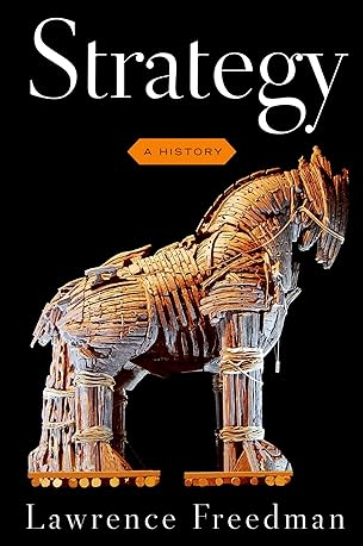
MAIN IDEA:
Here is the author’s definition of the theme and intentions of this book:
“So the realm of strategy is one of bargaining and persuasion as well as threats and pressure, psychological as well as physical effects, and words as well as deeds. This is why strategy is the central political art. It is about getting more out of a situation than the starting balance of power would suggest. It is the art of creating power.”
“This book describes the development of different approaches, from rigorous centralized planning processes at one extreme to the sum of numerous individual decisions at the other. It shows how in these distinct military, political, and business spheres, there has been a degree of convergence around the idea that the best strategic practice may now consist in forming compelling accounts of how to turn a developing situation into a desirable outcome. “
“As a history, this book aims to provide an account of the development of the most prominent themes in strategic theory—as they affect war, politics, and business—without losing sight of the critics and dissidents.”

MY TAKE ON IT:
It is a great and detailed review of the history of strategy in multiple domains, from organized violence in wars and revolutions to political actions directed either at changing society’s organization or maintaining an existing one. I disagree with the definition of strategy as “the art of creating power” because it does not sufficiently differentiate between strategy and tactics. In my opinion, the art of strategy consists of two parts: the first is to identify and articulate realistically achievable objectives with potentially available resources, and the second is to identify methods and processes required to generate and allocate resources over space and time to achieve these objectives reliably. The actual processes of resource generation, allocation, and application are the domain of tactics.
For example, consider a strategy of fighting off 30,000 Persian troops if one has only 300 Spartans. Historically, the chosen strategy was to use a narrow pass of Thermopylae, where only a few fighters could clash at a time. At first glance, such a strategy makes sense because it greatly diminishes the value of quantitative superiority. However, one step further in thinking would lead to understanding that it is not a valid approach because it does not consider the high probability that after a few hours of battle, the skilled but exhausted Spartans will be killed by less skilled but fresh Persian fighters. It also misses that there was a way around this narrow pass, which the Persians actually used. However, if the strategic decision were not to keep a narrow pass but to divide forces and engage in multiple encounters, each of which would guarantee local superiority of forces, Spartans could win after a hundred or so such engagements over some time sufficient for physical recovery after each engagement, providing tactical skills are sufficient to arrange such engagements.
Similar logic would apply to politics, business, or any other area of strategy, whether the fight is within people’s minds or in the marketplace.
20241020 – The Identity Trap

MAIN IDEA:
This is the book of a leftist professor who is nevertheless disgusted with identity politics, especially with its racist implementation, such as the segregation of children at school into different groups by race, preferential medical treatment by race, and so on. The author does not like the term “identity politics,” so he suggests a new one:” This body of ideas draws on a broad variety of intellectual traditions and is centrally concerned with the role that identity categories like race, gender, and sexual orientation play in the world. So I will, for the most part, refer to it as the “identity synthesis.” The author generally accepts the narrative of oppressors and victims but has serious concerns: “But sadly, the identity synthesis will ultimately prove counterproductive. Despite the good intentions of its proponents, it undermines progress toward genuine equality between members of different groups. In the process, it also subverts other goals we all have reasons to care about, like the stability of diverse democracies. Despite its allure, the identity synthesis turns out to be a trap.”
The author reviews the history of the development of identity ideology and its road to dominance in leftist thinking and, consequently, in all institutions controlled by the left: education, the legal profession, and government bureaucracies. He then analyses many flaws of this ideology, problems, and grievances it causes to the majority of the population that does not belong to the preferred identities and does not like to be inferior and discriminated against. The author understands that this could lead to an explosion, which could wipe out the existing bureaucratic state together with all the parasitic milieu that feeds off it: pseudo-educators, pseudo-scientists, and pseudo-intellectuals. So, the author offers a detailed plan for how to escape the identity trap without becoming “reactionary.”

MY TAKE ON IT:
It is interesting to observe the author who understands the dangers of identity ideology and its implementation in identity politics for the overall project of the Left to remove the independence of individuals by eliminating private property and placing everybody into some kind of governmental or quasi-governmental structure where their lives will be defined by decisions made by “intellectual” elite. The author obviously has difficulty understanding that it necessarily requires a totalitarian society and identity ideology, without which such a society cannot function. It does not really matter whether the identity is based on race, ethnicity, class, or education; the point is to divide the population into superior and inferior groups that will be too busy fighting for resource leftovers to notice that the lack of resources caused by elite’s waste of resources on multiple meaningless projects and elite’s preventing creation of resources by eliminating incentives for productive individuals. I guess the author, like many others before him, is on the road from left to right when he understands that individual freedom and society’s prosperity are possible only on the foundation of private property when resources are distributed, and their successful application provides a huge incentive for everybody capable of making such an application effectively and efficiently.
20241013 – The Nocebo Effect
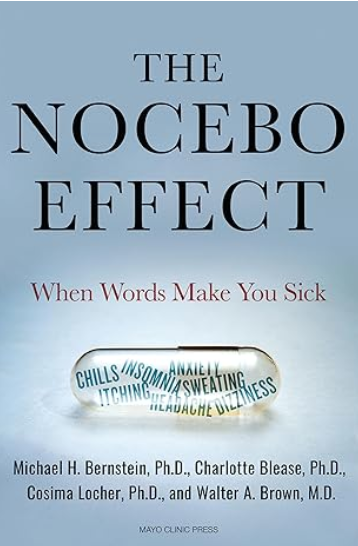
MAIN IDEA:
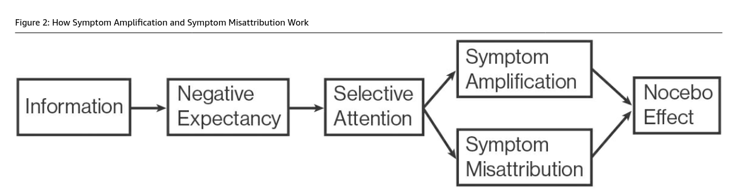
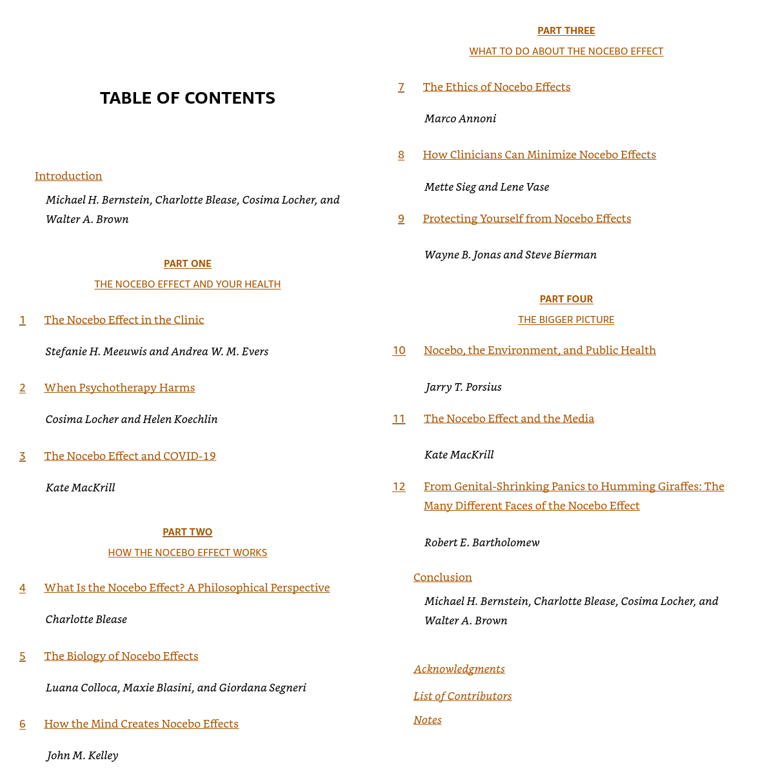
This book is about the nocebo effect, which is the opposite of the placebo when clearly inactive treatment works because of a patient’s psychological conditions. Here is the authors’ definition: “In our view, the nocebo effect can be summarized as “the occurrence of a harmful event that stems from consciously or subconsciously expecting it.” The core of the nocebo effect is that adverse health effects occur as a result of negative expectations.”. The authors present the history of research in this area since the early 1950s, the mechanics of its working, and its impact not only on the outcomes of medical treatments and the well-being of patients but also on healthcare costs. They also provide recommendations for minimizing this effect’s negative impact. Finally, the authors present their view on the nocebo effect’s impact on society overall and its ability or inability to handle various challenges from the environment to various political, economic, or personal risks.
Here is a nice diagram of how the nocebo effect works:
MY TAKE ON IT:
For me, the analysis in this book presents an interesting demonstration of the interconnection between the reality of life, human perception, and modeling of this reality, which leads to conscious or unconscious actions that, in turn, change reality. This topic goes way beyond the medical side of the placebo/nocebo effect. It could be used to understand human actions in all areas of life, including the economy and politics.
From this point of view, the currently popular contentions of information vs. disinformation, fake news, DEI, and such are just attempts to use the psychology of the nocebo effect to achieve specific population behaviors. In a democracy, even if flawed, such attempts usually fail because of the difficulty of isolating people from accurate information. That’s why people benefiting from COVID and Climate alarmism distortions of resource allocation fail to achieve complete dominance despite mass propaganda efforts and relatively limited violent actions such as the cancelation of non-compliant individuals.
Their ideological peers of the Communist and Nazi variety were more successful because the concentration camps and outright executions were much more effective than losing jobs and prestige. However, even their success was limited in time due to the nasty habit of reality to undermine any ideology that deviates too much from this reality.
The problem for individuals is that they do not have enough time and ability to recover from mistakes to afford too much of a nocebo effect impacting their lives. The solution is to control one’s perception of reality by seeking a variety of views and, most importantly, evaluating these views based on their ability to predict future events rather than the authority of their presenters, how much good feeling of virtue they provide, or even how logically consistent these views are.
20241006 – Our Ancient Faith

MAIN IDEA:
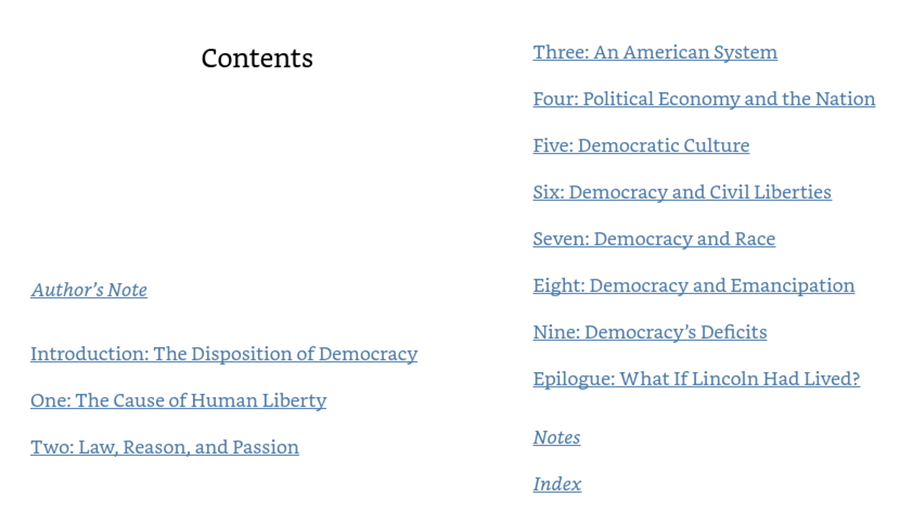
This book is about democracy, examined through the prism of American history, more specifically, through the words and actions of Abraham Lincoln—the man who managed to retain the democratic political system in the United States by fending off the challenge of the Southern slavery-based aristocratic republic to this system. The author meticulously goes through different aspects of democracy and how it was reflected in Lincoln’s attitudes, noting:” One more thing: a Lincolnian democracy is a democracy which embodies Lincoln’s own virtues—resilience, humility, persistence, work, and dignity. Through the example of Lincoln, democracy can claim to offer people, not only order, but decency, even a kind of quiet and unostentatious grandeur.”
The author also discusses what it looks like from a contemporary point of view when we know what happened over the next 160 years after Lincoln’s death.
MY TAKE ON IT:
I do not think that people have a choice in the political system under which they live. It is mainly defined by the system’s fitness to maintain the society it controls and protect it from challenges, both economic and violent, from external and internal enemies. Democracy in America is the result of a unique environment where a relatively small number of technologically advanced people obtained access to practically unlimited amounts of resources in the form of agricultural land, so nearly everyone could become self-sufficient, and nobody would have enough power to suppress others. This ability to survive on one’s own, albeit in cooperation with others, and the inability to suppress and exploit others forced people to seek peaceful accommodation with others. Only the Democratic political system could provide such accommodations. Correspondingly, the slave-owning aristocracy was incompatible with such Democracy and had to be aggressive against it to survive. The Civil War was not really a civil war between members of one society but rather a war between two societies for political dominance.
We are now in a similar situation when it is becoming increasingly obvious that the Democratic political system is incompatible with the Administrative state because top-down control of everything is incompatible with individual freedom based on arrangement when resources are distributed between people via private property. The Civil Conflict between these two systems is inevitable and is actually ongoing. One can only hope that this conflict will not grow into a war. The possible outcomes are clear: either diminishing the Administrative state or eliminating whatever is left of the Democratic political system. The diminishing of the Administrative state would lead to the expansion of prosperity and freedom because free people who own distributed resources are much more productive than people in any other economic arrangement. Alternatively, the triumph of the Administrative state would lead to misery, if not necessarily material, then definitely to psychological misery because the life of quasi-slaves of the administrative hierarchy working under the direction of bureaucrats whose main competency is the ability to move up within this hierarchy is always miserable.
 Equal Rights Libertarian