
20240825 – Public Interest and State Legitimation

MAIN IDEA:
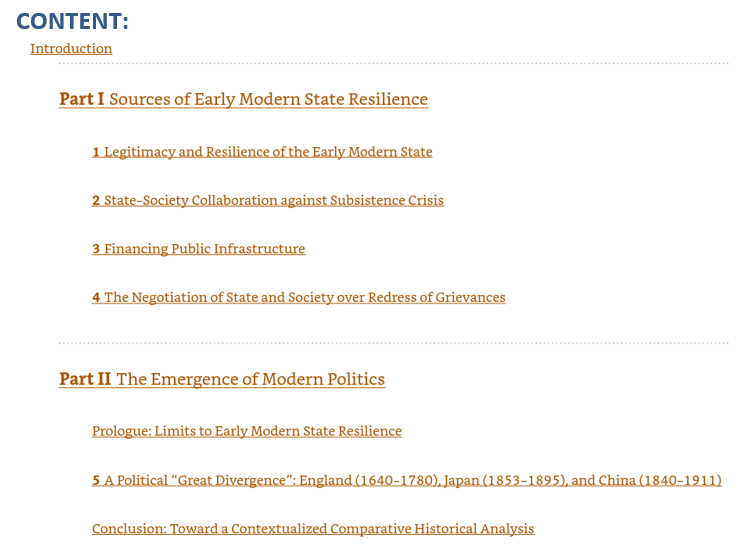
The author expressed the main idea of this book as a theory:” …this theory of state formation in which a public interest-based discourse of state legitimation serves as a common basis for state–society collaboration in public goods provision…” To support this theory, the author reviews specific periods in history:” One was the intensive collaboration between state and society over infrastructural facilities and even defense in England between 1600 and 1640, Japan between 1820 and 1853, and China between 1820 and 1840, periods when each state was encountering sustained fiscal difficulties. Such state–society collaboration in public goods provision such as famine relief, water control projects, and even national defense contributed significantly to the resilience of these early modern states with limited fiscal capacities.” This collaboration eventually led to the contemporary world due to the emergence of the conception of public interest:” This conception of public interest shared by both state and social actors thence constituted a common normative platform upon which state and society could interact over how to deliver concrete public goods to safeguard the public interest in specific circumstances. In this way, the obligation of the state to protect the public interest opened up a space for political participation as it entailed certain rights to the subordinates; most importantly, a right to petition the authorities for redressing welfare grievances so as to safeguard public interest. Such rights were, however, passive, as they were derived from the obligation of the state to protect the public interest. In contrast, active rights, at the level either of the local community or of the individual, are conceived as independent of the state. While passive rights are derived from obligation, active rights are often held to be entitlements of individuals. Examples of such inalienable rights include absolute private property rights or human rights, or freedom of conscience in religion.”
MY TAKE ON IT:
I do not believe in the validity of the notions around which this book’s discussion is built. Neither the public, the state, nor society exists as thinking, feeling, and acting entities; only individuals do. All this comes down to the interaction between the better-armed and better-organized violent groups of individuals – the state with unarmed or poorly armed, poorly organized, and less violent, much bigger groups of individuals – society. Whatever legitimacy, meaning voluntary compliance of the society’s individuals with commands of the state’s individuals, exists based exclusively on an internalized ideological framework established via education, indoctrination, and propaganda. The well-being of the state’s individuals is guaranteed by their ability to extract resources from individuals outside the state. When, for whatever reason, the totality of resources decreases, it impacts, first and foremost, members of society outside of the state hierarchy, undermining their well-being. If the impact is so big that it overrides the existing ideological framework, the society falls apart, leading to some form of rebellion or civil war. The new arrangement comes to life after eliminating either members of the old state hierarchy or those who challenged their rule. If the reason for resource depletion is removed or sufficiently diminished, either because fewer people are still alive to need resources or a better harvest of whatever, the new order strengthens, and the cycle repeats. It used to be that a very strong religious, ideological framework supported order up until the only choice of individuals at the bottom of the hierarchy left was between rebellion with probable violent death and assured death from starvation, providing relative stability of existing arrangements. With such a framework practically disappearing, the stability is decreasing. Still, thanks to contemporary science and technology, the availability of resources has increased so much that most people prefer to tolerate the rule of individuals (politicians) they despise via institutions they contempt rather than rebel. However, at some point, the psychological pain of this compliance could become too much, so the rebellion still could come.
20240818 – Why We Die

MAIN IDEA:
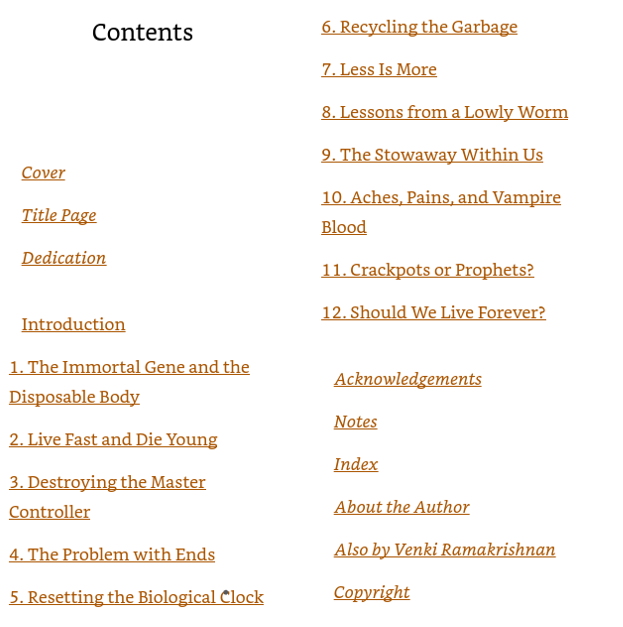
At the beginning of this book, the author discusses various ideas that humans came up with in search of immortality or at least longevity:” The first, or Plan A, is simply to try to live forever or as long as possible. If that fails, then Plan B is to be reborn physically after you die. In Plan C, even if our body decays and cannot be resurrected, our essence continues as an immortal soul. And finally, Plan D means living on through our legacy, whether that consists of works and monuments or biological offspring.” After that, the author defines the content of this book in the following way:” Because aging is connected intimately with so many biological processes, this book is also something of a romp through a lot of modern molecular biology. It will take us on a journey through the major advances that have led to our current understanding of why we age and die. Along the way, we will explore the program of life governed by our genes, and how it is disrupted as we age. We will look at the consequences of that disruption for our cells and tissues and ultimately ourselves as individual beings. We will examine the fascinating question of why even though all living creatures are subject to the same laws of biology, some species live so much longer than even closely related ones, and what this might mean for us humans. We will take a dispassionate look at the most recent efforts being made to extend life span and whether they live up to their hype.”
MY TAKE ON IT:
I found the idea of comparing an unchangeable and practically immortal gene with a disposable body quite interesting. Similarly, the idea of death as the desynchronization of various parts of an organism nicely describes the process of cessation of the system’s existence, even if its various parts are still functional. After reading through all the technical details presented in this book, I am pretty much convinced that there is technical potential to increase both lifespan and health span, maybe even without limit. However, what is puzzling to me is why people would want to do it beyond natural limits. Human life has nicely defined natural periods, and each of these periods has its positives and negatives. The only constant thing is the change and constant acquisition of new life features and the disappearance of old ones. Every 50-year-old is a very different person than he was at five years old, as well as the person he’d be if he lived to be 100. So, basically, life extension would lead to the substitution of the normal process of population change by substituting old, exhausted organisms with newly created individuals by the new process of adding additional life phases for the same old organism. I do not think it is a good idea because it would slow down progress in all areas by prolonging the existence of outdated and poorly working paradigms. It was said that science progresses from funeral to funeral, so no funeral means at least stagnation. Still, it would probably lead to violent eruptions because the status quo forever would not be acceptable to most people.
20240811 – Strategy, Evolution, and War
MAIN IDEA:
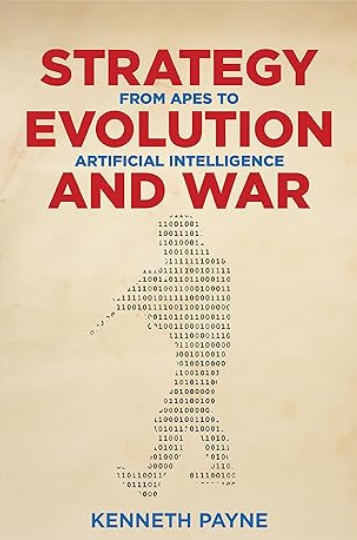
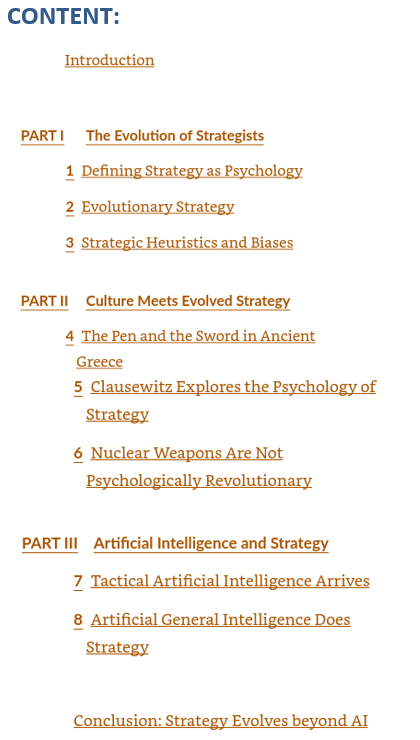
Here is the author’s definition of the main idea of this book:” THIS BOOK EXPLORES THE EVOLUTIONARY BASIS OF HUMAN STRATEGY IN war and considers the prospects of a radically distinct approach to strategy using artificial intelligence (AI). Strategy is defined here as the purposeful use of violence for political ends.” The book specifically reviews the expected transfer of human strategic thinking and action to AI-based processes. The book also reviews various parts of strategic thinking, such as force concentration and allocation, mind reading and deception, and the cultural evolution of strategic thinking. Also interesting is a comparison between human and chimpanzee strategies. Much attention is also given to Lanchester’s Law and scaled cooperation development prompted by persistent warfare.
MY TAKE ON IT:
I think that we are getting closer to the situation when the use of organized violence will become too dangerous for users and, therefore, ineffective. One of the big reasons for that will be the massive implementation of AI and the development of biological weapons. Both AI and bioweapons represent the qualitative leap in human ability to cause huge damage with minimal effort. As COVID demonstrated, the virus developed in a small lab by a few people could easily expand all over the world and kill millions. Similarly, dominance in AI could allow one side to take over the tools of the other and use them against it. However, the most important will be the difficulty in controlling the use of such weapons. Bioweapons could mutate and start killing organisms on the side of their users. Similarly, AI tools could potentially become uncontrollable. Consequently, the unpredictability of consequences from using such weapons could force all sides to resolve their difficulties peacefully and seek resolution of contentions without resorting to strategic violence in any way, shape, or form.
20240804-The Symbolic Species

MAIN IDEA:
This book explores language as a uniquely human symbolic method of communication that no other animals managed to develop, even in the simplest form imaginable. The author breaks down communications into three hierarchically organized forms, as represented by the graphs below:
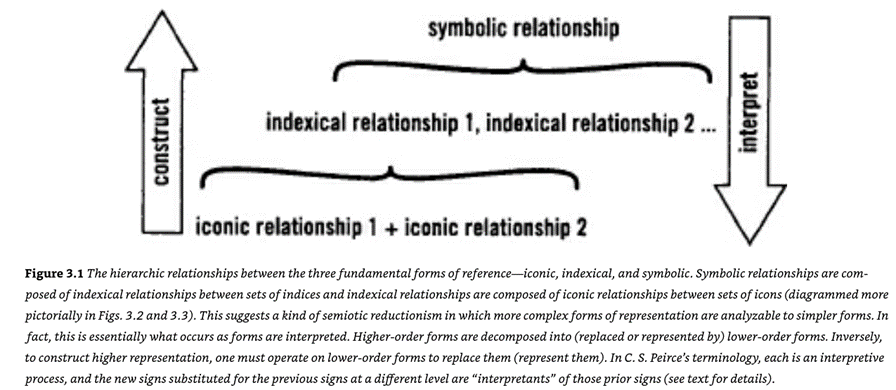

The author also provides an interesting model of the evolutionary development process that made us humans:
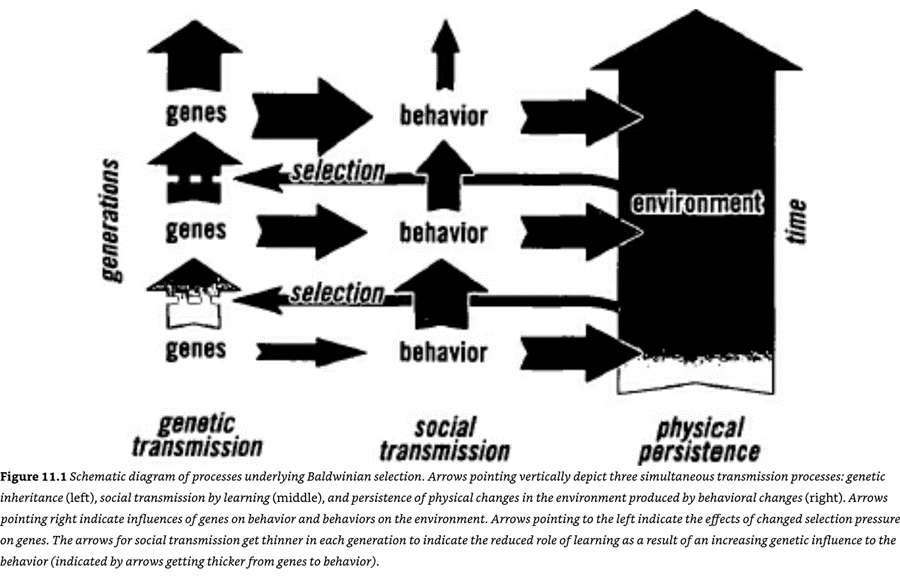
Here is the author’s description of the structure of this
book:” The first part of the book—Language—focuses on the nature of language
and the reasons that it is virtually confined to the human species. The second
part of the book—Brain—tackles the problem of identifying what is unusual about
human brain structure that corresponds with the unique problems posed by
language. The third part of the book—Co-Evolution—examines the peculiar
extension of natural selection logic that is behind human brain and language
evolution, and tries to identify what sort of communication “problem”
precipitated the evolution of our unprecedented mode of communication.”

MY TAKE ON IT:
I think it is a very good presentation of humanity’s core features as a system of coordination, cooperation, and integration between individuals that provides far superior functionality of existence than could be found in any other part of the animal world. The only small issue I have with all this is the treatment of it as a human paradox:” Biologically, we are just another ape. Mentally, we are a new phylum of organisms. In these two seemingly incommensurate facts lies a conundrum that must be resolved before we adequately explain what it means to be human.” As far as I’m concerned, we are not more unique than many other forms of life, each of which exists because it fits well into the existing environment. It just happened that the integrated system of humanity is based on individual organisms with much higher levels of functionality and self-direction capabilities than, for example, the integrated system of ants. Combined with unlimited communication and coordination abilities provided by the symbolic language, we did become a dominant form of life on this planet and, I believe, will remain so, even if in the process of planet-wide consolidation we’ll go through difficult times and catastrophic events.
 Equal Rights Libertarian