
20240728 – Everything Is Predictable
MAIN IDEA:
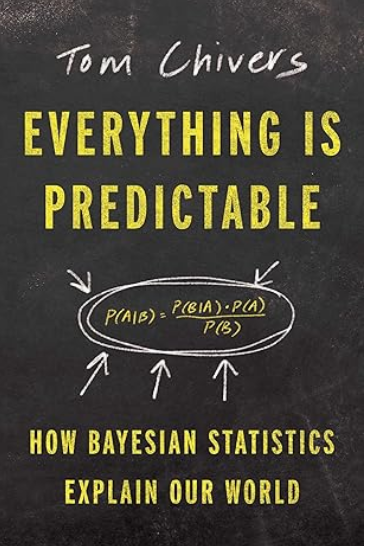
This book is about the history, philosophical, and practical aspects of the Bayesian theorem of conditional probability:

This formula defines the probability of A if B already occurred. The applications of this formula are unlimited because A and B could be any events, real or imaginative. Here is the author’s definition of its meaning:” …all decision-making under uncertainty is Bayesian—or to put it more accurately, Bayes’ theorem represents ideal decision-making, and the extent to which an agent is obeying Bayes is the extent to which it’s making good decisions. Logic itself, all that stuff you may remember about “All men are mortal; Socrates is a man; ergo Socrates is mortal” is just a special case of Bayesian reasoning where you’re only allowed to use probabilities of one and zero. We appear to be Bayesian machines. That’s true at a fairly high level: humans are rubbish at working out Bayes’ theorem formally, but the decisions we make in everyday life are pretty comparable to those that an ideal Bayesian reasoner would make. Which, unfortunately, doesn’t mean we all end up agreeing—if my prior beliefs are very different from yours, then the same evidence can lead us to entirely different conclusions. Which is how we can end up with profound, but sincere, disagreements on apparently well-evidenced questions about the climate, or vaccines, or any number of other questions. And we’re Bayesian at a deeper level too. Our brains, our perception, seem to work by predicting the world—prior probabilities—and updating those predictions with information from our senses: new data. Our conscious experience of the world can be best described as our priors. I predict, therefore I am.”

MY TAKE ON IT:
I first encountered Bayes’s theorem some 50 years ago while taking a university course on probability theory, but I never thought of it as anything other than a mathematical tool with some practical application. This book demonstrated, and quite convincingly, that conditional probability is everywhere, and it is how people make decisions, whether they realize it or not. It is obviously the foundation of AI because AI is nothing more than a prediction of the future based on probabilities of past events accumulated during the training. So, I have to agree with the idea that we humans base our existence on predictions of the future based on the past, whether it relates to language and image-based communications, decision-making, or working on some project to achieve desirable results. I think that we’ll have to learn to apply Bayesian thinking and processes in a much more formalized and effective way by using AI if we want to have a bright future rather than go into a very unpleasant decline or even possible self-annihilation.
20240721-Revolution and Dictatorship

MAIN IDEA:
This book seeks to explain the phenomenon of the long-term survival of authoritarian regimes created by revolutions. The idea is that the initial challenge of counter-revolutionary forces forges a strong and mutually dependent group of leaders capable of controlling the machinery of violence and maintaining the regime despite all odds. The authors contrast this with less durable regimes and clearly present their logic, with massive factual support from the history of Russian, Chinese, and Mexican regimes. Here is the graphic representation, with the three pillars of the authors’ argument presented at the top:


MY TAKE ON IT:
This is a pretty good model, but authors underappreciate the role of ideology, information manipulation, and people’s attitudes toward the regime. The revolutionaries have to convince a sufficient number of the population that it is in their best interests to support the new regime. The process has to be graduated when revolutionaries mislead people about their real objectives to obtain the support of some and the neutrality of others so they can eliminate an active opposition.
A good example is the history of the Russian Revolution. After a lifetime of theorizing about public property on a means of production and the need for the revolutionary war to establish worldwide dictatorship, Lenin and the Bolsheviks took power under the slogan: “Land to peasants, factories to workers, and peace to people.” For people at the time, it meant private property on land transferred to peasants who worked on it, cooperative ownership of factories, and rejection of wars as a means to society’s ends.
After initially acting according to this slogan, communists were able to eliminate the opposition from pillars of the old regime, then remove any trace of independence for workers’ unions, and eventually force peasants into slavery of collective farms. The key was maintaining an agenda-setting initiative so those a bit further on the elimination list would not feel threatened until their time came.
Another important part that is missing is an underestimate of the parasitic character of these regimes, which are usually unable to maintain effective economic and technological development without external support from developed countries with effective capitalist economies. Both the Soviet military power of the past and the Chinese economic power of the present came from the flow of money, technology, and informational support from Western intellectuals ideologically aligned with communism and big business seeking super profits by shifting production and technology to authoritarian countries where workforce could be violently suppressed as needed, outside of regulatory control of Western societies.
My final disagreement is with the very definition of durability. These regimes did not necessarily survive that long: 70 years of the Soviet Union or 75 years of Chinese communist power is not that long, and inevitable succession problems combined with the disillusionment of the next generations normally cut down these monstrosities long before Western intellectuals understood their levels of internal instability.
20240714 – Without Conscience

MAIN IDEA:
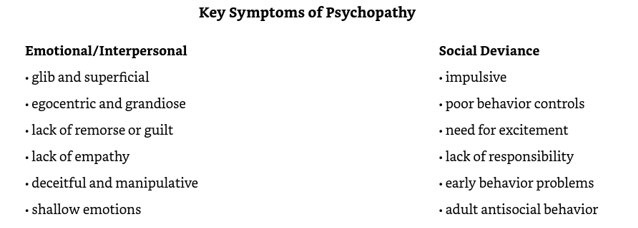
This is a classical book about psychopathy and psychopaths. It describes and defines this particular disorder, its diagnosis methods, and the behavior patterns of people who possess it. It describes multiple cases of psychopaths, both criminal and even murderous, and those that more or less fit into the frame of normal behavior. It also provides the Psychopathy Checklist:
CONTENT:

MY TAKE ON IT:
I think that, as of today, psychopaths still have pretty much a free run with little attempt to diagnose their condition and control it in the interest of normal people. As with any other human condition, it is not digital, meaning YES/NO status, but more like analog with lots of space between completely no signs and hardcore cases. For me, the most interesting is that, while having no empathy and little or no normal human emotions, psychopaths are very calculating and, therefore, responsive to cost-benefit analysis. This explains the tremendous success of “broken window” policies in suppressing criminal activities and the massive increase in crimes when such policies were discontinued in the name of leftist ideology. These policies provided quick and efficient feedback for psychopathic behavior, prompting psychopaths to control their urges or risk being eliminated if they failed. Based on the information presented in this book, the idea that a psychopath who was allowed to commit a dozen crimes and let go will not commit another dozen crimes looks absolutely ridiculous. From my point of view, any prosecutor who refuses to prosecute crime number N should go to prison as an accomplice when crime number N+1 is committed. In this case, we would quickly decrease both crimes and the number of criminals in positions of power.
20240707 – Values, Voice and Virtue
MAIN IDEA:
This book is about changes in British society, including the rise of populism, Brexit, and the overall collapse of politics as usual. The author sees these changes as a result of the reconfiguration of British society when the old aristocratic and business elite faded, and the new elite of educated bureaucrats and managers rose. One serious consequence of this is the nearly complete disappearance of the old noblesse oblige attitude of the old elite to non-elite and the commonality between them as parts of one nation. The new elite sees no difference between British workers and immigrants, whether legal or illegal, and prefers those who provide cheaper labor. The new elite is also multicultural and is educated in contempt of the British and overall Western culture and history. The non-elite is still mainly British, and its values are still based on the British nation-state and culture. This creates the dynamics of revolution vs. counter-revolution, and the author expects the ongoing fight to continue for a while.

MY TAKE ON IT:
I think that the diagnosis of the situation is, in general, correct and that it relates not only to Britain but to the whole Western world. Humanity is currently in the process of moving from being divided into separate nation-states and cultures competing between themselves into one unified global entity with one dominant culture all over the world. The question is what kind of culture and economic system will become dominant. The competitors are:
- The Western Enlightenment tradition, with its individualistic ideology and freedom, capitalist economy, and limited government divided into separate powers. The limited hierarchical control and distribution of resources provide individuals at the bottom with the opportunity to pursue their objectives the way they see fit.
- The pre-Enlightenment tradition, with its collectivistic ideology, hierarchical control from the top down, and complete subordination of individuals at the bottom to the will of individuals at the top.
Right now, the struggle between these competitors has taken the form of elite vs. non-elite at the national level, but often over global issues such as climate alarmism, top-down behavioral control, resource allocation, and similar issues. However, it is bound to consolidate into the worldwide struggle of elite vs. non-elite that will last for a while.
 Equal Rights Libertarian