
20240630-Indigenous Continent

MAIN IDEA:
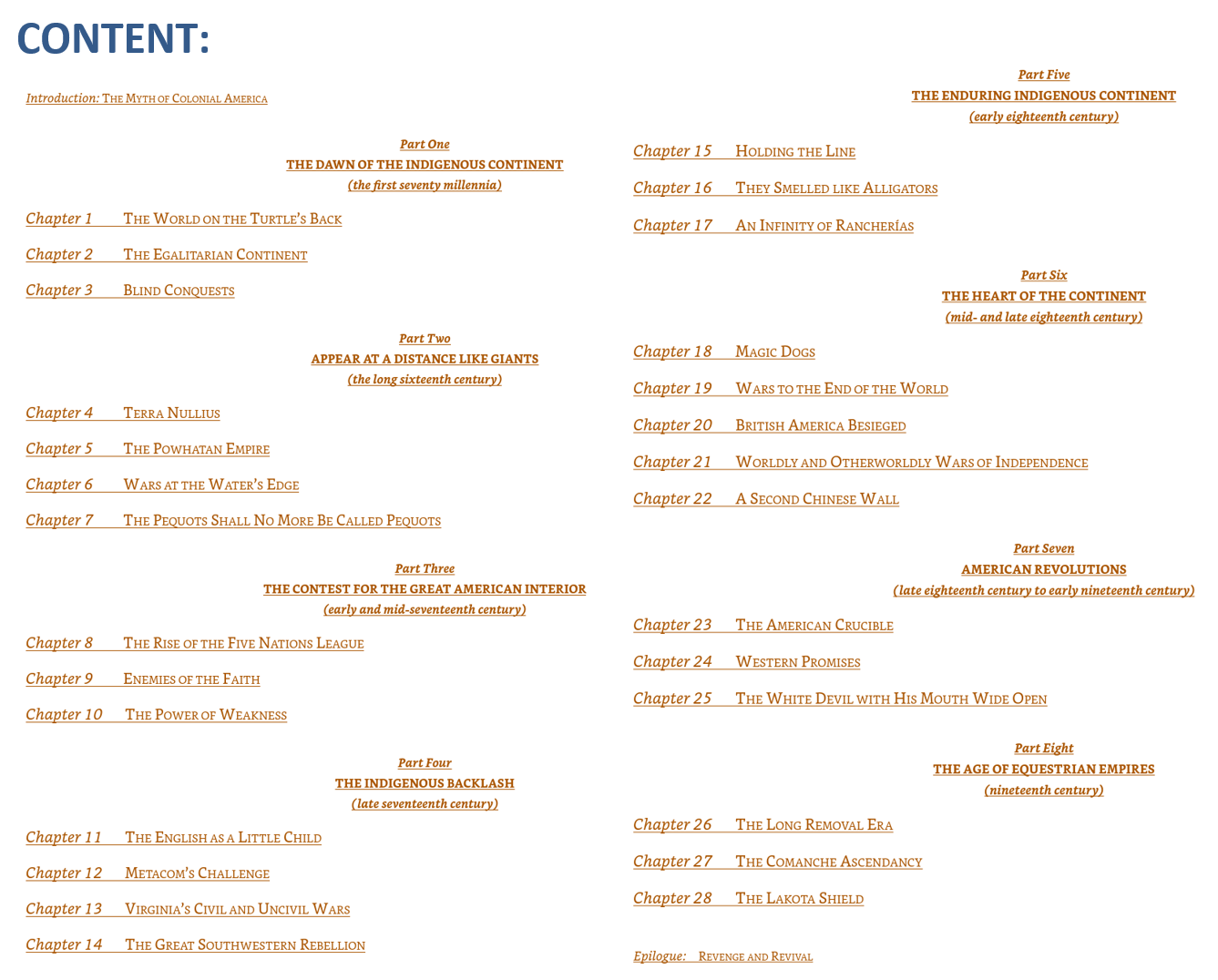
This is probably the best book about the history of America, not as the history of the United States but the history of the northern part of the continent in which the English-speaking tribe of newcomers from Europe gradually, over the period of centuries, became the dominant tribe of the continent after fighting other European French and Spanish speaking tribes, all of them being allied with various local Indian tribes up until the near end of the struggle. Here is the author’s definition of the main idea of this book:” It offers a new account of American history by challenging the notion that colonial expansion was inevitable and that colonialism defined the continent, as well as the experiences of those living on it. Stepping outside of such outdated assumptions, this book reveals a world that remained overwhelmingly Indigenous well into the nineteenth century. It argues that rather than a “colonial America,” we should speak of an Indigenous America that was only slowly and unevenly becoming colonial. By 1776, various European colonial powers together claimed nearly all of the continent for themselves, but Indigenous peoples and powers controlled it. The maps in modern textbooks that paint much of early North America with neat, color-coded blocks confuse outlandish imperial claims for actual holdings. The history of the overwhelming and persisting Indigenous power recounted here remains largely unknown, and it is the biggest blind spot in common understandings of the American past.”
MY TAKE ON IT:
I think this book goes a long way in disassembling many ideological myths about the history of America. Either old myths, based on the ideology of white racial and cultural superiority, or new myths, based on the ideology of white racial and cultural inferiority, distort and diminish the real history of America. In reality, it would be meaningless to seek signs of superiority or inferiority between peoples and civilizations that were developing differently. Qualitatively, Euro-African and American civilizations were approximately equal, about 60 to 80 million people each before encounter. However, land available for human sustenance in America was multiple of that in Europe. Therefore, forces pushing the switch from a hunter-gatherer and/or low-intensity agriculture way of life were much weaker in America, leaving people with much more humane conditions of life with a lot less need for military-technological development for survival. It is not surprising that by all accounts, Europeans who were captured and adopted into a more humane Indian culture preferred to remain in this culture even if they had the opportunity to go back to European civilization. It is also unsurprising that European civilizations of much more intensive agriculture and dependence on military competition had better military technology. Consequently, initially, representatives of European civilizations in America were happily embraced by local tribes as valuable allies despite their negligible numbers. The question of who was dominant in these alliances probably would be answered differently in different cases. Still, up until the latest part of the period from 1492 to 1880s, it was mainly cases of some newcomers and locals fighting other newcomers and locals rather than newcomers fighting locals. It would be nice if the understanding of real history led to the embrace of common humanity and the elimination of all racist ideologies. Still, since as many people are making as good a living now from promoting anti-white racism as other people used to make from promoting anti-black and anti-indian racism in the past, it will take a while before these junk ideologies are fully left behind.
20240623-The Cheating Cells

MAIN IDEA:
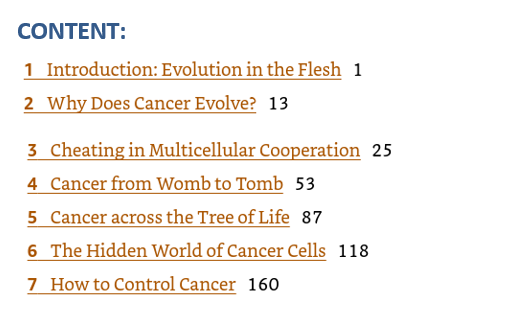
This book represents a very interesting approach to understanding the development processes of an organism during its existence as a system of semi-independent entities – cells that undergo a high-speed evolutionary selection process. From this approach comes a new understanding of cancer as the break in cooperation between cells when some cells start unstoppable resource acquisition at the expense of other cells:” cellular cheating.”. Here is the graphic representation:

MY TAKE ON IT:
To me, the evolutionary approach to cancer development seems potentially very productive for both understanding the nature of cancer and finding ways to avoid it and/or treat it. I would even expand and generalize these ideas to just about everything, from the development of technology to the functioning of human society. As long as key factors such as inheritance, variation, and selection are present, the process works similarly everywhere. When there is a necessity for group participation as a condition of survival, the multilevel selection inevitably kicks in. Correspondingly, it creates tension between individual and group selection within each individual that had to be resolved via cooperation in such a way that assures the survival of the group. Generally speaking, such cooperation could not possibly continue forever because any system would have some idiosyncrasies that violate the parameters of stability, leading to the system’s self-destruction. This book nicely describes how this process occurs in the human body when some of its cells become exceedingly selfish and, therefore, cancerous and kill the body. Similar processes occur at the level of human societies with similar results. We seem to be in the middle of this process, and it will be interesting to see how it works out.
20240616-Blunder
MAIN IDEA:
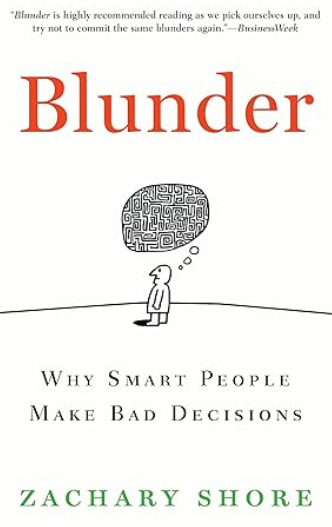
This book reviews all kinds of reasons, mainly psychological, that caused people to make blunders. Here is the author’s description of its main idea:” Blunder is a book about judgment calls. It is the story of how smart people like Edison get caught in cognition traps and wind up defeating themselves. Most complex problems have complex causes, and no single factor can explain it all. This book offers one possible explanation for why people blunder. I suggest that we all sometimes fall into “cognition traps”—rigid ways of approaching and solving problems.4 Cognition traps are inflexible mind-sets formed from faulty reasoning. They are the stolid ways in which people approach and solve problems based on preconceived notions and preset patterns of thought.
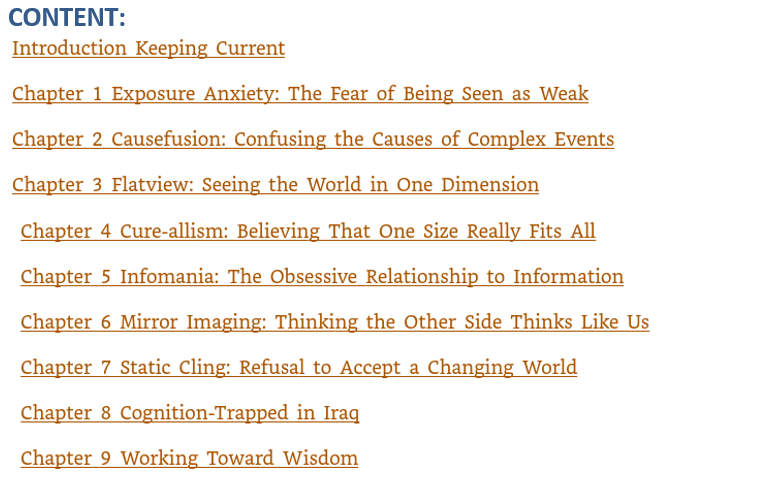
The author also defines three different types of problems that cause people to make poor decisions and implement actions that lead to failure: mistakes, blunders, and cognition traps: ” A mistake is simply an error arising from incorrect data, like believing that an electric wire is running direct current when it’s actually on AC. A blunder, in contrast, is a solution to a problem that makes matters worse than before you began, like attempting to discredit a potentially liberating technology rather than adapting to it. Finally, a cognition trap is the mental framework that led you to a blunder, like the one I call static cling, the refusal to accept that a fundamental change is under way.” The book allocates one chapter to each of the 9 most typical problems that cause blunders.
MY TAKE ON IT:
This is quite an interesting collection of cases in which human psychology caused behavior problems that resulted in negative and sometimes deadly consequences. The book is big on factoids but relatively low on proposed solutions. I am actually more interested in solutions. To a significant extent, I think these problems are caused by the lack of education. I do not mean formal education, which is often nothing more than a combination of indoctrination with low levels of technical skills, such as reading, writing, and doing some formalized algorithmic tasks. It would be much better to expand education to game-playing that emulates real-life situations and provides timely and effective feedback on individual actions, pretty much like it is done naturally by children when they are not disturbed. It is probably coming with massive implementation of AI tools and a shift to decision-making to AI models trained on the many situations relevant to skills and behavior patterns needed to avoid blunders.
20240609 – The Experience Machine

MAIN IDEA:
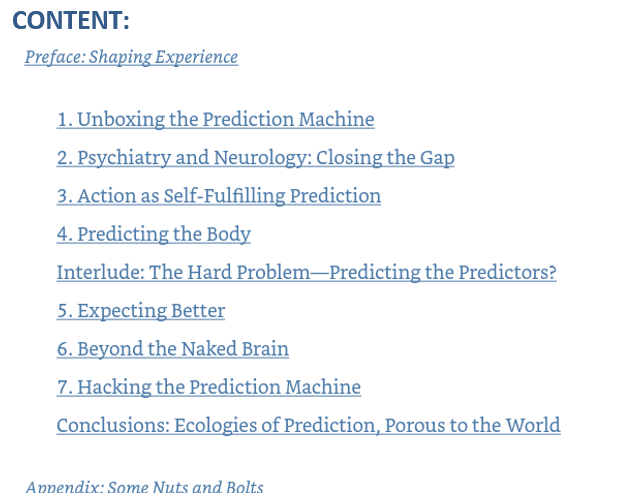
This book discusses a novel theory of human behavior and the functioning of the brain. In this theory the brain is considered, first and foremost, a tool to generate predictions about the environment and then use the sensory organs as secondary tools to adjust these predictions. Here is the author’s formulation:” Perception is now heavily shaped from the opposite direction, as predictions formed deep in the brain reach down to alter responses all the way down to areas closer to the skin, eyes, nose, and ears—the sensory organs that take in signals from the outside world. Incoming sensory signals help correct errors in prediction, but the predictions are in the driver’s seat now. This means that what we perceive today is deeply rooted in what we experienced yesterday, and all the days before that. Every aspect of our daily experience comes to us filtered by hidden webs of prediction—the brain’s best expectations rooted in our own past histories”. So human behavior is not reactive, but rather an active 4-step process: prediction–action-perception–correction rather than two steps: perception-action.
MY TAKE ON IT:
The approach to human brain information processing suggested in this book changes the understanding of this processing. So, the first step is to plan or build an internal abstract model of reality. The second step is to direct sensory organs to actively search for confirmation of this model while ignoring other information as irrelevant. Only when contradictory information becomes so overwhelming that it cannot be ignored does the brain implement the correction step. This makes sense and explains many experimental results related to priming, such as the famous experiment with the “invisible” gorilla in the basketball game. It is an interesting approach, and it points to a very important human brain functionality: building predictive models. Actually, this approach goes back to the very beginning of cybernetics when the objective was to direct anti-aircraft fire based on the prediction of the future position of the targeted aircraft and an artillery shell directed to shoot it down. This was a super simple process fully within the computational functionality of contemporary electronics. Obviously, the complexity of the model built by human brains is much higher than the simple beginnings, but the sequence of processes is the same. At the top level of complexity, it nicely explains a phenomenon when highly educated people are prone to be much more protective of their beliefs, even if such beliefs are obviously incorrect. This is because the models of highly educated people are very sophisticated, built at high costs, and, therefore, much more difficult to replace than models of simpler people. Hopefully, the new understanding presented in this book will help promote the development of modification processes for individuals whose perception of the world is built on propaganda and distortions of reality. The success of such an endeavor could help achieve peaceful coexistence between people with different world views based on different and often seemingly contradictory facts.
20240602 – Psych

MAIN IDEA:
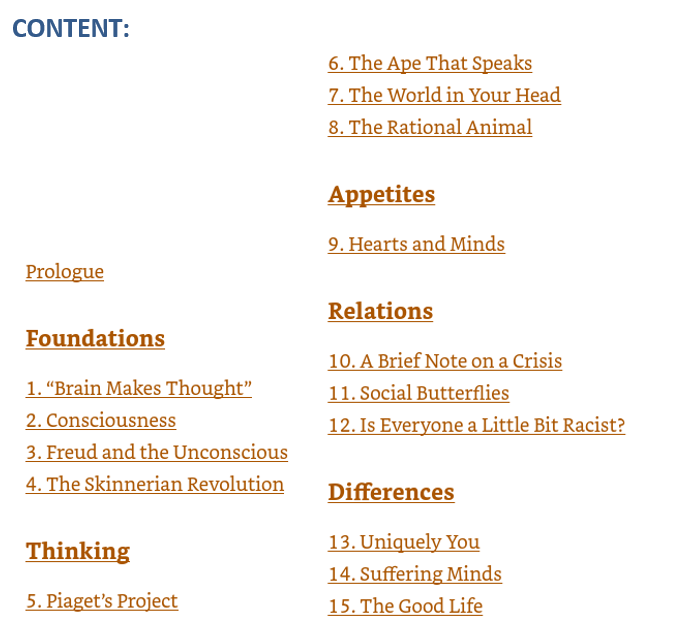
This book was built from the Introduction to Psychology course at Yale. Here is how the author defines his approach:” We’ll see that modern psychology accepts a mechanistic conception of mental life, one that is materialist (seeing the mind as a physical thing), evolutionary (seeing our psychologies as the product of biological evolution, shaped to a large extent by natural selection), and causal (seeing our thoughts and actions as the product of the forces of genes, culture, and individual experience).” However, the author also adds a qualifier:” I think the scientific perspective at the core of modern psychology is fully compatible with the existence of choice and morality and responsibility. Yes, we are, in the end, soft machines—but not just soft machines.”
MY TAKE ON IT:
I think it is a pretty good review of psychology’s history and contemporary condition. I agree with the author’s main positions: materialistic, evolutionary, and causal. From my point of view, what is usually called the mind is the product not only of a specific organ called the brain but also of the totality of the human body in which lots of necessary informational processing occurs at the peripheral level. The signals from peripheral subsystems have a huge impact on the functioning of the brain, as described by psychology methods. The most important thing, which is somehow poorly understood, is that the mind is the communication and information integration system that evolution developed to reconcile two levels of multilevel selection: individual survival and survival of the group that individual belongs to. There is a constant tension between the goals of these two levels, sometimes even direct contradiction, so the hugely complicated and biologically very costly brain is not a luxury but a necessity for survival. The human consciousness is also a necessary product of the brain because the complex system designed to solve complex problems has to have some top-level organizational and co-ordinational tool to synchronize multiple processes occurring in both conscious and unconscious parts of the system and even externally at the level of group and overall environment. The complexity also requires flexibility and delegation of controls to the levels where such control is most effective. This is seldom at the top when our conscious self perceives existing conditions and makes actionable decisions. Contemporary Psychology provides some level of understanding of how these processes work, but a lot less than is needed to obtain a good practical understanding, even if some bits and pieces of such understanding are applied immediately to the manipulation of people to achieve the objectives of others. Humanity is now in the process of moving from a multigroup environment with competition for resources to the formation of one group with a general abundance of resources when the focus will turn to the achievement of individual happiness when the most challenging part would be to assure such changes in human psychology that would make it inconceivable attempting to achieve it at the expense of others. I believe we’ll get there eventually, but it will take lots of time, pain, and suffering before it happens.
 Equal Rights Libertarian