
20240526 – Humankind

MAIN IDEA:
This book is about human psychology, and here is the author’s definition of its main idea:” An idea that’s long been known to make rulers nervous. An idea denied by religions and ideologies, ignored by the news media and erased from the annals of world history. At the same time, it’s an idea that’s legitimised by virtually every branch of science. One that’s corroborated by evolution and confirmed by everyday life. An idea so intrinsic to human nature that it goes unnoticed and gets overlooked. If only we had the courage to take it more seriously, it’s an idea that might just start a revolution. Turn society on its head. Because once you grasp what it really means, it’s nothing less than a mind-bending drug that ensures you’ll never look at the world the same again So what is this radical idea? That most people, deep down, are pretty decent.”
The book includes a detailed review of many well-known experiments and events that are believed to demonstrate human culpability and show that, in many cases, these experiments were staged to prove preexisting conclusions or real events misinterpreted for similar purposes. At the end of the book, the author, based on the material discussed in the book, provides what he called:” TEN RULES TO LIVE BY.”
Here are the rules:
I: When in doubt, assume the best
II: Think in win-win scenarios
III: Ask more questions
IV: Temper your empathy, train your compassion
V: Try to understand the other, even if you don’t get where they’re coming from
VI: Love your own as others love their own
VII: Avoid the news
VIII: Don’t punch Nazis
IX. Come out of the closet: don’t be ashamed to do good
X. Be realistic

MY TAKE ON IT:
This book is very interesting to me because it describes the manipulation of data and context that leads people to believe all kinds of lies about human nature and behavior. The reality is pretty simple: humans are the product of multilevel evolution when change occurs at the individual level under evolutionary pressure at two levels: individual and group survival. Humans are selfish at both levels, sometimes prioritizing individual survival but sometimes group survival, which could mean self-sacrifices to save others in the group. However, humans are often nasty to outsiders, all the way to the genocidal level. It used to make lots of sense because resources were limited, and individuals and groups often could survive only at the expense of others. It does not make sense anymore because scientific achievements of the last few centuries provide sufficient resources for all. Now, we are at the beginning of the big adjustment, after which all humans will be included in one big group, and no individual will need to fight others for resources. We need to learn to tolerate others in exchange for being tolerated by others, which means getting rid of all kinds of hierarchical structures and attempts to impose on others our own beliefs, whether these beliefs are religious or behavioral or whatnot. It will not come easy and probably cost lots of blood, sweat, and tears, but self-annihilation is the only alternative. Humanity needs to change the paradigm from the survival of the fittest individuals and groups at the expense of the less fit others to the prosperity of all because the weapons available to the less fit could obliterate all.
20240519 – Moral Origins
MAIN IDEA:
This book is about “the origination of moral behavior and
the human conscience.” The main idea is that morality and conscience are not
some kind of byproduct but rather logical and proper consequences of the
evolutionary development of humans as animals that survive in groups and,
therefore, need highly functional brains and effective sets of rules of
interactions within and without groups to maximize survival chances. Here is
how the author defines his hypothesis:” My idea will be that
prehistorically, humans began to make use of social control so intensively that
individuals who were better at inhibiting their own antisocial tendencies,
either through fear of punishment or through absorbing and identifying with their
group’s rules, gained superior fitness. By learning to internalize rules,
humankind acquired a conscience, and initially, this stemmed from the punitive
type of social selection I mentioned previously, which also had the effect of
strongly suppressing free riders. Later, I shall argue that a newly moralistic
type of free-rider suppression also helped us evolve our quite remarkable
capacity for extrafamilial generosity.”
MY TAKE ON IT:
My views on the subject are completely in sync with the author’s hypothesis about the evolutionary roots of human morality and conscience. It is nice to see such well-documented and thoroughly researched confirmation of these ideas. I only have a bit of a problem when the author, in his epilogue, moves to a discussion of world morality, global government, world public opinion, climate change, and other such topics. The combination of the desire for global top-down control combined with fear of nation-states does not provide a good foundation for the author’s hope for a “global moral community.” I agree that the evolutionary developed human morals could eventually become the foundation of a peaceful world, but only when all people are accepted as members of one group – humanity, with an exclusively voluntary combination of people in a variety of groups with resources distributed to individual levels as much as possible so, for example, to make territorial conflicts meaningless because the land does not belong one nation or another, but divided between millions of individuals so conflicts are resolved in courts, not on the battlefield.
20240512 – Manifesto of Evolutionary Humanism
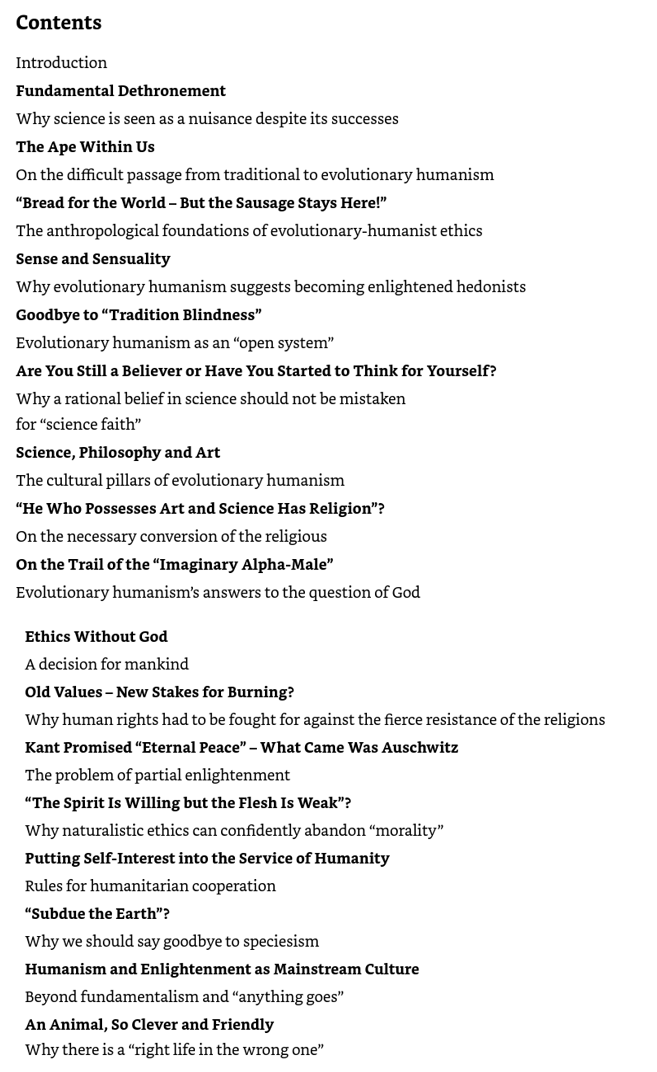
MAIN IDEA:
The main idea of this book is that humanity developed a huge
gap between its technological development and its philosophical and moral
understanding of reality. The author compares it to the situation when a
5-year-old child gets to control a jumbo jet with passengers, which could lead
to a disaster. So here is the author’s explanation of what it is all about:” The
present “Manifesto of Evolutionary Humanism” was commissioned by the Giordano
Bruno Foundation.4 It will attempt to formulate the basic positions of a
“contemporary enlightenment” appropriate to the modern world. The publication
of the manifesto serves the intention of supporting those who already feel
committed to a mainstream culture of humanism and enlightenment, as well as the
hope that some of the arguments presented here may yet reach those who, even
today, are of the opinion that they have to take their “wisdom” from archaic
myths.”
MY TAKE ON IT:
I probably agree with about 60% of the ideas in this manifesto, especially those regarding science and the unnecessity of a god for morality. However, I think that the author mixes two separate and unmixable things: knowledge and beliefs. Knowledge is a testable representation of reality in the human mind, enabling humans to act effectively and even somewhat efficiently. Belief is an untestable description of the world that provides psychological comfort and effective cooperation between individuals, all the way to true believers sacrificing themselves to protect this belief. There is nothing childish in believing, and the belief in science is no more justified than believing in God as long as these beliefs remain in the proper area of worldview combined with tolerance and acceptance of other worldviews as legitimate, however idiosyncratic. The problem emerges when people start moving their beliefs into the area of action, combined with intolerance. At the minimum, this could be somewhat deleterious to human well-being when resources are spent to build temples for God rather than housing for humans. Still, it is as bad, if not more so, when resources are spent to implement some “Great Leap Forward” or implement “collective farms-based agriculture according to principles of scientific communism.” The tolerance of the worldviews of others is absolutely necessary because otherwise, we are getting screwed, and it does not that much matter if it is by the Inquisition in the name of God or by the KGB in the name of a bright, scientifically defined communist future. Finally, morality is just an evolutionary developed set of rules for interaction between humans that assure that such interaction benefits all participants, preventing them from fighting and/or taking advantage of each other. A society without morality could not be stable and, therefore, will fail in competition with other societies.
20240505 – Big Intel

MAIN IDEA:
This book is written by a journalist who spent decades working in close contact with US intelligence agencies, such as the CIA and the FBI. Here is how the author defines what it is all about:” All utopian movements and societies require enforcers. Big Intel is about how these former protectors of American founding principles have followed societal trends to become the secret services of critical theory and fonts of the democracy-demolishing wokeness that the theory animates. This is a counterintelligence story—a chronicle of a battle the FBI and CIA fought for decades before they succumbed to a generations-old hostile foreign intelligence operation to destroy the United States and Western civilization from within. It’s about how American foreign intelligence was targeted and attacked as soon as it was founded. These attacks were not about partisan politics—yes, the FBI and CIA did meddle in domestic politics and still do—but something far deeper: they were meant to turn American instruments of power into enforcers of the vanguards spearheading the fundamental transformation of our country. Big Intel seeks to answer how it happened.”
MY TAKE ON IT:
All secret services of all countries are always instruments
of power. It is never the power of some abstraction, such as people, but rather
the power of a specific group controlling society’s resources and its political
and bureaucratic machinery. In a functioning democracy, resources and control
are divided between competing groups. For example, from the beginning of the
USA until the end of the Civil War, it was between Northern plutocrats and
Southern aristocrats. When the author started his career in the 1970s, it was
between business interests combining rich, middle-class business owners and
professionals represented by the Republican party and government-dependent
groups such as federal, state, and local bureaucracies, unions, welfare
recipients, and educational/cultural establishment represented by the
Democratic party. In this environment, the CIA and FBI remained more or less
neutral, directing their efforts mainly against foreign aggression and internal
criminality. While these are government bureaucracies, their role as the proper
and necessary tools of government psychologically separated members of these organizations
from other bureaucracies that mainly do staff improper for the government, such
as wealth redistribution. The huge growth of government bureaucracies in all
areas of life shifted a lot more areas of life under government control. Hence,
many previously independent groups, such as top-level business managers,
educators, medical professionals, and artists, became dependent on the
government’s handouts. Consequently, divisions within society changed from a
kind of vertical wall when approximately equal power groups, each with its own
elite and masses maintaining dynamic stability, into a kind of horizontal
separation between different floors of society, with united politically/bureaucratic/big
business elite comfortably sitting at the top level, when masses at the bottom
are losing the quality of lives as a result of the various pursuits of the
elite from globalization to climate alarmism. In this environment, the
governmental bureaucracies of the CIA and FBI necessarily lost any shade of
neutrality and had to act to protect their class interests. The big problem is
that the elite, even if it includes 25-30% of the population, is still a
minority. Its isolation and self-protection inevitably lead to incompetence
plentifully demonstrated by lost wars, massive technology, and wealth transfer
to communist China at the expense of the American population, failure in
handling COVID-19, massive illegal immigration, and other developments of
contemporary life. All this makes
society’s condition unstable and will lead to qualitative changes in its
organization and conditions. It reminds me of the last years of the Soviet
Union, including such features as the gerontologic leadership of the country
and its inability to make things work as they used to.
 Equal Rights Libertarian