
20240224 – Systems of Survival

MAIN IDEA:
Here is the author’s definition of the main idea of this book:” This book explores the morals and values that underpin viable working life. Like the other animals, we find and pick up what we can use, and appropriate territories. But unlike the other animals, we also trade and produce for trade. Because we possess these two radically different ways of dealing with our needs, we also have two radically different systems of morals and values—both systems valid and necessary.” From here follows the definition of two syndromes: Commercial and Guardian. Then, the book explores various aspects of these two syndromes, including their morals and corresponding types of human behavior depending on the preponderance of one or another syndrome in the worldview of individuals. Here are the key points:


MY TAKE ON IT:
For me, it is extremely interesting that the author of this book came to the same conclusions that I did, only from a completely different point of view. I look at it from the point of view of goods and services production and distribution when processes are based either on the voluntary cooperation of individuals in possession of resources or on a violent hierarchy forcing individuals to cooperate whether they want it or not.
The author of this book looks at the same dichotomy from a moralistic point of view, going into the details about human behavior relevant to each Moral syndrome, which is a proper approach for the moral philosopher.
My approach is to look at what kind of a system could be implemented to obtain the best of both sides of this dichotomy, which is a proper approach for the systems engineer that I am. So, my conclusion is that such a system should be based on minimizing the use of violence (governmental hierarchy) and maximizing the use of voluntary actions of free individuals (ownership of self and resources).
By the way, I expressed my views in a small essay, and here is the link:
20240217 – Conflict

MAIN IDEA:
This book is based on the history of warfare after WWII. It reviews and drives lessons from multiple limited conflicts and, based on these lessons, presents recommendations for leaders of countries involved in such conflicts:” Leaders, some of whom are politicians in this book while others are soldiers, must be able to master four major tasks.2 Firstly, they need comprehensively to grasp the overall strategic situation in a conflict and craft the appropriate strategic approach – in essence, to get the big ideas right. Secondly, they must communicate those big ideas, the strategy, effectively throughout the breadth and depth of their organization and to all other stakeholders. Thirdly, they need to oversee the implementation of the big ideas, driving the execution of the campaign plan relentlessly and determinedly. Lastly, they have to determine how the big ideas need to be refined, adapted and augmented, so that they can perform the first three tasks again and again and again. The statesmen and soldiers who perform these four tasks properly are the exemplars who stand out from these pages. The witness of history demonstrates that exceptional strategic leadership is the one absolute prerequisite for success, but also that it is as rare as the black swan.”

MY TAKE ON IT:
I did not see much new information in this book, but looking at these conflicts from the point of view of one of the top-level participants and decision-makers was somewhat interesting. From my point of view, the most significant characteristic of these conflicts is a lack of will to win on the part of the more powerful side, which in all these conflicts was Western democracies. The basis of this deficiency comes from the inability of top leadership to define what will constitute victory and pursue this victory despite the losses inevitable in such conflict. In addition to high vulnerability to one’s own losses, contemporary Western democracies are oversensitive to the enemy’s losses, creating opportunities for the enemy to use methods of war that would be not only unheard of before but would be inconceivable even for Western leaders in WWII. Such methods are massive use of Western media by the enemies for propaganda purposes and use their own civilians as human shields. This resulted in a sad situation when millions of people lost their lives due to the humanitarian paralysis of Western powers. However, I believe that despite this problem persisting for the last 70+ years, it is coming to the end of its run. It is mainly because the surviving enemy becomes ever stronger and, at some point, develops an ability to cause unacceptable damage. A good example is the events on October 7, 2023, in Israel, when decades of Israeli society’s division with a significant part of the population looking to accommodate the enemy finally understood the impossibility of such accommodation. Consequently, I expect that we are entering a qualitatively new type of war when the technological superiority of the West will be used quickly and decisively to achieve clearly defined objectives while removing all considerations except for operational effectiveness in the use of weapons and methods of war.
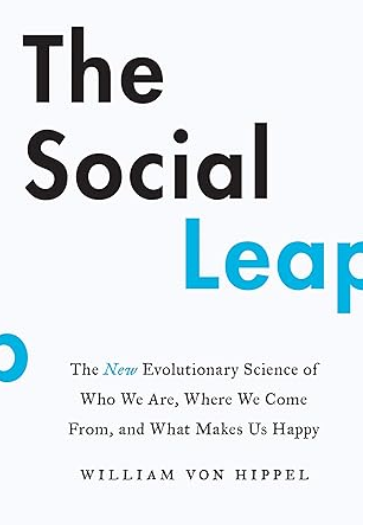
20240210 – The Social Leap
MAIN IDEA:
This book discusses the evolutionary development of humans a bit differently than usual. Here is the author’s main point:” What’s less obvious is the role that evolution played in shaping our psychology. We tend to think of evolution in terms of anatomy, but attitudes are just as important for survival as body parts. Preferences that don’t fit your abilities are as debilitating as limbs that don’t suit your lifestyle. Our bodies changed a little over the last six or seven million years, but our psychology changed a lot. Indeed, our evolution away from chimpanzees is marked primarily by adaptations to our mind and brain. The most important changes in our psychology concern our social functioning, particularly our capacity to work together.”
There is also a fascinating discussion about acquiring historical knowledge when there is little to no material evidence. A good example is the history of clothing based on an analysis of the genetic evolution of human louse. “The Social Leap” under discussion is the environmental change in human habitat from forest to savanna that directed evolution to the development of unprecedented levels of cooperation between individuals that made us human.
The book also goes on to discuss further human developments in cooperation, self-control, and innovation that made us the dominant species on this planet. There is also a high level of intellectual diversity generated by the need for different skill sets for the effective functioning of complex societies. Here is a very nice graph for the diversity of social orientations:

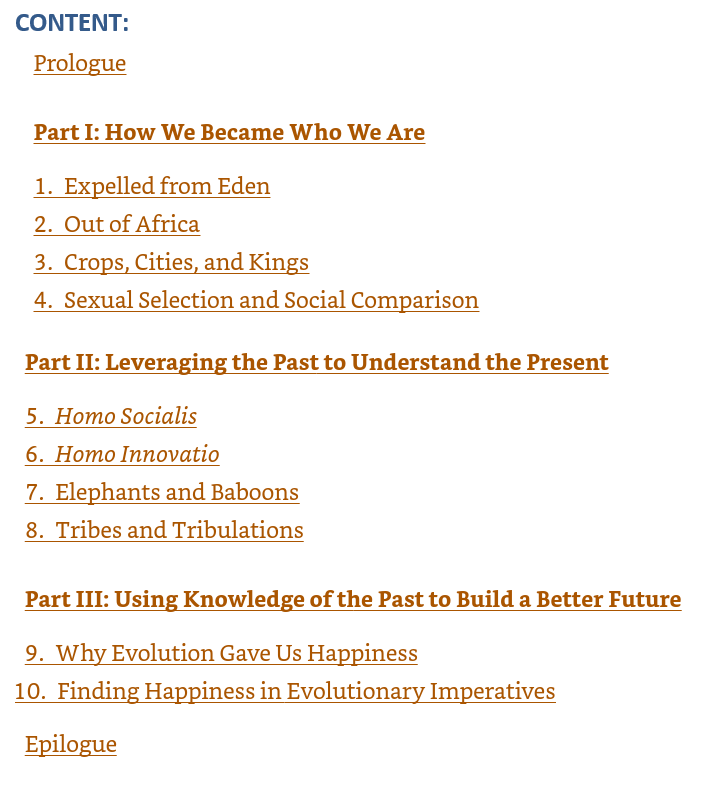
The book’s final part discusses the application of evolutionary knowledge to the pursuit of happiness.
MY TAKE ON IT:
I like this book’s approach to understanding human nature in light of the analysis of evolutionary conditions of human development. Such an approach is the only valid approach, unlike a typical approach from a moralistic or ideological point of view, either secular or religious. This is also necessary because the effective pursuit of happiness is only possible by understanding what makes us happy, which understanding could come only from understanding human nature formed by evolutionary pressures for survival.
20240203 – The Idea of Decline

MAIN IDEA:
At the very beginning of this book, the author makes an important note that the book is about the idea of the decline of Western civilization, not about the decline per se. It describes the cultural tradition of pessimism and how it was expressed in literature and intellectual debates. Here is the author’s description with reference to relevant authors:
“But we will also see that the idea of decline consists of two distinct traditions. For every Western intellectual who dreads the collapse of his own society (like Henry Adams or Arnold Toynbee or Paul Kennedy or Charles Murray), there is another who has looked forward to that event with glee. For the better part of three decades, America’s preeminent thinkers and critics—from Norman Mailer, Gore Vidal, Thomas Pynchon, Christopher Lasch, Jonathan Kozol, and Garry Wills to Joseph Campbell, Joan Didion, Susan Sontag, Jonathan Schell, Robert Heilbroner, Richard Sennett, Noam Chomsky, Paul Goodman, Michael Harrington, E.L. Doctorow, and Kirkpatrick Sale, not to mention Cornel West, Albert Gore, and the Unabomber—have advanced a picture of American society far more frightening than anything pessimists like Charles Murray or Kevin Phillips could come up with. As a critique of Western industrial society, it dates back to the nineteenth century. In this point of view, modern society appears as greedily materialistic, spiritually bankrupt, and devoid of humane values. Modern people are always displaced, rootless, psychologically scarred, and isolated from one another. They are, as the Unabomber puts it, “demoralized.” The key question now becomes not if American society or Western civilization can be saved, but whether it deserves to be saved at all.”
At the end, the author concludes:
“… the whole debate over “the decline of the West” presents us with a false set of choices. The alternative to historical pessimism about the future of modern society is not optimistic complacency: they are opposite sides of the same holistic view. The alternative to cultural pessimism is not some sort of megatrend “third wave” or other futurological adventure of authors like Warren Wagar and Alvin Toffler. The classical liberal view originally sprang up precisely because its adherents recognized the dangers of insisting that individuals have significance only if they are part of a larger whole. In earlier times, that holisticorganic model had been “the great chain of being,” in which a person’s status was assigned by God and nature and enforced by political authority. Enlightenment thinkers rebelled against this sort of social determinism; John Locke defined this position of “being under the determination of some other than himself” without that individual’s consent as a form of tyranny. One of the great blessings of the civilizing process, the Enlightenment concluded, is that it raises humans above that servile status by making them aware of their individual rights, interests, and powers as well as free from irrational passions and fears.”

MY TAKE ON IT:
For me, the American pessimism provides a somewhat funny contrast with the Soviet optimism, which surrounded me for the first part of my life. The funny parts come from the completely opposite character of these cultural environments. When one steps out of the milieu of books and debates into reality, the American and Soviet worlds could not be more different. The depressive mood of American pessimism when one reads about rotten capitalism crimes of the past, the misery of the present, and the imminent doom of the future immediately dissipates under the reality of a nice room, a car that could bring you anywhere, conditions of surrounding comfort, availability of any food and goods conceivable and freedom to read, think, and do just anything one desire. In contrast, in Soviet life, the feeling of optimism and excitement from anticipating the wonderful future of communism quickly turns into frustration caused by the need to wait in line for any necessity of life, the impossibility of traveling, the stifling bureaucracy of everything around and, finally, recognition of the reality that wrong thinking or reading something not approved by the party could bring a prison term.
Lots of people treated the cognitive dissonance of Soviet life by ceasing to believe in anything, which eventually led to the destruction of Soviet society. The question is, would it be possible for cognitive dissonance in American life to end up in the destruction of American society? I think it will not, mainly because the many anti-American, parasitic quasi-intellectuals will fail to generate support from the majority of regular people for such destruction. The massive intellectual pessimism did attract the support of a mass movement of unproductive people leaving on handouts from the administrative welfare state. However, these supporters are too weak to withstand the backlash from the majority that will inevitably demand the return to traditional American values that proved their ability to support the realization of the American dream of freedom and high quality of material life. It will probably not happen easily and smoothly, but it will happen anyway. After that, the American intellectual pessimism will be moved to the dustbin of history, accommodating a cozy place next to communism.
 Equal Rights Libertarian