
20240127 – Population Bombed
MAIN IDEA:
Unlike a great number of authors, the author of this book clearly identified its objectives and specific contributions that it intends to make. Here they are:
“This book is an attempt to present a relatively concise case for the environmental benefits of economic development, population growth and the use of carbon fuels.
- It explains how, paradoxically, economic prosperity and a cleaner environment are the direct results of both population growth and humanity’s increased use of fossil fuels. Today’s positive outcomes would have been impossible without them.
- It argues that while the predicted catastrophic impacts of climate change remain still largely uncertain, and in need of open scholarly debate instead of rigid consensus, the ongoing campaigns to reduce or constrain the development of fossil fuel use in the absence of truly affordable and electric-grid-friendly alternatives guarantee several negative outcomes:
- a large death toll in developing economies;
- a growing number of economically vulnerable people being pushed into energy poverty in advanced economies;
- an alarming trend of replacing products ultimately extracted from underground (for instance, synthetic products derived from fossil fuels) with resources that are produced on the ground (for instance, “renewable” but unsustainable products made from plants and animals), a process that can result in widespread damage to ecosystems.
The distinctive features of this book are:
- Its comprehensive historical coverage of:
- the long-standing debate between people who fear the economic and environmental impacts of population growth and those who believe that, in the context of market economies, more people are more hands to work and more brains to innovate, not merely more mouths to feed;
- how fossil-fuel-derived products alleviate environmental pressures by replacing resources extracted from the biosphere by resources extracted from below the ground.
- Its insight into why looking at human population growth as though it were similar to that of any other species (for instance, bacteria in a test tube full of food) is profoundly misleading and mistaken. In the book, we highlight that, unique among other species, modern humans transmit information and knowledge between individuals and through time, innovate by combining existing things in new ways, and engage in long-distance trade, thus achieving, to a degree, a decoupling from local limits.
- Its detailed discussion of why, even after two centuries of evidence refuting the pessimistic narrative on population growth, resource availability and environmental impact, that viewpoint still dominates academic and popular debates. The issues the book examines range from financial incentives among academics and activists to behavioural insights into why well-meaning people are unable to change their mind when confronted by contrary evidence.”

MY TAKE ON IT:
I think that from the scientific point of view, there is no reason for hype and alarmism surrounding the issues of climate change, population growth, and economic growth consuming finite resources.
- Climate change is occurring within the normal range for this planet and even within a narrow range of temperatures of the last few centuries after the Little Ice Age. It is quite obvious for anybody who looks at temperature charts and records.
- It is somewhat strange that there are still people worrying about unsustainable population growth when, by now, every culture in the world has convincingly demonstrated that when children turn from a critical source of resources in old age into a hugely expensive luxury, there are a lot less people willing to produce a lot of them. To satisfy the need for parenting, 2.1 children per woman is more than enough, and it is just a maintenance level with 0 population growth.
- Similarly, fear of the constantly growing consumption of material resources is overblown because new technologies constantly decrease the need for input per unit of output. Finally, human interaction with the environment constantly decreases in volume and improves in quality. As an example, one should only look at the land use in North America in the XIX and XXI centuries. In the XIX century, humans converted huge amounts of land into low-intensity agricultural production assets; in the XXI century, a lot of this land turned back into forests because the need for land for agriculture decreased due to productivity.
The real causes of environmental alarmism are not one or all of the above. The cause is the will for power and striving to obtain control over the lives of other people. All this alarmism is just a substitute for what used to be sold as the will of God(s) demanding the people to subordinate their lives to the wishes of the elite. The proper remedy is not an explanation of scientific facts and a search for accommodation. It is a forceful imposition of consequences of environmental craziness on people who promote it. For example, individuals who demand to substitute fossil fuel with wind and solar power must be forced to use only such power and pay full price for such use. For individuals who demand to stop regular people’s travel, it should be illegal to use private planes unless these planes use only wind or solar power. Somehow, I am pretty sure that if alarmists get to pay the price of alarmism instead of getting power over regular people, all these mainly fictitious alarms will calm down, and children with mental problems like Greta Thunberg could sleep tight at night.
20240120 – Happiness Lessons from a New Science
MAIN IDEA:
This book is about the paradox of happiness, which the author defines as the maintenance of the same level of happiness in developed countries despite the doubling of income and the implementation of many quality-of-life improving tools, from air-conditioning to the Internet. The author defines happiness this way:” Happiness is feeling good, and misery is feeling bad. At every moment we feel somewhere between wonderful and half-dead, and that feeling can now be measured by asking people or by monitoring their brains. Once that is done, we can go on to explain a person’s underlying level of happiness—the quality of his life as he experiences it. Every life is complicated, but it is vital to separate out the factors that really count. Some factors come from outside us, from our society: some societies really are happier. Other factors work from inside us, from our inner life.”
After that, the author provides what he believes are the defining factors of happiness:”
• Our wants are not given, in the way that elementary economics assumes. In fact they depend heavily on what other people have, and on what we ourselves have got accustomed to. They are also affected by education, advertising and television. We are heavily driven by the desire to keep up with other people. This leads to a status race, which is self-defeating since if I do better, someone else must do worse. What can we do about this?
• People desperately want security—at work, in the family and in their neighbourhoods. They hate unemployment, family break-up and crime in the streets. But the individual cannot, entirely on his own, determine whether he loses his job, his spouse or his wallet. It depends in part on external forces beyond his control. So how can the community promote a way of life that is more secure?
• People want to trust other people. But in the United States and in Britain (though not in continental Europe), levels of trust have plummeted in recent decades. How is it possible to maintain trust when society is increasingly mobile and anonymous?”
At the end of the book, the author provides a to-do list for society to make people happy. Here is the concise version:”
• We should monitor the development of happiness in our countries as closely as we monitor the development of income.
• We should rethink our attitude on many standard issues. (taxes, performance-related pay, mobility)
• We should spend more on helping the poor, especially in the Third World.
• We should spend more on tackling the problem of mental illness.
• To improve family life, we should introduce more family-friendly practices.
• We should subsidise activities that promote community life.
• We should eliminate high unemployment.
• To fight the constant escalation of wants, we should prohibit commercial advertising to children.
• Finally, and perhaps most importantly, we need better education, including, for want of a better word, moral education. “

MY TAKE ON IT:
This book provides a lot of valuable information about statistical, sociological, and psychological research in all areas related to happiness. It is all interesting, but I think that the key attitude compressed into “We as a society should do X to make people happy” reminds me a little bit of the old communist slogan:” With an iron fist, we’ll force humanity into the happy future.” I believe that such an approach is counterproductive for the simple reason that human life is a very dynamic process, and it is not possible to define what makes people happy at any given time. So, the role of society should be to create such arrangements that individuals are capable of obtaining all the resources they need to become happy, whether these resources are material, informational, or psychological. The role of science should be to produce information for personal use to help people understand what will make them happy and what to do to achieve it. In other words, accelerate the acquisition of life experience to minimize the difference between a 20-year-old belief of what will make him/her happy at 50 and 50-years-old being happy or not. Any other approach, when person A decides what should be done by person B for happiness and forces this action, works only to increase happiness from the exercise of power for person A at the expense of person B.
20240113 Levinovitz, Alan – Natural

MAIN IDEA:
This book asks the question:” HOW CAN WE LIVE IN HARMONY with nature?” and then attempts to provide the answer that the author defines in the following way:” This book is a comprehensive response to that question. Instead of choosing sides, it shows how the framing is fundamentally misguided and counterproductive. An oppositional binary between “natural” and “unnatural” inhibits constructive dialogue about humanity’s most pressing problems. It trades complicated truths for the comfort of clear categories. It encourages dogmatism over compromise, certainty over humility, and simplicity over nuance.” The bottom line is the recognition of the meaninglessness of the division of the world into natural and unnatural when humans and everything that they produce are parts of this world. The author also discusses attempts to derive morality from natural vs. unnatural in such cases as homosexuality. There is also a discussion of the theological aspect of nature’s goodness vs. humans’ unnatural badness, concluding that:” The best future for humanity and nature must be built on dialogue and evidence, not taboos and zealotry.”. Finally, the author discusses the interplay between science and natural/unnatural approaches in multiple areas, from economics to nature vs. nurture’s role in the formation of personality. At the end of the book, the author concludes:” I am more philosophically confused about nature than I was when I began. Maybe you feel the same way, full of questions instead of answers. This is no reason for shame or guilt. It is not something to be overcome. Uncertainty is humility, and humility can also be sacred, its own source of rituals and laws, which, like nature, can change while remaining true to themselves.”
MY TAKE ON IT:
In my simple mind, all these “natural vs unnatural” notions are just stand-ins for good vs bad and are somewhat puzzling. I think everything that exists is natural, and only imagination can create something that is not natural. For example, everything moving below the speed of light is natural, something moving with warp speed is not, unless it is observed in reality, causing humans to come up with some improvements to the theory of relativity. All human actions are natural, as well as the artifacts produced by these actions. They are as natural as artifacts produced by other animals, be it beaver-built dams or termite mounds that have air conditioning. It really does not matter that termites build their mounds without planning committees, budgeting, and government approvals.
Nature is not a conscious entity and, therefore, could not possibly care about humans and the products of their activities. Humans, however, have to care because any changes produced by humans or occurring regardless of their activity always do one of two things: they either make human life easier or more difficult. I support the idea that the powerful and energetically costly human brain was evolutionally developed as a tool to be used for speedy adjustment to environmental changes. For example, the ice age that moved at the speed of a couple of thousand years left no chance of survival for a naked ape without enough brain because DNA change required to grow fur cover required a much longer time. The naked ape with a powerful brain can learn to use the fur of other animals a lot faster than that. The process of adjustment speeds up considerably because it worked so well that humans multiplied to the level that required new adjustments. We came to the end of the human expansion phase when adjustments were local and are at the beginning of the global accommodation phase that will result in the state of dynamic accommodation to an always-changing environment based on a scientific understanding of these changes. This could occur only if there is freedom of scientific discussion, research, and debates. Otherwise, humanity will suffer from religious and quasi-religious movements such as global warming (climate change) that suppress real science and direct resources to waste. I believe that eventually, dynamic accommodation will be achieved, but lots of people will pay a high price with the misery of their lives for trusting crooks that promote quasi-religious environmentalism.
20240106 – Fourth Turning is here

MAIN IDEA:
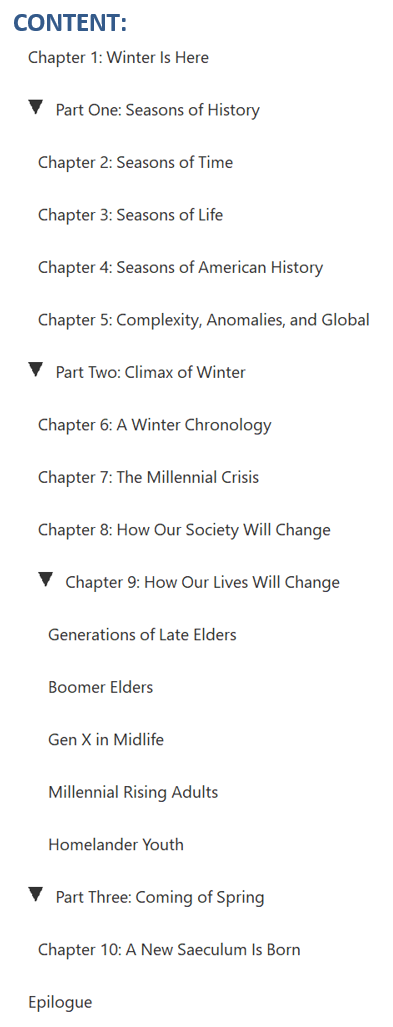
This book is an update on the previous work of the author about the seasonal character of human society development. The seasons are called turnings, last for about 20 years each, and are caused by generational changes. Each generation is formed by the environment created by the previous generation, or at least somewhat rejects it, creating a new environment for the next generation. Here is how the author defines his objective:
Over the course of this book, I hope to persuade you of a more ancient yet also more optimistic doctrine: that our collective social life, as with so many rhythmic systems in nature, requires seasons of sudden change and radical uncertainty in order for us to thrive over time. Or, to paraphrase Blaise Pascal: History has reasons that reason knows nothing of.”
In this book, the author concentrates his attention on the current season – Winter when society dramatically changes and becomes something new, quite different than what it was before. The author predicted this season of wars and revolutions since the early 1990s and was correct in both: its timing and severity. It started in 2008 with the financial crisis and is expected to last until the late 2020s or early 2030s. How society will look at the end is unknown, but the author is convinced that it will be radically different. After that, Spring will come and the newly renovated society will begin increasing its prosperity if the change is positive such as winning a war, or it will begin the process of adjustment and recovery if the change is negative such as losing a war.
MY TAKE ON IT:
This is one of a few books that prophecies coming of the difficult time, or, more precisely, demonstrate that the difficult time is here. It is hard not to agree with this evaluation if one just looks at today’s news. The current condition of human societies everywhere in the world is unstable. The previously dominant Western societies are ideologically undermined from within by allowing the takeover of their institutions by the elite clearly hostile to its philosophical foundation based on ideas of enlightenment, human rights, equality of individuals before the law, tolerance of religions, and economic freedom. They were also undermined by the economic elite that implemented the transfer of productive facilities to totalitarian countries such as China and established dependence for raw materials and energy on such culturally and ideologically hostile entities as Russia and countries of the Middle East. Finally, they allowed and encouraged mass immigration of culturally and ideologically hostile individuals that undermined the cohesiveness of society and even caused multiple terrorist attacks and suppression of individual freedoms. Finally, they created massive external threats by transferring technology to China, Russia, and other hostiles bent on changing the world order to the new one when the dominant power will be in the hands of totalitarians and individual freedom will be eliminated all over the world.
This is a pretty gloomy picture, but it is by far less gloomy than it was 80 years ago when the totalitarian powers of Nazi Germany, the Soviet Union, Imperial Japan, and fascist Italy were on the brink of taking over the world in the Spring of 1941 after the alliance of Hitler and Stalin pretty much completed the takeover of continental Europe, while Japan was well advanced in Asia. However, totalitarians largely failed because they turned on each other and Hitler attacked Stalin, just before Stalin was ready to attack Hitler.
The current situation is better because totalitarian China still has a relatively weak military and Russia has a lousy economy. Both also demonstrated that their strong sides: China’s economy and Russia’s military are quite weak under the façade of strength. As to internal threat, the anti-Western ideological elite that captured institutions brought these institutions down, increasingly convincing the population that these institutions must be cleaned up or even destroyed because of their hostility to regular people. Anyway, I am pretty sure that the next few years will be exciting to watch.
 Equal Rights Libertarian