
Home » 2024
Yearly Archives: 2024
20241229 – Sentience
MAIN IDEA:
This book is about conscience, sentience, the relationship between these two notions, and the evolutionary meaning of their development. The author defines these notions thus:
“The adjective ‘sentient’ came into use in the early seventeenth century to describe any creature—human or otherwise—that responds to sensory stimuli. But the meaning subsequently narrowed to put emphasis on the inner quality of the experience: what sensations feel like to the subject.”
“Consciousness means having knowledge of what’s in your mind. Your conscious mental states comprise just those states to which at any one time you have introspective access and of which you are the subject.”
After that, the author presents the results of the research on monkeys with different parts of the brain disabled and some unexpected results that it produced. The author also discusses sensations and perceptions using such framework:” “Sensations are about what’s happening to you at your sense organs. Perceptions are about the state of the world.”
Finally, the author allocates much space to discussing non-human sentience and conscience. Eventually, he concludes:” While we needn’t doubt that there are many other life forms out there in the universe, we’ve come to see that the evolution of life, even intelligent life, will not necessarily have entailed the evolution of phenomenal consciousness. On Earth, it has so happened that a sequence of ‘lucky’ breaks paved the way for it to evolve as it has done in mammals and birds. On Earth, if the same local conditions were to hold, it’s quite possible that the sequence could be repeated. But outside the Earthly environment all bets are off. The chances of phenomenal consciousness having evolved somewhere else in the universe could be vanishingly small.
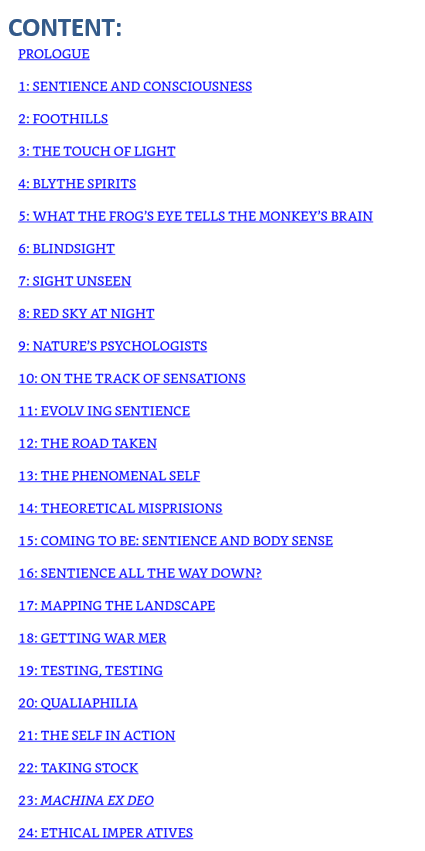
MY TAKE ON IT:
I think that sentience is a common feature of any object, whether living creatures or automata, capable of changing its condition in time and space due to interacting with the surrounding environment to achieve whatever objective this object has. Obviously, a more complex system, especially if it is biological, possesses much more complex internals and, therefore, has less predictability of change in internal conditions in response to stimuli. At some point, these internals include conscience as a tool that allows individuals to cooperate with others at high levels of sophistication and to handle a rapidly changing environment with success impossible at the lower levels. A big part of this cooperation is a highly developed language that allows conscientious creatures not just to transfer complex information but also to save it in distributed form so a group can do something that nobody can do alone. Moreover, it allows intergenerational cumulative transfer, leading to eventual progress in dealing with the environment from generation to generation. In other words, expanding sentience into conscience is not inevitable, but if it happens, it provides a huge evolutionary advantage.
20241222 – Theory of Irregular War

MAIN IDEA:
This book is about a specific way of conducting a war, and here is how the author defines the general meaning of war:” Whether those ways are conventional/unconventional, regular/irregular, symmetric/asymmetric, overt/covert, Napoleonic/Fabian, or any other diametric word pairing is irrelevant at the level of analysis dealing with war itself. War is a sovereign weapon expressed through organized violence between parties clashing over incommensurable policies.”. The author defines the objective of the book this way:” This book will accomplish two things: I will show that existing theoretical frameworks are insufficient to understand and explain irregular wars and I will present a novel theory that can. To do so, let us begin with a technical definition of irregular war. Irregular war is the apotheosis of conflict between the people and the state, a violent dialectic between a faction and a sovereign expressed outside existing political institutions.
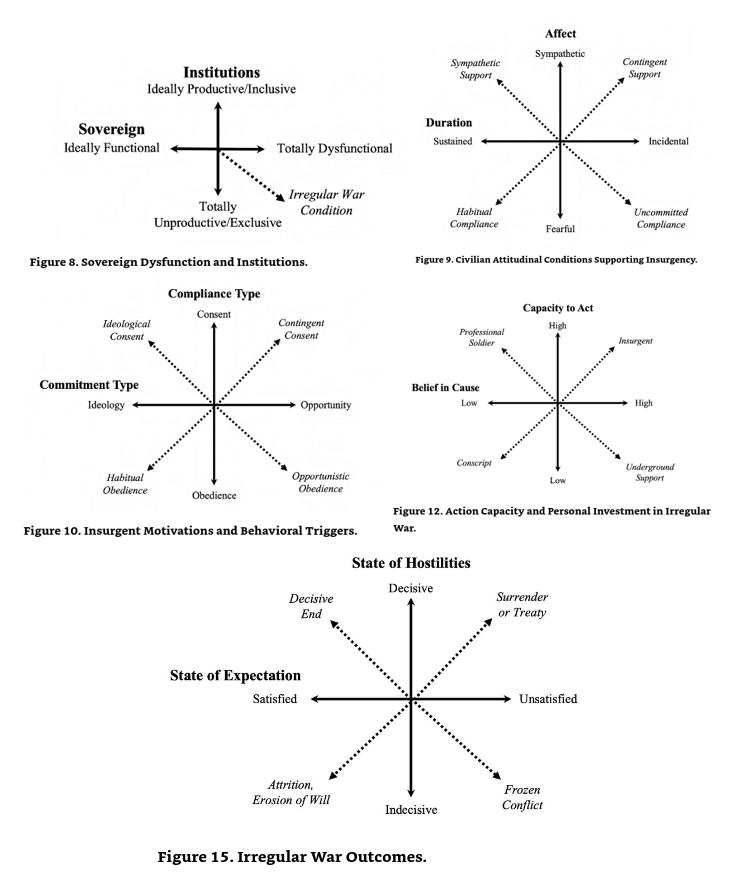
The author nicely summarizes his theory in a few graphic representations:

MY TAKE ON IT:
The author based the discussion of this book mainly on examples of colonial wars, such as the French in Algiers, or wars of external support for unpopular regimes, such as the American war in Vietnam. I think the author underestimates the role of external support for the irregular side of the war. There would be no serious resistance in Algiers or Vietnam without Soviet and Chinese support, which provided resources and save heavens for regrouping, rest, and resupply. When such support was weak or nonexistent, as was the case for Ukrainian and Baltic states’ resistance against the Soviet Union, the colonial power always won, even if it took a few years. The problem was that the Western powers tended to overcomplicate situations and overly rely on pseudo-expert opinion (pseudo because these “experts” often did not even know the local languages). Most importantly, they typically defined unrealistic objectives and tried to fit reality into the rigid framework, either turning Algier into France despite the huge cultural gap between populations or winning the hearts and minds of Muslim tribesmen in Afghanistan for American-style democracy. The realistic objective would be to eradicate whoever supports hostile, terroristic actions as quickly as possible and get out. If, after that, terrorist activities resume, come back, repeat, and get out. After a few repetitions, the normal evolutionary process would work out, leaving in place peaceful survivors who hate the very idea of terrorism and its inevitable consequences. There should be no attempts to impose on people values that are not acceptable to them, such as Western civilizational values of individual freedom and democracy.
20241215 Ranganath, Charan – Why We Remember
MAIN IDEA:
This is the look at memory from the point of view of human evolution. The author’s main point is that memory is nothing like computer memory with write/read features, albeit not as reliable and photographic. Here are the two most important author’s definitions:
- Memory is much, much more than an archive of the past; it is the prism through which we see ourselves, others, and the world. It’s the connective tissue underlying what we say, think, and do.
- We forget because we need to prioritize what is important so we can rapidly deploy that information when we need it. Our memories are malleable and sometimes inaccurate because our brains were designed to navigate a world that is constantly changing: A place that was once a prime foraging site might now be a barren wasteland. A person we once trusted might turn out to pose a threat. Human memory needed to be flexible and to adapt to context more than it needed to be static and photographically accurate.
The author also provides an excellent technical description:” I think of memory as the process by which our brains change over time. As we go about our lives, connections between neurons are constantly formed and modified, resulting in cell assemblies that help us sense, interact with, and understand the world around us. These intricately connected neural networks give us the ability to weave together the threads of the past so that we may envision how the future will unfold.”

MY TAKE ON IT:
I fully agree with the author that human memory has developed as an effective tool for survival and, as such, provides not an accurate picture of the past but rather a presentation of reality compiled from a combination of previous presentations and current inputs from both the external environment and the body’s internal conditions. This presentation serves one and only one purpose: to prompt such action or inaction that in the past was beneficial for survival and procreation. For conscientious beings such as humans, memory defines the notion of self and where this self belongs in relation to other selves and within the universe.
From this, I’d like to draw the important conclusion that we cannot rely on human memory in many important areas, from witness evidence to a view of past events and interactions.
Luckily, we have technology that allows us to save audio and visual information in just about any conceivable circumstance, and this technology improves constantly. So, any review and analysis of past events, whether a crime or who said and did what and where, should be based not on witness evidence but on technical recordings. However, it also contains the danger of modifying the recording using AI. The only way it could be prevented is by continuing blockchain postings of everything from everybody. It would be absolutely inconceivable back in the 1970s when we saved 2 bytes on a timestamp of the year, but it is conceivable now when we can carry terabytes of data on keychains in our pockets.
20241208 Khan, Salman -Brave New Words
MAIN IDEA:
This book presents some of Khan Academy’s history, but it is mainly about how the AI tool ChatGPT is used to improve its online courses. Based on this experience, the author defines the opportunity provided in this way:” What might it be like if every student on the planet had access to an artificially intelligent personal tutor: an AI capable of writing alongside the student; an AI that students could debate any topic with; an AI that fine-tuned a student’s inherent strengths and augmented any gaps in learning; an AI that engaged students in new and powerful ways of understanding science, technology, engineering, and mathematics; an AI that gave students new ways of experiencing art and unlocking their own creativity; an AI that allowed for students to engage with history and literature like never before?”
The author clearly understands that the old structure of labor and management as a pyramid is going away due to the automatization of everything everywhere with AI tools and envisions a solution in reforming education:” The real solution is to invert that labor pyramid so that most people can operate at the top and use AI and other technology for their own productivity and entrepreneurship. The only way we have a hope of doing this is to use the same AI technology to lift the skills of a large chunk of humanity in the coming decades.”

MY TAKE ON IT:
This is a very good report from the trenches of the fight for real education vs indoctrination. The author is absolutely correct that only switching to an AI-supported education process could provide the knowledge and skills necessary to maintain competitiveness in the labor market. However, if one rises above the narrow field of education and looks at the bigger picture of the economy, it would be obvious that the very need for human labor becomes obsolete, similar to the need for animal muscles for transportation. All human activities necessary to produce goods and services will become automated within the next 50 to 100 years because no human can compete with machines in producing goods and services, regardless of how complicated the production process is. So, the objective of education should switch from molding human beings who are good, reliable, and effective pieces of business or government hierarchy into individuals possessing the knowledge and skills necessary for self-fulfillment and the pursuit of happiness. It does not mean there will be nothing to do for individuals with scientific curiosity or entrepreneurial drive. It just means that such people will be able to satisfy their needs without other people spending their lives doing soul-killing routine jobs. Just imagine Henry Ford without the need for assembly line workers and engineers because AI-controlled automated tools can not only manufacture cars but also design these cars and do everything else necessary. In this case, we can have a wide variety of ideas for transportation that could be analyzed and processed in cyberspace, with actual production implemented only as needed. Obviously, it will require restructuring of society’s organization and resource allocation, which I believe will move in the direction of increasing individual freedoms via the expansion of private property in such a way that it would be available to everybody without diminishing rewards for the individuals most effective in creating something that other people need.
20241201 – A Theory of Everyone
MAIN IDEA:
The author claims that humans generally poorly understand themselves and their environment, analogous to fish that do not know what water is. So, here is the general description of the book per author:” This book is about the species called Homo sapiens…. From ancient bacteria-like life forms, humans have evolved through various laws that we shall explore in this book. But the forces that shape our thinking, our economies, and our societies have become invisible to us. And this leaves us with a deep, potentially existential problem. If we do not know who we are and how we got here, we cannot choose where we go next. If we cannot perceive the forces that shape us, we are impotent to shape these forces.”
Correspondingly, the author’s objective is to suggest what to do next:” It is about the future of humanity; about how each of our actions contributes to a collective brain. It’s about how Homo sapiens can reach the next level of abundance that leads to a better life for everyone and perhaps one day a civilization that spans the galaxy. And it’s about the things that stand in the way of getting where we need to be and what we can do to overcome them. Because today we stand on the shore of a sea of possibilities. We must be careful in how we address the coming waves ahead of us; waves that threaten our now precarious fossil-fueled civilizations.”
Here Is a nice graph presenting the author’s understanding of humanity:
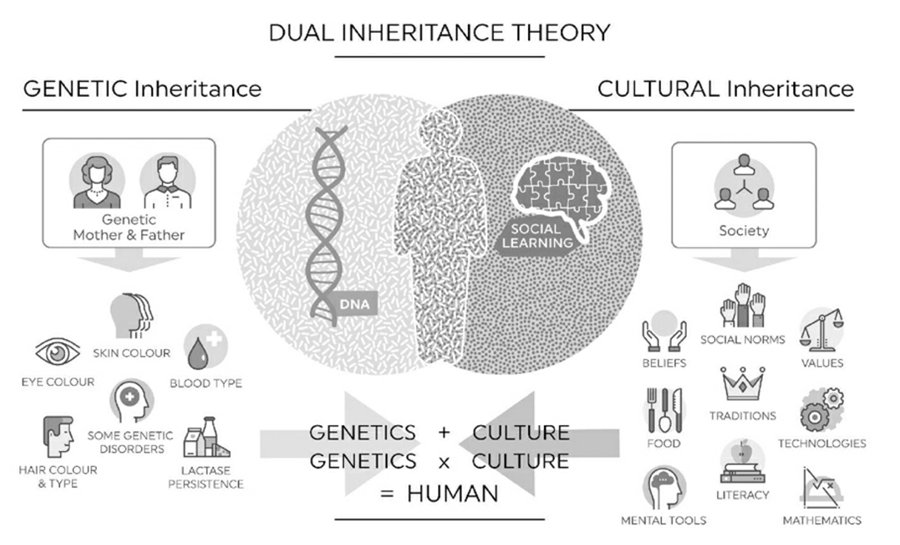
The author concludes with this:” I hope this book has provided tools for how to advocate and what to advocate for. Not proximate solutions that patch problems and polarize groups, creating more problems, but instead permanent systematic ultimate solutions. I hope I have helped you realize that our problems and their answers don’t lie with any particular leader, any particular person, or any particular group. They require us to consider the rules of the system and what they inevitably lead to. Often, we cannot design the right rules, but we can create conditions for the right rules to evolve.
We have laws of life and a theory of everyone. We have a periodic table for people.
I hope you now know the answer to what Wallace’s older fish asked. I hope you can now see the water. We have the power to shape our societies, to influence our systems, and to determine our future. We can crack the next energy revolution to create a world that is not just sustainable, but thriving; not just efficient, but just; not just innovative, but transformative. The laws of life will go ever onwards. If we make the right decisions, so too will we”.
CONTENT:

MY TAKE ON IT:
I agree with the author’s characterization of humanity, except for the idea of the “collective brain.” I think that the most harmful mistake in human thinking is the neglect of human individuality and the attempt to simplify humans by grouping them into cultural, ethnic, religious, and other groups. In reality, every human being could be represented by a multidimensional Venn diagram of genotypic and phenotypic features changing dynamically and unpredictably. Technological development makes all humans increasingly powerful, so the only way to prevent using this power against others is to ensure maximal freedom of individuals supported by resource availability and combined with the strict cultural upbringing that makes any attempt to force one’s own will on others psychologically impossible. It is also necessary to ensure the development of such attitudes to interhuman interactions that any attempt to do so would prompt resistance. In other words, we should move as close as possible to the psychological environment consistent with humanity’s background as hunter-gatherers when resources are available to everybody more or less equally, cooperation is voluntary, and leadership is based on competence rather than some formal hierarchical structure. Since different people are competent in various areas, the leadership would be fluid depending on which area requires cooperative efforts. I would guess that with the development of AI tools, the need for cooperation in the way when one individual must be a tool for achieving the objectives of another, such as a general/soldier or an entrepreneur/hired hand, will be diminished all the way to non-existence. In this case, voluntary cooperation would be directed mainly at achieving happiness via interaction rather than survival via sacrifice.
20241124 – How the World Made the West
MAIN IDEA:
This book represents the approach to history quite different from traditional when the world is divided into civilizations and the contemporary West is based on Greek and Roman civilizations. The author rejects this traditional notion and offers another view of the history defined this way:” There is no privileged connection between ancient Greeks and Romans and the modern “West”: the nation-states of western Europe and their settler colonies overseas. The capital of the Roman empire moved in the mid-first millennium CE to Constantinople, and remained there for over a thousand years. Muslims in the meantime combined Greek learning with science from Persia, India, and central Asia as new technologies streamed around Africa, Arabia, and the Indian Ocean, while sailors on northern seas and riders on the Steppe channeled goods and ideas from China to Ireland. This is the huge world extending from the Pacific to the Atlantic that the rising nations of western Europe inherited in the fifteenth century CE, as they set out into a new one. These millennia of interaction have however largely been forgotten, drowned out by ideas developed in the Victorian period that organized the world into “civilizations,” separate and often mutually opposed. I want to tell a different story: one that doesn’t begin in the Greco-Roman Mediterranean and then re-emerge in Renaissance Italy, but traces the relationships that built what is now called the West from the Bronze Age to the Age of Exploration, as societies met, tangled, and sometimes grew apart. More broadly, I want to make the case that it is connections, not civilizations, that drive historical change”.

MY TAKE ON IT:
I like this approach to history because I also believe that the traditional division of humanity into civilizations distorts the reality in which different parts of humanity constantly interact via war and trade, exchanging their cultural and technological artifacts and everything else conceivable. Sometimes, these are good things, such as wheels or agricultural techniques, while sometimes, these are really bad things, such as communism or smallpox. In either case, the exchange is constant and unstoppable. This book is a pretty good narrative about what we know about what happened before us.
However, I disagree with the author that: “The idea of a European civilization could still be problematic”, even if she admits that:”…notion of “Western Civilization” characterized by democracy and capitalism, freedom and tolerance, progress and science.” I do not see it as problematic because “Western Civilization” is qualitatively different from “Non-Western Civilizations.”
“Western” means resource allocation via widely distributed private property (capitalism). “Non-Western” means resource allocation from the top down, either from one center of power (socialism) or multiple loosely related centers of power(feudalism). “Western” also means individual freedom of expression and actions supported by private property resources with collective action controlled by fairly elected officials. “Non-Western” means suppression of individual freedom of expression and actions with some rigid doctrines violently enforced on people. The consequences of “Western” are wealth and prosperity of people resulting from efficient resource allocation and progress of science and technology due to independent probing of unknown conducted by individuals with the freedom and resources to perform it. “Non-Western” means economic misery resulting from inefficient resource allocation based on the whims of the elite in power and stagnation in science, technology, and arts due to “politically correct” pseudo-science and art combined with the non-competitive development of technology.
We are now in the process of a global clash between this “Western”, represented by individuals supporting its values, which could be openly done only in the USA and its allies and its enemies represented by the Left within “Western” powers together with all these “Non-Western” powers from Islamic supremacists to Russian and Chinese nationalists that control most of humanity at this point. Whether the next couple of generations will live in prosperity or misery depends on the outcome of this struggle.
20241117 – Out of the Darkness The Germans

MAIN IDEA:
The main idea of this book is not just to provide a very detailed history of Germany from 1942 to 2022 but to concentrate on the moral and psychological remaking of Germany from a nation of Nazis into a nation of seemingly docile environmentalists barely capable of defending themselves from such aggressors as Putin’s Russia. There was a huge moral change in German attitudes toward themselves and their place in the world. In the author’s words:” It is my ambition to unpack and explain its complexity,”
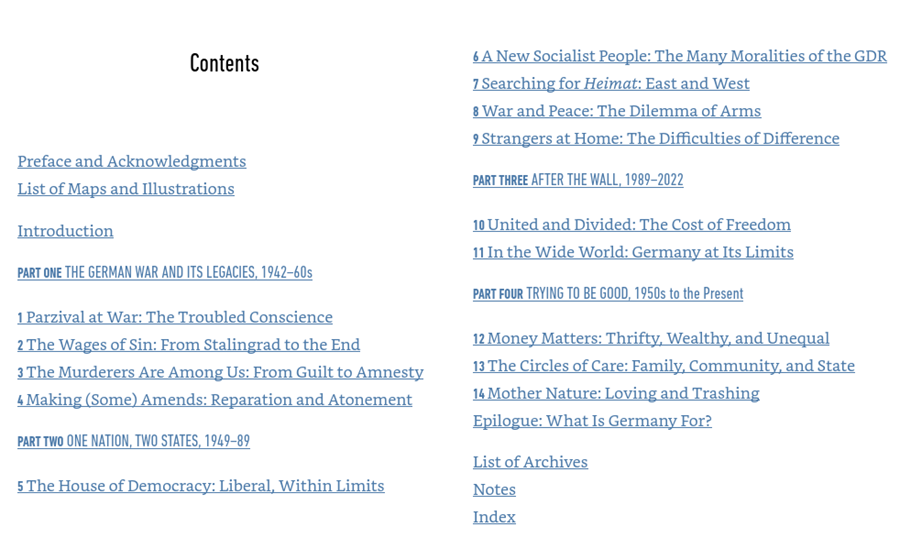
MY TAKE ON IT:
In my view, the author’s approach to history as a morality tale is somewhat interesting but not very relevant to explaining what happened and why. The bottom line is that people are basically looking for two things: to have a good life and feel good about themselves. The difference between Germany in the 1930s and Germany in the 2020s comes from the change in understanding of the world, themselves, and human evolution. This understanding moved from the notion of races fighting for survival and prosperity that could be achieved only at the expense of others and, therefore, requires conquest and subjugating these others to the notion of the world of equals, both genetically and culturally, in which prosperity is achieved via accommodation with others and constant search for win-win settlement. In the framework of the former notion, feeling good about oneself comes from racial superiority over others and being a reliable part of the hierarchically structured nation of supermen. In contrast, in the framework of the latter notion, it comes from the ability to accept others with their habits and cultures as equal and comply with whatever requirements produced by the elite of experts who know better how everybody must live.
The interesting part of this narrative is that it demonstrates that, as with any other paradigms, these notions do not change in the minds and hearts of the same individuals. It takes the change of generations when the new generation is raised with the new notion after the old notion proves its ineffectiveness. In Germany’s case, as a result of defeat at war, the old ideology was severely suppressed. In other words, the old Nazis of 1920 died out in the 1990s, still remaining Nazis, but quietly so, while being unable to raise a new generation of Nazis. It is also interesting how it worked differently in semi-capitalist West Germany and communist East Germany.
Finally, we are watching how the second notion of equality of everything and everybody, with the expert elite deciding everything for everybody, comes to ideological and material bankruptcy, similar to the bankruptcy of the old notion of racial superiority/inferiority. Hopefully, something new and more adequate to the needs of human nature will come out of this ongoing cataclysm.
20241110 – Wicked Problems
MAIN IDEA:
The main idea of this book is to analyze two different types of problems: simple problems that could be fixed, such as problems with clocks, and complex problems, such as understanding cloud behavior or societal issues, that are not easily described or fixed and demonstrate the feasibility of applying tools developed by humanity for fixing simple problems such as engineering to manage the complex ones. Here is the author’s description: “This book is double stranded. One strand follows a forgotten engineer; the other examines forgotten uses for engineering. Together, they weave an engineering vision for civics and a civic vision for engineering. While nonfiction, the book’s aspiration may feel like fiction. Engineers, after all, aren’t commonly invoked as pillars of democracy. Yet as we’ll see, engineering does more than tech support. Engineering is a carrier of history, simultaneously an instrument and the infrastructure of politics. It’s among the oldest cultural processes of know-how, far more ancient than the sciences of know-what. And through engineering, civics can gain a more structured, systemic, and survivable sense of purpose. By applying engineering concepts in a civic context, engineering can usefully grow the policy lexicon and enhance its cultural relevance. The usefulness of civics and engineering is often realized only in their breakdowns, much like trust, most longed for in their absence.”
Probably the most important conclusion the author comes up with is that the engineering of “Civicware” should be conducted cautiously and incrementally because it is way too complex, vague, and wicked character to apply relatively rigid engineering solutions:” Two decades before presenting on clocks and clouds, Karl Popper wrote about “piecemeal” social engineering. He argued for open-ended reforms over utopian blueprints. A piecemeal approach is evolutionary and begins by realizing that facts are fallible and contexts change. Yet, such increments require caution. Piecemeal responses can cancel one another out when not coordinated by an overarching principle or guided by a standard set of concepts. And obviously, you cannot optimize a system by optimizing its parts separately. Because wicked systems cannot be planned from the top down, they require an evolutionary approach to selecting and replicating improvements to civic welfare. The concept set of efficiency, vagueness, vulnerability, safety, maintenance, and resilience can facilitate such conscious cultural evolution.”

MY TAKE ON IT:
Engineering is the application of science to real-life problems. As such, it applies only to situations where a set of actions applied to a defined environment always results in the same or statistically consistent outcome. Consequently, it is very difficult but still conceivable to apply it to complex problems such as global climate control despite its wide variety of variables. However, this is never the case with society because society consists of thinking and self-directing entities- human beings, which brings the complexity level to near infinity because of a multitude of feedback loops, which makes the consistent outcome of any experiment nearly impossible. Consequently, to build such an organization of society that would reliably provide opportunities for human flourishing, one should look not at engineering approaches, whether piecemeal or global, but rather at resource allocation to individual humans so they could do with these resources whatever they wish and limit external, violent intervention only to situations when individuals attempt to use their resources to harm others.
20241103 – The Loom of Time

MAIN IDEA:
The main idea of this book is to examine history in an attempt to identify the causes of society’s development within one or another political framework, be it democracy, totalitarianism, or something else. The author first presents the contemporary Arab world that failed to move to democracy after the Arab Spring despite all the promises. Then, he looks at the recent history of this and the surrounding areas and provides a detailed narrative of events he observed as a high-level journalist covering these areas for most of the second half of the XXth and early XXI centuries. After that the author concludes:” Rather than pine exclusively for democracy in the Greater Middle East, we should desire instead consultative regimes in place of arbitrary ones: that is, regimes that canvass public opinion even if they do not hold elections. Monarchies, including the Gulf sheikhdoms, tend to consult more with various tribes, factions, and interest groups than do secular modernizing regimes, which have too often been arbitrary dictatorships, Ba‘athist or otherwise. In other words, aim for what is possible rather than what is merely just. … Thus, it is the middle path that should be sought. The middle path offers the only hope for a better world. Idealistic raptures in the service of change must be avoided.”
CONTENT:

MY TAKE ON IT:
Whether we want it or not, we live in a globalized, highly technological world in which people with cultural development at the level of the 7th century can obtain the technology of the 21st century. Consequently, instead of stoning neighbors at a distance of 100 meters, they can send ballistic missiles over thousands of miles.
However, societies are not thinking, feeling, and acting entities; only individuals are. Even societies under the control of savages, such as Islamic ayatollahs, have plenty of individuals who are culturally and intellectually at par with anybody else in contemporary civilized societies. Similarly, modern democratic societies produced quite a few savages of Islamist, socialist, or other varieties.
Consequently, to avoid a tragedy in which millions or even billions of people will perish, individuals in control of the civilized world, where contemporary technologies were developed due to individual freedoms and distributed resources, must deny savages access to technology.
The solution should be to find ways to sort people out: savages with limited access to technology on one side of the wall and civilized people on the other. Since individuals tend to change over time, it would be necessary to ensure constant movement of people and exchange of information so that the individuals who become civilized can move to a civilized world. Those who become less civilized due to religious or secular indoctrination move to a savage world.
20241027 – Strategy
MAIN IDEA:
Here is the author’s definition of the theme and intentions of this book:
“So the realm of strategy is one of bargaining and persuasion as well as threats and pressure, psychological as well as physical effects, and words as well as deeds. This is why strategy is the central political art. It is about getting more out of a situation than the starting balance of power would suggest. It is the art of creating power.”
“This book describes the development of different approaches, from rigorous centralized planning processes at one extreme to the sum of numerous individual decisions at the other. It shows how in these distinct military, political, and business spheres, there has been a degree of convergence around the idea that the best strategic practice may now consist in forming compelling accounts of how to turn a developing situation into a desirable outcome. “
“As a history, this book aims to provide an account of the development of the most prominent themes in strategic theory—as they affect war, politics, and business—without losing sight of the critics and dissidents.”

MY TAKE ON IT:
It is a great and detailed review of the history of strategy in multiple domains, from organized violence in wars and revolutions to political actions directed either at changing society’s organization or maintaining an existing one. I disagree with the definition of strategy as “the art of creating power” because it does not sufficiently differentiate between strategy and tactics. In my opinion, the art of strategy consists of two parts: the first is to identify and articulate realistically achievable objectives with potentially available resources, and the second is to identify methods and processes required to generate and allocate resources over space and time to achieve these objectives reliably. The actual processes of resource generation, allocation, and application are the domain of tactics.
For example, consider a strategy of fighting off 30,000 Persian troops if one has only 300 Spartans. Historically, the chosen strategy was to use a narrow pass of Thermopylae, where only a few fighters could clash at a time. At first glance, such a strategy makes sense because it greatly diminishes the value of quantitative superiority. However, one step further in thinking would lead to understanding that it is not a valid approach because it does not consider the high probability that after a few hours of battle, the skilled but exhausted Spartans will be killed by less skilled but fresh Persian fighters. It also misses that there was a way around this narrow pass, which the Persians actually used. However, if the strategic decision were not to keep a narrow pass but to divide forces and engage in multiple encounters, each of which would guarantee local superiority of forces, Spartans could win after a hundred or so such engagements over some time sufficient for physical recovery after each engagement, providing tactical skills are sufficient to arrange such engagements.
Similar logic would apply to politics, business, or any other area of strategy, whether the fight is within people’s minds or in the marketplace.
20241020 – The Identity Trap

MAIN IDEA:
This is the book of a leftist professor who is nevertheless disgusted with identity politics, especially with its racist implementation, such as the segregation of children at school into different groups by race, preferential medical treatment by race, and so on. The author does not like the term “identity politics,” so he suggests a new one:” This body of ideas draws on a broad variety of intellectual traditions and is centrally concerned with the role that identity categories like race, gender, and sexual orientation play in the world. So I will, for the most part, refer to it as the “identity synthesis.” The author generally accepts the narrative of oppressors and victims but has serious concerns: “But sadly, the identity synthesis will ultimately prove counterproductive. Despite the good intentions of its proponents, it undermines progress toward genuine equality between members of different groups. In the process, it also subverts other goals we all have reasons to care about, like the stability of diverse democracies. Despite its allure, the identity synthesis turns out to be a trap.”
The author reviews the history of the development of identity ideology and its road to dominance in leftist thinking and, consequently, in all institutions controlled by the left: education, the legal profession, and government bureaucracies. He then analyses many flaws of this ideology, problems, and grievances it causes to the majority of the population that does not belong to the preferred identities and does not like to be inferior and discriminated against. The author understands that this could lead to an explosion, which could wipe out the existing bureaucratic state together with all the parasitic milieu that feeds off it: pseudo-educators, pseudo-scientists, and pseudo-intellectuals. So, the author offers a detailed plan for how to escape the identity trap without becoming “reactionary.”

MY TAKE ON IT:
It is interesting to observe the author who understands the dangers of identity ideology and its implementation in identity politics for the overall project of the Left to remove the independence of individuals by eliminating private property and placing everybody into some kind of governmental or quasi-governmental structure where their lives will be defined by decisions made by “intellectual” elite. The author obviously has difficulty understanding that it necessarily requires a totalitarian society and identity ideology, without which such a society cannot function. It does not really matter whether the identity is based on race, ethnicity, class, or education; the point is to divide the population into superior and inferior groups that will be too busy fighting for resource leftovers to notice that the lack of resources caused by elite’s waste of resources on multiple meaningless projects and elite’s preventing creation of resources by eliminating incentives for productive individuals. I guess the author, like many others before him, is on the road from left to right when he understands that individual freedom and society’s prosperity are possible only on the foundation of private property when resources are distributed, and their successful application provides a huge incentive for everybody capable of making such an application effectively and efficiently.
20241013 – The Nocebo Effect
MAIN IDEA:
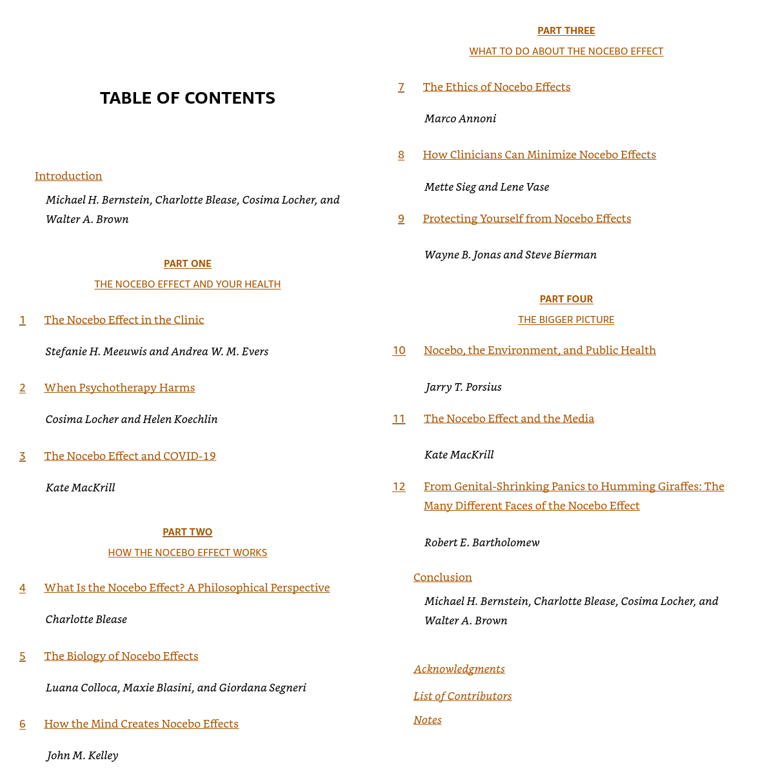
This book is about the nocebo effect, which is the opposite of the placebo when clearly inactive treatment works because of a patient’s psychological conditions. Here is the authors’ definition: “In our view, the nocebo effect can be summarized as “the occurrence of a harmful event that stems from consciously or subconsciously expecting it.” The core of the nocebo effect is that adverse health effects occur as a result of negative expectations.”. The authors present the history of research in this area since the early 1950s, the mechanics of its working, and its impact not only on the outcomes of medical treatments and the well-being of patients but also on healthcare costs. They also provide recommendations for minimizing this effect’s negative impact. Finally, the authors present their view on the nocebo effect’s impact on society overall and its ability or inability to handle various challenges from the environment to various political, economic, or personal risks.
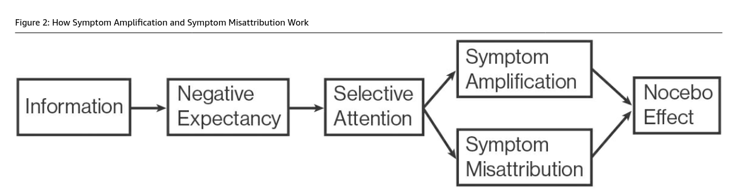
Here is a nice diagram of how the nocebo effect works:
MY TAKE ON IT:
For me, the analysis in this book presents an interesting demonstration of the interconnection between the reality of life, human perception, and modeling of this reality, which leads to conscious or unconscious actions that, in turn, change reality. This topic goes way beyond the medical side of the placebo/nocebo effect. It could be used to understand human actions in all areas of life, including the economy and politics.
From this point of view, the currently popular contentions of information vs. disinformation, fake news, DEI, and such are just attempts to use the psychology of the nocebo effect to achieve specific population behaviors. In a democracy, even if flawed, such attempts usually fail because of the difficulty of isolating people from accurate information. That’s why people benefiting from COVID and Climate alarmism distortions of resource allocation fail to achieve complete dominance despite mass propaganda efforts and relatively limited violent actions such as the cancelation of non-compliant individuals.
Their ideological peers of the Communist and Nazi variety were more successful because the concentration camps and outright executions were much more effective than losing jobs and prestige. However, even their success was limited in time due to the nasty habit of reality to undermine any ideology that deviates too much from this reality.
The problem for individuals is that they do not have enough time and ability to recover from mistakes to afford too much of a nocebo effect impacting their lives. The solution is to control one’s perception of reality by seeking a variety of views and, most importantly, evaluating these views based on their ability to predict future events rather than the authority of their presenters, how much good feeling of virtue they provide, or even how logically consistent these views are.
20241006 – Our Ancient Faith

MAIN IDEA:
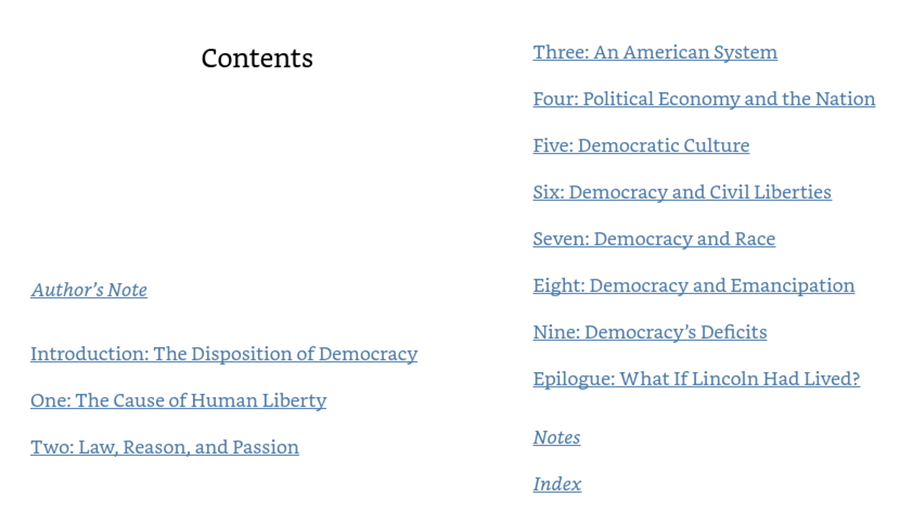
This book is about democracy, examined through the prism of American history, more specifically, through the words and actions of Abraham Lincoln—the man who managed to retain the democratic political system in the United States by fending off the challenge of the Southern slavery-based aristocratic republic to this system. The author meticulously goes through different aspects of democracy and how it was reflected in Lincoln’s attitudes, noting:” One more thing: a Lincolnian democracy is a democracy which embodies Lincoln’s own virtues—resilience, humility, persistence, work, and dignity. Through the example of Lincoln, democracy can claim to offer people, not only order, but decency, even a kind of quiet and unostentatious grandeur.”
The author also discusses what it looks like from a contemporary point of view when we know what happened over the next 160 years after Lincoln’s death.
MY TAKE ON IT:
I do not think that people have a choice in the political system under which they live. It is mainly defined by the system’s fitness to maintain the society it controls and protect it from challenges, both economic and violent, from external and internal enemies. Democracy in America is the result of a unique environment where a relatively small number of technologically advanced people obtained access to practically unlimited amounts of resources in the form of agricultural land, so nearly everyone could become self-sufficient, and nobody would have enough power to suppress others. This ability to survive on one’s own, albeit in cooperation with others, and the inability to suppress and exploit others forced people to seek peaceful accommodation with others. Only the Democratic political system could provide such accommodations. Correspondingly, the slave-owning aristocracy was incompatible with such Democracy and had to be aggressive against it to survive. The Civil War was not really a civil war between members of one society but rather a war between two societies for political dominance.
We are now in a similar situation when it is becoming increasingly obvious that the Democratic political system is incompatible with the Administrative state because top-down control of everything is incompatible with individual freedom based on arrangement when resources are distributed between people via private property. The Civil Conflict between these two systems is inevitable and is actually ongoing. One can only hope that this conflict will not grow into a war. The possible outcomes are clear: either diminishing the Administrative state or eliminating whatever is left of the Democratic political system. The diminishing of the Administrative state would lead to the expansion of prosperity and freedom because free people who own distributed resources are much more productive than people in any other economic arrangement. Alternatively, the triumph of the Administrative state would lead to misery, if not necessarily material, then definitely to psychological misery because the life of quasi-slaves of the administrative hierarchy working under the direction of bureaucrats whose main competency is the ability to move up within this hierarchy is always miserable.
20240929 – The Genetic Lottery

MAIN IDEA:
The main idea of this book is to demonstrate that success in life, or lack thereof, is highly dependent on an individual’s DNA and family wealth. To evaluate the impact of DNA, the author relies on the polygenic index for traits positively correlated with high levels of education. Here is the graphic representation:

The book’s first part is quite scientific, and the author clearly states what she was expecting to achieve:” By this point in the book, I hope I have convinced you of three things. One, genetic research has developed an array of methods, using family members, measured DNA, and combinations of both, that estimate the effects of genes on complicated human outcomes. Second, the overwhelming consensus of that research is that genetic differences between people matter for who succeeds in formal education, which structures many other forms of inequality. Third, while the biology of these genetics is still largely a mystery, progress is being made on understanding the psychological and social mediators of genetic effects on educational success.”
The book’s second part discusses the social environment, especially equity vs equality, and makes an interesting proposition that increases in resource availability actually increase the difference in outcomes:


MY TAKE ON IT:
It is a very interesting book. I enjoy watching how the author turns herself into a pretzel trying to reconcile somehow the knowledge she obtained as a scientist with leftist dogmas that she was brainwashed into via higher quasi-education and the liberal environment she lives in. There are many funny examples, such as diatribes against Charles Murray and Richard Herrnstein’s work, that demonstrate a clear lack of understanding of this work. The same applies to the author’s hate of eugenics and a few other similar things.
However, I fully agree with the author’s conclusions and overall direction of this book. It is just ridiculous to divide the environment into nature vs. nurture. It is all combined into one indivisible system with a multitude of positive and negative feedback loops that make it all but impossible to isolate them from each other.
As to eugenics, it is just the application of scientific methods developed in agriculture to human beings. The problem is not that it is scientifically wrong. Since humans are biological objects, one can produce tall blond people using the same methods as were successfully used to create more productive milk cows. The attitude of eugenics is wrong because humans are not cows; they exist for their own sake, not to satisfy some collectivistic ideologues of Nazism or Communism. Therefore, a decent society should provide people with resources sufficient to pursue happiness, protect them from individuals whose perceived happiness demands the misery of others, and leave it at that.
20240922 – Supercommunicators

MAIN IDEA:
This book is about communications, and here is the author’s definition of its main idea: “This book, then, is an attempt to explain why communication goes awry and what we can do to make it better. At its core are a handful of key ideas. The first one is that many discussions are actually three different conversations. There are practical, decision-making conversations that focus on What’s This Really About? There are emotional conversations, which ask How Do We Feel? And there are social conversations that explore Who Are We? We are often moving in and out of all three conversations as a dialogue unfolds. However, if we aren’t having the same kind of conversation as our partners, at the same moment, we’re unlikely to connect with each other.”
There is also a graphic representation:


MY TAKE ON IT:
I like the idea that there are different types of conversations, and communication difficulties often occur because participants perceive that they are in different types of communication than they really are. For example, one side believes it is in a Decision-making conversation and seeks a way to resolve a problem, while another is in a Social conversation and seeks to reaffirm its core beliefs. I think many problems, not only at the individual and small group levels but also at the international level, occur because people do not understand that the other side is in a completely different conversation.
A good example is the most enduring conflict of our time between representatives of contemporary secular Western Civilization and traditional theocratic Islamic Civilization. The leaders of the West believe that the conversation is about some specific problems, such as the Palestinian State, grievances from the history of colonialism, low level of economic development, or some other resolvable problem. They are in a Decision-making mindset conversation. The leaders of Islam believe that the issue is whether they are the one and only legitimate representatives of the true God or just one of many religions that different people come up with. If their beliefs are correct, their god should make them dominant in the world and give them the power to conquer and dominate over everybody else. If such conquest fails, they are wrong, and their core understanding of themselves is invalid. They are in a Social mindset conversation, seeking to assert their beliefs about who they are.
The possible outcomes of this conflict are either Islamic theocracy established all over the world or changes in the leadership of the Islamic populations, who eventually arrive at the same downgrading of their god that the Christian population went through in recent centuries regarding their god.
I think that the first outcome, Islamic dominance, is unfeasible, and the second is inevitable. However, due to Western leadership’s lack of understanding of what kind of conversation they are in, the road to this will be much more complex and bloody than it should have been.
20240915 – Where Have All the Democrats Gone


MY TAKE ON IT:
With all due respect, I think the authors are missing a big part of the picture. They correctly identified Democrats’ losses among working and middle-class people of all races and ethnicities but missed a big part of their gains. These gains came from the managerial class and business, not because they were good in economics but because contemporary businesses, both big and small, are highly incorporated into the regulatory hierarchy of government and dependent on government bureaucrats for their very existence. Ever since FDR’s revolution, these government bureaucrats have become a core constituency of the Democratic party, with the working class providing mass support in exchange for government handouts and interventions into the economy through Union support, labor legislation, welfare, and so on.
The expansion of government in all areas of life and the economy led to the creation of a massive parasitic class in overblown, hugely expensive, ineffective, and inefficient healthcare and education. This new class does not provide enough numbers to override the popular vote, but it has control over the election process, making popular vote nearly irrelevant to its results. Democratic success in 2020 and 2022 in fixing election results created overconfidence in their ability to maintain power forever.
This prompted Democrats to open borders so they could substitute Americans who used to feel themselves to be free, whether this feeling is realistic or not, and have a high demand for quality of life (American Dream) with masses of illegal immigrants that often see the difference between high-quality live in America and misery of their native countries as something natural, not related to culture and institutions. They could be excused in such thinking because all they see is that doing the same job they did back home in the USA provides 40-50 times more returns while doing nothing, and just getting on public assistance provides 10 times more. To come to America illegally and illegally vote for Democrats is a very small price to pay for such dramatic improvement.
However, I do not think this is the end of the story. Many more Americans were hurt by Democratic policies than benefited from it. These are not only working-class people who see their jobs going to illegals or that the factories they worked in before shipped to China or Mexico. It is also college graduates who invested in education and could not get decent jobs they counted on or could not move ahead because they belong to the wrong race. The history of the Soviet Union demonstrated that it is possible to suppress the majority, however miserable, using ideologically brainwashed youths and government violence. Still, it could happen only if all communications were fully controlled, any resistance or even expression of unhappiness suppressed with concentration camps or outright murder, and an organization like the KGB or Stasi fully controlled by the party had a vast network of informers. The control of the Democratic party over media, especially social media, is far from complete. The FBI is corrupted to the bone, but not KGB yet. The population not only has access to any information, but it also includes lots of people who understand the situation, including immigrants from totalitarian countries and lots of Americans educated in real history. Finally, the population is armed and seems uninclined to give up these arms. It would be interesting to see how it unfolds over the next few years or months.
20240908 – Free Agents

MAIN IDEA:
This book is about a very popular current discussion about whether the world is deterministic and humans, therefore, have no free will or whether something still allows them to exercise it. The author rejects both religious and purely mechanistic approaches, and here is how he defines his approach:
“…basic laws of physics that deal only with energy and matter and fundamental forces cannot explain what life is or its defining property: living organisms do things, for reasons, as causal agents in their own right. They are driven not by energy but by information. And the meaning of that information is embodied in the structure of the system itself, based on its history. In short, there are fundamentally distinct types of causation at play in living organisms by virtue of their organization.
My goal in this book is to explore how living things come to have this ability to choose, to autonomously control their own behavior, to act as causes in the world. The key to this effort, in my view, is to take an evolutionary perspective. If we want to understand how choice and free will could exist in a physical universe, let’s look at the details of how they actually came to exist. The book therefore tracks how agency evolved—from the origin of life itself, through the invention of nervous systems, the subsequent elaboration of decision-making and action selection systems, and the eventual emergence of the kind of conscious cognitive control in humans that we refer to as “free will.”

MY TAKE ON IT:
Somehow, the intensity of the discussion about free will puzzles me. For me, it just does not matter whether human actions are predetermined at the initiation of the universe or not. In either case, acting individuals should be held responsible for the consequences of their actions because responsibility should be not about the past but about the future. It means that if an individual commits some action that is considered not acceptable, like murder, the one and only way to make sure that this individual will never do it again is to eliminate this individual. Our society’s biggest problem is the disconnect between actions and consequences, meaning that some people commit actions, but others have their well-being compromised as a result. I think it is not that impossible to create such a link when we have a huge capacity for information processing. For example, many people who support increasing the gas price by additional taxation feel no difference between $2/gallon and $5/gallon. I am pretty sure that if instead of the same price for everybody, the gas tax would be linked to income, resulting in somebody making twice the average income paying double the price for gas, then the number of people supporting saving the planet would go down. I see no problem with a person making $50k a year paying $2 while a person making $500k paying $20. By the way, it would nicely demonstrate to what extent cosmic forces predetermine support for such measures, or this support could be manipulated by the free will of people who do not want to pay too much. Overall, I find the deterministic idea not necessarily wrong but just meaningless because it is impossible to falsify. It is also an impediment to any action because there is no action if there is no will to act.
20240901 – The End of Everything

MAIN IDEA
This book is not just about the history of destroyed
civilizations but also about applying the lessons of this destruction to the
contemporary world. Here is how the author defines his main point:” Naïveté,
hubris, flawed assessments of relative strengths and weaknesses, the loss of
deterrence, new military technologies and tactics, totalitarian ideologies, and
a retreat to fantasy can all explain why these usually rare catastrophic events
nevertheless keep recurring—from the destruction of the Inca Empire to the end
of the Cherokee nation to the genocide of a populous, vibrant, and
Yiddish-speaking prewar Jewish people in Central and Eastern Europe. The
continual disappearance of prior cultures across time and space should warn us
that even familiar twenty-first-century states can become as fragile as their
ancient counterparts, given that the arts of destruction march in tandem with
improvements in defense. The gullibility, and indeed ignorance, of contemporary
governments and leaders about the intent, hatred, ruthlessness, and capability
of their enemies are not surprising. The retreat to comfortable nonchalance and
credulousness, often the cargo of affluence and leisure, is predictable given
unchanging human nature, despite the pretensions of a postmodern
technologically advanced global village.” And, just in case somebody missed
this point, the author adds:”Unfortunately, the more things change
technologically, the more human nature stays the same—a law that applies even
to the United States, which often believes it is exempt from the misfortunes of
other nations, past and present. This book makes clear, however, that there is
no certainty that as scientific progress accelerates and leisure increases, and
as the world shrinks on our computer and television screens, there is any
corresponding advance in wisdom or morality, much less radical improvement in
innate human nature.”

MY TAKE ON IT:
This is a great description of what happens when people become too self-assured, try to find a compromise with enemies who are clearly looking to destroy these people and refuse to fight seriously until it is too late. I think that the author’s diagnosis is pretty much correct. I can understand when people believe that it would be already too late to save the USA and Western civilization from destruction by barbarians, whether these barbarians are Islamic religious fundamentalists living mentally in the 7th century or they are Chinese communists striving to remake the XX century, or they are Russian imperialists dreaming to bring the world into XIX century with global dominance of Russian Empire, which in historical XIX century Russia failed to achieve.
I am much more optimistic than that, mainly because of the war in Ukraine, which demonstrated the huge technological superiority of even older Western weapons and the barbarians’ clear inability to be effective and efficient in their attacks. Another interesting point is the barbarians’ economic dependence on the somewhat civilized world, which leaves the moral weakness of the Western population as the one and only reason for the barbarians’ hope to achieve their objectives.
However, human psychology is not something constant and can change really fast. It was clearly demonstrated by the recent attack of Islamic barbarians on Israel. Initially successful due to the bureaucratic ossification of the Israeli army and political divisions in the society, it failed to break this society, consequently leading to the massive violent response that clearly was not anticipated by the aggressor due to decades of previous weak responses. Similarly, Russian aggression against Ukraine changed the calculation of European leaders and led to a much stronger, even if insufficient, response. It is quite possible that this response convinced Chinese leaders that it was too early to attack and that they had to wait until the moral degradation of Western societies reached more significant levels.
In short, I believe that the impact of leadership failures on the Western population will be big enough to change the attitudes of this population and consequently lead to a change in leadership well before the balance of power will change sufficiently for barbarians to have a good chance for victory. When this happens, the unconstrained use of Western power will make Israel’s slow, constrained, and tentative use of power look miniscule.
20240825 – Public Interest and State Legitimation

MAIN IDEA:
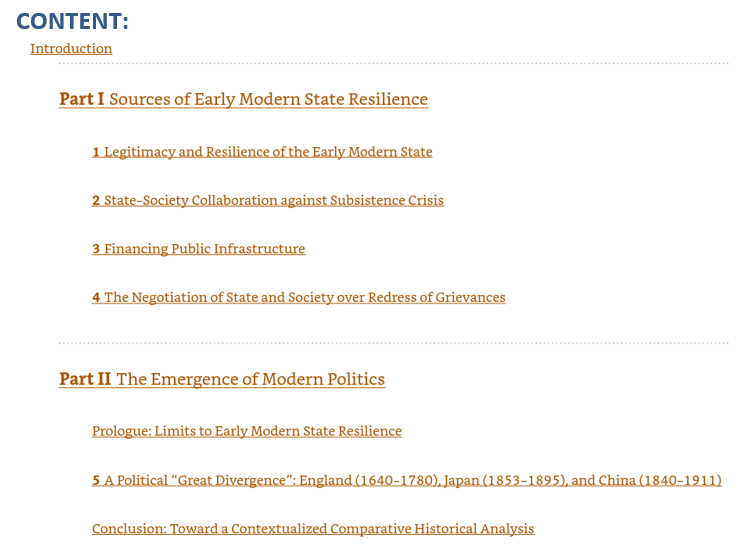
The author expressed the main idea of this book as a theory:” …this theory of state formation in which a public interest-based discourse of state legitimation serves as a common basis for state–society collaboration in public goods provision…” To support this theory, the author reviews specific periods in history:” One was the intensive collaboration between state and society over infrastructural facilities and even defense in England between 1600 and 1640, Japan between 1820 and 1853, and China between 1820 and 1840, periods when each state was encountering sustained fiscal difficulties. Such state–society collaboration in public goods provision such as famine relief, water control projects, and even national defense contributed significantly to the resilience of these early modern states with limited fiscal capacities.” This collaboration eventually led to the contemporary world due to the emergence of the conception of public interest:” This conception of public interest shared by both state and social actors thence constituted a common normative platform upon which state and society could interact over how to deliver concrete public goods to safeguard the public interest in specific circumstances. In this way, the obligation of the state to protect the public interest opened up a space for political participation as it entailed certain rights to the subordinates; most importantly, a right to petition the authorities for redressing welfare grievances so as to safeguard public interest. Such rights were, however, passive, as they were derived from the obligation of the state to protect the public interest. In contrast, active rights, at the level either of the local community or of the individual, are conceived as independent of the state. While passive rights are derived from obligation, active rights are often held to be entitlements of individuals. Examples of such inalienable rights include absolute private property rights or human rights, or freedom of conscience in religion.”
MY TAKE ON IT:
I do not believe in the validity of the notions around which this book’s discussion is built. Neither the public, the state, nor society exists as thinking, feeling, and acting entities; only individuals do. All this comes down to the interaction between the better-armed and better-organized violent groups of individuals – the state with unarmed or poorly armed, poorly organized, and less violent, much bigger groups of individuals – society. Whatever legitimacy, meaning voluntary compliance of the society’s individuals with commands of the state’s individuals, exists based exclusively on an internalized ideological framework established via education, indoctrination, and propaganda. The well-being of the state’s individuals is guaranteed by their ability to extract resources from individuals outside the state. When, for whatever reason, the totality of resources decreases, it impacts, first and foremost, members of society outside of the state hierarchy, undermining their well-being. If the impact is so big that it overrides the existing ideological framework, the society falls apart, leading to some form of rebellion or civil war. The new arrangement comes to life after eliminating either members of the old state hierarchy or those who challenged their rule. If the reason for resource depletion is removed or sufficiently diminished, either because fewer people are still alive to need resources or a better harvest of whatever, the new order strengthens, and the cycle repeats. It used to be that a very strong religious, ideological framework supported order up until the only choice of individuals at the bottom of the hierarchy left was between rebellion with probable violent death and assured death from starvation, providing relative stability of existing arrangements. With such a framework practically disappearing, the stability is decreasing. Still, thanks to contemporary science and technology, the availability of resources has increased so much that most people prefer to tolerate the rule of individuals (politicians) they despise via institutions they contempt rather than rebel. However, at some point, the psychological pain of this compliance could become too much, so the rebellion still could come.
20240818 – Why We Die

MAIN IDEA:
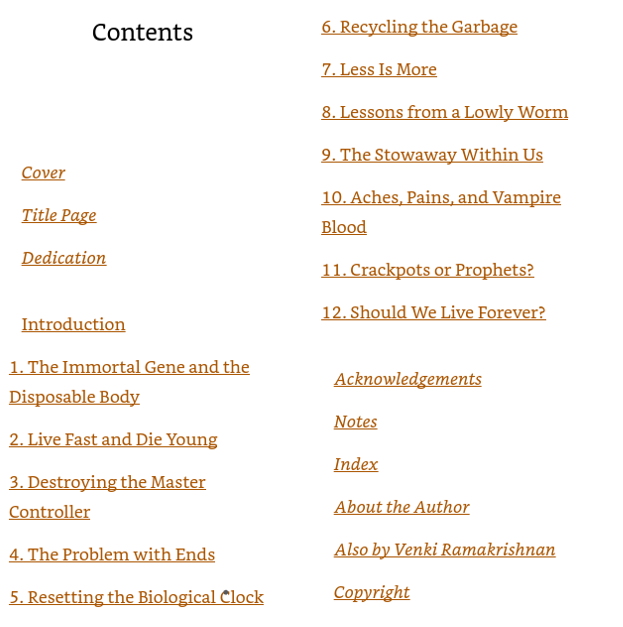
At the beginning of this book, the author discusses various ideas that humans came up with in search of immortality or at least longevity:” The first, or Plan A, is simply to try to live forever or as long as possible. If that fails, then Plan B is to be reborn physically after you die. In Plan C, even if our body decays and cannot be resurrected, our essence continues as an immortal soul. And finally, Plan D means living on through our legacy, whether that consists of works and monuments or biological offspring.” After that, the author defines the content of this book in the following way:” Because aging is connected intimately with so many biological processes, this book is also something of a romp through a lot of modern molecular biology. It will take us on a journey through the major advances that have led to our current understanding of why we age and die. Along the way, we will explore the program of life governed by our genes, and how it is disrupted as we age. We will look at the consequences of that disruption for our cells and tissues and ultimately ourselves as individual beings. We will examine the fascinating question of why even though all living creatures are subject to the same laws of biology, some species live so much longer than even closely related ones, and what this might mean for us humans. We will take a dispassionate look at the most recent efforts being made to extend life span and whether they live up to their hype.”
MY TAKE ON IT:
I found the idea of comparing an unchangeable and practically immortal gene with a disposable body quite interesting. Similarly, the idea of death as the desynchronization of various parts of an organism nicely describes the process of cessation of the system’s existence, even if its various parts are still functional. After reading through all the technical details presented in this book, I am pretty much convinced that there is technical potential to increase both lifespan and health span, maybe even without limit. However, what is puzzling to me is why people would want to do it beyond natural limits. Human life has nicely defined natural periods, and each of these periods has its positives and negatives. The only constant thing is the change and constant acquisition of new life features and the disappearance of old ones. Every 50-year-old is a very different person than he was at five years old, as well as the person he’d be if he lived to be 100. So, basically, life extension would lead to the substitution of the normal process of population change by substituting old, exhausted organisms with newly created individuals by the new process of adding additional life phases for the same old organism. I do not think it is a good idea because it would slow down progress in all areas by prolonging the existence of outdated and poorly working paradigms. It was said that science progresses from funeral to funeral, so no funeral means at least stagnation. Still, it would probably lead to violent eruptions because the status quo forever would not be acceptable to most people.
20240811 – Strategy, Evolution, and War
MAIN IDEA:
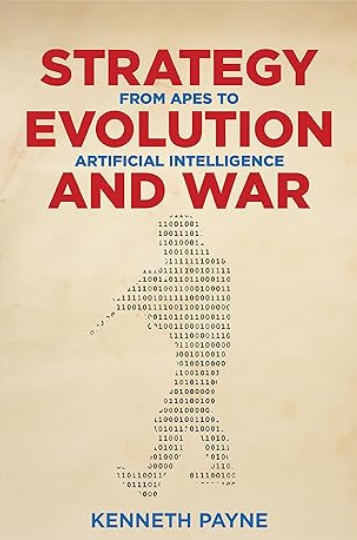
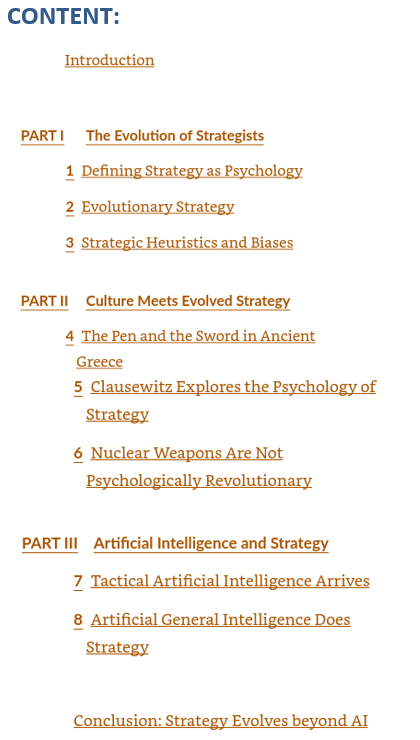
Here is the author’s definition of the main idea of this book:” THIS BOOK EXPLORES THE EVOLUTIONARY BASIS OF HUMAN STRATEGY IN war and considers the prospects of a radically distinct approach to strategy using artificial intelligence (AI). Strategy is defined here as the purposeful use of violence for political ends.” The book specifically reviews the expected transfer of human strategic thinking and action to AI-based processes. The book also reviews various parts of strategic thinking, such as force concentration and allocation, mind reading and deception, and the cultural evolution of strategic thinking. Also interesting is a comparison between human and chimpanzee strategies. Much attention is also given to Lanchester’s Law and scaled cooperation development prompted by persistent warfare.
MY TAKE ON IT:
I think that we are getting closer to the situation when the use of organized violence will become too dangerous for users and, therefore, ineffective. One of the big reasons for that will be the massive implementation of AI and the development of biological weapons. Both AI and bioweapons represent the qualitative leap in human ability to cause huge damage with minimal effort. As COVID demonstrated, the virus developed in a small lab by a few people could easily expand all over the world and kill millions. Similarly, dominance in AI could allow one side to take over the tools of the other and use them against it. However, the most important will be the difficulty in controlling the use of such weapons. Bioweapons could mutate and start killing organisms on the side of their users. Similarly, AI tools could potentially become uncontrollable. Consequently, the unpredictability of consequences from using such weapons could force all sides to resolve their difficulties peacefully and seek resolution of contentions without resorting to strategic violence in any way, shape, or form.
20240804-The Symbolic Species

MAIN IDEA:
This book explores language as a uniquely human symbolic method of communication that no other animals managed to develop, even in the simplest form imaginable. The author breaks down communications into three hierarchically organized forms, as represented by the graphs below:
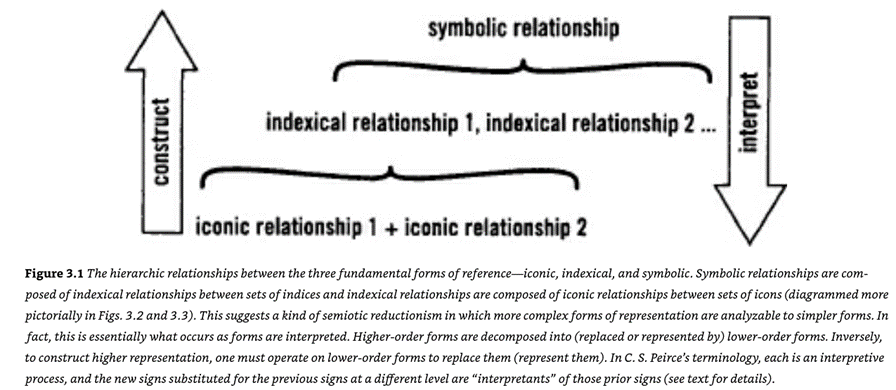

The author also provides an interesting model of the evolutionary development process that made us humans:
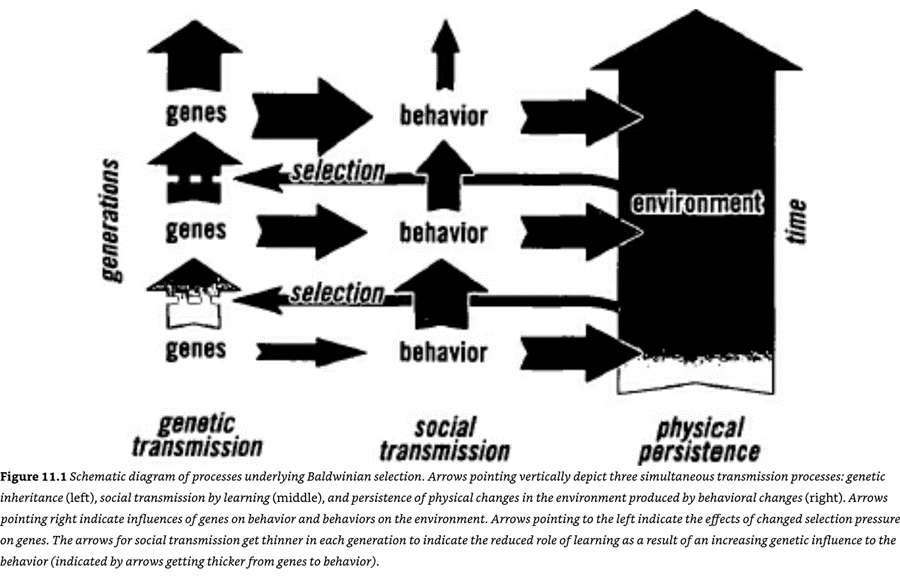
Here is the author’s description of the structure of this
book:” The first part of the book—Language—focuses on the nature of language
and the reasons that it is virtually confined to the human species. The second
part of the book—Brain—tackles the problem of identifying what is unusual about
human brain structure that corresponds with the unique problems posed by
language. The third part of the book—Co-Evolution—examines the peculiar
extension of natural selection logic that is behind human brain and language
evolution, and tries to identify what sort of communication “problem”
precipitated the evolution of our unprecedented mode of communication.”

MY TAKE ON IT:
I think it is a very good presentation of humanity’s core features as a system of coordination, cooperation, and integration between individuals that provides far superior functionality of existence than could be found in any other part of the animal world. The only small issue I have with all this is the treatment of it as a human paradox:” Biologically, we are just another ape. Mentally, we are a new phylum of organisms. In these two seemingly incommensurate facts lies a conundrum that must be resolved before we adequately explain what it means to be human.” As far as I’m concerned, we are not more unique than many other forms of life, each of which exists because it fits well into the existing environment. It just happened that the integrated system of humanity is based on individual organisms with much higher levels of functionality and self-direction capabilities than, for example, the integrated system of ants. Combined with unlimited communication and coordination abilities provided by the symbolic language, we did become a dominant form of life on this planet and, I believe, will remain so, even if in the process of planet-wide consolidation we’ll go through difficult times and catastrophic events.
20240728 – Everything Is Predictable
MAIN IDEA:
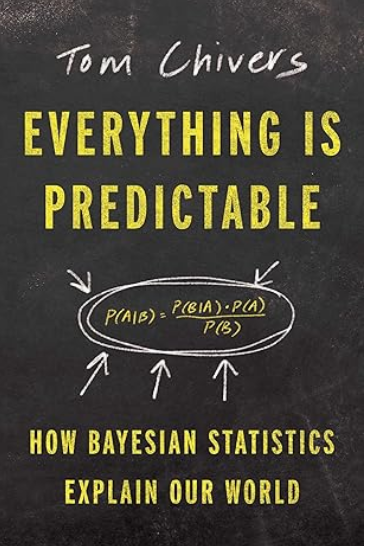
This book is about the history, philosophical, and practical aspects of the Bayesian theorem of conditional probability:

This formula defines the probability of A if B already occurred. The applications of this formula are unlimited because A and B could be any events, real or imaginative. Here is the author’s definition of its meaning:” …all decision-making under uncertainty is Bayesian—or to put it more accurately, Bayes’ theorem represents ideal decision-making, and the extent to which an agent is obeying Bayes is the extent to which it’s making good decisions. Logic itself, all that stuff you may remember about “All men are mortal; Socrates is a man; ergo Socrates is mortal” is just a special case of Bayesian reasoning where you’re only allowed to use probabilities of one and zero. We appear to be Bayesian machines. That’s true at a fairly high level: humans are rubbish at working out Bayes’ theorem formally, but the decisions we make in everyday life are pretty comparable to those that an ideal Bayesian reasoner would make. Which, unfortunately, doesn’t mean we all end up agreeing—if my prior beliefs are very different from yours, then the same evidence can lead us to entirely different conclusions. Which is how we can end up with profound, but sincere, disagreements on apparently well-evidenced questions about the climate, or vaccines, or any number of other questions. And we’re Bayesian at a deeper level too. Our brains, our perception, seem to work by predicting the world—prior probabilities—and updating those predictions with information from our senses: new data. Our conscious experience of the world can be best described as our priors. I predict, therefore I am.”

MY TAKE ON IT:
I first encountered Bayes’s theorem some 50 years ago while taking a university course on probability theory, but I never thought of it as anything other than a mathematical tool with some practical application. This book demonstrated, and quite convincingly, that conditional probability is everywhere, and it is how people make decisions, whether they realize it or not. It is obviously the foundation of AI because AI is nothing more than a prediction of the future based on probabilities of past events accumulated during the training. So, I have to agree with the idea that we humans base our existence on predictions of the future based on the past, whether it relates to language and image-based communications, decision-making, or working on some project to achieve desirable results. I think that we’ll have to learn to apply Bayesian thinking and processes in a much more formalized and effective way by using AI if we want to have a bright future rather than go into a very unpleasant decline or even possible self-annihilation.
20240721-Revolution and Dictatorship

MAIN IDEA:
This book seeks to explain the phenomenon of the long-term survival of authoritarian regimes created by revolutions. The idea is that the initial challenge of counter-revolutionary forces forges a strong and mutually dependent group of leaders capable of controlling the machinery of violence and maintaining the regime despite all odds. The authors contrast this with less durable regimes and clearly present their logic, with massive factual support from the history of Russian, Chinese, and Mexican regimes. Here is the graphic representation, with the three pillars of the authors’ argument presented at the top:


MY TAKE ON IT:
This is a pretty good model, but authors underappreciate the role of ideology, information manipulation, and people’s attitudes toward the regime. The revolutionaries have to convince a sufficient number of the population that it is in their best interests to support the new regime. The process has to be graduated when revolutionaries mislead people about their real objectives to obtain the support of some and the neutrality of others so they can eliminate an active opposition.
A good example is the history of the Russian Revolution. After a lifetime of theorizing about public property on a means of production and the need for the revolutionary war to establish worldwide dictatorship, Lenin and the Bolsheviks took power under the slogan: “Land to peasants, factories to workers, and peace to people.” For people at the time, it meant private property on land transferred to peasants who worked on it, cooperative ownership of factories, and rejection of wars as a means to society’s ends.
After initially acting according to this slogan, communists were able to eliminate the opposition from pillars of the old regime, then remove any trace of independence for workers’ unions, and eventually force peasants into slavery of collective farms. The key was maintaining an agenda-setting initiative so those a bit further on the elimination list would not feel threatened until their time came.
Another important part that is missing is an underestimate of the parasitic character of these regimes, which are usually unable to maintain effective economic and technological development without external support from developed countries with effective capitalist economies. Both the Soviet military power of the past and the Chinese economic power of the present came from the flow of money, technology, and informational support from Western intellectuals ideologically aligned with communism and big business seeking super profits by shifting production and technology to authoritarian countries where workforce could be violently suppressed as needed, outside of regulatory control of Western societies.
My final disagreement is with the very definition of durability. These regimes did not necessarily survive that long: 70 years of the Soviet Union or 75 years of Chinese communist power is not that long, and inevitable succession problems combined with the disillusionment of the next generations normally cut down these monstrosities long before Western intellectuals understood their levels of internal instability.
20240714 – Without Conscience

MAIN IDEA:
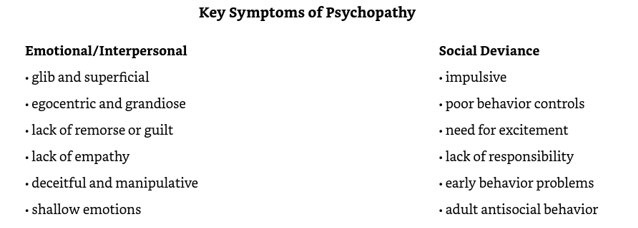
This is a classical book about psychopathy and psychopaths. It describes and defines this particular disorder, its diagnosis methods, and the behavior patterns of people who possess it. It describes multiple cases of psychopaths, both criminal and even murderous, and those that more or less fit into the frame of normal behavior. It also provides the Psychopathy Checklist:
CONTENT:

MY TAKE ON IT:
I think that, as of today, psychopaths still have pretty much a free run with little attempt to diagnose their condition and control it in the interest of normal people. As with any other human condition, it is not digital, meaning YES/NO status, but more like analog with lots of space between completely no signs and hardcore cases. For me, the most interesting is that, while having no empathy and little or no normal human emotions, psychopaths are very calculating and, therefore, responsive to cost-benefit analysis. This explains the tremendous success of “broken window” policies in suppressing criminal activities and the massive increase in crimes when such policies were discontinued in the name of leftist ideology. These policies provided quick and efficient feedback for psychopathic behavior, prompting psychopaths to control their urges or risk being eliminated if they failed. Based on the information presented in this book, the idea that a psychopath who was allowed to commit a dozen crimes and let go will not commit another dozen crimes looks absolutely ridiculous. From my point of view, any prosecutor who refuses to prosecute crime number N should go to prison as an accomplice when crime number N+1 is committed. In this case, we would quickly decrease both crimes and the number of criminals in positions of power.
20240707 – Values, Voice and Virtue
MAIN IDEA:
This book is about changes in British society, including the rise of populism, Brexit, and the overall collapse of politics as usual. The author sees these changes as a result of the reconfiguration of British society when the old aristocratic and business elite faded, and the new elite of educated bureaucrats and managers rose. One serious consequence of this is the nearly complete disappearance of the old noblesse oblige attitude of the old elite to non-elite and the commonality between them as parts of one nation. The new elite sees no difference between British workers and immigrants, whether legal or illegal, and prefers those who provide cheaper labor. The new elite is also multicultural and is educated in contempt of the British and overall Western culture and history. The non-elite is still mainly British, and its values are still based on the British nation-state and culture. This creates the dynamics of revolution vs. counter-revolution, and the author expects the ongoing fight to continue for a while.

MY TAKE ON IT:
I think that the diagnosis of the situation is, in general, correct and that it relates not only to Britain but to the whole Western world. Humanity is currently in the process of moving from being divided into separate nation-states and cultures competing between themselves into one unified global entity with one dominant culture all over the world. The question is what kind of culture and economic system will become dominant. The competitors are:
- The Western Enlightenment tradition, with its individualistic ideology and freedom, capitalist economy, and limited government divided into separate powers. The limited hierarchical control and distribution of resources provide individuals at the bottom with the opportunity to pursue their objectives the way they see fit.
- The pre-Enlightenment tradition, with its collectivistic ideology, hierarchical control from the top down, and complete subordination of individuals at the bottom to the will of individuals at the top.
Right now, the struggle between these competitors has taken the form of elite vs. non-elite at the national level, but often over global issues such as climate alarmism, top-down behavioral control, resource allocation, and similar issues. However, it is bound to consolidate into the worldwide struggle of elite vs. non-elite that will last for a while.
20240630-Indigenous Continent

MAIN IDEA:
This is probably the best book about the history of America, not as the history of the United States but the history of the northern part of the continent in which the English-speaking tribe of newcomers from Europe gradually, over the period of centuries, became the dominant tribe of the continent after fighting other European French and Spanish speaking tribes, all of them being allied with various local Indian tribes up until the near end of the struggle. Here is the author’s definition of the main idea of this book:” It offers a new account of American history by challenging the notion that colonial expansion was inevitable and that colonialism defined the continent, as well as the experiences of those living on it. Stepping outside of such outdated assumptions, this book reveals a world that remained overwhelmingly Indigenous well into the nineteenth century. It argues that rather than a “colonial America,” we should speak of an Indigenous America that was only slowly and unevenly becoming colonial. By 1776, various European colonial powers together claimed nearly all of the continent for themselves, but Indigenous peoples and powers controlled it. The maps in modern textbooks that paint much of early North America with neat, color-coded blocks confuse outlandish imperial claims for actual holdings. The history of the overwhelming and persisting Indigenous power recounted here remains largely unknown, and it is the biggest blind spot in common understandings of the American past.”
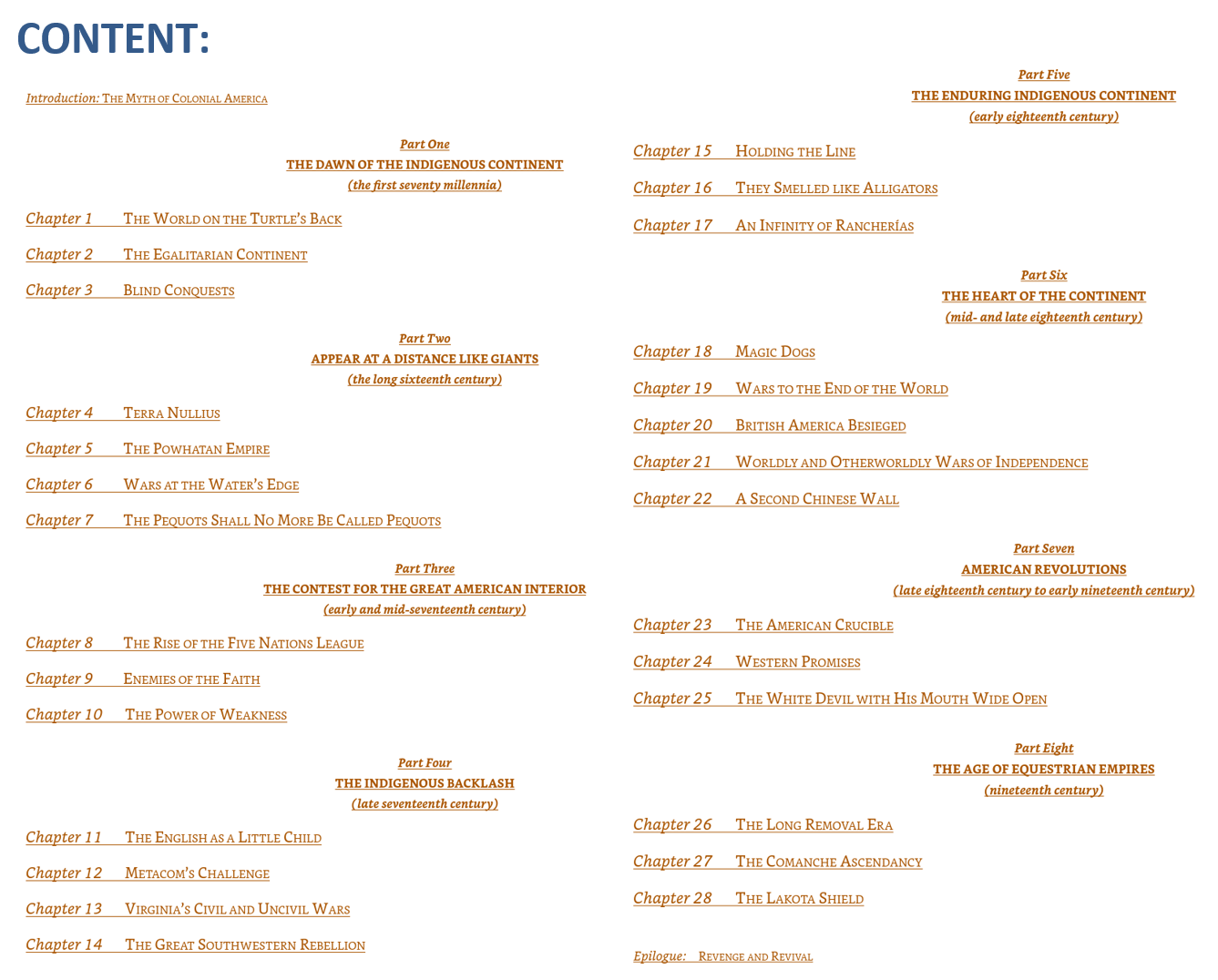
MY TAKE ON IT:
I think this book goes a long way in disassembling many ideological myths about the history of America. Either old myths, based on the ideology of white racial and cultural superiority, or new myths, based on the ideology of white racial and cultural inferiority, distort and diminish the real history of America. In reality, it would be meaningless to seek signs of superiority or inferiority between peoples and civilizations that were developing differently. Qualitatively, Euro-African and American civilizations were approximately equal, about 60 to 80 million people each before encounter. However, land available for human sustenance in America was multiple of that in Europe. Therefore, forces pushing the switch from a hunter-gatherer and/or low-intensity agriculture way of life were much weaker in America, leaving people with much more humane conditions of life with a lot less need for military-technological development for survival. It is not surprising that by all accounts, Europeans who were captured and adopted into a more humane Indian culture preferred to remain in this culture even if they had the opportunity to go back to European civilization. It is also unsurprising that European civilizations of much more intensive agriculture and dependence on military competition had better military technology. Consequently, initially, representatives of European civilizations in America were happily embraced by local tribes as valuable allies despite their negligible numbers. The question of who was dominant in these alliances probably would be answered differently in different cases. Still, up until the latest part of the period from 1492 to 1880s, it was mainly cases of some newcomers and locals fighting other newcomers and locals rather than newcomers fighting locals. It would be nice if the understanding of real history led to the embrace of common humanity and the elimination of all racist ideologies. Still, since as many people are making as good a living now from promoting anti-white racism as other people used to make from promoting anti-black and anti-indian racism in the past, it will take a while before these junk ideologies are fully left behind.
20240623-The Cheating Cells
MAIN IDEA:
This book represents a very interesting approach to understanding the development processes of an organism during its existence as a system of semi-independent entities – cells that undergo a high-speed evolutionary selection process. From this approach comes a new understanding of cancer as the break in cooperation between cells when some cells start unstoppable resource acquisition at the expense of other cells:” cellular cheating.”. Here is the graphic representation:

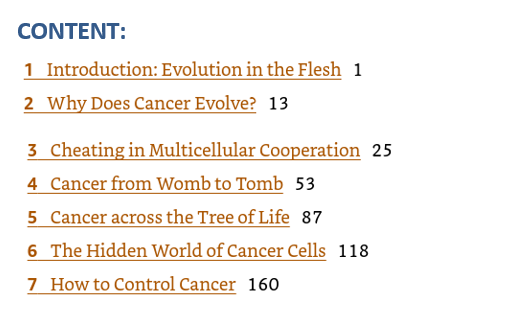
MY TAKE ON IT:
To me, the evolutionary approach to cancer development seems potentially very productive for both understanding the nature of cancer and finding ways to avoid it and/or treat it. I would even expand and generalize these ideas to just about everything, from the development of technology to the functioning of human society. As long as key factors such as inheritance, variation, and selection are present, the process works similarly everywhere. When there is a necessity for group participation as a condition of survival, the multilevel selection inevitably kicks in. Correspondingly, it creates tension between individual and group selection within each individual that had to be resolved via cooperation in such a way that assures the survival of the group. Generally speaking, such cooperation could not possibly continue forever because any system would have some idiosyncrasies that violate the parameters of stability, leading to the system’s self-destruction. This book nicely describes how this process occurs in the human body when some of its cells become exceedingly selfish and, therefore, cancerous and kill the body. Similar processes occur at the level of human societies with similar results. We seem to be in the middle of this process, and it will be interesting to see how it works out.
20240616-Blunder
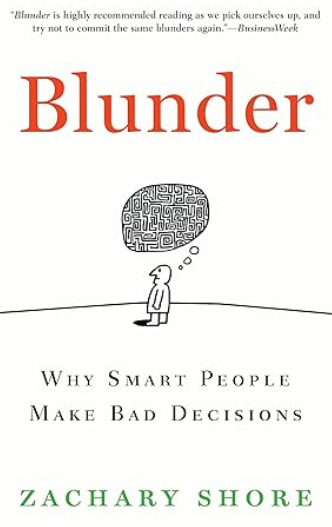
MAIN IDEA:
This book reviews all kinds of reasons, mainly psychological, that caused people to make blunders. Here is the author’s description of its main idea:” Blunder is a book about judgment calls. It is the story of how smart people like Edison get caught in cognition traps and wind up defeating themselves. Most complex problems have complex causes, and no single factor can explain it all. This book offers one possible explanation for why people blunder. I suggest that we all sometimes fall into “cognition traps”—rigid ways of approaching and solving problems.4 Cognition traps are inflexible mind-sets formed from faulty reasoning. They are the stolid ways in which people approach and solve problems based on preconceived notions and preset patterns of thought.
The author also defines three different types of problems that cause people to make poor decisions and implement actions that lead to failure: mistakes, blunders, and cognition traps: ” A mistake is simply an error arising from incorrect data, like believing that an electric wire is running direct current when it’s actually on AC. A blunder, in contrast, is a solution to a problem that makes matters worse than before you began, like attempting to discredit a potentially liberating technology rather than adapting to it. Finally, a cognition trap is the mental framework that led you to a blunder, like the one I call static cling, the refusal to accept that a fundamental change is under way.” The book allocates one chapter to each of the 9 most typical problems that cause blunders.
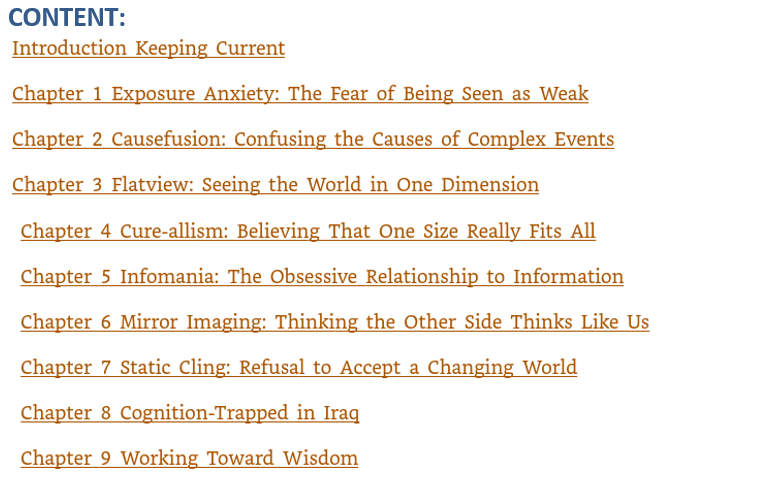
MY TAKE ON IT:
This is quite an interesting collection of cases in which human psychology caused behavior problems that resulted in negative and sometimes deadly consequences. The book is big on factoids but relatively low on proposed solutions. I am actually more interested in solutions. To a significant extent, I think these problems are caused by the lack of education. I do not mean formal education, which is often nothing more than a combination of indoctrination with low levels of technical skills, such as reading, writing, and doing some formalized algorithmic tasks. It would be much better to expand education to game-playing that emulates real-life situations and provides timely and effective feedback on individual actions, pretty much like it is done naturally by children when they are not disturbed. It is probably coming with massive implementation of AI tools and a shift to decision-making to AI models trained on the many situations relevant to skills and behavior patterns needed to avoid blunders.
20240609 – The Experience Machine

MAIN IDEA:
This book discusses a novel theory of human behavior and the functioning of the brain. In this theory the brain is considered, first and foremost, a tool to generate predictions about the environment and then use the sensory organs as secondary tools to adjust these predictions. Here is the author’s formulation:” Perception is now heavily shaped from the opposite direction, as predictions formed deep in the brain reach down to alter responses all the way down to areas closer to the skin, eyes, nose, and ears—the sensory organs that take in signals from the outside world. Incoming sensory signals help correct errors in prediction, but the predictions are in the driver’s seat now. This means that what we perceive today is deeply rooted in what we experienced yesterday, and all the days before that. Every aspect of our daily experience comes to us filtered by hidden webs of prediction—the brain’s best expectations rooted in our own past histories”. So human behavior is not reactive, but rather an active 4-step process: prediction–action-perception–correction rather than two steps: perception-action.
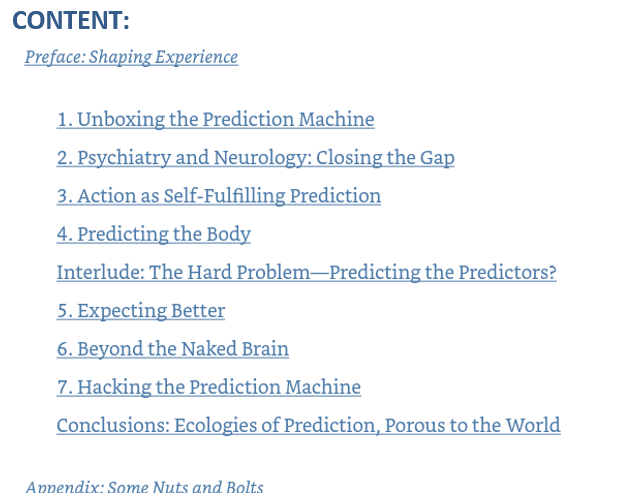
MY TAKE ON IT:
The approach to human brain information processing suggested in this book changes the understanding of this processing. So, the first step is to plan or build an internal abstract model of reality. The second step is to direct sensory organs to actively search for confirmation of this model while ignoring other information as irrelevant. Only when contradictory information becomes so overwhelming that it cannot be ignored does the brain implement the correction step. This makes sense and explains many experimental results related to priming, such as the famous experiment with the “invisible” gorilla in the basketball game. It is an interesting approach, and it points to a very important human brain functionality: building predictive models. Actually, this approach goes back to the very beginning of cybernetics when the objective was to direct anti-aircraft fire based on the prediction of the future position of the targeted aircraft and an artillery shell directed to shoot it down. This was a super simple process fully within the computational functionality of contemporary electronics. Obviously, the complexity of the model built by human brains is much higher than the simple beginnings, but the sequence of processes is the same. At the top level of complexity, it nicely explains a phenomenon when highly educated people are prone to be much more protective of their beliefs, even if such beliefs are obviously incorrect. This is because the models of highly educated people are very sophisticated, built at high costs, and, therefore, much more difficult to replace than models of simpler people. Hopefully, the new understanding presented in this book will help promote the development of modification processes for individuals whose perception of the world is built on propaganda and distortions of reality. The success of such an endeavor could help achieve peaceful coexistence between people with different world views based on different and often seemingly contradictory facts.
20240602 – Psych

MAIN IDEA:
This book was built from the Introduction to Psychology course at Yale. Here is how the author defines his approach:” We’ll see that modern psychology accepts a mechanistic conception of mental life, one that is materialist (seeing the mind as a physical thing), evolutionary (seeing our psychologies as the product of biological evolution, shaped to a large extent by natural selection), and causal (seeing our thoughts and actions as the product of the forces of genes, culture, and individual experience).” However, the author also adds a qualifier:” I think the scientific perspective at the core of modern psychology is fully compatible with the existence of choice and morality and responsibility. Yes, we are, in the end, soft machines—but not just soft machines.”
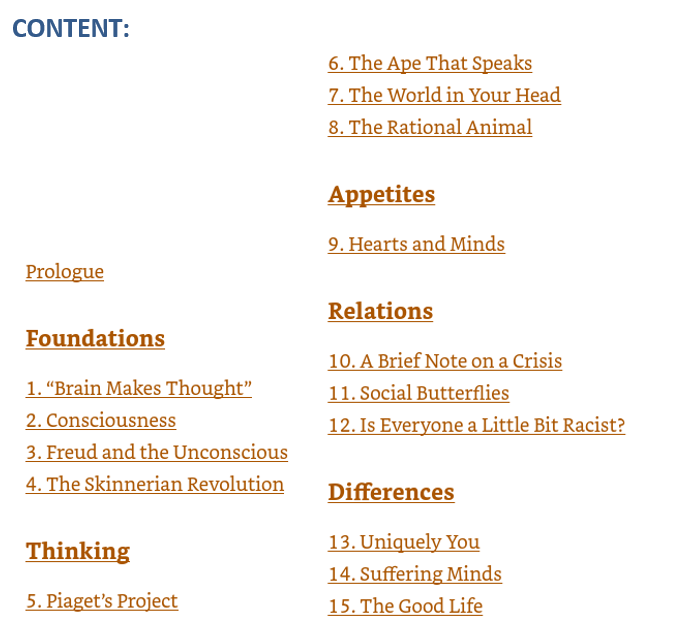
MY TAKE ON IT:
I think it is a pretty good review of psychology’s history and contemporary condition. I agree with the author’s main positions: materialistic, evolutionary, and causal. From my point of view, what is usually called the mind is the product not only of a specific organ called the brain but also of the totality of the human body in which lots of necessary informational processing occurs at the peripheral level. The signals from peripheral subsystems have a huge impact on the functioning of the brain, as described by psychology methods. The most important thing, which is somehow poorly understood, is that the mind is the communication and information integration system that evolution developed to reconcile two levels of multilevel selection: individual survival and survival of the group that individual belongs to. There is a constant tension between the goals of these two levels, sometimes even direct contradiction, so the hugely complicated and biologically very costly brain is not a luxury but a necessity for survival. The human consciousness is also a necessary product of the brain because the complex system designed to solve complex problems has to have some top-level organizational and co-ordinational tool to synchronize multiple processes occurring in both conscious and unconscious parts of the system and even externally at the level of group and overall environment. The complexity also requires flexibility and delegation of controls to the levels where such control is most effective. This is seldom at the top when our conscious self perceives existing conditions and makes actionable decisions. Contemporary Psychology provides some level of understanding of how these processes work, but a lot less than is needed to obtain a good practical understanding, even if some bits and pieces of such understanding are applied immediately to the manipulation of people to achieve the objectives of others. Humanity is now in the process of moving from a multigroup environment with competition for resources to the formation of one group with a general abundance of resources when the focus will turn to the achievement of individual happiness when the most challenging part would be to assure such changes in human psychology that would make it inconceivable attempting to achieve it at the expense of others. I believe we’ll get there eventually, but it will take lots of time, pain, and suffering before it happens.
20240526 – Humankind

MAIN IDEA:
This book is about human psychology, and here is the author’s definition of its main idea:” An idea that’s long been known to make rulers nervous. An idea denied by religions and ideologies, ignored by the news media and erased from the annals of world history. At the same time, it’s an idea that’s legitimised by virtually every branch of science. One that’s corroborated by evolution and confirmed by everyday life. An idea so intrinsic to human nature that it goes unnoticed and gets overlooked. If only we had the courage to take it more seriously, it’s an idea that might just start a revolution. Turn society on its head. Because once you grasp what it really means, it’s nothing less than a mind-bending drug that ensures you’ll never look at the world the same again So what is this radical idea? That most people, deep down, are pretty decent.”
The book includes a detailed review of many well-known experiments and events that are believed to demonstrate human culpability and show that, in many cases, these experiments were staged to prove preexisting conclusions or real events misinterpreted for similar purposes. At the end of the book, the author, based on the material discussed in the book, provides what he called:” TEN RULES TO LIVE BY.”
Here are the rules:
I: When in doubt, assume the best
II: Think in win-win scenarios
III: Ask more questions
IV: Temper your empathy, train your compassion
V: Try to understand the other, even if you don’t get where they’re coming from
VI: Love your own as others love their own
VII: Avoid the news
VIII: Don’t punch Nazis
IX. Come out of the closet: don’t be ashamed to do good
X. Be realistic

MY TAKE ON IT:
This book is very interesting to me because it describes the manipulation of data and context that leads people to believe all kinds of lies about human nature and behavior. The reality is pretty simple: humans are the product of multilevel evolution when change occurs at the individual level under evolutionary pressure at two levels: individual and group survival. Humans are selfish at both levels, sometimes prioritizing individual survival but sometimes group survival, which could mean self-sacrifices to save others in the group. However, humans are often nasty to outsiders, all the way to the genocidal level. It used to make lots of sense because resources were limited, and individuals and groups often could survive only at the expense of others. It does not make sense anymore because scientific achievements of the last few centuries provide sufficient resources for all. Now, we are at the beginning of the big adjustment, after which all humans will be included in one big group, and no individual will need to fight others for resources. We need to learn to tolerate others in exchange for being tolerated by others, which means getting rid of all kinds of hierarchical structures and attempts to impose on others our own beliefs, whether these beliefs are religious or behavioral or whatnot. It will not come easy and probably cost lots of blood, sweat, and tears, but self-annihilation is the only alternative. Humanity needs to change the paradigm from the survival of the fittest individuals and groups at the expense of the less fit others to the prosperity of all because the weapons available to the less fit could obliterate all.
20240519 – Moral Origins
MAIN IDEA:
This book is about “the origination of moral behavior and
the human conscience.” The main idea is that morality and conscience are not
some kind of byproduct but rather logical and proper consequences of the
evolutionary development of humans as animals that survive in groups and,
therefore, need highly functional brains and effective sets of rules of
interactions within and without groups to maximize survival chances. Here is
how the author defines his hypothesis:” My idea will be that
prehistorically, humans began to make use of social control so intensively that
individuals who were better at inhibiting their own antisocial tendencies,
either through fear of punishment or through absorbing and identifying with their
group’s rules, gained superior fitness. By learning to internalize rules,
humankind acquired a conscience, and initially, this stemmed from the punitive
type of social selection I mentioned previously, which also had the effect of
strongly suppressing free riders. Later, I shall argue that a newly moralistic
type of free-rider suppression also helped us evolve our quite remarkable
capacity for extrafamilial generosity.”
MY TAKE ON IT:
My views on the subject are completely in sync with the author’s hypothesis about the evolutionary roots of human morality and conscience. It is nice to see such well-documented and thoroughly researched confirmation of these ideas. I only have a bit of a problem when the author, in his epilogue, moves to a discussion of world morality, global government, world public opinion, climate change, and other such topics. The combination of the desire for global top-down control combined with fear of nation-states does not provide a good foundation for the author’s hope for a “global moral community.” I agree that the evolutionary developed human morals could eventually become the foundation of a peaceful world, but only when all people are accepted as members of one group – humanity, with an exclusively voluntary combination of people in a variety of groups with resources distributed to individual levels as much as possible so, for example, to make territorial conflicts meaningless because the land does not belong one nation or another, but divided between millions of individuals so conflicts are resolved in courts, not on the battlefield.
20240512 – Manifesto of Evolutionary Humanism
MAIN IDEA:
The main idea of this book is that humanity developed a huge
gap between its technological development and its philosophical and moral
understanding of reality. The author compares it to the situation when a
5-year-old child gets to control a jumbo jet with passengers, which could lead
to a disaster. So here is the author’s explanation of what it is all about:” The
present “Manifesto of Evolutionary Humanism” was commissioned by the Giordano
Bruno Foundation.4 It will attempt to formulate the basic positions of a
“contemporary enlightenment” appropriate to the modern world. The publication
of the manifesto serves the intention of supporting those who already feel
committed to a mainstream culture of humanism and enlightenment, as well as the
hope that some of the arguments presented here may yet reach those who, even
today, are of the opinion that they have to take their “wisdom” from archaic
myths.”
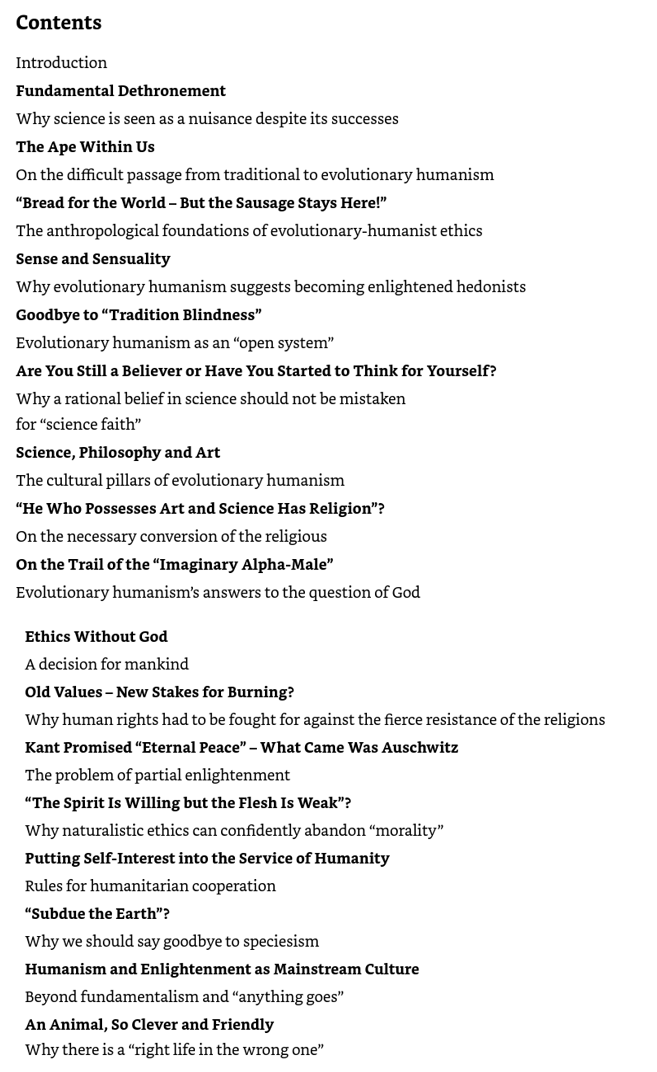
MY TAKE ON IT:
I probably agree with about 60% of the ideas in this manifesto, especially those regarding science and the unnecessity of a god for morality. However, I think that the author mixes two separate and unmixable things: knowledge and beliefs. Knowledge is a testable representation of reality in the human mind, enabling humans to act effectively and even somewhat efficiently. Belief is an untestable description of the world that provides psychological comfort and effective cooperation between individuals, all the way to true believers sacrificing themselves to protect this belief. There is nothing childish in believing, and the belief in science is no more justified than believing in God as long as these beliefs remain in the proper area of worldview combined with tolerance and acceptance of other worldviews as legitimate, however idiosyncratic. The problem emerges when people start moving their beliefs into the area of action, combined with intolerance. At the minimum, this could be somewhat deleterious to human well-being when resources are spent to build temples for God rather than housing for humans. Still, it is as bad, if not more so, when resources are spent to implement some “Great Leap Forward” or implement “collective farms-based agriculture according to principles of scientific communism.” The tolerance of the worldviews of others is absolutely necessary because otherwise, we are getting screwed, and it does not that much matter if it is by the Inquisition in the name of God or by the KGB in the name of a bright, scientifically defined communist future. Finally, morality is just an evolutionary developed set of rules for interaction between humans that assure that such interaction benefits all participants, preventing them from fighting and/or taking advantage of each other. A society without morality could not be stable and, therefore, will fail in competition with other societies.
20240505 – Big Intel

MAIN IDEA:
This book is written by a journalist who spent decades working in close contact with US intelligence agencies, such as the CIA and the FBI. Here is how the author defines what it is all about:” All utopian movements and societies require enforcers. Big Intel is about how these former protectors of American founding principles have followed societal trends to become the secret services of critical theory and fonts of the democracy-demolishing wokeness that the theory animates. This is a counterintelligence story—a chronicle of a battle the FBI and CIA fought for decades before they succumbed to a generations-old hostile foreign intelligence operation to destroy the United States and Western civilization from within. It’s about how American foreign intelligence was targeted and attacked as soon as it was founded. These attacks were not about partisan politics—yes, the FBI and CIA did meddle in domestic politics and still do—but something far deeper: they were meant to turn American instruments of power into enforcers of the vanguards spearheading the fundamental transformation of our country. Big Intel seeks to answer how it happened.”
MY TAKE ON IT:
All secret services of all countries are always instruments
of power. It is never the power of some abstraction, such as people, but rather
the power of a specific group controlling society’s resources and its political
and bureaucratic machinery. In a functioning democracy, resources and control
are divided between competing groups. For example, from the beginning of the
USA until the end of the Civil War, it was between Northern plutocrats and
Southern aristocrats. When the author started his career in the 1970s, it was
between business interests combining rich, middle-class business owners and
professionals represented by the Republican party and government-dependent
groups such as federal, state, and local bureaucracies, unions, welfare
recipients, and educational/cultural establishment represented by the
Democratic party. In this environment, the CIA and FBI remained more or less
neutral, directing their efforts mainly against foreign aggression and internal
criminality. While these are government bureaucracies, their role as the proper
and necessary tools of government psychologically separated members of these organizations
from other bureaucracies that mainly do staff improper for the government, such
as wealth redistribution. The huge growth of government bureaucracies in all
areas of life shifted a lot more areas of life under government control. Hence,
many previously independent groups, such as top-level business managers,
educators, medical professionals, and artists, became dependent on the
government’s handouts. Consequently, divisions within society changed from a
kind of vertical wall when approximately equal power groups, each with its own
elite and masses maintaining dynamic stability, into a kind of horizontal
separation between different floors of society, with united politically/bureaucratic/big
business elite comfortably sitting at the top level, when masses at the bottom
are losing the quality of lives as a result of the various pursuits of the
elite from globalization to climate alarmism. In this environment, the
governmental bureaucracies of the CIA and FBI necessarily lost any shade of
neutrality and had to act to protect their class interests. The big problem is
that the elite, even if it includes 25-30% of the population, is still a
minority. Its isolation and self-protection inevitably lead to incompetence
plentifully demonstrated by lost wars, massive technology, and wealth transfer
to communist China at the expense of the American population, failure in
handling COVID-19, massive illegal immigration, and other developments of
contemporary life. All this makes
society’s condition unstable and will lead to qualitative changes in its
organization and conditions. It reminds me of the last years of the Soviet
Union, including such features as the gerontologic leadership of the country
and its inability to make things work as they used to.
20240428 – Homelands

MAIN IDEA:
This is a book on European history after the end of WWII. It covers the Cold War with its division into West and East, traced via a narrative about people’s lives on both sides of the Iron Curtain. It also covers the dissolution of the East, sometimes with its peaceful divisions, such as in Czechoslovakia, and, at other times, with violent divisions, such as Yugoslavia. It also covers the process of European Unification into a quasi-federal state of the EU and the later disappointment that resulted in Brexit. It ends with the current state of affairs when the Semi-democratic West has to face invasion by invitation by the fundamentalist Islamic population from failed states frozen in medieval intellectual milieu, seeking to destroy Western civilization and substitute it with an Islamic caliphate and the invasion from outside by revanchist Russia seeking to restore the great Russian empire and make it the dominant force in Europe. A little bit further is lurking another revanchist power – China that is seeking to restore the proper order of the world, which in the minds of Chinese leaders is the absolute dominance of China with everybody else happily accepting the roles of vassals. The author, being a moderate leftist, seems to be unhappy with these developments, but he is also quite scared by the growing resistance to the destruction of the West that comes mainly from the right. The author ends with the description of his encounter with a representative of such right in Normandy and how he managed to bring it to this semi-happy conclusion:” Finally, after long resistance, he yields, raising his last glass with a half-reluctant, half-cheerful shrug. ‘L’Europe!’”

MY TAKE ON IT:
This book is a good illustration of how we all live now in
“Interesting Time.” I believe that we
are now in the process of restructuring society, brought about by technological
developments that, for all practical purposes, eliminate barriers between
countries, cultures, and individuals. These barriers limited the exchange of
goods, services, cultural artifacts, and ideas. Still, they provided security
to all these entities, from reliable, clearly defined territory and homogeneity
of the population for countries to privacy and secure place within society for
individuals. This will all be gone within 50 to 100 years, and a unified
society will be created covering all humans worldwide. The question is whether
it will be a top-down hierarchical society with a rigid elite controlling
everything and everybody via AI technology or it will be a flexible network in
which individuals are in possession of sufficient resources to conduct their
lives any way they want it combined with the cultural and organizational environment
in which any attempt to establish dominance and control over other people’s
lives would be immediately suppressed either by soft methods like cultural
pressure or by violent methods. I believe that in the long run, the second
outcome is much more probable for two reasons. The first one is that it is much
more appropriate for human nature as it formed over the previous 200,000 years
when humans were hunter-gatherers and maintained their societies in such mode.
The second one is that any hierarchy with a rigid elite at the top inevitably
causes individuals to fight each other for power and control, causing all the
entertaining staff of history with its kings, barons, general secretaries,
presidents, and CEOs. In addition to entertainment, it also creates misery for
all, including members of the elite, making the system unstable overall. We
certainly could move directly to the global equivalent of the hunter-gatherer
community of generally happy people right away using emerging technology, but I
doubt that this would happen. Humanity possesses an uncanny ability to do everything
right, but only after it tries everything else, so I expect lots of misery to
occur during this trying.
20240421 – Coup dÉtat
MAIN IDEA:
This is a very detailed manual on how to conduct a coup. It describes everything required to conduct a successful coup, from the political conditions of society that make a coup possible to the psychological preparation of participants and even tactical recommendations on force allocation and the sequence of objectives. It also provides very good statistical data about this form of political activity. Here is the table describing the overall results over the last historical period:
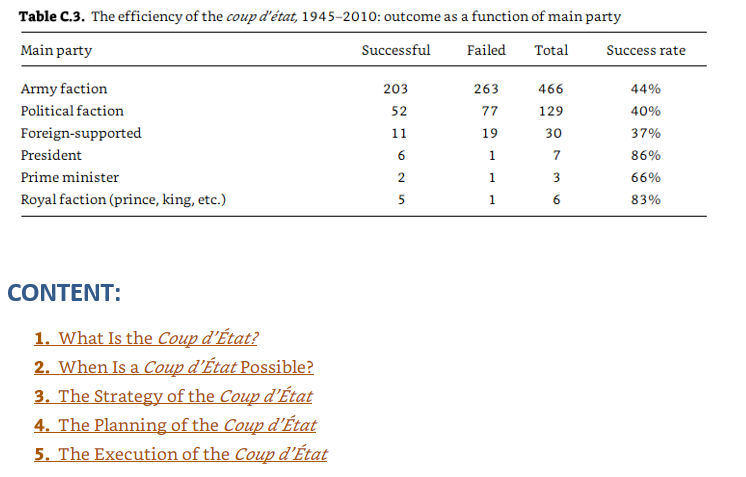
MY TAKE ON IT:
This book was first published in 1968 when coups were quite
common and in a very old-fashioned way: as military action. The author
correctly identifies preconditions for the coup:” The social and economic
conditions of the target country must be such as to confine political
participation to a small fraction of the population.” It seems to me that such
preconditions have become increasingly improbable because of widespread social
media and the availability of multichannel communications with high levels of redundancy.
There has also been a massive change in the requirements for legitimacy, which
now often includes at least some form of popular vote, whether real or
falsified. In short, the change of people in power is becoming much more dependent
on the manipulation of the political opinions of the population than on the
support of a small group of military men in the capital of a country. A
contemporary coup requires the ability to organize mass demonstrations in its
support, which then transferred into taking political power away from previous
rulers via some emergency election, however faked, rather than just getting a
small military detachment to arrest these previous rulers. With the world being
currently in turmoil unseen since the wave of dissolution of the communist
system in Europe, we’ll probably have the opportunity to see how the new,
qualitatively different generation of coups happens in the near future.
20240414 -The Square and the Tower

MAIN IDEA:
This book is about the history of parallel development of two methods of organization used by human societies and their interaction. Here is the author’s statement of the purpose:” This book is about the past more than it is about the future; or, to be precise, it is a book that seeks to learn about the future mainly by studying the past, rather than engaging in flights of fancy or the casual projection forward of recent trends. There are those (not least in Silicon Valley) who doubt that history has much to teach them at a time of such rapid technological innovation. Indeed, much of the debate I have just summarized presupposes that social networks are a new phenomenon and that there is something unprecedented about their present-day ubiquity. This is wrong. Even as we talk incessantly about them, the reality is that most of us have only a very limited understanding of how networks function, and almost no knowledge of where they came from. We largely overlook how widespread they are in the natural world, what a key role they have played in our evolution as a species, and how integral a part of the human past they have been. As a result, we tend to underestimate the importance of networks in the past, and to assume erroneously that history can have nothing to teach us on this subject.”

MY TAKE ON IT:
I think both methods, networks, and hierarchies, are necessary components of human existence, always intertwined and codeveloped. However, they always have different weights and impacts on the conditions of human societies depending on the phase of human development we are looking at. Judging by what we know about great apes that had developed from a common ancestor some 4 million years ago in parallel with humans such as chimpanzees, we started with small hierarchical bands based on individual physical power and psychological aggressiveness. Chimpanzees are still there, maintaining hierarchy as the dominant method of organization. Humans, however, moved in a different direction by developing language and more complex brain structures that allowed for a high level of cooperation in hunting, mutual help, and building conspiracies to overthrow whatever megalomaniac attempted to build a hierarchy with self at the top. Over the period of tens of thousands of years, this produced highly egalitarian hunting-gathering societies of people with genotypical and phenotypical features that made them strive to obtain the optimal ratio between being a part of a network of cooperating individuals adjusting to each other needs and free agents taking care about one’s own needs. Then we had about 20,000 years of hiatus in the equality mode when human expansion all over the world forced transfer to militaristic/agrarian societies in which fights for territories and suppression of opposition made hierarchy the most appropriate form of society for individual survival, even if it more often than meant live in misery. Now, with the new technologies of resource acquisition and networking, stabilization of population, and soon disappearance of the need to work for a living, humanity could minimize the need for hierarchies and all this violence and coercion that are inevitable features of hierarchy. This process is not simple and will probably take a few decades, but I believe we will eventually get there.
20240407 – The Indoctrinated Brain

MAIN IDEA:
The author is a German neuroscientist specializing in processes related to brain changes due to environment and aging and reviews recent events such as the COVID-19 pandemic. He concludes that these events, when the normal functioning of democracy was dramatically disrupted, are not random but rather part of the quite open process of changing the existing political and economic systems of the Western democracies to the new one characterized by complete dominance over society by the global technocracy: something represented by “Davos people.” Here is the author’s description of how it works using the example of vaccination based on the assumption that a natural immune system cannot handle the COVID-19 virus:” The proclaimed need to be vaccinated against it every three to six months was ultimately based on this false assumption. In the case of this pathogen, however, this meant that for the first time a largely experimental injection was being administered, the mode of action of which is in many cases similar to that of gene therapy (i.e., involving modified active genetic material). This was made palatable to people by a combination of media-generated fear of death (with the key word self-protection) and ethically sanctioned social pressure (protection of others). Thus, this lifelong injection subscription also fulfills the definition of psychosocial dependency, with the ministries of health worldwide having increased their influence on individual lifestyles and pharmaceutical companies having made high profits.”
The author refers to other works that describe the process of people’s indoctrination and then links it to his area of expertise:” An entirely new approach to explaining the increasing controllability of society and the astonishing response of little resistance emerges from this neurological insight. It goes far beyond the sociopsychological approach formulated by Desmet and, in a sense, forms its neuropathological basis. This profound explanation is, however, highly dramatic, for it will take much more than psychological insight and a change of mentality to halt or reverse this dangerous development. Trapped in zombie mode, it is impossible for victims to question their own precarious situation. Natural curiosity or interest in alternative explanations and courses of action is lost, opening the door to indoctrination. The underlying neuropathological process leads to a decrease in psychological resilience. The result is not only an increased fear of anything new but also a particular susceptibility to being controlled by fear.”
In the final chapter, the author presents the closing argument detailing a to-do list for achieving a “Healthier Brain, Healthier Decisions.” He also promises a nice result from implementing it:


MY TAKE ON IT:
I generally do not believe in any conspiracy theories, not because there are no conspiracies, but because the functioning of human societies is way too complicated for conspiracies to be functional. More often than not, great changes in societies, as well as in technology, happen unexpectedly as a result of long undercurrent development that conditions a small number of activists to capture a momentary disturbance of the system and move it to a qualitatively different state. At the same time, the vast majority of people remain passive, whether they support it or not. Such qualitative change could be for the best, as it happened with the Enlightenment and the Industrial Revolution, which led to prosperity and a huge improvement in quality of life, but it can also happen as it did with Fascism and Communism for the worst, which led to a massive decrease in quality of life and termination of millions of lives.
I think that humanity is at a crossroads now, with one road leading to an attempt to establish a dictatorship of a global elite and another one leading to the massive expansion of individual property rights to everybody. Either of these roads will
substitute the current method of resource generation and distribution based on control over most of the resources by the minority of members of the bureaucratic hierarchy of government and/or corporations and on the labor-based resource allocation for the majority. It will inevitably happen because technology makes all labor increasingly redundant, with make-believe jobs being a non-viable substitute due to the evolutionary-formed human psychology.
I also think that the road to complete dominance of bureaucratic hierarchy is a dead end because top members of the elite will always fight each other for power, causing pain and suffering for all in the process. So, eventually, humanity will come to an arrangement when everybody has property rights sufficient to obtain necessary resources via voluntary exchange, and the scale, role, and power of elite bureaucracy will be diminished to the absolute minimum required to maintain law and order.
20240330 -Facing the beast

MAIN IDEA:
This is the story of awakening, but it is not of the leftist
type but rather of the awakening from leftism to reality. The author is a
well-known leftist personality, a top-level political consultant to Clinton and
Gore, and a supporter of all left causes, including Islamic extremists, producing
such pearls as the claims that Islamists’ beheading of journalists was a fake
staged by the US government. The awakening started on a personal level after
various threats led to hiring an Army veteran for security protection that
ended in marriage. The direct encounter with a representative of middle-class
working America and an outsider to liberal America caused the author to
discover the beauty of this middle-class America. In addition to this, COVID,
with its lockdowns, suppression of information flows, forced vaccinations, and other
such beauties, turned the author into a “right-wing conspiracy theorist” who
doubts the efficacy of COVID vaccination, supports the Second Amendment and
freedom of speech even for those that leftists hate. It even led to a formal
apology to conservatives.

MY TAKE ON IT:
It is quite an interesting case of recovering from the sickness of leftist totalitarianism as a result of traveling outside of the closed quarters of leftists’ intellectual circle. It also results from the work of the instinct of self-preservation when the forced COVID vaccination with the cover-up of adverse effects scared the author to her core.
This case could serve as a template of how to bring extreme leftists to reality so they would understand that the world created by Western civilization, especially its American alteration, is the one and only world where they could have a decent chance for a good life. The world of victorious leftist totalitarianism historically represented by the Soviet Union or Maoist China guarantees their pain and suffering in some GULAG or just a bullet to the back of their heads. The world of victorious Islam, historically represented by Iran’s ayatollahs, ISIS, or Hamas, would bring them just a bit of diversity in the form of beheadings rather than just plain shooting. So, the template would be simple:
- Scare them to death by massively popularizing leftist views of Israeli women who got into the hands of Hamas and what happened to them.
- Force them to encounter real life by eliminating all government support for pseudo-education and all NGOs. By the way, if this is combined with limiting all charitable exemptions from taxes to not more than double the average income, it will also eliminate the USA’s debt in very short order.
20240323 Junger, Sebastian-Tribe
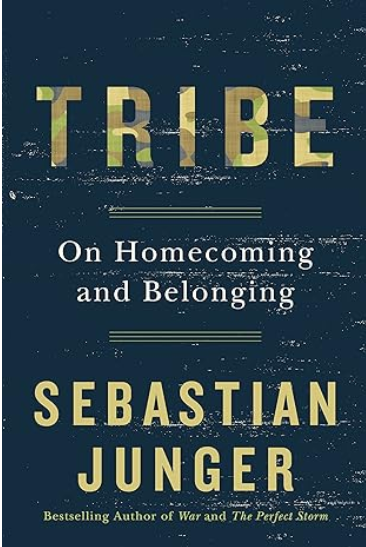
MAIN IDEA:
This book is about the human need to belong to some group of humans – a tribe. The author defines it this way:” Robert Frost famously wrote that home is the place where, when you have to go there, they have to take you in. The word “tribe” is far harder to define, but a start might be the people you feel compelled to share the last of your food with.” The author describes how the evolutionary developed norms of the human tribe proved to be a much better environment for human thriving than norms developed by militaristic/agricultural civilization. The author uses the historical example of interaction between societies representing these two norms: American Indian tribes and American European Settlers. This example clearly demonstrates the superiority of the norms of American Indian tribes by retelling stories of individuals who moved between these societies. On many occasions when settlers, either children or adults, were captured by Indians and accepted into a tribe, there were very few cases when these individuals wanted to return back to European society. The tribal way of life was clearly preferable. After that, the author discusses why this is the case and concludes that humans feel uncomfortable or, as he put it in a postscript: “Just dead inside” without belonging to a tribe and correspondingly sharing resources with other members of the tribe.
MY TAKE ON IT:
I think that the description of human nature provided in
this book is correct – humans do need to belong to a tribe and are miserable
when they are on their own in life. However, a lot of human life is also
defined by attitude toward other tribes, which evolutionarily developed to be
hostile by default because another tribe nearby was always a competitor for
limited resources. So, humans need both other members of their own tribe to
give life for and people who belong to other tribes to fight and kill. Without
friends and enemies, humans feel a void inside. The sad history of the clash of
Indian tribes and European tribes is a very good illustration.
Indian tribes were better adjusted to human nature in an
environment of relative abundance of natural resources when the survival of
individuals and groups was mainly dependent on effective interaction with the
environment. The European tribes were better adjusted to military competition
between groups when survival was obtained at the expense of the misery of
individual lives. As a result, the European tribes nearly completely eliminated
Indians, as it happened many times before when militaristic/agrarian societies
eliminated hunter/gatherers despite providing an inferior quality of life for
individuals.
On the bright side, humanity is now moving to form a global
tribe when all humans are included, and a superabundance of resources makes
military competition meaningless. It is not an easy process, which will take
decades or maybe even a century or two because one of the legacies of human
militaristic/agricultural societies is the psychological need to suppress
others and control them. Whether this need is expressed via the expansion of
the bureaucratic machinery of the big and deep state, via the religious
extremism of Islamists, or through activities of white or black supremacists,
it will have to be eliminated. Only after eliminating individuals who act
according to these views will humanity be able to move to a better place when
psychological comfort provided by tribes of hunter/gatherers will be combined
with the material comforts of technological civilization. Such elimination
could be psychological when individuals decide that they will be better off
without the ability to control others in exchange for the freedom of not being
controlled by others. However, for some, it would not be possible, so for these
cases, military and/or law enforcement options will become necessary. In either
case, it will take lots of time and struggle to get to this better place from
where we are now in human development.
20240316 – American Homicide

MAIN IDEA:
Here is the author’s definition of the book:” This book presents a working hypothesis about why adult homicide rates in the United States are so high. The hypothesis is based on tens of thousands of murder cases from the United States and Europe and includes complete or near-complete data from scores of counties across the United States.”
The book reviews the history of homicide not just in the USA but also in European countries from which Americans came. After reviewing this history, it concludes that while deterrence works, the rate of homicide depends on more important factors:” That rate is also dependent upon forces that are hard to engineer: political stability, the legitimacy of the government, the degree of unity and fellow feeling in the nation, and men’s prospects for achieving a satisfactory place in society.”
Here is a very clear graphic representation supporting the author’s hypothesis:
MY TAKE ON IT:
I completely agree with the author that the rate of homicide could not be treated as some kind of isolated problem, somehow dependent on such factors as the availability of guns or drugs or education. Even the level of deterrence that does minimize homicide rate by removing individuals that commit it after the first offense could not remove it completely. This book’s historical statistical data convincingly supports the author’s hypothesis. So, I would suggest that people who really want to live without homicide should direct their efforts to support political stability and the feeling of belonging to a unified society. It is also necessary to support the belief that it is not just possible but realistic to achieve satisfactory conditions in one’s life. If one adds to it a decent system of early warning and psychiatric care for a small number of mentally disturbed individuals, the rate of homicide could be brought to very close to zero. Correspondingly, all efforts directed at increasing divisions in society, either in the form of antiwhite or antiblack racism or in the form of equalization of results or the form of antisemitism, even if the intention is just to obtain political power, will always lead to the increase in homicide as a side effect of these efforts. Similarly, increased political and economic corruption, which is an inevitable consequence of the growth of a government, would also lead to an increase in homicide, even if the objective is just to steal public money and get control over the lives of other people. One also needs to understand that the idea of law and order seemingly provided by totalitarian societies is just plain wrong because in such societies, crimes such as murders, robberies, and kidnappings are committed by government bureaucrats on the massive scale and just not considered crimes.
20240309 – Determined

MAIN IDEA:
The main point of this book is that free will does not exist and that everything humans do is predefined by their biological, cultural, and evolutionary history, which happens within time frames ranging from milliseconds to millions of years. The author presents four possible positions regarding the issue of free will, clearly stating that he supports the first one and then proceeds to discuss why the other three are incorrect. Here are the choices:
- The world is deterministic and there’s no free will.
- The world is deterministic and there is free will.
- The world is not deterministic; there’s no free will.
- The world is not deterministic; there’s free will.
The author is a very good scientist and, therefore, clearly defines free will and a deterministic world.
About free will: “Here’s the challenge to a free willer: Find me the neuron that started this process in this man’s brain, the neuron that had an action potential for no reason, where no neuron spoke to it just before. Then show me that this neuron’s actions were not influenced by whether the man was tired, hungry, stressed, or in pain at the time. That nothing about this neuron’s function was altered by the sights, sounds, smells, and so on, experienced by the man in the previous minutes, nor by the levels of any hormones marinating his brain in the previous hours to days, nor whether he had experienced a life-changing event in recent months or years. And show me that this neuron’s supposedly freely willed functioning wasn’t affected by the man’s genes, or by the lifelong changes in regulation of those genes caused by experiences during his childhood. Nor by levels of hormones he was exposed to as a fetus, when that brain was being constructed. Nor by the centuries of history and ecology that shaped the invention of the culture in which he was raised. Show me a neuron being a causeless cause in this total sense.”
About the deterministic world: If you had a superhuman who knew the location of every particle in the universe at this moment, they’d be able to accurately predict every moment in the future. Moreover, if this superhuman (eventually termed “Laplace’s demon”) could re-create the exact location of every particle at any point in the past, it would lead to a present identical to our current one. The past and future of the universe are already determined… Contemporary views of determinism have to incorporate the fact that certain types of predictability turn out to be impossible and certain aspects of the universe are actually nondeterministic. Moreover, contemporary models of determinism must also accommodate the role played by meta-level consciousness.
Finally, the author defines the issue’s importance by using the analogy of the graduate ceremony in an elite college, where some people are graduates, and others of the same age are garbage collectors: “Because we all know that the graduate and the garbage collector would switch places. And because, nevertheless, we rarely reflect on that sort of fact; we congratulate the graduate on all she’s accomplished and move out of the way of the garbage guy without glancing at him.

MY TAKE ON IT:
The author’s view of free will is just plain materialism. If no neuron activates spontaneously without any signals from other neurons or its previous internal condition, then there is no free will. This means that if there is no material cause for such activation, and we can identify some non-material(spiritual) cause, then there is free will. I think it is just incorrect to switch the issue from human free will and, consequently, human responsibility for actions to biological, cultural, and social factors that influence these actions. I also think it is incorrect to discount the non-deterministic character of physical reality proved by quantum mechanics, even if it applies at the micro level of reality. So, in my opinion, the world is non-deterministic, and even if human actions are influenced by a multitude of factors, these actions still represent choices made by humans and, therefore, are subject to their responsibility for these actions. The proof of the validity is the simple fact that human actions are easily changed by the external circumstances that provide reward or punishment for such actions, making any such actions only partially predictable. Actually, the predictability of human actions is directly correlated with levels of rewards and punishments. Light rewards or punishments make actions much less probable than heavy rewards or punishments.
For example, a university professor promoting antisemitism on campus, knowing that he will be formally slightly reprimanded and informally admired for his heroic stand against all-powerful Jews, will keep doing it again and again. However, he would find some other cause to promote if the punishment would be immediate dismissal and the impossibility of having a job in the educational system. The professor would still have free will to promote antisemitism, but there would be no openly antisemitic professors, only antisemitic former professors. The implementation of such a measure would change nothing in the biological and cultural history of antisemitic professors, so if there is no free will, sociological departments would be empty within a week. Since I believe in free will, I do not doubt that they continue to function as always, and only a few hard-core antisemites, if any, resign. Surely, they will still remain antisemitic, but quietly.
20240302 – Crowds and Power

MAIN IDEA:
This book goes all the way back to 1960 and explores the dynamic relationship between different types of crowds and power. The author differentiates types of crowds into crowds and packs and provides a detailed analysis of each type. Similarly, he analyses the process of applying power and the psychology of the people who do it and to whom it is done. Finally, a lot of attention and space is allocated to the components of power and processes relevant to its use.

MY TAKE ON IT:
In my view, it is way too detailed and a minuscule analysis of relatively simple things. Obviously, the individuals in the crowd act and behave differently than they do by themselves, but they remain individuals all the same. So, the question is how to train individuals to maintain psychological independence and avoid becoming an insignificant and passive part of a bigger organism. I believe that it is necessary because only by maintaining such psychological independence among the significant share of the population can humanity avoid the collective madness of wars, revolutions, and massive witch-hunt movements periodically exploding within human societies. All these forms of organized massive violence are based on the elimination of individual responsibility for actions and mistaken beliefs in the tremendous rewards in the future for all members of the crowd. Such future collectivistic rewards usually never come, while pain and suffering caused by all this greatly damage people’s lives, whether they are victims or perpetrators. In short, only individual freedom of action with sufficient resources to implement these actions could lead to human happiness. At the same time, “great” ideas, like Nazis and Islamists’ idea to kill all Jews or communists’ idea to build a society perfectly controlled by the elite from the top down, could never do it.
20240224 – Systems of Survival

MAIN IDEA:
Here is the author’s definition of the main idea of this book:” This book explores the morals and values that underpin viable working life. Like the other animals, we find and pick up what we can use, and appropriate territories. But unlike the other animals, we also trade and produce for trade. Because we possess these two radically different ways of dealing with our needs, we also have two radically different systems of morals and values—both systems valid and necessary.” From here follows the definition of two syndromes: Commercial and Guardian. Then, the book explores various aspects of these two syndromes, including their morals and corresponding types of human behavior depending on the preponderance of one or another syndrome in the worldview of individuals. Here are the key points:


MY TAKE ON IT:
For me, it is extremely interesting that the author of this book came to the same conclusions that I did, only from a completely different point of view. I look at it from the point of view of goods and services production and distribution when processes are based either on the voluntary cooperation of individuals in possession of resources or on a violent hierarchy forcing individuals to cooperate whether they want it or not.
The author of this book looks at the same dichotomy from a moralistic point of view, going into the details about human behavior relevant to each Moral syndrome, which is a proper approach for the moral philosopher.
My approach is to look at what kind of a system could be implemented to obtain the best of both sides of this dichotomy, which is a proper approach for the systems engineer that I am. So, my conclusion is that such a system should be based on minimizing the use of violence (governmental hierarchy) and maximizing the use of voluntary actions of free individuals (ownership of self and resources).
By the way, I expressed my views in a small essay, and here is the link:
20240217 – Conflict

MAIN IDEA:
This book is based on the history of warfare after WWII. It reviews and drives lessons from multiple limited conflicts and, based on these lessons, presents recommendations for leaders of countries involved in such conflicts:” Leaders, some of whom are politicians in this book while others are soldiers, must be able to master four major tasks.2 Firstly, they need comprehensively to grasp the overall strategic situation in a conflict and craft the appropriate strategic approach – in essence, to get the big ideas right. Secondly, they must communicate those big ideas, the strategy, effectively throughout the breadth and depth of their organization and to all other stakeholders. Thirdly, they need to oversee the implementation of the big ideas, driving the execution of the campaign plan relentlessly and determinedly. Lastly, they have to determine how the big ideas need to be refined, adapted and augmented, so that they can perform the first three tasks again and again and again. The statesmen and soldiers who perform these four tasks properly are the exemplars who stand out from these pages. The witness of history demonstrates that exceptional strategic leadership is the one absolute prerequisite for success, but also that it is as rare as the black swan.”

MY TAKE ON IT:
I did not see much new information in this book, but looking at these conflicts from the point of view of one of the top-level participants and decision-makers was somewhat interesting. From my point of view, the most significant characteristic of these conflicts is a lack of will to win on the part of the more powerful side, which in all these conflicts was Western democracies. The basis of this deficiency comes from the inability of top leadership to define what will constitute victory and pursue this victory despite the losses inevitable in such conflict. In addition to high vulnerability to one’s own losses, contemporary Western democracies are oversensitive to the enemy’s losses, creating opportunities for the enemy to use methods of war that would be not only unheard of before but would be inconceivable even for Western leaders in WWII. Such methods are massive use of Western media by the enemies for propaganda purposes and use their own civilians as human shields. This resulted in a sad situation when millions of people lost their lives due to the humanitarian paralysis of Western powers. However, I believe that despite this problem persisting for the last 70+ years, it is coming to the end of its run. It is mainly because the surviving enemy becomes ever stronger and, at some point, develops an ability to cause unacceptable damage. A good example is the events on October 7, 2023, in Israel, when decades of Israeli society’s division with a significant part of the population looking to accommodate the enemy finally understood the impossibility of such accommodation. Consequently, I expect that we are entering a qualitatively new type of war when the technological superiority of the West will be used quickly and decisively to achieve clearly defined objectives while removing all considerations except for operational effectiveness in the use of weapons and methods of war.
20240210 – The Social Leap
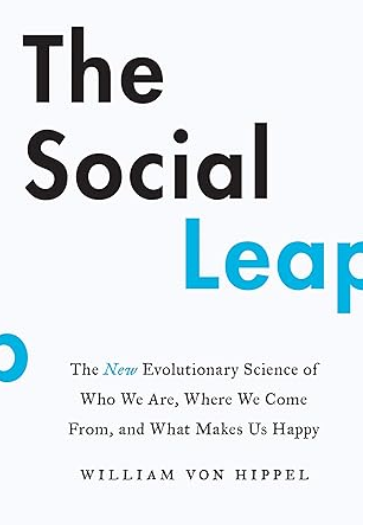
MAIN IDEA:
This book discusses the evolutionary development of humans a bit differently than usual. Here is the author’s main point:” What’s less obvious is the role that evolution played in shaping our psychology. We tend to think of evolution in terms of anatomy, but attitudes are just as important for survival as body parts. Preferences that don’t fit your abilities are as debilitating as limbs that don’t suit your lifestyle. Our bodies changed a little over the last six or seven million years, but our psychology changed a lot. Indeed, our evolution away from chimpanzees is marked primarily by adaptations to our mind and brain. The most important changes in our psychology concern our social functioning, particularly our capacity to work together.”
There is also a fascinating discussion about acquiring historical knowledge when there is little to no material evidence. A good example is the history of clothing based on an analysis of the genetic evolution of human louse. “The Social Leap” under discussion is the environmental change in human habitat from forest to savanna that directed evolution to the development of unprecedented levels of cooperation between individuals that made us human.
The book also goes on to discuss further human developments in cooperation, self-control, and innovation that made us the dominant species on this planet. There is also a high level of intellectual diversity generated by the need for different skill sets for the effective functioning of complex societies. Here is a very nice graph for the diversity of social orientations:

The book’s final part discusses the application of evolutionary knowledge to the pursuit of happiness.
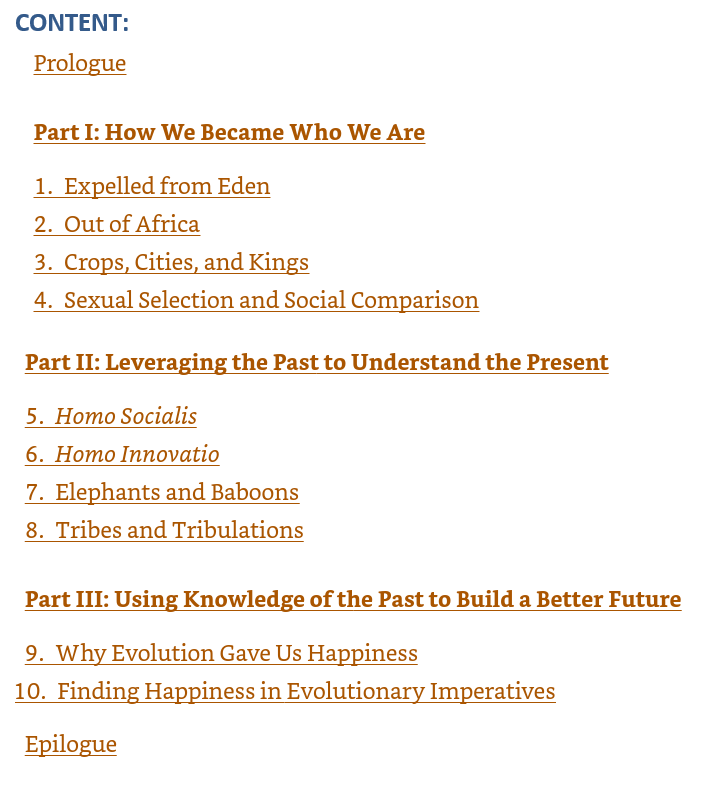
MY TAKE ON IT:
I like this book’s approach to understanding human nature in light of the analysis of evolutionary conditions of human development. Such an approach is the only valid approach, unlike a typical approach from a moralistic or ideological point of view, either secular or religious. This is also necessary because the effective pursuit of happiness is only possible by understanding what makes us happy, which understanding could come only from understanding human nature formed by evolutionary pressures for survival.
20240203 – The Idea of Decline

MAIN IDEA:
At the very beginning of this book, the author makes an important note that the book is about the idea of the decline of Western civilization, not about the decline per se. It describes the cultural tradition of pessimism and how it was expressed in literature and intellectual debates. Here is the author’s description with reference to relevant authors:
“But we will also see that the idea of decline consists of two distinct traditions. For every Western intellectual who dreads the collapse of his own society (like Henry Adams or Arnold Toynbee or Paul Kennedy or Charles Murray), there is another who has looked forward to that event with glee. For the better part of three decades, America’s preeminent thinkers and critics—from Norman Mailer, Gore Vidal, Thomas Pynchon, Christopher Lasch, Jonathan Kozol, and Garry Wills to Joseph Campbell, Joan Didion, Susan Sontag, Jonathan Schell, Robert Heilbroner, Richard Sennett, Noam Chomsky, Paul Goodman, Michael Harrington, E.L. Doctorow, and Kirkpatrick Sale, not to mention Cornel West, Albert Gore, and the Unabomber—have advanced a picture of American society far more frightening than anything pessimists like Charles Murray or Kevin Phillips could come up with. As a critique of Western industrial society, it dates back to the nineteenth century. In this point of view, modern society appears as greedily materialistic, spiritually bankrupt, and devoid of humane values. Modern people are always displaced, rootless, psychologically scarred, and isolated from one another. They are, as the Unabomber puts it, “demoralized.” The key question now becomes not if American society or Western civilization can be saved, but whether it deserves to be saved at all.”
At the end, the author concludes:
“… the whole debate over “the decline of the West” presents us with a false set of choices. The alternative to historical pessimism about the future of modern society is not optimistic complacency: they are opposite sides of the same holistic view. The alternative to cultural pessimism is not some sort of megatrend “third wave” or other futurological adventure of authors like Warren Wagar and Alvin Toffler. The classical liberal view originally sprang up precisely because its adherents recognized the dangers of insisting that individuals have significance only if they are part of a larger whole. In earlier times, that holisticorganic model had been “the great chain of being,” in which a person’s status was assigned by God and nature and enforced by political authority. Enlightenment thinkers rebelled against this sort of social determinism; John Locke defined this position of “being under the determination of some other than himself” without that individual’s consent as a form of tyranny. One of the great blessings of the civilizing process, the Enlightenment concluded, is that it raises humans above that servile status by making them aware of their individual rights, interests, and powers as well as free from irrational passions and fears.”

MY TAKE ON IT:
For me, the American pessimism provides a somewhat funny contrast with the Soviet optimism, which surrounded me for the first part of my life. The funny parts come from the completely opposite character of these cultural environments. When one steps out of the milieu of books and debates into reality, the American and Soviet worlds could not be more different. The depressive mood of American pessimism when one reads about rotten capitalism crimes of the past, the misery of the present, and the imminent doom of the future immediately dissipates under the reality of a nice room, a car that could bring you anywhere, conditions of surrounding comfort, availability of any food and goods conceivable and freedom to read, think, and do just anything one desire. In contrast, in Soviet life, the feeling of optimism and excitement from anticipating the wonderful future of communism quickly turns into frustration caused by the need to wait in line for any necessity of life, the impossibility of traveling, the stifling bureaucracy of everything around and, finally, recognition of the reality that wrong thinking or reading something not approved by the party could bring a prison term.
Lots of people treated the cognitive dissonance of Soviet life by ceasing to believe in anything, which eventually led to the destruction of Soviet society. The question is, would it be possible for cognitive dissonance in American life to end up in the destruction of American society? I think it will not, mainly because the many anti-American, parasitic quasi-intellectuals will fail to generate support from the majority of regular people for such destruction. The massive intellectual pessimism did attract the support of a mass movement of unproductive people leaving on handouts from the administrative welfare state. However, these supporters are too weak to withstand the backlash from the majority that will inevitably demand the return to traditional American values that proved their ability to support the realization of the American dream of freedom and high quality of material life. It will probably not happen easily and smoothly, but it will happen anyway. After that, the American intellectual pessimism will be moved to the dustbin of history, accommodating a cozy place next to communism.
20240127 – Population Bombed
MAIN IDEA:
Unlike a great number of authors, the author of this book clearly identified its objectives and specific contributions that it intends to make. Here they are:
“This book is an attempt to present a relatively concise case for the environmental benefits of economic development, population growth and the use of carbon fuels.
- It explains how, paradoxically, economic prosperity and a cleaner environment are the direct results of both population growth and humanity’s increased use of fossil fuels. Today’s positive outcomes would have been impossible without them.
- It argues that while the predicted catastrophic impacts of climate change remain still largely uncertain, and in need of open scholarly debate instead of rigid consensus, the ongoing campaigns to reduce or constrain the development of fossil fuel use in the absence of truly affordable and electric-grid-friendly alternatives guarantee several negative outcomes:
- a large death toll in developing economies;
- a growing number of economically vulnerable people being pushed into energy poverty in advanced economies;
- an alarming trend of replacing products ultimately extracted from underground (for instance, synthetic products derived from fossil fuels) with resources that are produced on the ground (for instance, “renewable” but unsustainable products made from plants and animals), a process that can result in widespread damage to ecosystems.
The distinctive features of this book are:
- Its comprehensive historical coverage of:
- the long-standing debate between people who fear the economic and environmental impacts of population growth and those who believe that, in the context of market economies, more people are more hands to work and more brains to innovate, not merely more mouths to feed;
- how fossil-fuel-derived products alleviate environmental pressures by replacing resources extracted from the biosphere by resources extracted from below the ground.
- Its insight into why looking at human population growth as though it were similar to that of any other species (for instance, bacteria in a test tube full of food) is profoundly misleading and mistaken. In the book, we highlight that, unique among other species, modern humans transmit information and knowledge between individuals and through time, innovate by combining existing things in new ways, and engage in long-distance trade, thus achieving, to a degree, a decoupling from local limits.
- Its detailed discussion of why, even after two centuries of evidence refuting the pessimistic narrative on population growth, resource availability and environmental impact, that viewpoint still dominates academic and popular debates. The issues the book examines range from financial incentives among academics and activists to behavioural insights into why well-meaning people are unable to change their mind when confronted by contrary evidence.”

MY TAKE ON IT:
I think that from the scientific point of view, there is no reason for hype and alarmism surrounding the issues of climate change, population growth, and economic growth consuming finite resources.
- Climate change is occurring within the normal range for this planet and even within a narrow range of temperatures of the last few centuries after the Little Ice Age. It is quite obvious for anybody who looks at temperature charts and records.
- It is somewhat strange that there are still people worrying about unsustainable population growth when, by now, every culture in the world has convincingly demonstrated that when children turn from a critical source of resources in old age into a hugely expensive luxury, there are a lot less people willing to produce a lot of them. To satisfy the need for parenting, 2.1 children per woman is more than enough, and it is just a maintenance level with 0 population growth.
- Similarly, fear of the constantly growing consumption of material resources is overblown because new technologies constantly decrease the need for input per unit of output. Finally, human interaction with the environment constantly decreases in volume and improves in quality. As an example, one should only look at the land use in North America in the XIX and XXI centuries. In the XIX century, humans converted huge amounts of land into low-intensity agricultural production assets; in the XXI century, a lot of this land turned back into forests because the need for land for agriculture decreased due to productivity.
The real causes of environmental alarmism are not one or all of the above. The cause is the will for power and striving to obtain control over the lives of other people. All this alarmism is just a substitute for what used to be sold as the will of God(s) demanding the people to subordinate their lives to the wishes of the elite. The proper remedy is not an explanation of scientific facts and a search for accommodation. It is a forceful imposition of consequences of environmental craziness on people who promote it. For example, individuals who demand to substitute fossil fuel with wind and solar power must be forced to use only such power and pay full price for such use. For individuals who demand to stop regular people’s travel, it should be illegal to use private planes unless these planes use only wind or solar power. Somehow, I am pretty sure that if alarmists get to pay the price of alarmism instead of getting power over regular people, all these mainly fictitious alarms will calm down, and children with mental problems like Greta Thunberg could sleep tight at night.
20240120 – Happiness Lessons from a New Science
MAIN IDEA:
This book is about the paradox of happiness, which the author defines as the maintenance of the same level of happiness in developed countries despite the doubling of income and the implementation of many quality-of-life improving tools, from air-conditioning to the Internet. The author defines happiness this way:” Happiness is feeling good, and misery is feeling bad. At every moment we feel somewhere between wonderful and half-dead, and that feeling can now be measured by asking people or by monitoring their brains. Once that is done, we can go on to explain a person’s underlying level of happiness—the quality of his life as he experiences it. Every life is complicated, but it is vital to separate out the factors that really count. Some factors come from outside us, from our society: some societies really are happier. Other factors work from inside us, from our inner life.”
After that, the author provides what he believes are the defining factors of happiness:”
• Our wants are not given, in the way that elementary economics assumes. In fact they depend heavily on what other people have, and on what we ourselves have got accustomed to. They are also affected by education, advertising and television. We are heavily driven by the desire to keep up with other people. This leads to a status race, which is self-defeating since if I do better, someone else must do worse. What can we do about this?
• People desperately want security—at work, in the family and in their neighbourhoods. They hate unemployment, family break-up and crime in the streets. But the individual cannot, entirely on his own, determine whether he loses his job, his spouse or his wallet. It depends in part on external forces beyond his control. So how can the community promote a way of life that is more secure?
• People want to trust other people. But in the United States and in Britain (though not in continental Europe), levels of trust have plummeted in recent decades. How is it possible to maintain trust when society is increasingly mobile and anonymous?”
At the end of the book, the author provides a to-do list for society to make people happy. Here is the concise version:”
• We should monitor the development of happiness in our countries as closely as we monitor the development of income.
• We should rethink our attitude on many standard issues. (taxes, performance-related pay, mobility)
• We should spend more on helping the poor, especially in the Third World.
• We should spend more on tackling the problem of mental illness.
• To improve family life, we should introduce more family-friendly practices.
• We should subsidise activities that promote community life.
• We should eliminate high unemployment.
• To fight the constant escalation of wants, we should prohibit commercial advertising to children.
• Finally, and perhaps most importantly, we need better education, including, for want of a better word, moral education. “

MY TAKE ON IT:
This book provides a lot of valuable information about statistical, sociological, and psychological research in all areas related to happiness. It is all interesting, but I think that the key attitude compressed into “We as a society should do X to make people happy” reminds me a little bit of the old communist slogan:” With an iron fist, we’ll force humanity into the happy future.” I believe that such an approach is counterproductive for the simple reason that human life is a very dynamic process, and it is not possible to define what makes people happy at any given time. So, the role of society should be to create such arrangements that individuals are capable of obtaining all the resources they need to become happy, whether these resources are material, informational, or psychological. The role of science should be to produce information for personal use to help people understand what will make them happy and what to do to achieve it. In other words, accelerate the acquisition of life experience to minimize the difference between a 20-year-old belief of what will make him/her happy at 50 and 50-years-old being happy or not. Any other approach, when person A decides what should be done by person B for happiness and forces this action, works only to increase happiness from the exercise of power for person A at the expense of person B.
20240113 Levinovitz, Alan – Natural

MAIN IDEA:
This book asks the question:” HOW CAN WE LIVE IN HARMONY with nature?” and then attempts to provide the answer that the author defines in the following way:” This book is a comprehensive response to that question. Instead of choosing sides, it shows how the framing is fundamentally misguided and counterproductive. An oppositional binary between “natural” and “unnatural” inhibits constructive dialogue about humanity’s most pressing problems. It trades complicated truths for the comfort of clear categories. It encourages dogmatism over compromise, certainty over humility, and simplicity over nuance.” The bottom line is the recognition of the meaninglessness of the division of the world into natural and unnatural when humans and everything that they produce are parts of this world. The author also discusses attempts to derive morality from natural vs. unnatural in such cases as homosexuality. There is also a discussion of the theological aspect of nature’s goodness vs. humans’ unnatural badness, concluding that:” The best future for humanity and nature must be built on dialogue and evidence, not taboos and zealotry.”. Finally, the author discusses the interplay between science and natural/unnatural approaches in multiple areas, from economics to nature vs. nurture’s role in the formation of personality. At the end of the book, the author concludes:” I am more philosophically confused about nature than I was when I began. Maybe you feel the same way, full of questions instead of answers. This is no reason for shame or guilt. It is not something to be overcome. Uncertainty is humility, and humility can also be sacred, its own source of rituals and laws, which, like nature, can change while remaining true to themselves.”
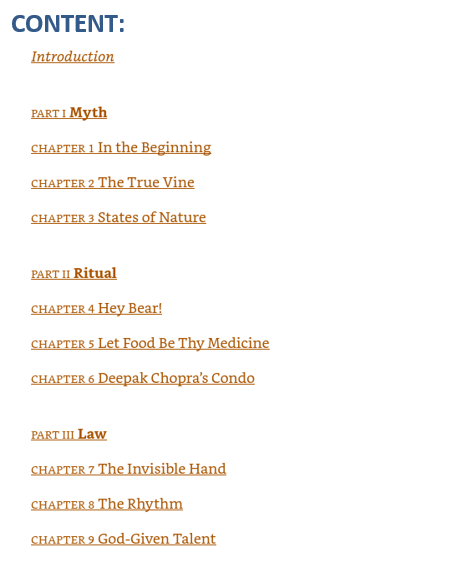
MY TAKE ON IT:
In my simple mind, all these “natural vs unnatural” notions are just stand-ins for good vs bad and are somewhat puzzling. I think everything that exists is natural, and only imagination can create something that is not natural. For example, everything moving below the speed of light is natural, something moving with warp speed is not, unless it is observed in reality, causing humans to come up with some improvements to the theory of relativity. All human actions are natural, as well as the artifacts produced by these actions. They are as natural as artifacts produced by other animals, be it beaver-built dams or termite mounds that have air conditioning. It really does not matter that termites build their mounds without planning committees, budgeting, and government approvals.
Nature is not a conscious entity and, therefore, could not possibly care about humans and the products of their activities. Humans, however, have to care because any changes produced by humans or occurring regardless of their activity always do one of two things: they either make human life easier or more difficult. I support the idea that the powerful and energetically costly human brain was evolutionally developed as a tool to be used for speedy adjustment to environmental changes. For example, the ice age that moved at the speed of a couple of thousand years left no chance of survival for a naked ape without enough brain because DNA change required to grow fur cover required a much longer time. The naked ape with a powerful brain can learn to use the fur of other animals a lot faster than that. The process of adjustment speeds up considerably because it worked so well that humans multiplied to the level that required new adjustments. We came to the end of the human expansion phase when adjustments were local and are at the beginning of the global accommodation phase that will result in the state of dynamic accommodation to an always-changing environment based on a scientific understanding of these changes. This could occur only if there is freedom of scientific discussion, research, and debates. Otherwise, humanity will suffer from religious and quasi-religious movements such as global warming (climate change) that suppress real science and direct resources to waste. I believe that eventually, dynamic accommodation will be achieved, but lots of people will pay a high price with the misery of their lives for trusting crooks that promote quasi-religious environmentalism.
20240106 – Fourth Turning is here

MAIN IDEA:
This book is an update on the previous work of the author about the seasonal character of human society development. The seasons are called turnings, last for about 20 years each, and are caused by generational changes. Each generation is formed by the environment created by the previous generation, or at least somewhat rejects it, creating a new environment for the next generation. Here is how the author defines his objective:
Over the course of this book, I hope to persuade you of a more ancient yet also more optimistic doctrine: that our collective social life, as with so many rhythmic systems in nature, requires seasons of sudden change and radical uncertainty in order for us to thrive over time. Or, to paraphrase Blaise Pascal: History has reasons that reason knows nothing of.”
In this book, the author concentrates his attention on the current season – Winter when society dramatically changes and becomes something new, quite different than what it was before. The author predicted this season of wars and revolutions since the early 1990s and was correct in both: its timing and severity. It started in 2008 with the financial crisis and is expected to last until the late 2020s or early 2030s. How society will look at the end is unknown, but the author is convinced that it will be radically different. After that, Spring will come and the newly renovated society will begin increasing its prosperity if the change is positive such as winning a war, or it will begin the process of adjustment and recovery if the change is negative such as losing a war.
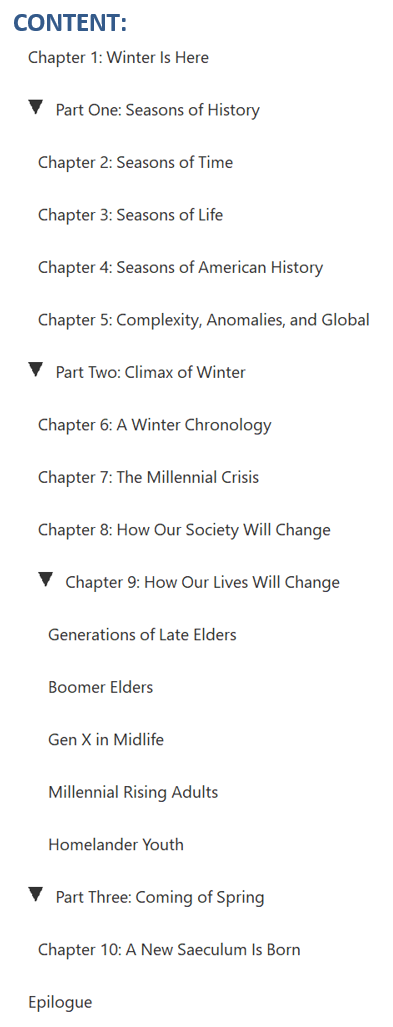
MY TAKE ON IT:
This is one of a few books that prophecies coming of the difficult time, or, more precisely, demonstrate that the difficult time is here. It is hard not to agree with this evaluation if one just looks at today’s news. The current condition of human societies everywhere in the world is unstable. The previously dominant Western societies are ideologically undermined from within by allowing the takeover of their institutions by the elite clearly hostile to its philosophical foundation based on ideas of enlightenment, human rights, equality of individuals before the law, tolerance of religions, and economic freedom. They were also undermined by the economic elite that implemented the transfer of productive facilities to totalitarian countries such as China and established dependence for raw materials and energy on such culturally and ideologically hostile entities as Russia and countries of the Middle East. Finally, they allowed and encouraged mass immigration of culturally and ideologically hostile individuals that undermined the cohesiveness of society and even caused multiple terrorist attacks and suppression of individual freedoms. Finally, they created massive external threats by transferring technology to China, Russia, and other hostiles bent on changing the world order to the new one when the dominant power will be in the hands of totalitarians and individual freedom will be eliminated all over the world.
This is a pretty gloomy picture, but it is by far less gloomy than it was 80 years ago when the totalitarian powers of Nazi Germany, the Soviet Union, Imperial Japan, and fascist Italy were on the brink of taking over the world in the Spring of 1941 after the alliance of Hitler and Stalin pretty much completed the takeover of continental Europe, while Japan was well advanced in Asia. However, totalitarians largely failed because they turned on each other and Hitler attacked Stalin, just before Stalin was ready to attack Hitler.
The current situation is better because totalitarian China still has a relatively weak military and Russia has a lousy economy. Both also demonstrated that their strong sides: China’s economy and Russia’s military are quite weak under the façade of strength. As to internal threat, the anti-Western ideological elite that captured institutions brought these institutions down, increasingly convincing the population that these institutions must be cleaned up or even destroyed because of their hostility to regular people. Anyway, I am pretty sure that the next few years will be exciting to watch.
 Equal Rights Libertarian