
20231230 – Regime Change

MAIN IDEA:
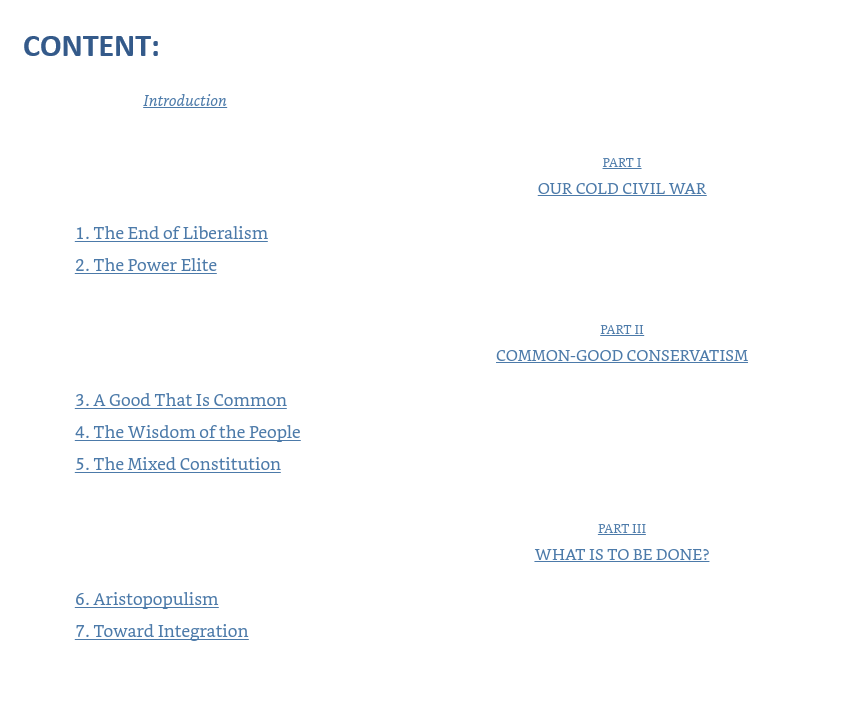
The main thesis of this book is that the political regime currently existing in the USA and other Western countries is a combination of two forms of liberalism: social and economic when the “entrenched progress-oriented liberal elite” uses control over nearly all political and economic institutions to suppress non-elite population enforcing compliance with all kinds of “progressive” ideas that counter traditional culture such as new notions of marriage, abortion, equality of results, substitution of anti-black racism with anti-white racism, and so on. In the economic area, it means opening the internal market to China and other hostile powers that bribe the economic elite with cheap labor in manufacturing and high returns on investment in exchange for technology transfer. It also includes the promotion of illegal immigration to obtain cheap labor in services and potential political support for the elite. The author’s conclusion is:” What is needed, in short, is regime change—the peaceful but vigorous overthrow of a corrupt and corrupting liberal ruling class and the creation of a postliberal order in which existing political forms can remain in place, as long as a fundamentally different ethos informs those institutions and the personnel who populate key offices and positions. While superficially the same political order, the replacement of rule by a progressive elite by a regime ordered to the common good through a “mixed constitution” will constitute a genuine regime change.” The author also suggests the method of achieving this result:” This change will not occur simply by a mythic revolutionary uprising of the many against the few. Rather, it will require some number of “class traitors” to act on behalf of the broad working class, articulating the actual motives and effects of widespread elite actions. Even if relatively small, an elite cadre skilled at directing and elevating popular resentments, combined with the political power of the many, can bolster populist political prospects as a working governmental and institutional force. In turn, a new elite can be formed, or the old elite reformed, to adopt a wider understanding of what constitutes their own good—a good that is indivisible and common—and to steer America to a state of flourishing.”
MY TAKE ON IT:
This is one of quite a few recent books that reflect the general understanding that the current political-economical regime is not sustainable and will end pretty soon in some form of massive restructuring. Such restructuring will happen either via internal regime modification or disintegration of society either via internal civil war or defeat inflicted by ideological enemies. These enemies present such alternatives to existing liberal semi-democratic regimes as the Chinese model of the combination of communist political and cultural totalitarianism combined with a semi-capitalist economy or a similar Islamist model in which fundamentalist religion is used instead of communist ideology.
I generally agree with the author’s analysis of the current regime. I also think that we are on the brink of massive regime change that involves political, cultural, and economic restructuring. I do not think it requires lots of help from “the traitors to their class” from the elite. We have a massive overproduction of the elite, that is educated individuals who cannot find a place within society that would be consistent with their expectations. History demonstrates that such individuals do not easily accept disappointment and direct their talents and energy to implement regime change. There is a problem with ideology for these individuals to embrace because neither communism nor religious totalitarianism would be good enough for them. Communism has been discredited over the last 150 years of multiple attempts at its implementation while religion is too much out of synch with the deeply secular redundant elite. A recent attempt to create some mix of ideology in the form of Wokeism seems to be failing due to its too-obvious idiocy. It certainly remains to be seen, but I think that this ideological emptiness creates an opportunity for democratic rebirth founded on the new understanding of property as a subject to exclusively individual rights allocated in such a way that everybody would have sufficient property not only for subsistence but for very decent living conditions achievable with effective use of this property. If such property is defined as an unalienable individual share of the common inheritance that could be rented out at market prices, the need to obtain a place in the bureaucratic hierarchy of governments or corporations or some ideological structure would cease to be a necessity, freeing individuals to pursue happiness any way they want to.
20231223 – End Times
MAIN IDEA:
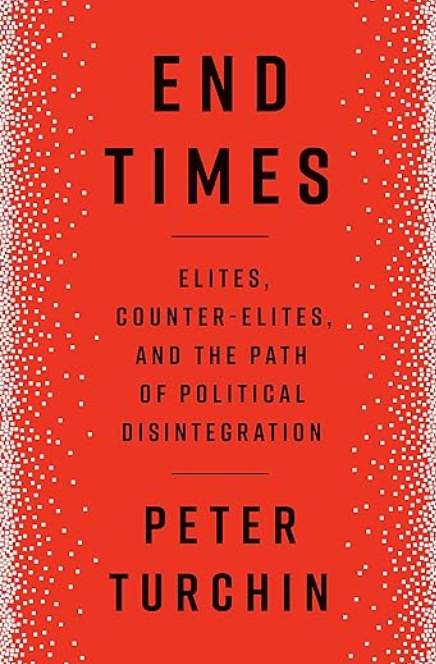
This book presents a new scientific approach to history and to the prediction of future developments of society called Cliodynamics. This approach includes the development of a massive database of information about crises of many societies in the past and the outcomes of these crises. Here is the main point of the analysis of the collected data:” Our analysis points to four structural drivers of instability: popular immiseration leading to mass mobilization potential; elite overproduction resulting in intraelite conflict; failing fiscal health and weakened legitimacy of the state; and geopolitical factors. The most important driver is intraelite competition and conflict, which is a reliable predictor of the looming crisis”.
The application of this result to current events in American Society leads to the conclusion that it is on the brink of revolutionary events that would include massive, organized violence and may result in the breakdown of this society. Despite the generally pessimistic mood of the book, the conclusion is this:” The final thought with which I want to end this book is that humanity has come a long way since our species appeared some two hundred thousand years ago. The last ten thousand years have seen a particularly rapid evolution. Despotic elites who oppressed common people repeatedly arose and were repeatedly overthrown. We are now again in the disintegrative phase of this cycle, but while we live through our own age of discord, it’s worth remembering that humanity has learned from previous such debacles. Cumulative cultural evolution equipped us with remarkable technologies, including social technologies—institutions—that enable our societies to deliver an unprecedentedly high—and broadly based—quality of life. Yes, this capacity is often not fully realized—there is great variation between different states in providing well-being for their citizens. But in the longer term, such variation is necessary for continuing cultural evolution. If societies don’t experiment in trying for better social arrangements, evolution will stop. Even more importantly, when selfish ruling classes run their societies into the ground, it is good to have alternatives—success stories.”

MY TAKE ON IT:
It is not the first and not the last book that predicts cataclysmic events for American society in the near future. Unlike the previous 30+ years of my life in this country, this time it looks like quite a reasonable probability. It is not caused by just the overproduction of the elite, the immiseration of the masses, and the rise of authoritarian powers bent on world domination. I see the most important underlying cause in the global process of elimination of human beings from the process of production of goods and services. Initially, this process liberated most of the population from the necessity to work all the time just to survive, as was the case until very recently when something like 90% of the population had to work in agriculture to produce enough food to avoid famines. From this point just a few hundred years ago humanity moved to a situation where 2% of the population easily produced enough food for everybody, even for everybody with poor control over appetite to be obese. The existing forms of society, either autocracies based on massive suppression and slavery (traditional monarchies or contemporary communist dictatorships) or democratic ones based on mass ownership of private property (material, like land, or intellectual, like professional skills), would no longer work. This is because autocrats will not need slaves and businesses will not need workers of any level of skills. This situation will cause mass restructuring of societies, quite possibly violent, everywhere in the world, America included. The result could be a new structure of society based either on mass bureaucratization when everybody will have a place within the bureaucracy doing some meaningless job, suffering psychological stress from control from above while causing similar stress to individuals below. Alternatively, it could be a society based on mass possession of private property not only material or intellectual but also as a share of the common inheritance of humanity that provides sufficient returns to do whatever one wants to do with his or her life in pursuit of happiness.
I am pretty sure that eventually, a second outcome will occur, and a society of freedom based on property will eventually be established. However, it will not happen without decades of struggles, violent or otherwise, and lots of pain and suffering caused by failed attempts to make a society of mass bureaucratization work for people.
20231216 – Corruptible
MAIN IDEA:
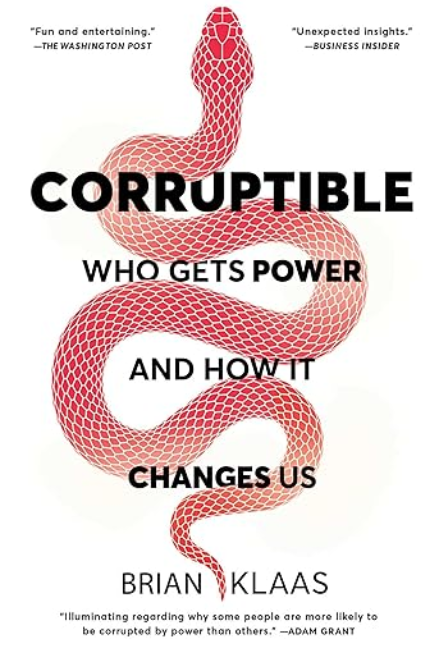
This book explores the relationship between power and corruption. The author defines his objective this way:” This book answers four main questions.
First, do worse people get power?
Second, does power make people worse?
Third, why do we let people control us who clearly have no business being in control? Fourth, how can we ensure that incorruptible people get into power and wield it justly?
To answer these questions the author goes all the way to the very beginning starting with chimpanzees and human anatomy that provide the ability to fight over some distance such as through a stone or a spear. that other animals do not have. Another core difference is by far superior communication abilities. All of this provides for the development of hierarchies and the implementation of highly organized violence. After reviewing many cases and situations, the author comes up with a list of 10 lessons that could alleviate or even resolve the problem of power and corruption. These are:
Lesson 1: Actively Recruit Incorruptible People and Screen Out Corruptible Ones
Lesson 2: Use Sortition and Shadow Governance for Oversight
Lesson 3: Rotate to Reduce Abuse
Lesson 4: Audit Decision-Making Processes, Not Just Results
Lesson 5: Create Frequent, Potent Reminders of Responsibility
Lesson 6: Don’t Let Those in Power See People as Abstractions
Lesson 7: Watched People Are Nice People
Lesson 8: Focus Oversight on the Controllers, Not the Controlled
Lesson 9: Exploit Randomness to Maximize Deterrence While Minimizing Invasions of Privacy
Lesson 10: Stop Waiting for Principled Saviors. Make Them Instead

MY TAKE ON IT:
The lessons provided by the author are pretty good, but I do not think they go to the core of the issue and therefore hardly would help to resolve it. In my opinion, this core is the process of resource acquisition for individuals in power and the ability of these individuals to control other people’s behavior using the violent hierarchy of the state. The rules should be simple:
- Nobody who obtains control over the violent hierarchy of a state, however temporarily, should be able to become wealthier than he or she was before obtaining such power. It should be extended all the way until the end of life and include strict control over wealth acquisition by the members of their families. This rule would exclude young individuals who are after wealth from pursuing high-level positions in government. Simultaneously it would attract older individuals who already obtained wealth from voluntary market exchange and would bring their experience to bear. It should not exclude younger individuals who seek a career in government, it would just ensure that plane material corruption such as taking bribes would not be possible.
- Another important way to minimize corruption of power would be to minimize the power itself by expanding individual rights as much as possible, strictly identifying all and any limitations, and making enforcement of such limitations not optional, but required. For example, freedom of speech should be complete, except for incitement of violence against a group of people with the condition that failure to apply such restriction is in itself a severe offense.
- Finally, there should be a completely separate hierarchical violent structure that is in no way, shape, or form connected to the general violent hierarchy of the state and limited only to control over members of this general hierarchy. It should be elected or selected via a separate process from the selection of members of the general hierarchy.
I do not think that such rules could be implemented in the current condition of society, but we are living during a time of the growing crisis of society and its mores, so the future resolution of this crises could lead to the establishment of these or some other rules that do make corruption of power technically impossible.
20231209 – Fear of Microbial Planet

MAIN IDEA:
This book looks at humans and their environment from a somewhat non-standard point of view. In this view, a human is not some stand-alone object surrounded by an environment, but rather an integral part of this environment: “Our bodies are colonized by so many microbes that our cells (about 10 trillion total) are outnumbered by our microbial inhabitants by a factor of ten (about 100 trillion total). The microbiota of our bodies is incredibly diverse, with thousands of species of bacteria and fungi that collectively express 4.4 million genes, compared to our meager 21,000-gene genome. As science writer and ecologist Alanna Collen noted in her excellent primer to the human microbiota 10% Human, genetically we aren’t even 10% human, it’s actually more like 0.5%.”
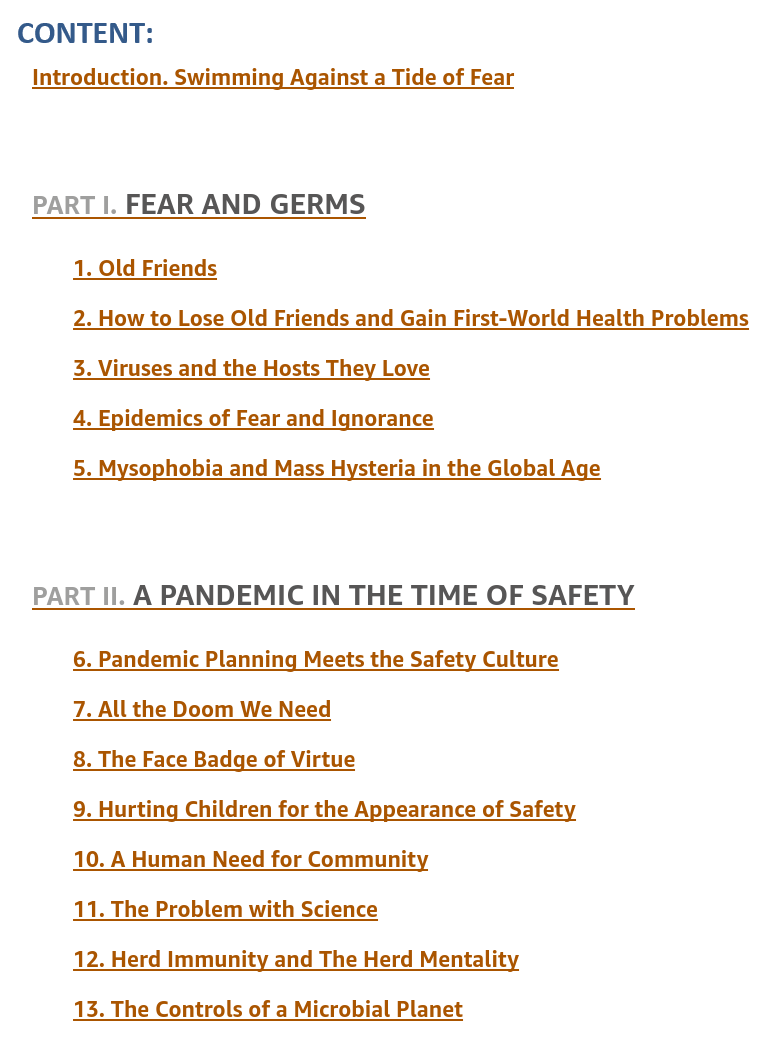
From the moment of birth, a human organism builds complex relationships with other biological objects, some of which are necessary for survival and some impeding it. The book reviews multiple cases of pandemics and epidemics, especially the last one COVID when political and ideological interference led to catastrophic mismanagement of the society’s response to it.
MY TAKE ON IT:
In addition to the general assessment of a human as a biological object in constant interaction with other biological objects, this book is also a very good and thoroughly convincing presentation of what went wrong with COVID-19. However, I think that it is not enough. The very notion that politics could be involved in any way, shape, and form in scientific affairs: promoting some ideas and suppressing others is not just deeply disturbing but dangerous. The danger comes from two directions: one is unjustified expenses to implement scientifically and technologically invalid measures such as windmills to fight an overblown thread of global warning and another one, even more dangerous – use of the state power to force people to comply with clear meaningless and even harmful things, such as vaccination with poorly tested vaccines with the protection of corporation from legal responsibility for failure to assure the safety of these vaccines. In the first case, the damage is economic, decreasing the general welfare of the population. Still, in the second case, it threatens freedom and even the health of the population, which could potentially cause such a response that could undermine the stability of society. I doubt that the American elite fully understands the consequences of their actions of suppressing real science to benefit scientific bureaucrats, but these consequences will occur regardless of their understanding or lack thereof.
20231202 – Knowing what we know

MAIN IDEA:
Here is the author’s summary of what this book is about:” This book seeks to tell the story of how knowledge has been passed from its vast passel of sources into the equally vast variety of human minds, and how the means of its passage have evolved over the thousands of years of human existence. In the earliest times—back even in hominid days, before Homo was even on the verge of becoming sapiens—the transmission was effected near-entirely as a consequence of experience. The experience of rain and cold required the seeking of clothing and shelter; to accommodate and reverse the experience of hunger necessitated the finding and preparation of sustenance; to counter the perils of hostility—whether experiencing it from wild beasts or from other humans, and so knowing its dangers—required preparedness and, perhaps, the acquisition of some kind of martial equipment, and which might overcome the approaching challenge.”
In addition to retelling the history of the development of human knowledge, the author also looks at the meaning of new developments such as computers and AI that threaten to take the process of knowledge acquisition away from humans:” If our brains—if we, that is, for our brains are the permanent essence of us—no longer have need of knowledge, and if we have no need because the computers do it all for us, then what is human intelligence good for? An existential intellectual crisis looms: If machines will acquire all our knowledge for us and do our thinking for us, then what, pray, is the need for us to be? “

MY TAKE ON IT:
This book provides a good overview of the history of knowledge. It poses a serious question for what is next when computers with AI technology very soon will be able justifiably to sing to humans an old song from the musical “Annie, Get Your Gun”: Anything You Can Do (I Can Do Better)”.
However, I do not see an existential problem here as long as humans remain subjects and computers remain objects. Any activities directed to achieve some objective always include:
- Explicit or implicit formulation of: “Why do it?”
- Definition of “What to do?”
- Detailed, even if flexible, the algorithm of actions: “How to do it”
- Finally, activities of doing it.
The development of knowledge-based technology sequentially moved these stages from humans to computers and machines. First machines substituted multiple humans doing something by multiplying the power of the machine operator. For example, unloading trucks with bags of rice used to require several men who were carrying bags on their backs. Then came the forklift and only one man could unload the truck by telling the machine how to unload the truck by moving control levers. The next came a computer-based warehouse control system that produces signals telling forklift operators (human or automatic) what to do: go to this truck, unload it, and put bags there. These activities, however complex, could be done by computers and machines. However, only humans can define the objective of doing all this and answer the question “Why do it”, because computers do not recognize the self as an entity with wants and needs. Is it conceivable to create a self-directing computer with wants and needs? I am sure it will be possible someday, even if the human brain has 85 billion neurons: way beyond the current technological level. It also requires decades of development to bring this brain to the functionality level of a regular human adult. It would probably be done as an experiment within a century or so, but what is the point beyond the proof of “yes we can do it?”. It would be pretty much like the moon landing: “Yes we did it”, but do we really need to do it again?
 Equal Rights Libertarian