
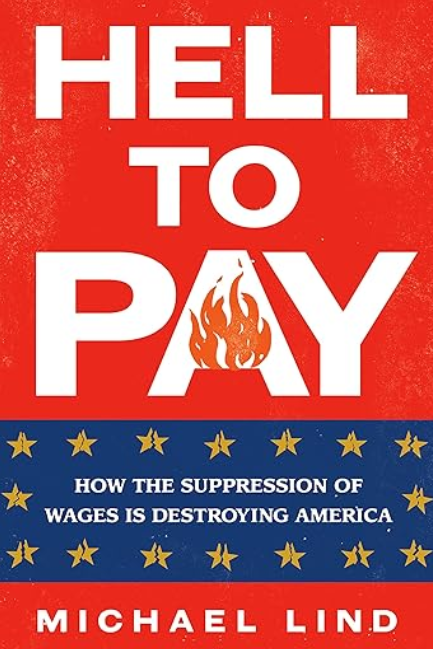
20231126 – Hell to Pay
MAIN IDEA:
This book’s main idea is that most problems in the USA come from the changes in the power balance between workers and employers. The old balance was based on an expansive goods-producing economy and featured strong unions and the pro-workers Democratic party, which resulted in well-paying jobs and consequently general prosperity. The new balance is based on a service economy divided into a high-tech/managerial economy and a low-tech mainly service economy. The former produces new knowledge, technology, and control over multinational corporations, providing high-paying jobs for the educated part of the population. This part of the population does not need unions because they possess highly marketable knowledge and skills. The latter produces simple services that require little knowledge and skills and therefore pay very little, preventing the uneducated part of the population from having the quality of life typical for the generation of their parents and grandparents. The author sees the solution in the revival of the labor movement via its rejection of one-way subordination to the Democratic party. The more independent labor movement would force political parties to compete for the support of middle and low-skill labor. This, in turn, would result in political actions forcing employers to pay much more for labor than they do now using global arbitrage. The author seems to believe in the real possibility of moving from low low-wage / high-welfare system to a living wage / social insurance system. He correctly notices that it is not possible to move history backward but is so scared of the future that does not see any good alternative:” It could be worse. The emergent national class hierarchy in America may solidify into a neo-feudal system run by a more or less hereditary aristocracy that assigns everyone incomes and rewards based on government-certified identity categories like race and gender or discretionary political patronage. Another possibility is that populist demagogues, some of them perhaps more effective and focused than Donald Trump, will lead ephemeral and disruptive rebellions by the marginalized and dispossessed. Given the nightmarish alternatives of stable oligarchy or demagogue-exploited turmoil, the restoration of worker power in the United States of America is worth a try.”

MY TAKE ON IT:
I think that the author does not completely realize that the very notion of a job and labor is rapidly becoming outdated due to emerging technologies based on AI. It already demonstrates that a great many jobs could be done without human intervention. It would not be possible to go back to the truck drivers’ union if there were no track drivers and all deliveries were made by self-driving cars. And it does not relate only to the jobs of uneducated people. Already the job of a secretary could be seen only in old movies, as well as the job of a travel agent. So, let’s forget about the restoration of labor unions and the non-existent option of going back to the glorious 1950s, which, by the way, did not feel glorious at the time. The real alternatives are:
- Bureaucratization of everything so everybody does quasi-work, the only meaning of which is to provide people with jobs. It would be a kind of socialism, only materially more comfortable: without starvation and absence of goods and services. In this system uneducated part of the population would play games, live on minimal basic income, and kill themselves with drugs, alcohol, and similar entertainments. The educated and ambitious part of the population would be busy playing bureaucratic games of mini-thrones intriguing against each other and striving to obtain a higher place in the hierarchy.
- The other option could be based on the simple fact that people always obtain resources either directly from the environment as the farmers growing food or from a property they own as an owner of a warehouse where this food is stored or from services as grocery store owner converting this food from balk in warehouse into retail quantity in shopping bag. When AI substitutes all labor all three will be fine because the farmer would still own land so he will be paid for what the AI farming machine would produce, and so will the owner of a warehouse for his property. However, none of them will hire any labor whether unionized or not. So, the other option could be based on the fact that information content embedded in all these pieces of property developed over a long time by millions of people and therefore equally belongs to others, If this common inheritance is formally recognized as everybody’s equal and unalienable property and become legal foundation for enforcing payment for its rent from an individual in possession of current material property such as warehouse to somebody who has no material property and historically would make living by selling labor. As long as the amount of payment is defined by the market mechanism of buying and selling rather than some bureaucratic decision, we would have property owners dealing with each other. Such a solution would provide not just resources, but also dignity and mutual respect. In short, the solution to deficiencies of capitalism should be not socialism, but rather turning 100% of the population into capitalists who have property to rent out to each other.
20231119 – The Birth of Plenty

MAIN IDEA:
This book presents a four-factor model of economic development that seeks to explain the difference between developed nations and nations that failed to develop. The author describes the model as” the framework within which human beings think, interact, and carry on business. This section describes those institutions and lays out how they relate to each other.
Four such institutions stand out as prerequisite for economic growth:
- Secure property rights, not only for physical property, but also for intellectual property and one’s own person—civil liberties
- A systematic procedure for examining and interpreting the world—the scientific method
- A widely available and open source of funding for the development and production of new inventions—the modern capital marketplace
- The ability to rapidly communicate vital information and transport people and goods
The author describes in great detail how these factors historically developed in the Western countries, starting with the countries of the English-speaking world, and even provides a nice graphic representation of this process:


MY TAKE ON IT:
The multi-factor analysis presented in this book looks like an interesting and productive approach. However, it is mainly a review of the second-level causes of development or lack thereof. The foundational causes are always people’s behavior and interactions. Humans are animals developed via multilevel evolution when complex interactions between individuals within and without groups produced individuals that always internally conflict between doing what is beneficial for self, even at the expense of a group, or doing what is beneficial for the group, even at the expense to self. Property rights are just a formal framework within which this conflict is continuously processed. Scientific rationalism, capital markets, and infrastructure more or less developed in one or another society are just derivatives of this process.
In turn, as the foundation of society, property rights are always the product of violence and completely depend on the ability of an individual to protect his/her property directly or via supportive actions of some violent hierarchy of individuals (government) who recognize these rights. The historical development of societies led to different patterns of such recognition when some patterns lead to effective development and prosperity, while others lead to failure of development and misery. The key is to find a Goldilocks spot where individuals can retain a share of the product of their activity sufficient to have an incentive to conduct this activity to the best of their ability, whether this product is the material result of the harvest or the intellectual result of the scientific research.
If the violent bureaucracy of the group is very strong and transfers too much of the product, individuals direct their activity to minimize the efforts. This is true regardless of whether it is the traditional form of slavery that includes just a master and overseer, or it is the contemporary form of communist/socialist slavery when violent bureaucracy consists of a vast government machine that includes the State Planning Committee and KGB. It could also be a contemporary highly developed state in which the violent bureaucracy, instead of protecting property rights, imposes multiple laws and regulations intended to transfer resources away from productive individuals to members of the bureaucracy to satisfy their needs and wants.
If the violent bureaucracy is too weak and incapable of protecting individual property, it leads to the need to spend too much effort on self-defense at the expense of productive activities. Such weakness could be material, leading to gangs of bandits (nation-states including) fighting each other for control over people and locations. It could also be ideological, leading to the contemporary democratic states in which violent bureaucracy refuses to protect property for ideological reasons. In either case, failure to protect individual rights leads to failure of development or even to degradation.
20231112 – Equality of Opportunity

MAIN IDEA:
This book discusses the core American idea of equality of opportunity as it was the subject of indirect debate between Left and Right for the last century. The authors define the book this way:” we ask what has happened to equality of opportunity, a term that came to the fore in the Hoover-Roosevelt era. Hoover described and defended the American system as one based on rugged individualism coupled with equality of opportunity. On the other hand, Roosevelt, in his famous Commonwealth Club speech in 1932, said “equality of opportunity as we have known it no longer exists.” The doctrine has had its ups and downs, its defenders and attackers, over the years, but it is still alive and an important part of the conversation today.”
The book reviews the key historical points of this idea as it was implemented in the constitution at the very foundation of the USA, its expansion across race lines after the Civil War, and the progressive movement of the early XXth century. The main milestones such as the New Deal, the Great Society, and the Reagan revolution, were reviewed in more detail. Finally, the book discusses contemporary attacks against this idea and attempts to substitute equality of opportunity with equality of results.


MY TAKE ON IT:
Unlike most people who discuss the contemporary challenges to equality of opportunity, I do not believe that it comes from some noble ideas providing a better life for everybody. I think it comes from a completely different motivation: transfer resources generated by other people to the bureaucratic machinery of the state so credentialed bureaucrats could use these resources for their own consumption and control over other people by providing or denying them access to these resources. A simple example would be the difference between the behavior of a teacher in a private school when the teacher’s income and work conditions depend on resources provided by parents or the teacher in a government-controlled school when resources confiscated from parents by the government, moved through the bureaucratic hierarchy of the state and provided to a teacher on condition of compliance with requirements of educational bureaucrats. In the first case, the objective of the teacher is the transfer of knowledge and skill to students so they would be effective in future productive activities because that is what parents would require in exchange for provided resources. In the second case, the objective is to satisfy the requirements of bureaucrats, whatever they are, with the overriding requirement being to condition students to support resource transfer to bureaucracy. It is clear, that such motivation necessitates rejection of the idea of equality of opportunity and its substitution with the idea of equality of results because the equality of opportunity means resource allocation outside of the bureaucratic machine, while equality of results could be produced only by resource transfer through the bureaucratic machine. In reality, the final result is never equal results because the bureaucrats at the higher level of the hierarchy would always get more resources than bureaucrats at the lower levels, and those will get more than people outside the bureaucracy. The implementation of equalization of results always means the more unequal allocation of fewer resources.
20231105 – Religion’s Sudden Decline

MAIN IDEA:
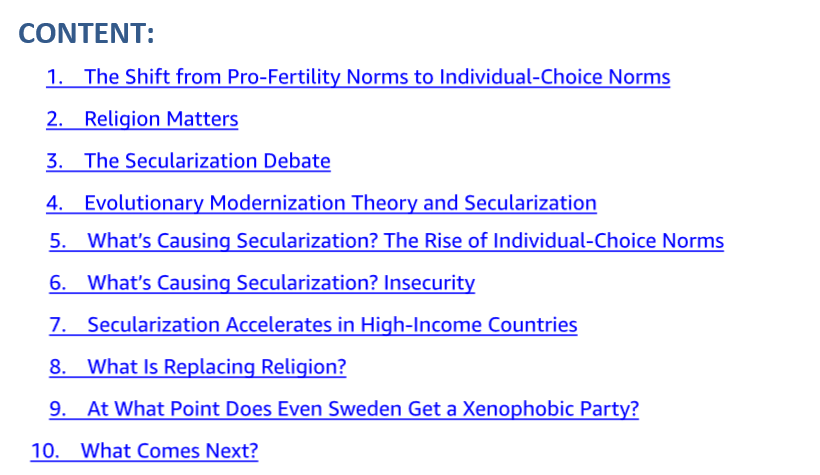
This is pretty much a review of the statistical data about religiosity that demonstrates its consistent decline practically elsewhere in the world. It also presents different explanations of this phenomenon, mainly related to the change in human needs for security and adherence to various values that define relationships between individuals and groups. Here is a graph demonstrating the overall process over the late part of XX and the early part of XXI centuries:

MY TAKE ON IT:
The continuing process of secularization of humanity is clearly connected to an increasing understanding of the world and accumulation of knowledge about the environment that allows much more effective use of resources. Basically, due to the development of science and technology human needs satisfaction, which used to be unreliable and therefore required help from some external, all-powerful, and conscious authority, now could be reliably satisfied without such help. Correspondingly the god(s) that represented such authority and had to be convinced to help either by prayers or gifts or adherence to some specific behavior, increasingly become redundant. Who needs to pray for rain if one has an irrigation system, fertilizers, and other technology? This pretty much explains the relationship between income, prosperity, and religiosity. Rich people do not need to pray for something they can just buy, be it food supplies for the next year or even a baby. One does not need to pray if food can be reliably obtained in the local supermarket, while a fertility clinic provides a much better probability of having a baby than just praying. Interestingly enough, when society falls apart, so the local supermarket is empty or too expensive, there are no jobs available, and people feel powerless, the secular attitude goes away and religiosity comes back in force, as it happened in Eastern Europe after the failure of communism. So, the future of religiosity depends on the future of prosperity. The prosperous people hardly need the god(s), while people living in misery need help from somebody, or, at least assurance that they will be somehow compensated in the future, either by getting to paradise or by living in the bright communist future.
 Equal Rights Libertarian