
20231029 – The American Dream is Not Dead
MAIN IDEA:
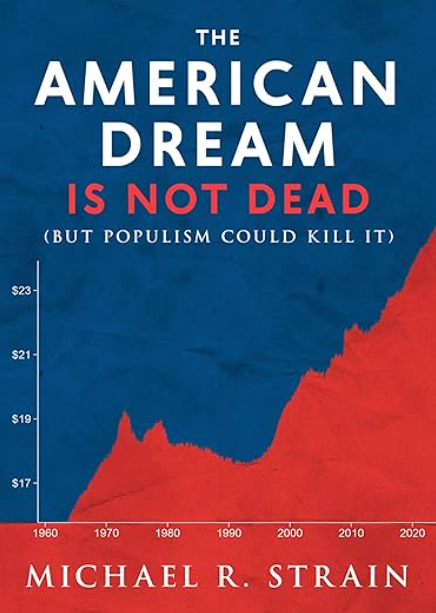
This book first defines the American Dream mainly via its economic component based on polls:” Ninety-four percent of respondents reported that having a successful career was essential or important to their own view of the Dream. Eighty-eight percent reported the same about having a better quality of life than their parents.” It also stresses the realistic character of this dream and its basis in typical middle-class values:” If you work hard and play by the rules, you can get ahead. Your effort will be rewarded. America is a place where you can build a better life for yourself and, in an economic sense, where your children will be better off than you. And in America, going from rags to riches is still possible.”
The statements above are based on statistical data such as these:


MY TAKE ON IT:
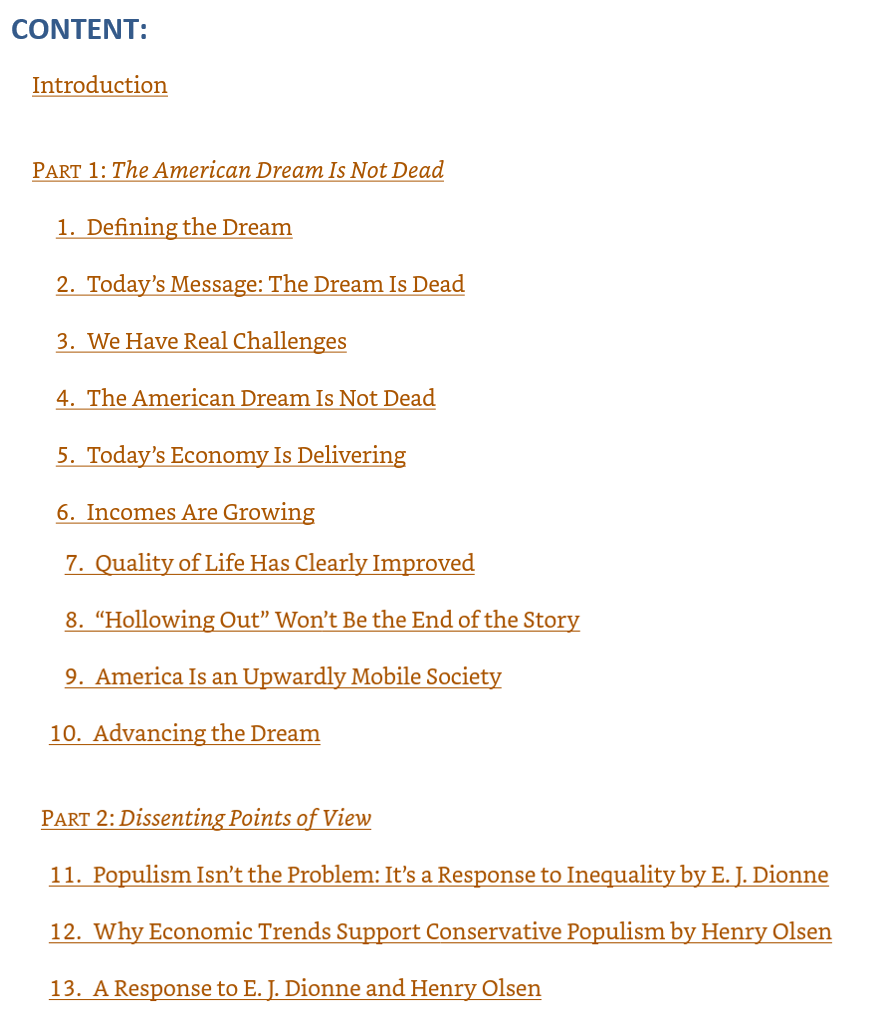
This nice little optimistic book provides quite a few factoids in support of this optimism. Compared to typical cataloging of what is wrong with America, it is a really enjoyable staff. However, I would not be overly optimistic because the future now is not what it used to be, just as Yogi Berra once said. The future will be built on AI technology that makes human labor redundant for producing goods and services. Actually, I am optimistic about the long run: something like 50-70 years during which humans will finally understand that the meaning of life is not in producing goods and services. It is also not in consuming them. It is in enjoying life while having all necessary good and services available with minimal effort. The switch from a survival way of life to an enjoyment way of life will be a complex process, requiring a complete change in the structure of societies, their values, and processes. It will not be simple and easy, but it will happen anyway.
20231022 – Ages of American Capitalism
MAIN IDEA:
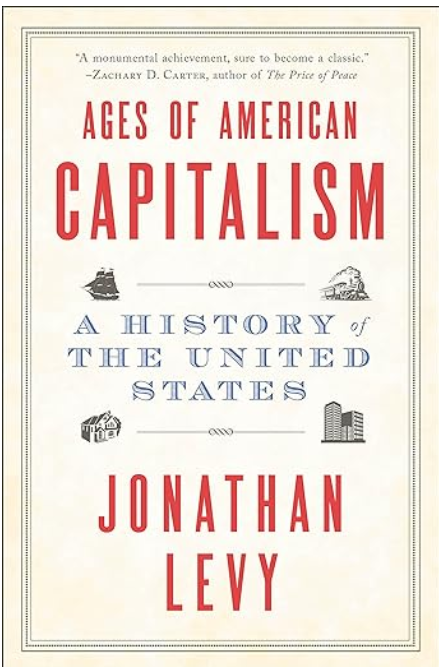
This book is about the history of the American economy, which developed via various forms of capitalism. Unlike the usual approach, the author clearly defines what he means by capitalism and presents three theses that express the book’s main ideas, around which the author builds logical, historical, and statistical support. These theses are:
Thesis #1: Rather than a physical factor of production, a thing, capital is a process. Specifically, capital is the process through which a legal asset is invested with pecuniary value, in light of its capacity to yield a future pecuniary profit.
Thesis #2: Capital is defined by the quest for a future pecuniary profit. Without capital’s habitual quest for pecuniary gain, there is no capitalism. But the profit motive of capitalists has never been enough to drive economic history, not even the history of capitalism.
Thesis #3: The history of capitalism is a never-ending conflict between the short-term propensity to hoard and the long-term ability and inducement to invest. This conflict holds the key to explaining many of the dynamics of capitalism over time, including its periods of long-term economic development and growth, and its repeating booms and busts.
MY TAKE ON IT:
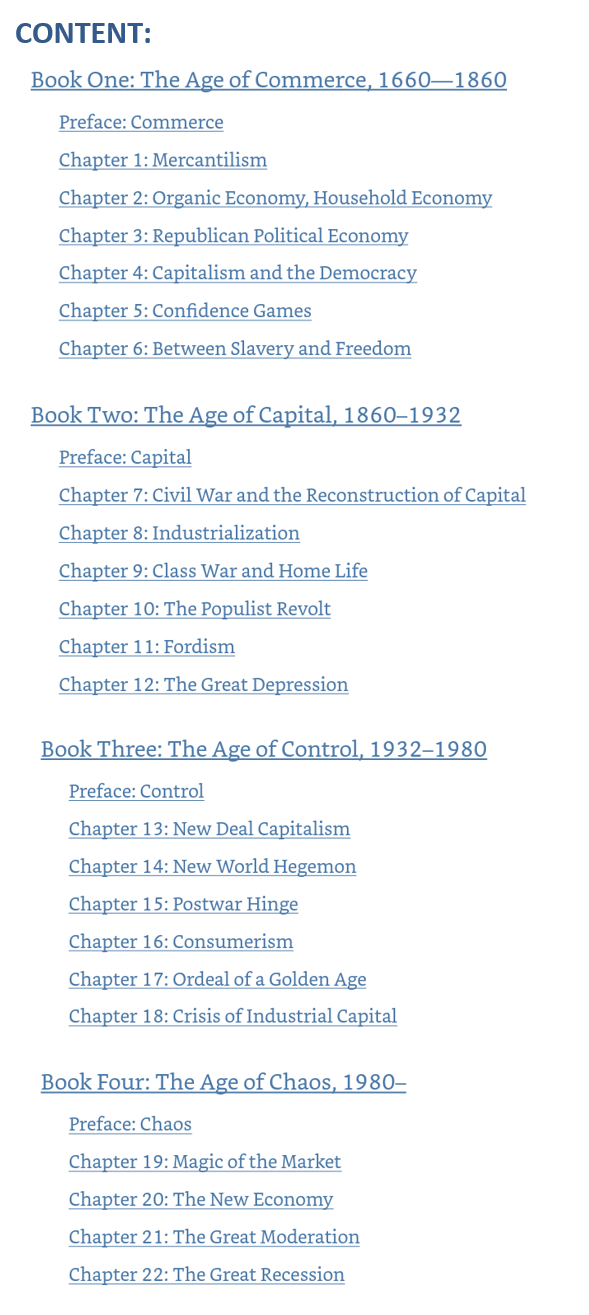
As much as I appreciate the huge amount of information collected for this book and the presentation of historical data, the author’s approach seems to me not sufficiently explanatory. In my opinion, not only capitalism but any economic system is not just an abstract process when something happens with “legal assets.” It is rather the process of relationship between people that includes resource allocation to individuals, the establishment of the lines of control and subordination between these individuals, and actions of individuals directed at the satisfaction of their psychological needs via the application of these resources. The pecuniary gain does not differentiate capitalism from other systems. After all, a bureaucrat in a socialist system clearly obtains pecuniary gains while moving up the hierarchy when each higher position provides better living conditions and more power over others than any super capitalist could ever obtain. The key feature of capitalism that differentiates it from all other systems is the formal resource allocation to individuals and clearly defined entities as property protected by the state. The distributed resources allow for independent decision-making and resource application via a competitive market, which results in the superior economic performance of such a society. This superiority was demonstrated by American society during its existence both internally in economic, political, and, eventually, military competition within the United States between North and South when the Northern society with a higher level of resource distribution outcompeted the South where a significant part of the population – slaves were deprived of agency and used by masters just as other resources. Such superiority was also demonstrated via external competition with multiple socialist and semi-socialist societies in which resources were concentrated in the hands of a bureaucratic hierarchy with top-down decision-making, and the majority of the population was deprived of agency, sometimes to the same level as slaves.
I would suggest looking at the history of economic development of the United States from the point of view of what kind of resources were used, how they were allocated to individuals, and how economic performance was impacted by the ability of individuals to use their agency applying these resources in their own interest. From this point of view, I would look at the following stages of development:
- The main resource is land, which is pretty much available to everybody, creating a country of farmers and small business owners who were dominant in the North and plantation masters and slaves who were dominant in the South. This period lasted from the 1600s to the early 1900s. It did not end at the end of the Civil War, which just somewhat changed the relations between slaves and masters in the South, but not core economic processes. It lasted until the end of the frontier and mass industrialization, when farmers’ productivity became too high, pushing the population out of this economic activity.
- During the second stage, the main resource is human capital. This stage started in the late 1800s and is still ongoing. During this stage, the majority of the population can obtain sufficient resources via small businesses producing goods and services or as highly qualified, productive individuals capable of moving between big businesses as valuable self-controlled resources. However, a small but growing share of the population that possessed too little human capital to obtain sufficient resources on the open market had to resort to violent means to obtain such resources. For the uneducated and unconnected part of this population, such means were unionization and support of political parties that promoted welfare, meaning resource transfer from productive individuals to non-productive with the use of government violence. For the educated and connected part of this population, such means were the growth of government and the transfer of as many goods and services from the market to government control. The growth of government meant the increase of bureaucracy, which provided highly profitable places for educated and connected individuals.
- We are now moving into the third stage when the share of the population with high levels of human capital is decreasing due to automatization. With the implementation of Artificial Intelligence, this share could eventually get very close to 0. The future offers one of two possible developments: one is the bureaucratization of society when people fight for places in the hierarchy and do make-believe work that nobody needs. The other one would be to recognize the common immaterial inheritance of humanity: knowledge, know-how, and such as equally belonging to everybody. Consequently, it could be recognized as individual unalienable property, subject to regular compensation in the form of periodic trade of rights between owners of automated material productive resources and individuals who have little to no such material resources. The first method – complete bureaucratization of society would lead to misery due to the loss of agency and the constant fight for a place in the hierarchy. The second method – complete proprietization would lead to everybody having independent means and therefore free to use the agency in pursuit of happiness.
20231015 – Superabundance

MAIN IDEA:
This book promotes the idea that humanity has now achieved superabundance. the authors define it this way:” When the abundance of resources grows at a faster rate than population increases, we call that relationship “superabundance.” To support this idea, the authors provide statistical data about resource availability from history and its progress till our time. Unlike most economists and historians, they look at real resource availability as expressed in the amount of resources available per unit of time spent to acquire these resources. Here is a nice graphic representation at the high level:
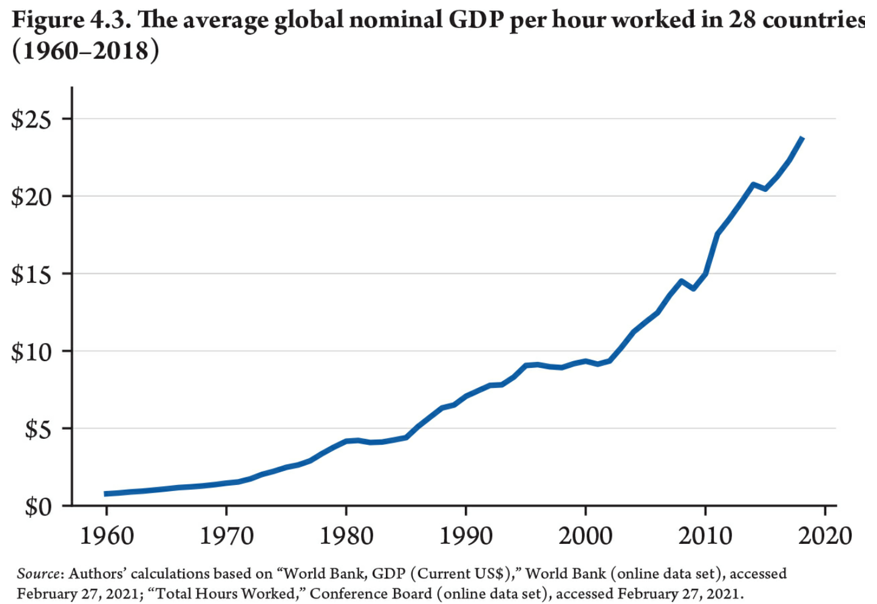
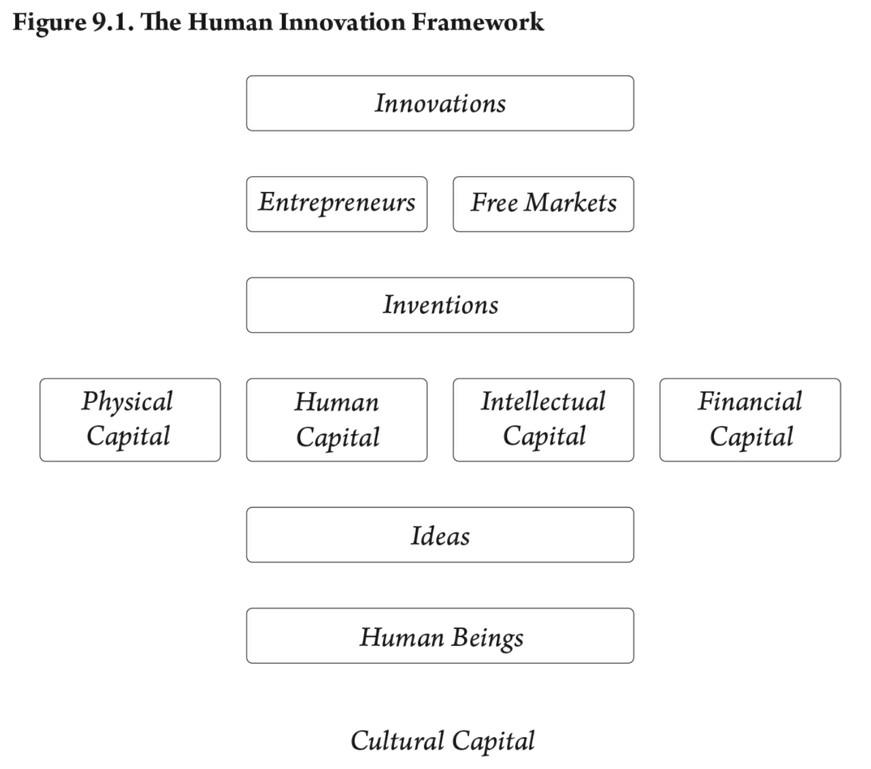
This book is the most detailed scientific analysis of humanity’s economic development since the beginning of industrialization when the civilized part of humanity broke out of the Malthusian trap by moving to more or less democratic capitalism. The authors convincingly reject the ideas of popular and well-paid doomsayers and provide data-based support for the ideas of Julian Simon that the only scarce resources are productive and innovative humans. The authors provide the framework that includes key components of the superabundance development:
MY TAKE ON IT:
I agree entirely with the authors of this book, and I have been a big fan of Julian Simon ever since I first learned about his work some 25 or 30 years ago. The only point I would like to make regarding this book is that it is mainly directed to the past and present, while humanity is now approaching the point when AI is making the industrial society of the last 300 years outdated. I think material abundance is here to stay, and the world population is becoming stable and well-provided with the necessities of life. However, I think that the inevitable obsolescence of the need for human labor would cause massive disruption and revolutionary changes in the structure of society. The result would be one of two outcomes. It could be a totalitarian society with massive suppression of individual freedoms with the subordination of individuals to the will of others above them in some hierarchical structure. Alternatively, it could be some form of free, but not necessarily democratic, society where individuals have the resources to pursue their happiness any way they want without regard to others as long as they do not invade the personal space of these others. We currently have two samples of these two types of society. The prototype of a future totalitarian option could be contemporary China, where people are more or less satisfied materially but strictly subordinated to the communist party hierarchy. The prototype of a future free society option could be America of XVIII-XIX centuries before the closure of the frontier when everybody could get property on land. The totalitarian option would be pretty bad because it inevitably includes continuing the fight for power and place at the top of the hierarchy. The second option would be much better. However, it would require implementing property rights on something that would provide individuals with sufficient resources. In my opinion, it could be the formalization of the common inheritance of knowledge accumulated by humanity as property equally belonging to all and a subject for compensation from individuals who use more of it to those who use less. It would require some suppression of individuals whose pursuit of happiness requires control over others. Still, it would be much less violent than a constant power struggle in a totalitarian society.
20231007 – The Gift of Violence

MAIN IDEA:
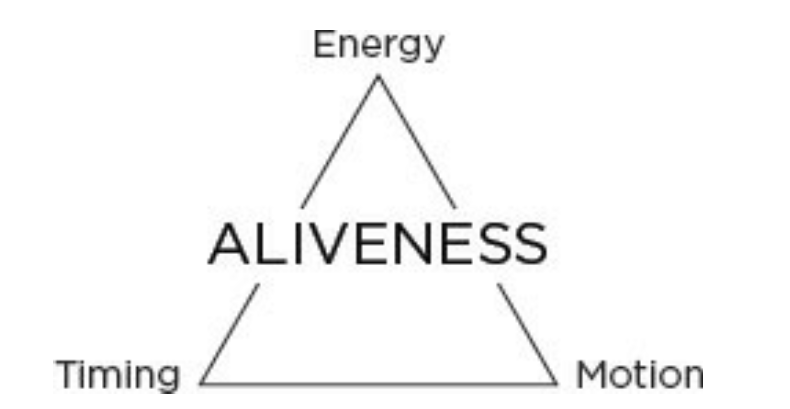
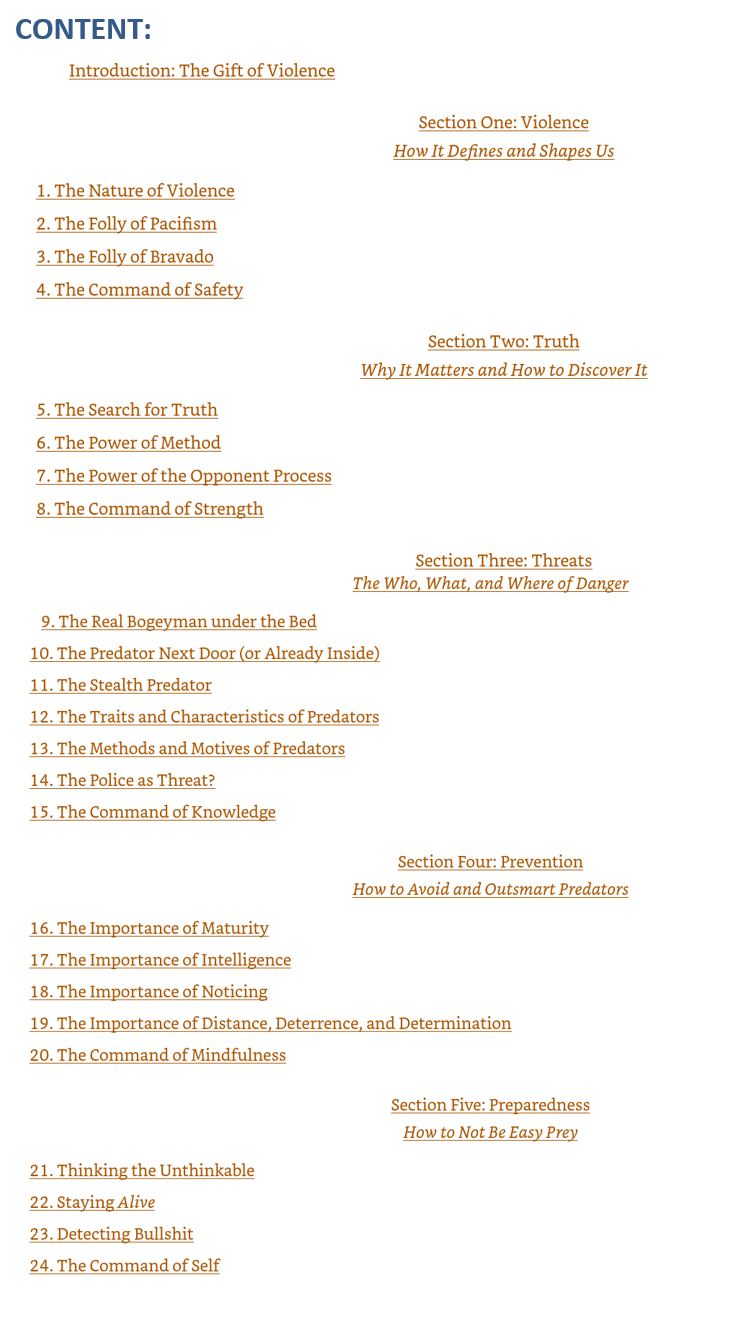
This book by the martial arts professional is about violence, its use, and its usefulness. It is not about self-defense techniques; here is how the author defines it for a reader:” Your goal should be to understand violence as it actually is—so that you can manage its role in your life. This will require analytical thought, not emotion. One of the largest impediments to solving much of the violence around us is our inability to see it as it is rather than how we would like it to be. This can lead to a failure to notice when it is near or to recognize it when it is already upon us, and trigger a refusal to take decisive action when we are no longer in a position to deny it. The final part of this equation—decisive action—is the least understood and, as a consequence, the most fetishized.” I also like the author’s definition of his objective in writing this book:” My overriding goal is to help good people become more dangerous to bad people.” The author presents a nice diagram demonstrating the key elements of defense and discusses at length their meaning and implementation:
The author also reviews quite a few myths related to violence that create illusions about its use, general occurrence, and methods of preparedness.
MY TAKE ON IT:
As far as I am concerned, violence, until very recently, was a normal form of interaction between people belonging to different coalitions within a group or competing groups. This understanding refers not only to humans but also to all primates. There is not much to discuss here, except for the fact that one and only one reliable method to prevent or stop violence is the ability to inflict such a level of violence on the potential or active initiator of violence that he stops either because of being incapacitated or forced to retreat.
There are, however, two very human-specific features. One is the ability to create organized hierarchical groups capable of not only interfering right away but also inflicting severe levels of violence on the initiator in the future without limits as retaliation. Another is the use of technology that makes the outcome unpredictable and potentially deadly for the aggressor.
Whether an aggressor is some semi-conscious bum on drags or the Russian army initiating aggression against Ukraine, the law of unintended consequences can always produce unexpected outcomes. A little old lady that the bum decided to rob and beat up may have a concealed firearm, and Ukrainians may decide to fight and get serious material support from the West. In either case, the aggressor’s perception of the victim’s limitation in the ability for self-defense caused the attack. If a little old lady openly carried a machine gun, the bum would not come close to her. Similarly, if Ukraine would not give up its nuclear weapons stupidly believing guarantees of the Budapest memorandum, it would be in peace.
Finally, from the point of view of individuals living in contemporary Western society, where levels of violence are generally low, the massive effort to prepare for violent encounters is just not cost-effective. Be careful to avoid the potential for such encounters and, just in case, having tools for inflicting violence, such as guns handy, would be enough.
20231001 – The Death of Expertise
MAIN IDEA:
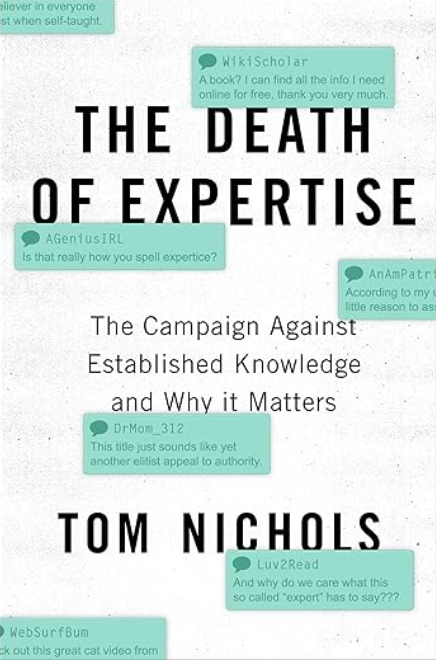
This book is about a very important cultural development: loss of trust in experts, their knowledge, the validity of their advice, and the honesty of their intentions. Here is the author’s description of this development: “Never have so many people had so much access to so much knowledge and yet have been so resistant to learning anything. In the United States and other developed nations, otherwise intelligent people denigrate intellectual achievement and reject the advice of experts. Not only do increasing numbers of laypeople lack basic knowledge, they reject fundamental rules of evidence and refuse to learn how to make a logical argument. In doing so, they risk throwing away centuries of accumulated knowledge and undermining the practices and habits that allow us to develop new knowledge.”
Consequently, the nature of this book the author describes in this way:” Americans now believe that having equal rights in a political system also means that each person’s opinion about anything must be accepted as equal to anyone else’s. This is the credo of a fair number of people despite being obvious nonsense. It is a flat assertion of actual equality that is always illogical, sometimes funny, and often dangerous. This book, then, is about expertise. Or, more accurately, it is about the relationship between experts and citizens in a democracy, why that relationship is collapsing, and what all of us, citizens and experts, might do about it.”
The author concludes, “The relationship between experts and citizens, like almost all relationships in a democracy, is built on trust. When that trust collapses, experts and laypeople become warring factions. And when that happens, democracy itself can enter a death spiral that presents an immediate danger of decay either into rule by the mob or toward elitist technocracy. Both are authoritarian outcomes, and both threaten the United States today. This is why the collapse of the relationship between experts and citizens is a dysfunction of democracy itself. The abysmal literacy, both political and general, of the American public is the foundation for all of these problems.”
At the end of the book, the author discusses the “revolt of the experts” and offers his advice:” Experts need to remember, always, that they are the servants and not the masters of a democratic society and a republican government. If citizens, however, are to be the masters, they must equip themselves not just with education, but with the kind of civic virtue that keeps them involved in the running of their own country. Laypeople cannot do without experts, and they must accept this reality without rancor. Experts, likewise, must accept that their advice, which might seem obvious and right to them, will not always be taken in a democracy that may not value the same things they do. Otherwise, when democracy is understood as an unending demand for unearned respect for unfounded opinions, anything and everything becomes possible, including the end of democracy and republican government itself.”

MY TAKE ON IT:
There are many reasons that trust in experts, and their advice is at its lowest level ever. For more knowledgeable people, it could be the research results of Philip Tetlock that clearly demonstrated a deficiency of expert advice in politics and international relations. For less knowledgeable but thinking people, it is probably an amazingly consistent failure of the “experts in economics” to predict recessions or “climate scientists” to predict next year’s weather. Finally, massive operations to extract resources from the population under the false pretense of “Global Warming,” the moniker which had to be changed to “Climate Change” since no significant warming occurred if one looks at the temperature charts instead of experts provided BS. I do not think that the loss of trust could be possibly restored without significant changes in the process of obtaining and evaluating expertise. If instead of defining expertise as the accumulation of degrees and peer-reviewed publications, expertise is defined by a track record of correct predictions of future events, then and only then will the trust in expert advice be restored. It would also help if instead of financing by the government that violently extracts resources from taxpayers, the financing would be provided by individuals and businesses that are interested in expert opinions. If such entities depend for their well-being on the correctness of the experts’ advice, they will find many ways to make sure that experts are selected based on real expertise, not formalities.
 Equal Rights Libertarian