
20230924 – True Age

MAIN IDEA:
The author’s main point in this book is that there is an essential difference between chronological and biological age. The chronological age is easily defined by dates and moves in one direction when every second an organism becomes one second older and never it becomes one second younger. Contrary to this, biological age is defined by the condition of an organism relative to the typical condition for organisms of the same chronological age and can move in both directions.
Since the condition of an organism, at least to some extent, is defined by its behavior, it is possible to become a bit younger biologically by behaving correctly. So, the author allocates a big part of this book to describing proper behavior and discussing how one can implement it. The author also presents some relevant research results and discusses methods of identifying biological age, which opens the possibility of controlling the aging process, albeit in a limited way.
MY TAKE ON IT:
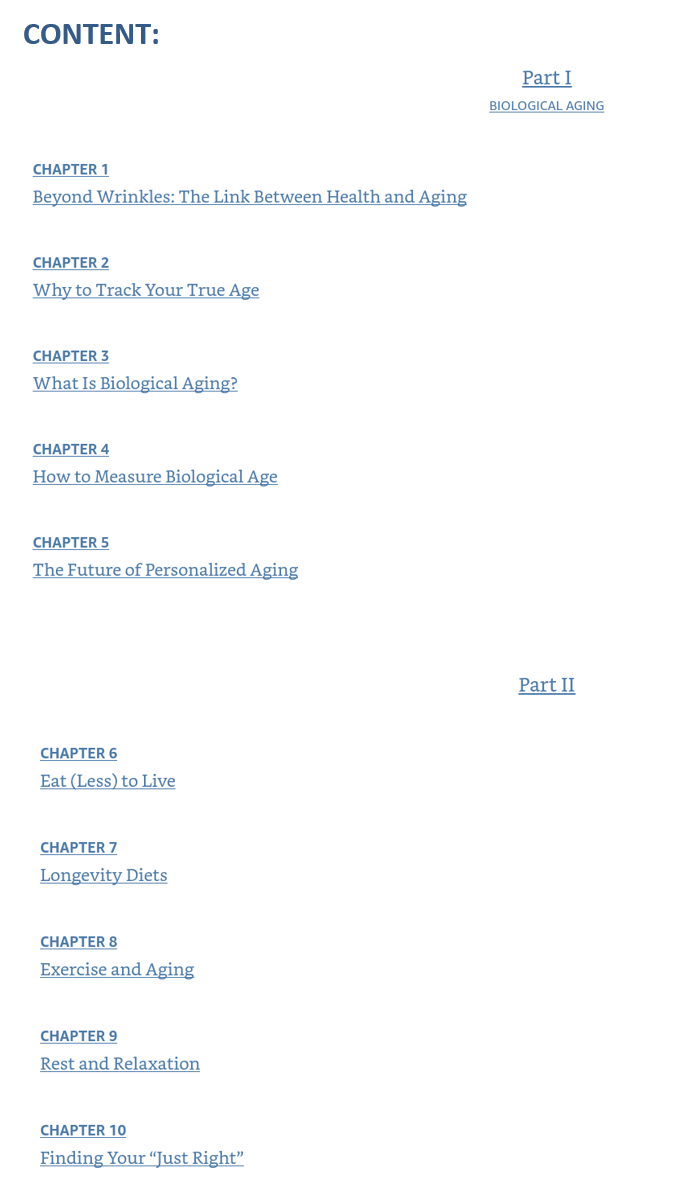
The most interesting part of this book for me is the information about research results and practical implementation of tools for defining biological age by collecting biomaterials in a way similar to DNA analysis. I will probably try this Elysium test at some point. The book’s advice on maintaining a younger biological age is pretty standard and consistent with typical recommendations: control weight, diet, and exercise.
20230917 – The Individualists
MAIN IDEA:
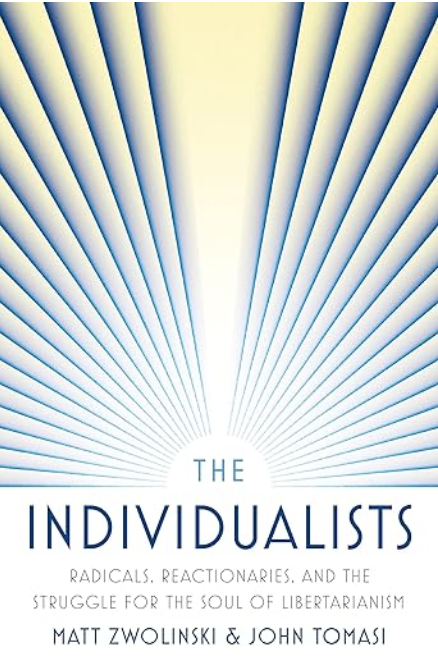
This book is about the history and content of libertarianism. The authors trace its origin to XIX century America, which started as a movement for freedom against slavery. Later, it developed into a mainly anti-socialist ideology, championing individual freedom against all forms of suppression of individuals in the name of the collective. Here is how the authors characterize this movement:
” Taken to their logical conclusion, libertarian principles entail that most existing political and economic institutions are deeply unjust. Libertarianism thus counsels not gradualist reform but a sweeping revolution. The system of welfare—whether social or corporate—is to be abolished. Unjustly acquired property is to be returned to its rightful owner. Restrictions on freedoms of movement and labor must be swept away. Militarism, in which states tax citizens to prepare to fight other states, is intolerable.
In terms of its theoretical foundations, libertarianism is uncompromising in its radicalism. In practice, however, not all libertarians were comfortable embracing the wholesale upheaval of existing institutions—and privileges. From its beginning, then, libertarianism has attracted a mix of radical and reactionary elements: those who were eager to follow the dictates of libertarian justice wherever they might lead, and those who saw in libertarianism a rationale for defending the status quo against change. The tension between progressive and reactionary elements, a tension within the very soul of libertarianism, is the major theme of this book.”
The author also offers a precise formulation of the intention of this book:” This book is a history of libertarian ideas. It offers neither a history of libertarian politics nor a history of the libertarian movement.1 It is an intellectual history. Further, this book offers an intellectual history of libertarianism and not a philosophical defense.”
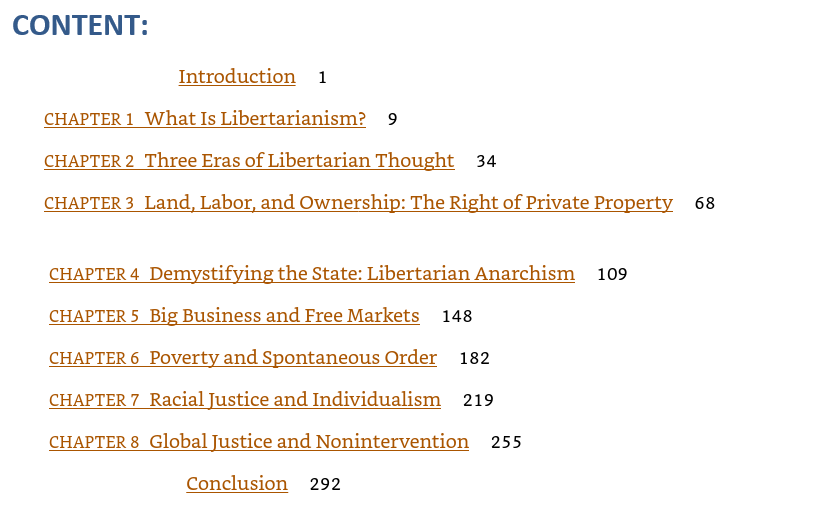
Finally, the authors describe their understanding of the nature of libertarianism in this way:” As we see it, libertarianism cannot be defined by any one set of necessary and sufficient conditions. Instead, libertarianism is best understood as a cluster concept. We see libertarianism as a distinctive combination of six key commitments: property rights, negative liberty, individualism, free markets, a skepticism of authority, and a belief in the explanatory and normative significance of spontaneous order. Chapter 1 introduces each of these six concepts, shows how libertarians interpret them, and explains how, when brought together into an integrated set, they form a distinct and recognizably libertarian approach.”
MY TAKE ON IT:
I consider myself a libertarian, and it is nice to see such a detailed analysis of the nature and historical development of libertarian ideas. However, libertarianism had never attracted the mass following that could be converted into electoral success, and consequently, libertarian participation in American politics is kind of a joke. I think the reason for this comes from human nature to support movements that bring or at least promise to bring some tangible benefits to the people. Since libertarianism promotes freedom based on property, for most people with no property to speak about there is little value in such abstract freedom. Therefore, these ideas are alien and could even be considered hostile to non-propertied people. It is possible to change this if the common informational inheritance of humanity: concepts, knowledge, and know-how is recognized as a formal property belonging to everybody equally, even if it is applied and benefited from by individuals depending on their individual abilities and circumstances, which means highly unequally. Such recognition would lead to the requirement for more effective users to compensate ineffective users of the common inheritance. It would be no different than three people commonly owning a car, with one using it four days per week, one for two days, and one only for one day. Obviously, two guys who use the car less would demand compensation. As soon as a property in common inheritance is recognized as unalienable and a compensation mechanism established, everybody would become supporters of property rights so that libertarian ideas would become viable drivers of electoral politics and, probably, even dominant ideas of society.
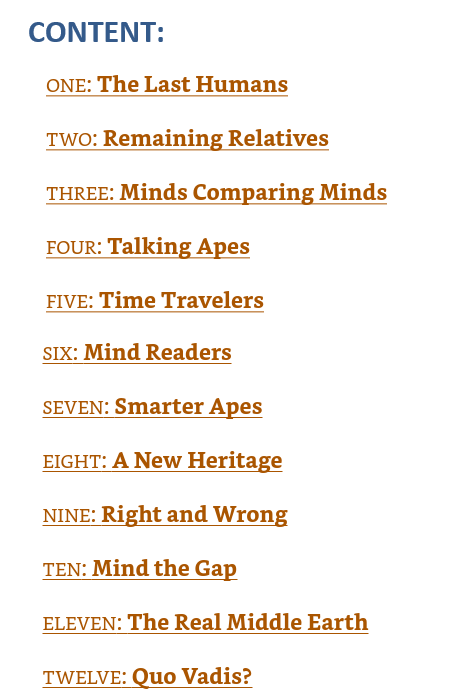
20230910 Suddendorf, Thomas – The Gap
MAIN IDEA:
This book explores the gap between humans and other animals. It rejects the dualistic approach and looks at the gap from the scientific point of view, which it defines this way:” Yet modern science has established that the mind is inextricably intertwined with the body. Lesions to your brain, say, from a tumor or a stroke, have predictable effects on your mind. For example, a lesion in the temporal lobes just behind your ear can destroy your ability to comprehend language. A subdiscipline of modern psychological science called “embodied cognition” examines more subtle links, showing that people’s mental experiences and judgments change when their bodies are slightly manipulated.”
MY TAKE ON IT:
The very interesting part for me is the detailed and careful approach to comparing the human brain to other animals’ brains, demonstrating the human brain’s comparative excess for satisfying the typical needs of an organism’s survival.

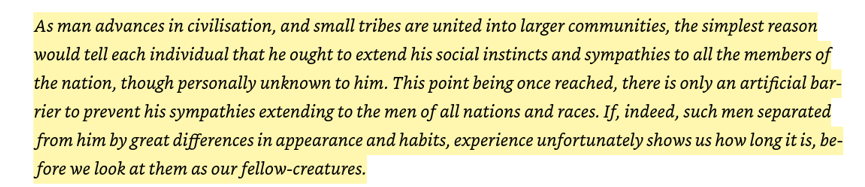
So, like many others, I agree that human specificity comes from super complex human socialization and the need to reconcile individual survival and DNA evolution with group survival and cultural evolution. With the development of technology, which provides abundant goods and services, individual survival is guaranteed, while competition(war) between groups becomes exceedingly dangerous, potentially threatening the destruction of the species.
We seem to be approaching the point when humanity must become civilized or die. Here is Darwin’s quote referring to this:”
20230903 – Spin Dictators
MAIN IDEA:
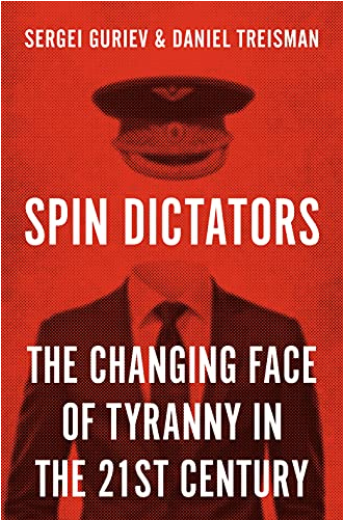
This book explores the massive changes that occurred over the last century in such traditional human endeavors as the capture of dictatorial power and control over people. The main difference is the methodology of dictatorship’s processes, from ones based on fear and direct violence to ones based on spin. The authors provided a handy comparative table of the use of the main features of these two methods:


MY TAKE ON IT:
I do not think that spin dictatorship is something really new. I suggest it is a well-known phenomenon, which is most recently called democracy. The power is always applied by a hierarchy of people who comply with orders depending on their beliefs and perception of reality. The only way to achieve such compliance is to use spin, a necessary part of every human culture. This spin applied to reality to form human beliefs in “us” being good guys and “them” being the bad ones, our leaders wise and honest while theirs just plain evil. The “them” could be anything from the other political party in democracies to hidden “enemies of the people” in totalitarian regimes to witches in medieval societies.
The popular variation that has a history of especially effective use in Russia is the idea of the leader (czar, general secretary, or president) being perfect in his thoughts and actions, so everything good in life comes from him. At the same time, people at lower levels of the hierarchy are stupid and evil, so everything wrong comes from them.
The authors end on an optimistic note that spin dictators are not that powerful after all:” In more developed, highly educated societies, what holds back aspiring spin dictators, we have argued, is the resistance of networks of lawyers, judges, civil servants, journalists, activists, and opposition politicians. Such leaders survive for a while, lowering the tone and eroding their country’s reputation. But so far they have all been voted out of office to face possible corruption prosecutions.” I do not think that the optimism based on these types of people is justified because all of them are parts of ruling hierarchies, whether it is one openly dictatorial, as is typical for Russia, or one of a few semi-competing / semi-cooperating hierarchies as it is usual in Western democracies. I am also optimistic, but my optimism is derived from my belief in two forces: one is the culturally defined psychological need for the majority of people to be free from the control of others, and another one is: the certainty of the constant competition of aspiring dictators between themselves, which periodically opens the gate for change when dictatorship weakens, and people driven by the need to be free improve the system.
 Equal Rights Libertarian