
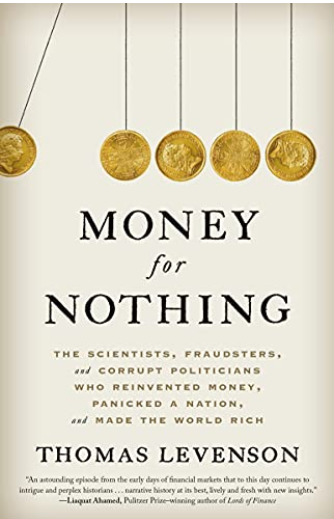
20230827 – Money for Nothing
MAIN IDEA:
This book is a detailed history of: “THE CATASTROPHE NOW known as the South Sea Bubble is on record as the first and in many ways the archetypal stock market crash and fraud. What happened then and what the British state did in response both have a direct connection to what has occurred (and may soon come again) in the financial life of the twenty-first century.” The author links it to the general development of enlightenment and the discovery of the scientific method as a tool that allows predicting future events based on current data. Consequently, the book shows how an attempt to apply this method in its simple mechanical form to a more complex world of finance led to unpredictable and unpleasant events. Despite this, progress did occur, and here is the author’s statement recognizing it:” The various breakthroughs behind the new forms of money and credit that Britain exploited for its ends weren’t either. But the cultural changes that flowed from the eruption of natural philosophers’ habits of mind—the way many people came to incorporate the values of empiricism, of experiment and the importance of measurement and calculation—had a profound effect on British civic life. What animated people and events in London, that is, was the eagerness, almost urgency, to apply emerging ways of thinking to everyday human experience.”

MY TAKE ON IT:
This book is an excellent illustration of the need to understand the nature of intellectual tools so one can apply them when there is a good fit for the means and the problem they are supposed to resolve. By now, it should be clear that “good” ideas such as a planned economy or controlling climate by limiting CO2 emissions or equalizing rewards between high achievers and non-achievers lead to disastrous consequences, often causing misery and even deaths on the mass scale. So, instead of great global projects like Mao’s great leap forward or Stalin’s collectivization, or the most recent reincarnation: fighting Covid via suppression of freedoms and destruction of the economy, I would recommend applying something that Lenin called “crawling empiricism,” meaning slow and careful movement ahead while continuously collecting and analyzing results before expanding the scale of any idea’s implementation.
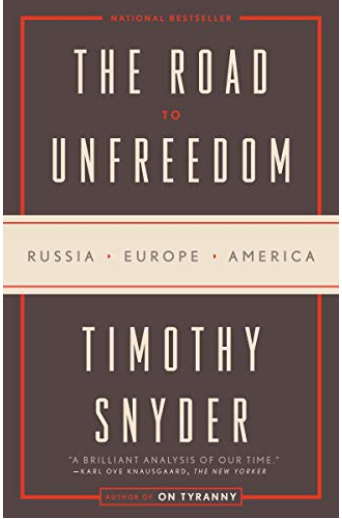
20230820 – The Road to Unfreedom
MAIN IDEA:
The main idea here is about two types of politics: one of inevitability and another one of eternity. The first relates to the notion of the “end of history” with the final victory of liberal democracy over its authoritarian competition. This politic failed. Per the author:” The collapse of the politics of inevitability ushers in another experience of time: the politics of eternity. Whereas inevitability promises a better future for everyone, eternity places one nation at the center of a cyclical story of victimhood. Time is no longer a line into the future, but a circle that endlessly returns the same threats from the past. Within inevitability, no one is responsible because we all know that the details will sort themselves out for the better; within eternity, no one is responsible because we all know that the enemy is coming no matter what we do. Eternity politicians spread the conviction that government cannot aid society as a whole, but can only guard against threats. Progress gives way to doom.
In power, eternity politicians manufacture crisis and manipulate the resultant emotion. To distract from their inability or unwillingness to reform, eternity politicians instruct their citizens to experience elation and outrage at short intervals, drowning the future in the present. In foreign policy, eternity politicians belittle and undo the achievements of countries that might seem like models to their own citizens. Using technology to transmit political fiction, both at home and abroad, eternity politicians deny truth and seek to reduce life to spectacle and feeling”.
The author then applies this framework to the contemporary realities of European and American politics. Here is the author’s description of the book’s structure: “Each chapter focuses upon a particular event and a particular year—the return of totalitarian thought (2011); the collapse of democratic politics in Russia (2012); the Russian assault upon the European Union (2013); the revolution in Ukraine and the subsequent Russian invasion (2014); the spread of political fiction in Russia, Europe, and America (2015); and the election and presidency of Donald Trump (2016–).”

MY TAKE ON IT:
This book provides a lovely review of the inherently totalitarian thinking of Russian ideologues of the XXth century, such as Ilyin, who created a philosophical foundation for contemporary Russian totalitarian nationalism, which finally expressed itself via direct military aggression against Ukraine after for years expressing itself via social, political, and communicational attack against Europe and USA. I believe the author is correct regarding the philosophy, ideology, and description of Russian aggression. However, his mixing of this ideology with Trump and anti-elitist movements in Europe demonstrates nothing more than typical leftist academicians’ lack of knowledge and understanding of their vast differences. Putin’s Russia is traditionally a fascistic state with territorial aggression, conquest, and claim of superiority over other countries. Its aggression was caused by the firm belief in its national superiority and the apparent reality of material inferiority in all essential areas, such as wealth, technology, and even military power. The same applies to contemporary China.
The anti-elitist movements, Trump included, are internal movements within democratic societies produced by the refusal of the middle class of these societies to submit to the dictates of their own elite, which is increasingly becoming a part of the global elite that gets rich via globalization. This process deprives these middle classes of the wealth created by the combination of hard work and belonging to populations of well-developed countries. The substitution of well-paying jobs that moved externally to relatively poor countries with low wages and internally to the legal, semi-legal, and illegal immigrants, with welfare checks supplemented by expressions of contempt for their culture, seems way too much for them to bear.
The proper way to deal with non-elite resurrection is to recognize and restore national unity by moving the production of goods and services back to developed countries and limiting immigration to individuals who clearly demonstrate intention and effort to become productive and loyal citizens of these countries.
There is a straightforward solution to the idea that it would not be possible for developed countries to compete on price with poor countries. Just make one very brief law: “All goods and services sold within the developed country X should be produced with full compliance with all environmental, labor, and other regulations of the country X, however idiotic these regulations are. The first violation of this law is punishable by confiscation of 50% of individual assets of the violator, the second by confiscating whatever assets left”.
As to the Russian and Chinese aggression, the proper way to deal with it is by cutting them off from contemporary technology, depriving them of the ability to obtain serious military power. In addition, democracies should initiate a massive attack on the ideology of these regimes in defense of the human rights of people in these countries, creating internal conditions for their change into somewhat more civilized entities.
20230813 – The Self Explained

MAIN IDEA:
This book is about a human individual as a cultural entity and an object of research. The author defines it this way:” The human self is a cultural solution to natural problems: how to survive and reproduce. Humankind has succeeded very well at both of those criteria by means of a highly unusual strategy: culture. The self is a vital tool by which each human animal participates in culture. You can’t get the full benefits of culture without a self. That in turn requires a brain that can understand and perform its roles in the social system—in other words, a brain that can create a self. That’s what enables humans to create culture and reap its benefits, including better survival and reproduction.”
The author looks at the “self” from several different points of view, such as its Evolutionary roots defined by human nature as a group member. So, evolution shapes the individual self by the need to survive within a group, which is done by playing one of many various roles within the group, communicating and cooperating with others, and complying with many rules that define the group’s culture and morality.

MY TAKE ON IT:
I think a detailed description of the human self and its relationship with other selves as a member of the group presented here is excellent, and the results of experimental research well support it. I am somewhat puzzled by the usual declarations about enormous complexities and the impossibility of understanding such things as a conscience, self, and general human behavior. As everything else related to reality, unlike purely academic or religious approach that often defines the reality of existence, the individual self, and its needs and functionality is easily understood at the high level of principles but contains a nearly infinite variety of details that makes it almost impossible to predict or control. Such a high-level principle is the duality of human nature caused by the simple fact that survival depends on combining two processes: individual survival and group survival. The details of these two processes are complex and inevitably result in benefits or costs to others. And, because they are not easily controlled from the outside, everybody should support creating and maintaining such an environment that any individual would perceive peaceful cooperation with others and maximum freedom for everybody as the preferable pattern of behavior. The alternative to freedom that always include attempts to control others is the source of many bad things in life, such as violence and whatnot.
20230806 – The Life after Capitalism

MAIN IDEA:
This book states that humanity has already moved beyond the classical capitalism of Adam Smith to the new economic system when governments and their regulations severely restrict markets. This new economic system also characterizes by the switch of primary human efforts from material production to information processing. The book defines it by four propositions:
- Wealth is knowledge.
- Growth is learning.
- Information is surprise.
- Money is time.
In the end, after going into details of each proposition, the book offers a concise formulation of the new system and its “Do and Don’ts.”


MY TAKE ON IT:
I also believe that information and knowledge became much more critical than material production, providing this material production is continuously maintained at the necessary level, including reserve capacities. However, I would note that not only does material production become automated and eventually will not need human efforts except for high-level decision-making, but the same relates to information processing and the generation of new knowledge. This development makes human capital outdated, and the most important task for humanity in the next 100 years or so is to find a way to develop a new economic and societal system that would support the human pursuit of happiness. Since the very foundation of human society – activities in creating and distributing resources, including information and knowledge, becomes redundant, people will have to develop new ways to be happy. It is not a simple and easy process, and the most dangerous development I could think about is that humanity will fail to restrict those individuals for whom happiness comes from control over others. Such failure would lead to practically unlimited totalitarianism. It is somewhat similar to the growth in productivity during recent centuries when food acquisition in industrial society became much more manageable than for hunter-gatherers, resulting in using the newly available human resources to initiate territorial or ideological conquest wars with massive armies fighting regardless of agricultural seasons.
 Equal Rights Libertarian