
20230730 – Civil War by Other Means

MAIN IDEA:
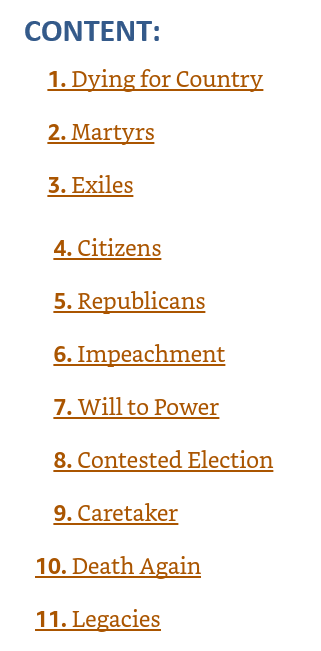
This book is about the aftermath of the Civil War. It provides historical data about people and events that followed the war in such a way as to demonstrate how exactly it happened that after the military victory and its formal political affirmation in the 13th, 14th, and 15th constitutional amendments, the South actually won peace. This cultural and political victory after the war was military loss was demonstrated by the transformation of rebel losers into the heroes fighting for the “noble Lost Cause” and the Union winners into insignificant participants, at best or even into villains at worst. It was also demonstrated in legislative and judicial forms by establishing racial segregation. Finally, an essential part of this Southern Victory of the peace was the rehabilitation of the Southern leaders at all levels and their return to power by the late 1870s.
MY TAKE ON IT:
This book is an excellent example of how complicated change is in society and its culture and how difficult it is to impose something on people if they do not want it in a somewhat democratic republic such as the USA. The truth is that American society, despite its political novelty, was still a pretty much traditional society and, like all conventional societies, had racism and class stratification deeply embedded in its culture, therefore requiring generational changes that took about a hundred years. An interesting fact that the author does not mention, but I think was significant, is that U.S. Grant suggested a much better road for development as the president at the time. It included the creation of a black majority state by including Haiti in the USA. Such a state would open an opportunity for black Americans to control their fate by moving away and depriving the South of their labor and input. The result would be a dramatic economic impact on the lives of white Southerners, forcing them to choose between racism and economic well-being. It would become inevitable because assuring economic well-being would require providing sufficiently better conditions for black labor than it could find in a black-majority state. Typically, such a choice results in a preference for well-being so that the racists who wanted prosperity would suppress their racism in a much shorter period than it happened and with much less pain and suffering than it caused.
20230723 – Liberalism and it’s Discontents
MAIN IDEA:
This book aims to defend “classical liberalism,” which the author understands as “the doctrine that first emerged in the second half of the seventeenth century that argued for the limitation of the powers of governments through law and ultimately constitutions, creating institutions protecting the rights of individuals living under their jurisdiction.”
The book reviews the history of liberalism, its foundational ideas, current condition, and challenges. It goes through such ideological developments as critical theories, especially critical race theory, various forms of identity politics, attacks against rationality, and the very foundation of Western society.
The book also looks at several alternatives: a conservative offer based on community and religious morality, a nationalist offer, also communalist, but based more on ethnic and cultural community. It accuses conservatives of authoritarian inclinations but describes leftist alternatives in such a way:” A more likely scenario for a progressive post-liberal society would be one which saw a vast intensification of existing trends. Considerations of race, gender, gender preference, and other identity categories would be injected into every sphere of everyday life, and would become the primary considerations for hiring, promotion, access to health, education, and other sectors.” In the economic area, the old ideas of socialism seem to have little support even among the left, so the alternative looks like this:” The government would provide generous social services, pay for higher education, fund health care, guarantee jobs and minimum incomes, regulate if not nationalize the financial system, and massively shift investment towards preventing climate change. All of this would be paid for by equally massive new taxes on the wealthy, or, as per modern monetary policy, through the time-tested printing mechanism.”
Finally, the author offers his own solution to the crisis of liberalism:” The urgent issue for liberal states does not have to do with the size or scope of government, which the left and right have been fighting over for decades. The issue rather is the quality of government. There is no way around the need for state capacity—that is, a government that has sufficient human and material resources to provide necessary services to its population. A modern state needs to be impersonal, meaning that it seeks to relate to citizens on an equal and uniform basis, and not on the basis of personal, political, or family ties to politicians wielding power at a given moment. Modern states have to deal with a whole range of complex policy issues, from macroeconomic policy to health to electromagnetic spectrum regulation and weather forecasting, and they need access to well-educated professionals with a strong sense of public purpose if they are to do their jobs well.

MY TAKE ON IT:
I fully agree that classical liberal ideas and their practical implementation in contemporary Western societies are in crisis. However, I disagree that it is the crises of left-right confrontation or cultural contradictions caused by globalization and the growing population diversity. I see the main cause in the underlying development of resources generating and distribution methods. The essential characteristic of these methods up until recently was the need to work for a living for the vast majority of the population. I mean productive work that creates goods and services necessary for survival, whether hunting and gathering in early stages or industrial agriculture and manufacturing in the later stages. The current level of productivity is such that just a few hours of work per year produce an abundance of food, so one person could feed hundreds. The same relates to manufacturing goods and services. So, over the last hundred years, most of the population has become redundant. This redundancy significantly decreases human needs in each other.
The super simple example: if there are only two people and one growing the apples and another growing the oranges, they need and have to tolerate each other if they want to eat both apples and oranges. The bulk of their activity would be directed at production, while distribution would be settled via trade with a ratio defined by their relative productivity. However, suppose machines are growing both: apples, and oranges. In that case, the bulk of activities will shift to distribution. Since resources are always limited, the bulk of activity would move from struggling with the environment to produce more to struggling between people to get more. Correspondingly, the distribution ratio could not be based any more on relative productivity; it will have to be based on something else, which could be an identity, whether racial or cultural or sexual or whatnot. Obviously, it is on condition that somebody else with a gun would prevent these two people from fighting each other with sticks and stones. This other guy with a gun, let us call him the government, will enforce the distribution according to some type of “justice.” And, since “justice” is always in the eyes of the beholder, the authoritarian form of government becomes a necessity reversing society back to a situation when a man with a gun was needed to ensure that producers were robbed moderately enough to survive and keep producing.
I see a much better solution in creating formal property rights on all resources for everybody, albeit in such a form that it would be unequal depending on individual abilities to do something, even if nobody else requires it. I also think that people could defend such property rights only if they were all armed, making violations extraordinarily costly or even deadly for the violators.
20230716 – The Russian Revolution
MAIN IDEA:
This book is a very unusual history book about the Russian Revolution because it breaks away from a typical narrative of the inevitability of this revolution. The author provides convincing evidence based on newly available data demonstrating that the Marxist deterministic interpretations of this event are way too far from reality. In reality, it was a close affair in which a small group of revolutionaries supported by German General staff and intelligence that provided money and other help could use internal divisions in Russian society to take power and keep it for 70 years using mass violence and propaganda. The author’s summary is:” After a quarter-century of exhilarating discoveries from the archives, it is time to take stock of what we have learned. Russia in the last days of the tsars was a land of contradictions, of great wealth and extreme poverty and the myriad social and ethnic tensions of a vast multiethnic empire; but there was nothing inevitable about the collapse of the regime in 1917. Nearly torn asunder by the revolution of 1905, which came in the wake of a humiliating defeat in the Russo-Japanese War, the Russian Empire made a remarkable recovery over the following decade, owing to the tsar’s concessions that allowed the creation of the Duma, the formation of labor unions, and the far-sighted land reforms of Peter Stolypin. The tragedy of Russian liberalism is that it was the country’s most dedicated reformers and constitutionalists who, by embracing the fashionable ideas of pan-Slavism, convinced Nicholas II that he needed to mobilize in July 1914 to appease public opinion—and then spent the war plotting against him anyway, in spite of his foolish decision to follow their advice. It was the tsar’s fateful decision to go to war, despite the pointed warnings of Rasputin and other conservative monarchist advisers he usually trusted more than the liberals, which brought an end to an era of great economic and social progress in Russia, and ultimately cost him his throne. In this way an empire founded on the autocratic principle foundered on the feeble will to power of its last autocrat, who lacked the courage of his own convictions. Once he had the upper hand, Lenin would not make the same mistake.”

MY TAKE ON IT:
I think the real reasons were only partially fundamental, mainly due to overall tensions in Russian society resulting from rapid industrialization changes that existed everywhere in the world. The particular Russian case was that it had the combination of a general rejection of the regime by the middle to upper-class educated elite, which was looking up to the elite of Western societies, displacement of people, economic and psychological tensions of the war, and massive financial and other help from hostile power (Germany) aimed to undermine country’s military effort. This story has an essential lesson because it looks a lot like what we see now in USA and other advanced Western countries. There are increasing social tensions due to economic changes of globalization, automation, and poorly controlled immigration. There is a massive rejection of societal norms and mores by an educated elite, which, quite similar to the Russian intellectual elite of the early XX century, wants to remake society along Marxist ideas of super big government. In the dreams of this elite, which includes mainly educational, governmental, and corporate bureaucracy, such a remake would put society under the control of “experts” and free them from dependency on the middle class of entrepreneurs, small business owners, professionals, and their elected representatives.
At this point, we do not have a well-organized group of professional revolutionaries, and the Chinese communist party is not as effective as the German General staff of WWI. Even more important is that the democratic form of Western societies allows this elite periodically win elections, take control of the government, and consequently demonstrate its fundamental incompetence. The USA now conducts this kind of testing in California, where the elite has nearly absolute power, and in Florida, where the middle class has control over state power, even if it is heavily restricted by federal government bureaucracy from the top, local bureaucracy from the bottom and corporate bureaucracy from all sides. The results are pretty obvious, but we’ll see if it will be enough to activate the political participation of the middle class or if people need more pain and suffering to get triggered.
20230709 – The Price of Time

MAIN IDEA:
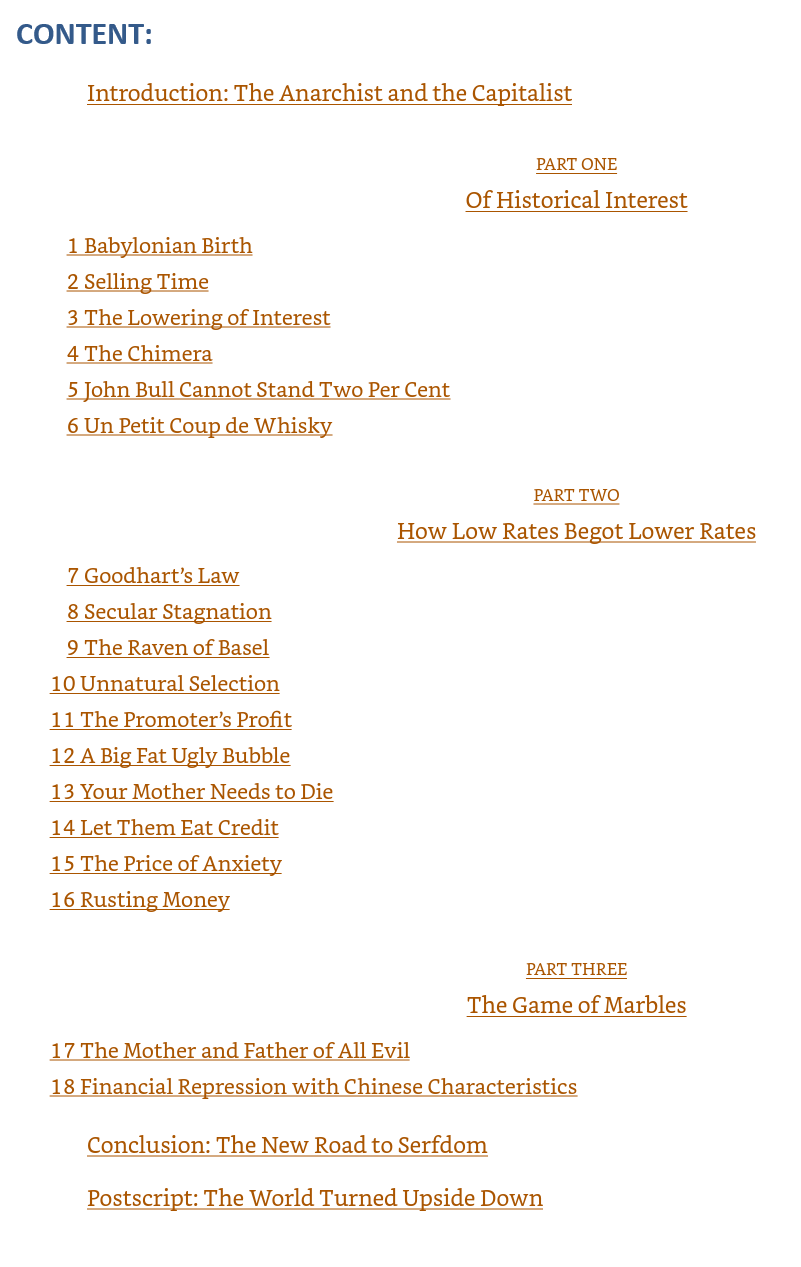
This book is mainly about the time value of money and its accounting representation by the interest rate on loans. The author reviews the history of the money credit, starting with Babylon and all the way until our time. Special attention is allocated to using credit as an instrument of power. For the part of the book about our time, the author reviewed in some detail the Chinese “financial repression” when the Communist Party used artificially depressed interest rates on households’ deposits to transfer resources to a government-controlled part of the economy. In conclusion, the author refers to Hayek’s “Road to Serfdom” and demonstrates how this road often includes financial methods in addition to trivial for communist regimes’ concentration camps and killings. The author stresses the change that occurred in the process of moving from XX to XXI century:”… our central planning hasn’t so far involved the nationalization of industries, large-scale public investment, the regulation of prices and incomes, high levels of taxation, rationing, or other wartime measures. Instead, central planning in the twenty-first century has involved manipulating the most important price in a market-based economy, the universal price, namely the rate of interest. Interest lies at the heart of capitalism. Interest rates are the traffic signals that guide the market economy, writes James Grant. Turn off those signals and pile-ups occur. If money is provided too cheaply, the market’s steering mechanism breaks down”
MY TAKE ON IT:
It is a good review of the history of interest rates and overall finance as a resource allocation tool. In my opinion, the essential thing to understand is that the current trend of building the Road to Serfdom via financial manipulation is a simple consequence of economic and human disasters that occurred in countries that implemented any form of socialism, whether it was the Soviet or Chinese or European style. As a practical idea, socialism/communism lost its attractiveness for anybody who is even slightly knowledgeable of history. However, the government-dependent “intellectuals,” either bureaucrats, pseudo-educators, or statist politicians continue to seek ways to implement this “good” idea that somehow was consistently implemented poorly. I do not doubt that an attempt to implement it via finance will be a fiasco. It may not be as bloody as such attempts of the XXth century, but it will still cause much pain and suffering.
20230702 – Big Fat Surprise

MAIN IDEA:
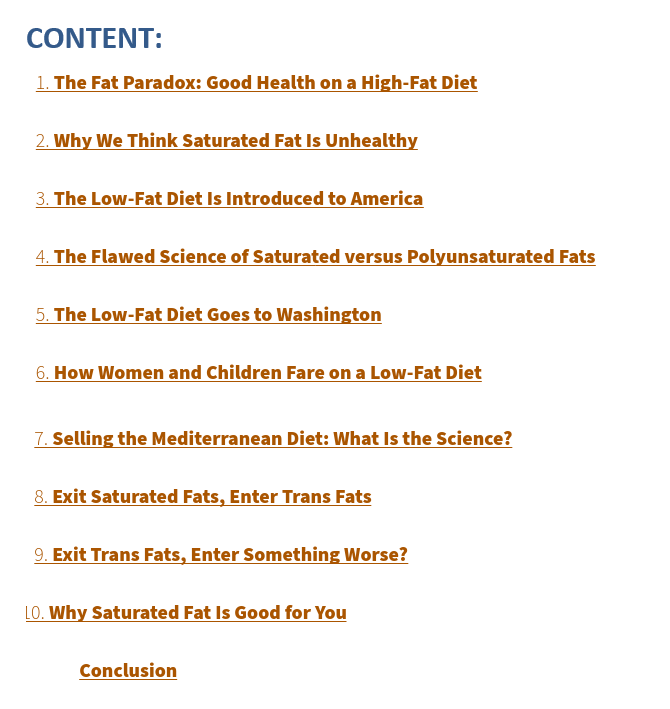
This book seems to be about fat, but it is really not. It is more about government science, which is not science, but rather the method of transferring public money to government scientists. The author reviews the history of how fat became something bad and how the government created the fat-free industry, making many people rich at the expense of making many people sick.
MY TAKE ON IT:
As a history of mass deception, I think this book is very educational and nicely demonstrates the methods and means of such campaigns. The critical points of the process are:
- Pseudo-scientific studies in which the results are predefined and data massaged until they fit into the required framework.
- Suppression of any contrarian views with personal attacks and the use of all means available from label to government power
- Use of mass media to create a narrative that supports whatever is promoted.
The sad results of such science conversion into an ideological tool are recommendations and, recently, even the use of government force that cause considerable damage to the people. These results are pretty obvious. One need only look at any photo or documentary from the 1950s and 1960s to see how fit most people were at the time. Now just look around, and you will see how many people become fat. So the main inference is not to trust government science unthinkingly but rather do your own check on any ideas promoted.
 Equal Rights Libertarian