
20230625 – The Next American Economy

MAIN IDEA:
This book is about the current ideological crisis of the market economy caused by such failures as the financial crisis of 2008, the negative impact of globalization on the working and lower middle class of the developed Western world, and the rise of China, which seems to be demonstrating the economic superiority of the combination of the totalitarian political system with limited economic freedom. The author believes that all this causes the growth of economic nationalism and populism, as represented by Trump’s presidency. Here is how the author defines the objectives of this book:” Recognizing this underscores the need to persuade Americans that markets aren’t just about economic growth. They can also help express and bolster an understanding of America as a commercial republic. This is an ideal of a republican form of political community that integrates a strong case for economic liberty into a vision of America as a free and commercially orientated sovereign nation in a world in which other sovereign nations are pursuing what they regard as their national interests. It is also the ideal which, I believe, represents that the surest political underpinning for an American economy that takes free markets and their institutional supports seriously. As readers will discover, it brings together an understanding of the strong empirical case for free markets and limited government, a commitment to the moral habits associated with commercial society, the conviction that these are good for Americans as a sovereign nation, and the argument that this is ultimately faithful to the principles which were given powerful expression in America during the Founding period.”

MY TAKE ON IT:
I think that the contemporary crisis is not something new but rather the continuation of the ongoing struggle within capitalism between owners of material property and production controllers (capitalists and managers), controllers of political power (bureaucrats, politicians, and state handouts-dependent intelligentsia), and owners of human capital (labor sellers). The most recent temporary settlement between these groups established after WWII is obviously crumbling. The crisis occurred due to the two developments.
The first and obvious development is the temporary, even if the painful, process of devaluation of labor in developed Western countries due to the massive addition of cheap labor either via globalization of trade with undeveloped and totalitarian worlds or opening borders to massive migration (legal and illegal) of people. This process is already coming to an end in the first because the compensation levels in the undeveloped world raised high enough to make production overseas a lot less profitable and in the second because the leaders of undeveloped and totalitarian worlds decided that they strong enough to expand their power over the whole world via economic, ideological, and political subversion – mainly Chinese way, or direct military aggression – mostly Russian way. Fortunately, as it usually happens with totalitarians, the habit of being protected from contrarian views made them prone to mistakes of overestimation of their abilities. The most critical error is their contempt for the elite of the Western democracies. The totalitarians are absolutely correct when they think this Western elite is corrupted and dishonest. However, they are wrong, believing that this elite is stupid and, in Lenin’s words, “will sell us the rope we will hang them with.” The selling of rope is ending, and totalitarians might be surprised to find this rope around their own neck. That is what seems to be happening with Putin and the Russo-Ukrainian war.
The second and less obvious development that led to the current crisis is the permanent disappearance of need in human labor of any type due to complete production automation. The substitution of human mental labor will happen similarly to what already happened with human manual labor over the last 200 years. The latter process caused the creation of unions, socialist and communist parties, and overall ideological struggles of the XIX and XX centuries. It was resolved by the rise of the value of human capital via massive expansion and professionalization of information processing in the form of science, education, engineering, and real healthcare (instead of bloodletting and other similar services). As for a significant share of the population incapable or unwilling to develop human capital, the solution was provided via welfare, drugs, and pop culture. Unfortunately, AI automation makes the solution’s first part outdated. Nobody will need the services of a doctor or engineer, or programmer if AI could do it much faster, better, and cheaper.
I think that the eventual resolution of the crisis will come in the form of the expansion of the private property to the whole population so everyone will be the owner of some property sufficient to obtain resources not only for everyday survival but also for the pursuit of happiness in market independent activities in science, art, gossip, and what not. The way to do it is to recognize that all goods and services are produced using common inheritance of knowledge and know-how. This common inheritance belongs equally to all, and when some people use it to control the production of goods and services, they should pay a royalty to people who are not productive. I suggested the process of how to do it in this essay: https://www.amazon.com/OWNERSHIP-versus-HIERARCHY-Choice-Dominant-ebook/dp/B09KMBP6JG/ref=sr_1_5?crid=MVDILQ3H4Q4X&keywords=branzburg&qid=1685799822&sprefix=branzburg%2Caps%2C114&sr=8-5
20230618 – The Primacy of Doubt
MAIN IDEA:
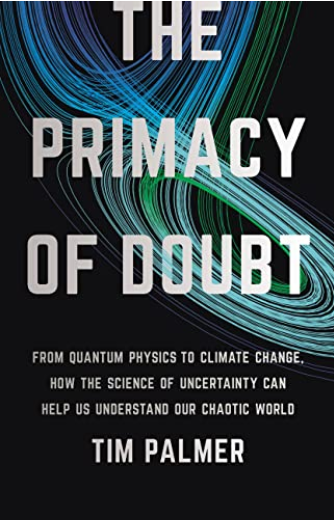
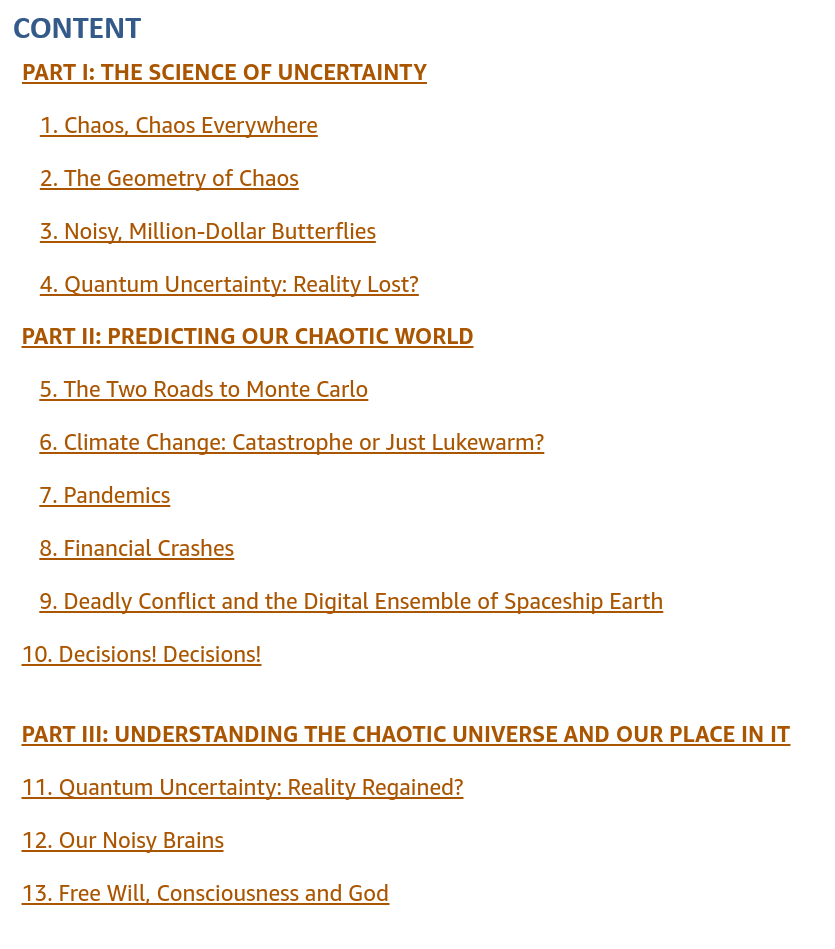
This book is about the chaos and unpredictability of the future. The two most important ideas in this book are the idea that “the butterfly effect is profoundly intermittent” and the second is that the way to handle this unpredictability is to run multiple models of the future and assembly “what is called an “ensemble prediction.” The author provides examples of this process in various areas, from weather forecasts to economic projections. Finally, the author suggests a general way of achieving the necessary diversity of models required to cover a variety of future outcomes. The author characterizes his approach this way:” I challenge this consensus view of quantum uncertainty using ideas based around the geometry of chaos.”
MY TAKE ON IT:
It is interesting to discuss future predictability in multiple areas including climate, pandemics, economics, etc. I generally agree that various models covering a range of future parameters are much better than one rigid model that tries to explain everything and predict the future in some detail. It is also quite apparent that using noise in initial parameters is a decent way to achieve the necessary diversity of results. However, I think a relatively close cluster of effects is bound to miss severe outliers. And, since outliers make the difference, the future with significant dramatic changes will always remain unpredictable. That is the reason to avoid the prediction of such dramatic events and concentrate on what humans can predict at least somewhat reliably: small changes that incremental actions could correct.
A good example would be global warming. Neither claims of alarmists that colossal change is already at the gates nor wholesale rejection of change are supported by data, especially if wide-ranged data distortion aimed to get grants and promote one’s career, are considered. The reasonable approach would be to limit CO2 emissions not as an emergency measure but as long-term objective, parts of building a human-controlled global sustainable environment while assuring economic growth that would provide enough wealth to handle changes as needed. In short, the chaos and unpredictability make it imperative to be cautious and implement change incrementally, preferably on a small scale so, to avoid such cataclysmic events as building communism, socialism, national socialism, big imperial entities, and so on: all being “good ideas” that never work in reality.
20230611 – The Secret World

MAIN IDEA:
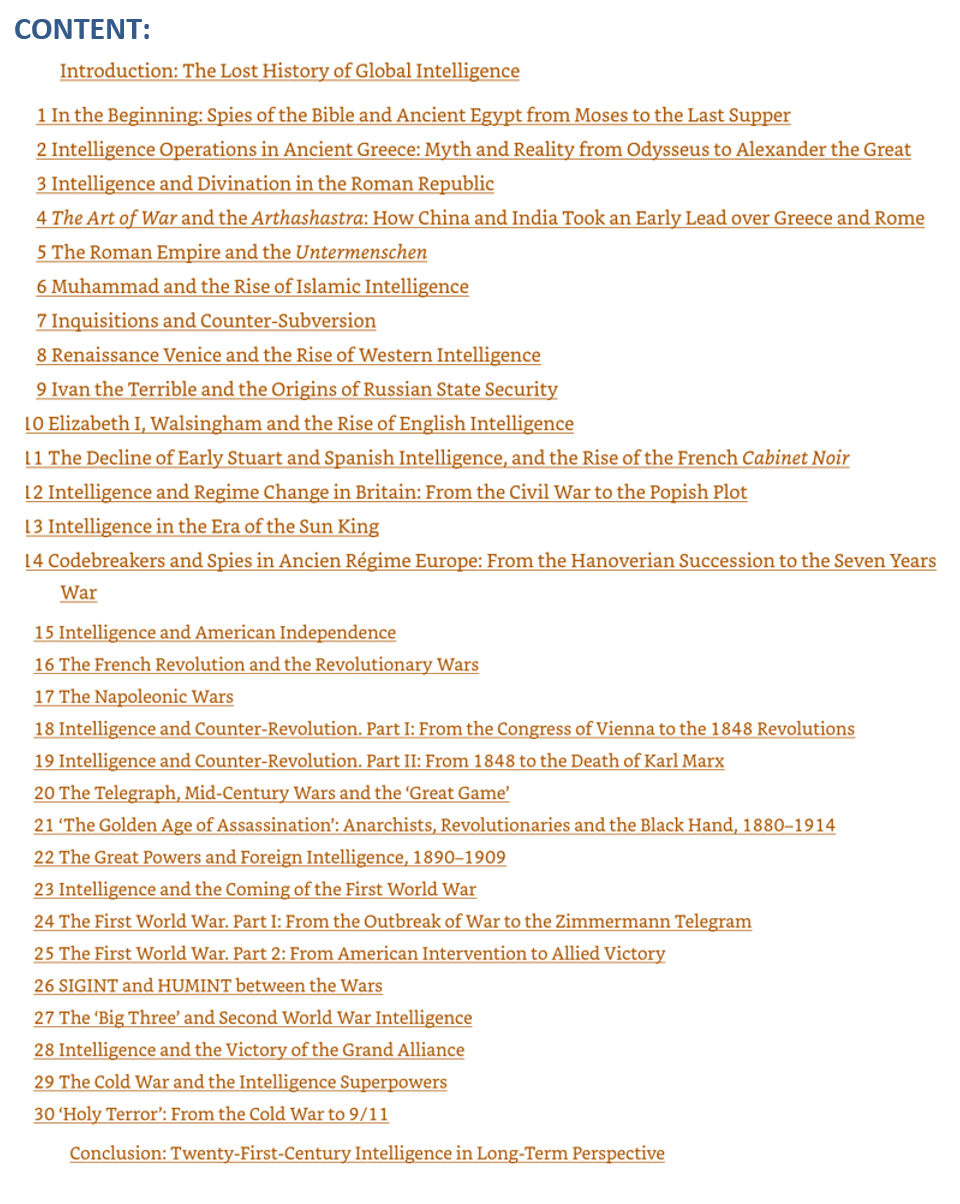
This book about history is somewhat unusual. It is not that much about events development as about specific activities: spying, intelligence collection, and subversion. Since any competitive human activity includes a match between shield and sword, the book also has a history of the other side: counterintelligence, security measures, and counter-terrorism. The idea is not only to demonstrate how it worked over centuries but also to show how often it was ignored.
MY TAKE ON IT:
In my opinion, the role of intelligence as information acquisition is often overestimated, while the role of intelligence as a tool of effective information analysis is often understated. Especially poorly understood is the role of general data analysis and leadership decision-making that could prevent the disclosure of secrets and successes of terrorism and sabotage. There are vast numbers of examples of the intellectual failure of leaders to implement preventive security measures or ignoring valuable intelligence about the enemy’s actions. Two of the most consequential cases in the last hundred years come to mind: Stalin’s failure on June 22nd, 1941, and American leadership’s failure on September 11th, 2001. In either case, the failure resulted from an intellectual deficiency of leadership.
In Stalin’s case, the rigidity of planning when conviction that Hitler would not fight on two fronts simultaneously led to ignoring all signs that an attack was imminent. Stalin failed to understand that Hitler’s correct evaluation of the UK’s inability to maintain active fighting at the moment and the USA politically restrained by isolationists from entry into WWII, the preventive attack on USSR was the only chance to avoid such a situation. The war was imminent, with Stalin’s USSR actively preparing for the attack and concentrating troops at the border. Whether this attack would come just a few days or weeks after June 22nd or sometime in 1942, Stalin’s intention to move the communist revolution ahead using Red Army tanks was not in doubt.
In the case of American leadership in 2001, it was the plain bureaucratic failure when compliance with norms, regulations, and political considerations was by far more important than providing security for the country. The reasons for failure that leaders later came up with, including such justifications as “failure of imagination,” sounds quite ridiculous. They could just watch Hollywood movies, some of which included plots with terrorists capturing an airline plane and intending to use this plane as a weapon in populated areas. Some measures that would prevent September 11th were just fortifying doors to the pilot cabin and not complying with any terrorist demands. It is precisely what Israel did after several attacks in the 1970s, and it worked. Moreover, I believe American Airlines intended to fortify doors and advertise higher security but dropped this idea because a few hundred dollars per plane would cost too much.
Anyway, to have good intelligence and consequently know the plans of one’s adversary is nice, but to have leaders with brains in good working conditions is by far more critical.
20230604 – Bad Medicine

MAIN IDEA:
In this book, the author reviews the history of medicine as a profession and very convincingly demonstrates how far away from science were typical methods of treatments and even overall approaches to all kinds of medical problems. For the first few thousand years of documented medical treatments, doctors killed by far more people than they healed. The author also describes real progress in medicine achieved in the last 150 and how it really helps in healing. Here is how the author presents his conclusions: “Before 1865 all medicine was bad medicine, that is to say, it did far more harm than good. But 1865 did not usher in a new era of good medicine. For the three paradoxes of progress—ineffectual progress, immoral progress, progress postponed—are still at work. They may not work quite as powerfully now as they did before 1865, but they work more powerfully than we are prepared to acknowledge. There has been progress; but not nearly as much as most of us believe.”

MY TAKE ON IT:
I think that the author’s approach and conclusions are very valid. Yes, there is real progress and medicine, so lots of people did not die from appendix or smallpox. However, this progress is much more limited, and many treatments are still pretty much in the dark ages: relying on authority instead of factual data, treating patients with the primary objective of making money, rather than making patients healthy, and so on. It is probably inevitable as long as doctors depend on the money flow from patients either directly or indirectly via the government. Actually, consciously or unconsciously, but doctors have to aim to keep patients in a condition somewhere between being healthy or being dead. Neither healthy nor dead people produce income for doctors. I have experience with two organizational forms of medicine: Soviet 100% government care and American somewhat private healthcare. This experience demonstrates that in the Soviet form when doctors depend on government salary, the objective moves a bit closer to a patient being dead, albeit doctors’ humanity and character somewhat tempered it. The American form has more space for this humanity because there are no Soviet-style directives like not treating anybody older than 60. After all, it is a waste of resources. However, the use of the medical treatment as a money pump is very pervasive. In short, one has to remember that there is always a conflict of interests between doctor and patient: the doctor needs the patient to be moderately sick and pay lots of money, while the patient wants to be healthy and pay as little as possible. On the bright side, they both want to prevent the patient from being dead.
 Equal Rights Libertarian