
20230430 – Language vs Reality

MAIN IDEA:
The main point of this book is that human language serves not as much as an instrument of accumulation and transfer of information but rather as a tool of social organization, which is necessary to coordinate the actions of groups of human individuals. From this point of view, the linguistic and ideological representation of reality has only tangible relation to the reality of the environment because this representation must be limited to the technical capacity of the human brain. The book describes how it is done and scientific experiments that demonstrate this process. It also provides some interesting examples from comparing different languages, proving how human perception of reality depends on the language. Finally, it reflects the manipulation of people applied by using “the power of framing, stories, and narratives in persuasion, sense making, and social cohesion.”

MY TAKE ON IT:
This book is quite a helpful tool for anybody who wants to be at least somewhat free and independent because it nicely demonstrates how others manipulate us all. This manipulation starts from birth and ends only at the point of death. It is done via language structure and use, the control of information flows, and the framing of individual mindset during culture acquisition and throughout the lifetime. From my experience, I could say that the ability to recognize such manipulation and act accordingly could be a defining factor in the quality of an individual’s life and even its quantity.
20230423 – Stolen Focus

MAIN IDEA:
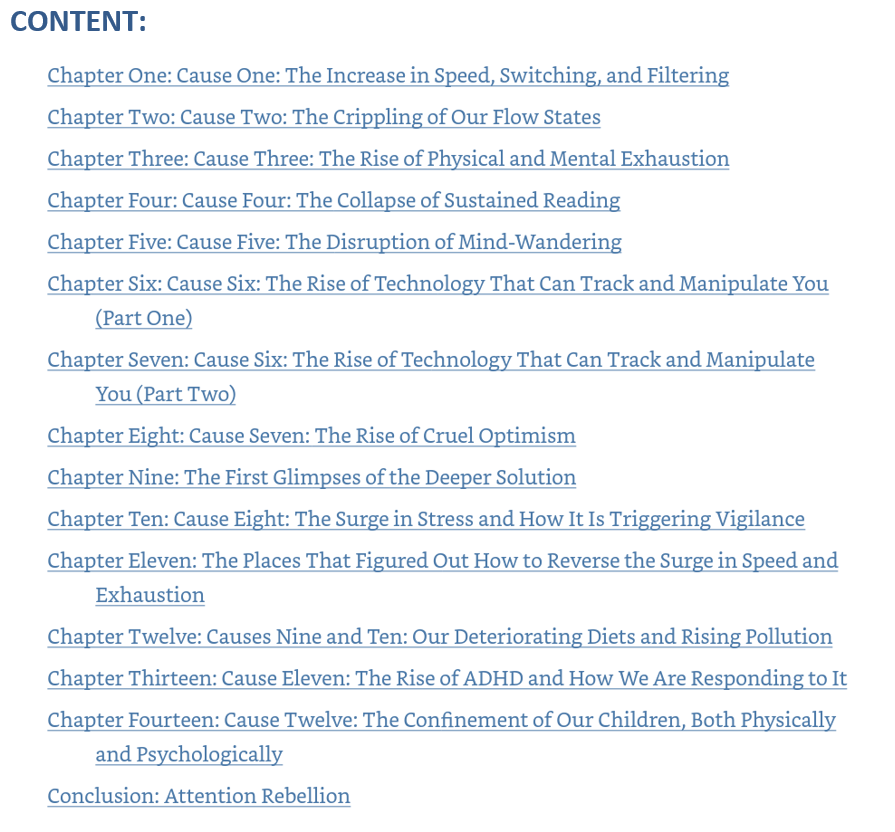
This book is about human focus, which is the human ability and even the need to concentrate narrowly on some informational process, whether reading, problem analysis, communication with others, etc. The focus also means excluding everything else that is not in focus from human perception and thoughts, as if it just does not exist. The book discusses at length the necessity of focus for being productive in any area of human activity and technology that distract people from applying it effectively. The author also discusses the consequences of this distraction, which include the inability to deal with complex problems and adherence to simplistic solutions. Eventually, this inability to focus on effective problem solutions causes stress, illness, and a general failure to have a good life. In conclusion, the author offers six behavioral changes that could help manage attention and control focus.
MY TAKE ON IT:
It is a good review of the problem, with many references to psychological research and books. For me, the problem does not look too tricky to resolve, probably because I grew up in an environment where the primary news source was radio and one TV program, computers were mainframes not accessible to people, and books were available only within limits established by the totalitarian government. This was the environment of severe informational deprivation combined with the massive overflow of propaganda and disinformation in all forms conceivable. But on the other hand, this environment provided good training for setting up filters to select what makes sense and what does not, which tools help get things done, and which mainly distract one from doing this. So, I think the distraction problem will be resolved via training in setting similar filters from early childhood. In addition, such training should develop skills in consciously deciding what one wants to achieve, what information one needs for this, and which tools are best; after that, one can just cut off all this noise and even forget about its existence.
20230416 – Stalin’s War

MAIN IDEA:
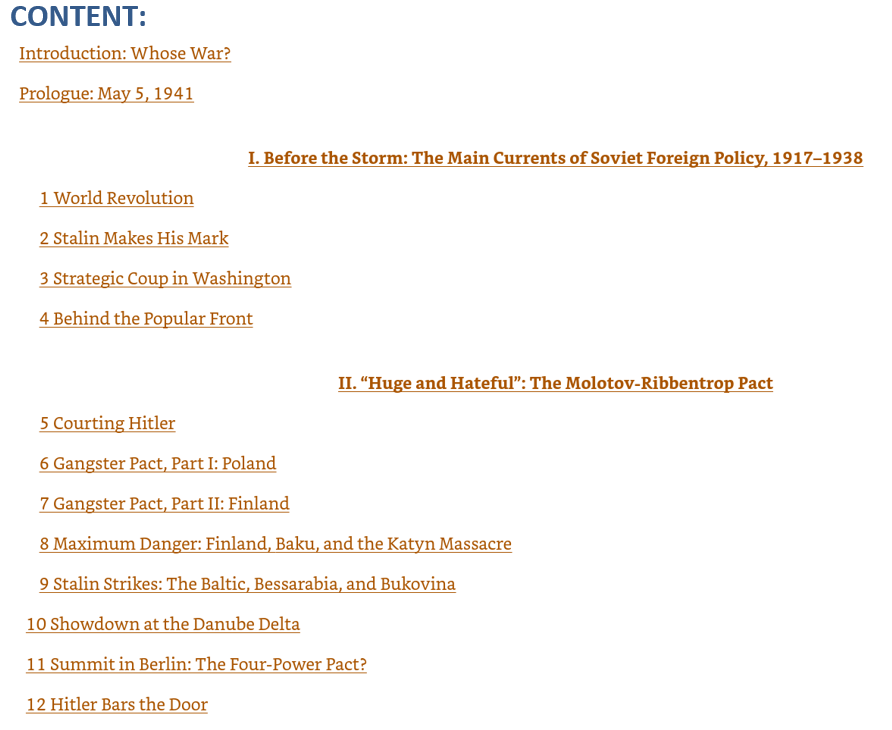
The book is about the History of WWII. Unlike the thousands of other books about this period in History, this book offers a reality check on what then happened and how it happened. The typical narrative is that it was a good war in which forces of democracy and freedom fought and won over forces of Nazis’ totalitarian dictatorship, aggression, and genocide. This typical narrative also misses a small, inconvenient, but essential fact that on the side of democracy and freedom was the Communist totalitarian dictatorship of the Soviet Union that was as aggressive and genocidal as Nazis, if not more so. It also misses another inconvenient fact that in the first two years of WWII, from September 1939 to June 1941, totalitarian Germany and the totalitarian Soviet Union were allies, actively supporting each other politically and economically. They even had a formal diplomatic agreement with the secret protocol specifying details of the attack of this totalitarian alliance against Poland and the territorial division of this country. Finally, this book very convincingly demonstrates how the Roosevelt administration in the USA spared no effort to support the Soviet Union. It worked hard, bleaching out its image from all traces of seas of blood of its millions of victims, and successfully turned this monster of the country from a technological weakling into technologically advanced military power.

MY TAKE ON IT:
In my opinion, this book should be required reading for any individual involved in the politics of democratic societies. Not only it provides in great detail information about History, but it also demonstrates how much distortion of History in service of the ideology of socialism impacts the actions of individuals in control and how it results in huge costs that people have to pay as a result of these actions. It is not only people under Soviet dictatorship who suffered these costs by having miserable lives of economic and intellectual deprivations. It was also the people of democratic states who had to suffer a decrease in well-being resulting from vast amounts of resources of these states directed to support the growing power of the USSR during WWII and then to maintain substantial military expenses to contain it. I would suggest looking at two historical events to demonstrate how they happened. One is from WWII – the Warsaw uprising again Nazis in 1944, and another is Russia’s current aggression against Ukraine.
The first event was when Stalin rejected all requests of the USA and UK to help the Polish resistance and allowed Nazis to destroy thousands of people, which could become an obstacle to his plans of control over Poland. It is described in chapter 30 of this book. It clearly demonstrates the ideological and moral weakness of the Western leadership of the time. Just imagine that instead of timidly asking for help, Roosevelt demanded it and warned that refusal to help Poland meant immediately suspending all lend-lease supplies. Stalin would have no choice but to comply because, without tremendous material support from the USA, Red Army would not be able to fight. The result of such assertiveness in this and similar cases would be the democratic Easter Europe, significantly diminished abilities of the USSR to initiate and conduct Cold War, and much better lives that generations of people elsewhere would have in the second part of the XXth century.
The second event, even if it started 77 years after WWII, is directly related to this war and its History distortion. Russian dictator Putin and other members of the contemporary Russian elite grew up in an environment where the USSR’s role in WWII was glorified, its material and military achievements magnified beyond any reasonable relation to factual reality, and the role of Western allies diminished to insignificance. This distortion became an inseparable part of these peoples’ worldviews. It also created the foundation for their strong belief in the superiority of their people and, therefore, Russian ability to generate military power superior to anything that could be generated by the West, despite the West’s enormous economic and technological superiority. Such belief will sustain Russian aggression as long as the West allows it by pretending that it does not happen before February 2022 and not providing sufficient weapons to Ukraine to win quickly.
If Western leaders truly learned the History of WWII, they would understand that choice is not fight or not fight. The option is what price to pay. Admission of Ukraine to NATO on February 21st of 2022 would save hundreds of billions of dollars and hundreds of thousands of lives. Correspondingly, the suspension of military support to Ukraine, if it happens, will lead not to peace but to spending trillions of dollars and millions of lives due to the expansion of this war. It remains to be seen what road they will choose.
20230409 – Not Born Yesterday
MAIN IDEA:
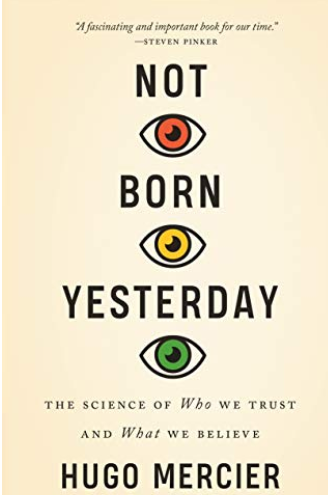
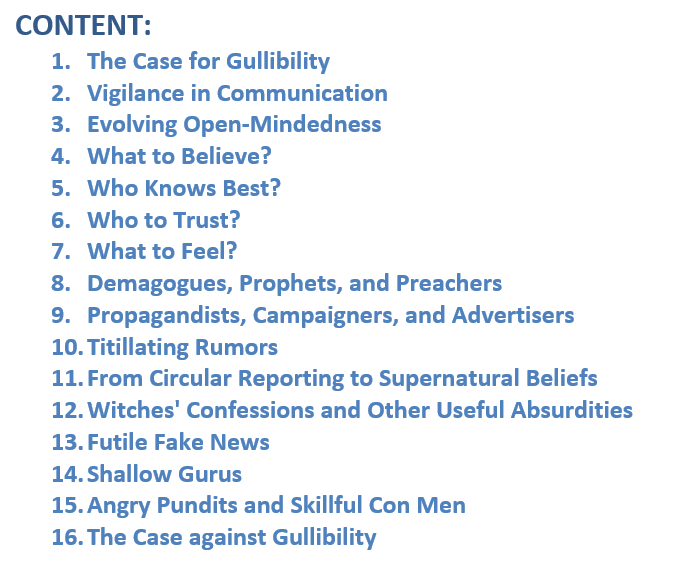
The author explicitly defines his intention in writing this book as rejecting the idea that regular people are too gullible and are an easy mark for cheating and manipulation by politicians, businesses, and other crooks. “The goal of this book is to show this is all wrong. We don’t credulously accept whatever we’re told—even if those views are supported by the majority of the population, or by prestigious, charismatic individuals. On the contrary, we are skilled at figuring out who to trust and what to believe, and, if anything, we’re too hard rather than too easy to influence.”
MY TAKE ON IT:
I think that the majority of people are gullible and often allow others to manipulate them to act against their own interests. There are quite a few reasons for that; the main probably is the cost of resources and attention that are required to resist. It is not the cost per se but a rather typical human inability to compare the cost of paying attention to the cost of not paying it. A typical example would be something like “global warming” manipulated into “climate change” when it became obvious that temperature is not going up that much. The cost of resisting this ideology, such as conflict with its noisy supporters, is very real and immediate.
In contrast, the cost of letting the supporters of this religion have their way in the legislature, culture, and other areas is remote and not obvious. This cost will come in price increases for energy, and consequently everything else, inability to do things that used to be trivial, suppression of speech, and an overall decrease in quality of life. Eventually, with the expansion of these costs, it will become intolerable and inevitably lead to fighting back. In a working democracy, it is a bit less difficult than in a dictatorship, but the price of this gullibility will still be pretty high.
20230402 – The Myth of American Inequality
MAIN IDEA:
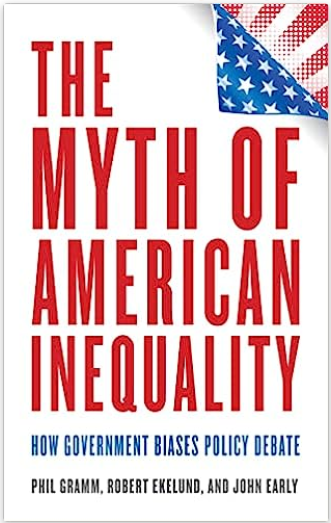
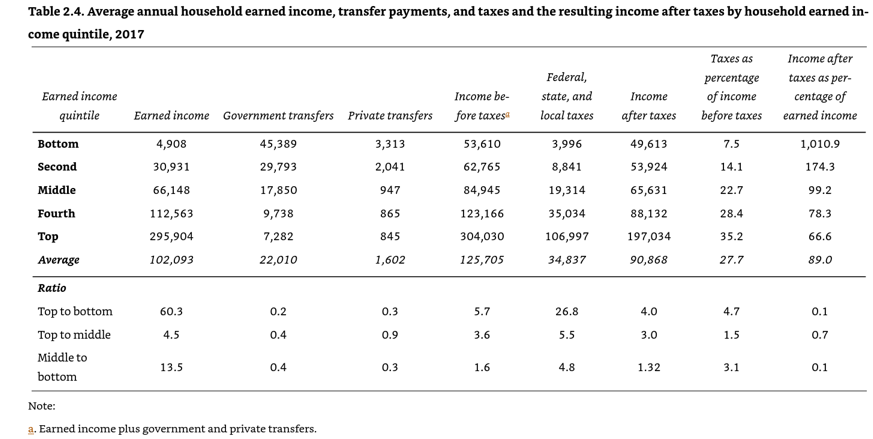
This book is about widely spread misconceptions regarding enormous and still growing inequality in America. The authors use government statistics to demonstrate, and quite convincingly at that, that it is not the case. The point they make is that government transfers pretty much-eliminated poverty. Furthermore, the calculations demonstrate that government expenses on the poor, if counted as income, would firmly put these poor into the middle class. Here is a lovely table summarizing this point:
The authors also look at consumption and conclude that the poor in America consumes so much of everything that they hardly should be considered poor by comparing them with the poor in most other countries.
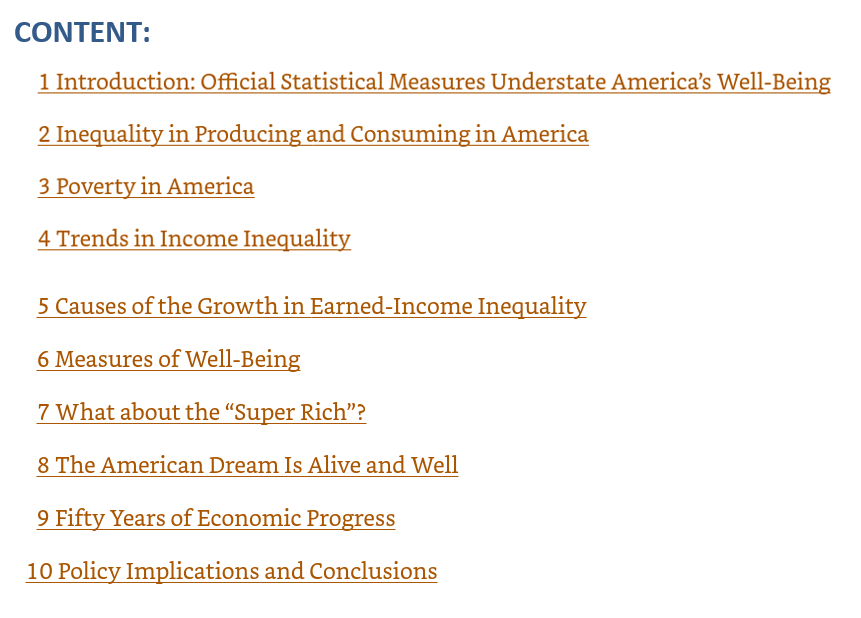
The authors also discuss inequality, the Gini coefficient, and how leftist economists manipulate data to arrive to preset conclusions. Finally, the authors demonstrate that, far from being stagnant, America has made significant progress, and the contemporary poor are much wealthier than the real poor in the 1960s.
MY TAKE ON IT:
It is a very interesting book with lots of excellent and relevant statistics. I believe that material well-being becomes secondary after people achieve some level of satisfaction with material needs. The problem becomes not economic but rather psychological. To achieve an acceptable level of self-esteem, a human need to be self-sufficient and effective in obtaining resources from the environment. Handouts and transfers of resources from others prevent such achievement. Hence, people try to compensate for this by the demand to increase transfers to the resource availability level of really self-sufficient people. The hope is that such an achievement of false equality would make the feeling of inadequacy disappear. An even more critical factor is the powerful forces of bureaucracy and government-supported layers of society that control resource transfers from productive people to unproductive, directing a significant share, if not the most, of resources to themselves. These forces include the teachers that produce illiterates after 12 years of schooling and paper pushers that make any business spend extraordinary time and effort complying with meaningless regulations. They also include politicians that create these regulations. Together with other members of the parasitic part of society, they represent a powerful force that would make the “struggle for equality” continue forever, regardless of actual resource availability for everybody in society.
Moreover, with the approaching switch of a large part of the production of goods and services to automatic, AI-based processes, the number of people that cannot compete will grow, increasing the power of the parasitic part of society. This change could lead to an increase in the hierarchical structure of government expanding to include these people directly as educated bureaucrats doing meaningless “work” or indirectly as uneducated “poor” living off government transfers. The alternative to this unified hierarchy would be resource distribution via individual ownership covering the totality of the population and totality of available resources and designed to make such ownership permanent while dynamically adjusting it depending on individual actions and their success or failure. In my essay, I proposed a process for doing just this.
 Equal Rights Libertarian