
Home » 2023
Yearly Archives: 2023
20231230 – Regime Change

MAIN IDEA:
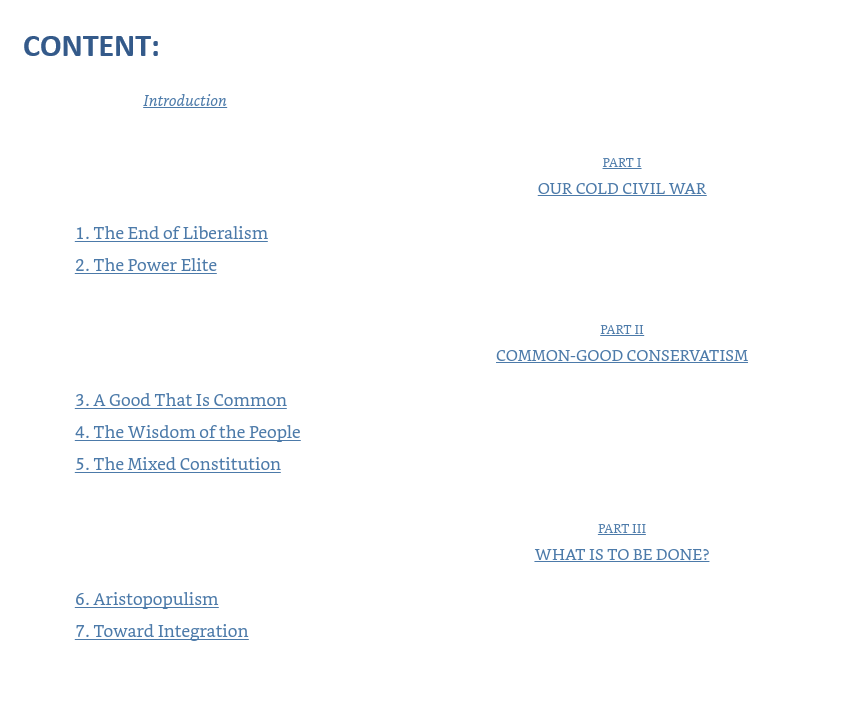
The main thesis of this book is that the political regime currently existing in the USA and other Western countries is a combination of two forms of liberalism: social and economic when the “entrenched progress-oriented liberal elite” uses control over nearly all political and economic institutions to suppress non-elite population enforcing compliance with all kinds of “progressive” ideas that counter traditional culture such as new notions of marriage, abortion, equality of results, substitution of anti-black racism with anti-white racism, and so on. In the economic area, it means opening the internal market to China and other hostile powers that bribe the economic elite with cheap labor in manufacturing and high returns on investment in exchange for technology transfer. It also includes the promotion of illegal immigration to obtain cheap labor in services and potential political support for the elite. The author’s conclusion is:” What is needed, in short, is regime change—the peaceful but vigorous overthrow of a corrupt and corrupting liberal ruling class and the creation of a postliberal order in which existing political forms can remain in place, as long as a fundamentally different ethos informs those institutions and the personnel who populate key offices and positions. While superficially the same political order, the replacement of rule by a progressive elite by a regime ordered to the common good through a “mixed constitution” will constitute a genuine regime change.” The author also suggests the method of achieving this result:” This change will not occur simply by a mythic revolutionary uprising of the many against the few. Rather, it will require some number of “class traitors” to act on behalf of the broad working class, articulating the actual motives and effects of widespread elite actions. Even if relatively small, an elite cadre skilled at directing and elevating popular resentments, combined with the political power of the many, can bolster populist political prospects as a working governmental and institutional force. In turn, a new elite can be formed, or the old elite reformed, to adopt a wider understanding of what constitutes their own good—a good that is indivisible and common—and to steer America to a state of flourishing.”
MY TAKE ON IT:
This is one of quite a few recent books that reflect the general understanding that the current political-economical regime is not sustainable and will end pretty soon in some form of massive restructuring. Such restructuring will happen either via internal regime modification or disintegration of society either via internal civil war or defeat inflicted by ideological enemies. These enemies present such alternatives to existing liberal semi-democratic regimes as the Chinese model of the combination of communist political and cultural totalitarianism combined with a semi-capitalist economy or a similar Islamist model in which fundamentalist religion is used instead of communist ideology.
I generally agree with the author’s analysis of the current regime. I also think that we are on the brink of massive regime change that involves political, cultural, and economic restructuring. I do not think it requires lots of help from “the traitors to their class” from the elite. We have a massive overproduction of the elite, that is educated individuals who cannot find a place within society that would be consistent with their expectations. History demonstrates that such individuals do not easily accept disappointment and direct their talents and energy to implement regime change. There is a problem with ideology for these individuals to embrace because neither communism nor religious totalitarianism would be good enough for them. Communism has been discredited over the last 150 years of multiple attempts at its implementation while religion is too much out of synch with the deeply secular redundant elite. A recent attempt to create some mix of ideology in the form of Wokeism seems to be failing due to its too-obvious idiocy. It certainly remains to be seen, but I think that this ideological emptiness creates an opportunity for democratic rebirth founded on the new understanding of property as a subject to exclusively individual rights allocated in such a way that everybody would have sufficient property not only for subsistence but for very decent living conditions achievable with effective use of this property. If such property is defined as an unalienable individual share of the common inheritance that could be rented out at market prices, the need to obtain a place in the bureaucratic hierarchy of governments or corporations or some ideological structure would cease to be a necessity, freeing individuals to pursue happiness any way they want to.
20231223 – End Times
MAIN IDEA:
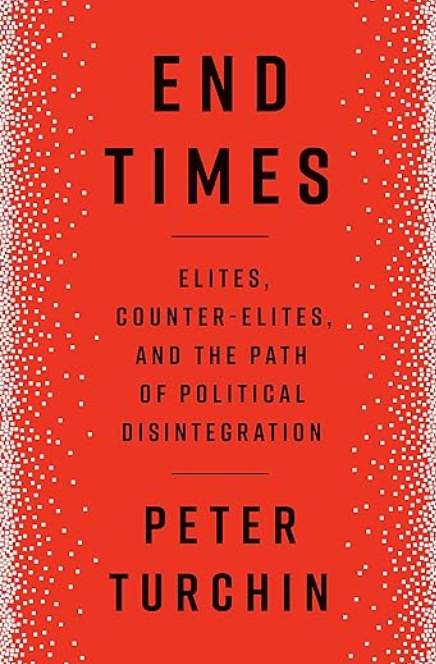
This book presents a new scientific approach to history and to the prediction of future developments of society called Cliodynamics. This approach includes the development of a massive database of information about crises of many societies in the past and the outcomes of these crises. Here is the main point of the analysis of the collected data:” Our analysis points to four structural drivers of instability: popular immiseration leading to mass mobilization potential; elite overproduction resulting in intraelite conflict; failing fiscal health and weakened legitimacy of the state; and geopolitical factors. The most important driver is intraelite competition and conflict, which is a reliable predictor of the looming crisis”.
The application of this result to current events in American Society leads to the conclusion that it is on the brink of revolutionary events that would include massive, organized violence and may result in the breakdown of this society. Despite the generally pessimistic mood of the book, the conclusion is this:” The final thought with which I want to end this book is that humanity has come a long way since our species appeared some two hundred thousand years ago. The last ten thousand years have seen a particularly rapid evolution. Despotic elites who oppressed common people repeatedly arose and were repeatedly overthrown. We are now again in the disintegrative phase of this cycle, but while we live through our own age of discord, it’s worth remembering that humanity has learned from previous such debacles. Cumulative cultural evolution equipped us with remarkable technologies, including social technologies—institutions—that enable our societies to deliver an unprecedentedly high—and broadly based—quality of life. Yes, this capacity is often not fully realized—there is great variation between different states in providing well-being for their citizens. But in the longer term, such variation is necessary for continuing cultural evolution. If societies don’t experiment in trying for better social arrangements, evolution will stop. Even more importantly, when selfish ruling classes run their societies into the ground, it is good to have alternatives—success stories.”

MY TAKE ON IT:
It is not the first and not the last book that predicts cataclysmic events for American society in the near future. Unlike the previous 30+ years of my life in this country, this time it looks like quite a reasonable probability. It is not caused by just the overproduction of the elite, the immiseration of the masses, and the rise of authoritarian powers bent on world domination. I see the most important underlying cause in the global process of elimination of human beings from the process of production of goods and services. Initially, this process liberated most of the population from the necessity to work all the time just to survive, as was the case until very recently when something like 90% of the population had to work in agriculture to produce enough food to avoid famines. From this point just a few hundred years ago humanity moved to a situation where 2% of the population easily produced enough food for everybody, even for everybody with poor control over appetite to be obese. The existing forms of society, either autocracies based on massive suppression and slavery (traditional monarchies or contemporary communist dictatorships) or democratic ones based on mass ownership of private property (material, like land, or intellectual, like professional skills), would no longer work. This is because autocrats will not need slaves and businesses will not need workers of any level of skills. This situation will cause mass restructuring of societies, quite possibly violent, everywhere in the world, America included. The result could be a new structure of society based either on mass bureaucratization when everybody will have a place within the bureaucracy doing some meaningless job, suffering psychological stress from control from above while causing similar stress to individuals below. Alternatively, it could be a society based on mass possession of private property not only material or intellectual but also as a share of the common inheritance of humanity that provides sufficient returns to do whatever one wants to do with his or her life in pursuit of happiness.
I am pretty sure that eventually, a second outcome will occur, and a society of freedom based on property will eventually be established. However, it will not happen without decades of struggles, violent or otherwise, and lots of pain and suffering caused by failed attempts to make a society of mass bureaucratization work for people.
20231216 – Corruptible
MAIN IDEA:
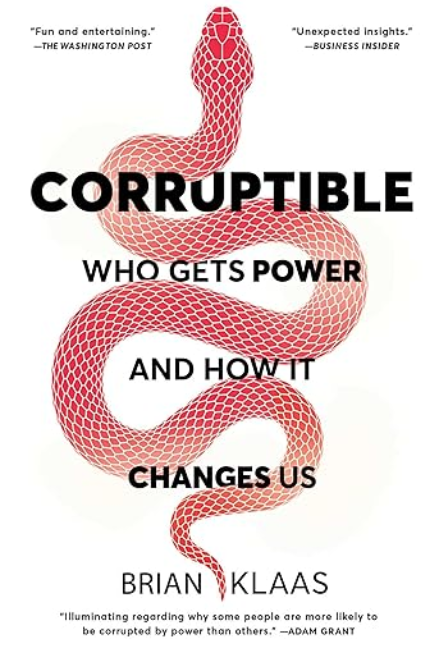
This book explores the relationship between power and corruption. The author defines his objective this way:” This book answers four main questions.
First, do worse people get power?
Second, does power make people worse?
Third, why do we let people control us who clearly have no business being in control? Fourth, how can we ensure that incorruptible people get into power and wield it justly?
To answer these questions the author goes all the way to the very beginning starting with chimpanzees and human anatomy that provide the ability to fight over some distance such as through a stone or a spear. that other animals do not have. Another core difference is by far superior communication abilities. All of this provides for the development of hierarchies and the implementation of highly organized violence. After reviewing many cases and situations, the author comes up with a list of 10 lessons that could alleviate or even resolve the problem of power and corruption. These are:
Lesson 1: Actively Recruit Incorruptible People and Screen Out Corruptible Ones
Lesson 2: Use Sortition and Shadow Governance for Oversight
Lesson 3: Rotate to Reduce Abuse
Lesson 4: Audit Decision-Making Processes, Not Just Results
Lesson 5: Create Frequent, Potent Reminders of Responsibility
Lesson 6: Don’t Let Those in Power See People as Abstractions
Lesson 7: Watched People Are Nice People
Lesson 8: Focus Oversight on the Controllers, Not the Controlled
Lesson 9: Exploit Randomness to Maximize Deterrence While Minimizing Invasions of Privacy
Lesson 10: Stop Waiting for Principled Saviors. Make Them Instead

MY TAKE ON IT:
The lessons provided by the author are pretty good, but I do not think they go to the core of the issue and therefore hardly would help to resolve it. In my opinion, this core is the process of resource acquisition for individuals in power and the ability of these individuals to control other people’s behavior using the violent hierarchy of the state. The rules should be simple:
- Nobody who obtains control over the violent hierarchy of a state, however temporarily, should be able to become wealthier than he or she was before obtaining such power. It should be extended all the way until the end of life and include strict control over wealth acquisition by the members of their families. This rule would exclude young individuals who are after wealth from pursuing high-level positions in government. Simultaneously it would attract older individuals who already obtained wealth from voluntary market exchange and would bring their experience to bear. It should not exclude younger individuals who seek a career in government, it would just ensure that plane material corruption such as taking bribes would not be possible.
- Another important way to minimize corruption of power would be to minimize the power itself by expanding individual rights as much as possible, strictly identifying all and any limitations, and making enforcement of such limitations not optional, but required. For example, freedom of speech should be complete, except for incitement of violence against a group of people with the condition that failure to apply such restriction is in itself a severe offense.
- Finally, there should be a completely separate hierarchical violent structure that is in no way, shape, or form connected to the general violent hierarchy of the state and limited only to control over members of this general hierarchy. It should be elected or selected via a separate process from the selection of members of the general hierarchy.
I do not think that such rules could be implemented in the current condition of society, but we are living during a time of the growing crisis of society and its mores, so the future resolution of this crises could lead to the establishment of these or some other rules that do make corruption of power technically impossible.
20231209 – Fear of Microbial Planet

MAIN IDEA:
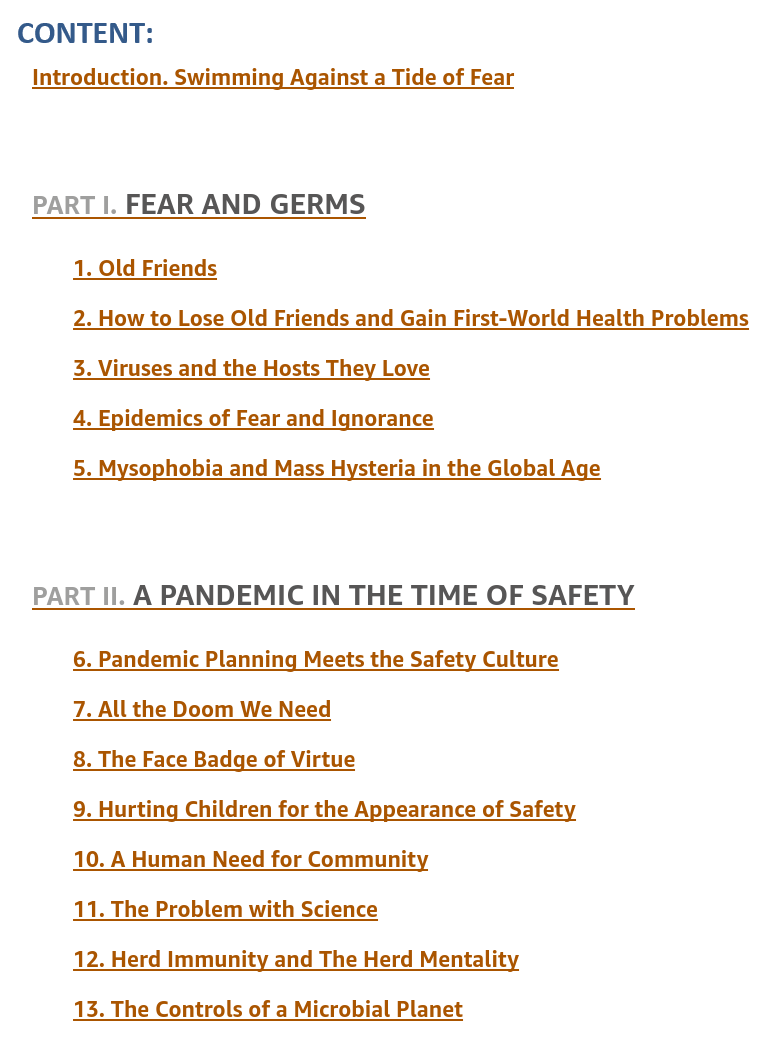
This book looks at humans and their environment from a somewhat non-standard point of view. In this view, a human is not some stand-alone object surrounded by an environment, but rather an integral part of this environment: “Our bodies are colonized by so many microbes that our cells (about 10 trillion total) are outnumbered by our microbial inhabitants by a factor of ten (about 100 trillion total). The microbiota of our bodies is incredibly diverse, with thousands of species of bacteria and fungi that collectively express 4.4 million genes, compared to our meager 21,000-gene genome. As science writer and ecologist Alanna Collen noted in her excellent primer to the human microbiota 10% Human, genetically we aren’t even 10% human, it’s actually more like 0.5%.”
From the moment of birth, a human organism builds complex relationships with other biological objects, some of which are necessary for survival and some impeding it. The book reviews multiple cases of pandemics and epidemics, especially the last one COVID when political and ideological interference led to catastrophic mismanagement of the society’s response to it.
MY TAKE ON IT:
In addition to the general assessment of a human as a biological object in constant interaction with other biological objects, this book is also a very good and thoroughly convincing presentation of what went wrong with COVID-19. However, I think that it is not enough. The very notion that politics could be involved in any way, shape, and form in scientific affairs: promoting some ideas and suppressing others is not just deeply disturbing but dangerous. The danger comes from two directions: one is unjustified expenses to implement scientifically and technologically invalid measures such as windmills to fight an overblown thread of global warning and another one, even more dangerous – use of the state power to force people to comply with clear meaningless and even harmful things, such as vaccination with poorly tested vaccines with the protection of corporation from legal responsibility for failure to assure the safety of these vaccines. In the first case, the damage is economic, decreasing the general welfare of the population. Still, in the second case, it threatens freedom and even the health of the population, which could potentially cause such a response that could undermine the stability of society. I doubt that the American elite fully understands the consequences of their actions of suppressing real science to benefit scientific bureaucrats, but these consequences will occur regardless of their understanding or lack thereof.
20231202 – Knowing what we know

MAIN IDEA:
Here is the author’s summary of what this book is about:” This book seeks to tell the story of how knowledge has been passed from its vast passel of sources into the equally vast variety of human minds, and how the means of its passage have evolved over the thousands of years of human existence. In the earliest times—back even in hominid days, before Homo was even on the verge of becoming sapiens—the transmission was effected near-entirely as a consequence of experience. The experience of rain and cold required the seeking of clothing and shelter; to accommodate and reverse the experience of hunger necessitated the finding and preparation of sustenance; to counter the perils of hostility—whether experiencing it from wild beasts or from other humans, and so knowing its dangers—required preparedness and, perhaps, the acquisition of some kind of martial equipment, and which might overcome the approaching challenge.”
In addition to retelling the history of the development of human knowledge, the author also looks at the meaning of new developments such as computers and AI that threaten to take the process of knowledge acquisition away from humans:” If our brains—if we, that is, for our brains are the permanent essence of us—no longer have need of knowledge, and if we have no need because the computers do it all for us, then what is human intelligence good for? An existential intellectual crisis looms: If machines will acquire all our knowledge for us and do our thinking for us, then what, pray, is the need for us to be? “

MY TAKE ON IT:
This book provides a good overview of the history of knowledge. It poses a serious question for what is next when computers with AI technology very soon will be able justifiably to sing to humans an old song from the musical “Annie, Get Your Gun”: Anything You Can Do (I Can Do Better)”.
However, I do not see an existential problem here as long as humans remain subjects and computers remain objects. Any activities directed to achieve some objective always include:
- Explicit or implicit formulation of: “Why do it?”
- Definition of “What to do?”
- Detailed, even if flexible, the algorithm of actions: “How to do it”
- Finally, activities of doing it.
The development of knowledge-based technology sequentially moved these stages from humans to computers and machines. First machines substituted multiple humans doing something by multiplying the power of the machine operator. For example, unloading trucks with bags of rice used to require several men who were carrying bags on their backs. Then came the forklift and only one man could unload the truck by telling the machine how to unload the truck by moving control levers. The next came a computer-based warehouse control system that produces signals telling forklift operators (human or automatic) what to do: go to this truck, unload it, and put bags there. These activities, however complex, could be done by computers and machines. However, only humans can define the objective of doing all this and answer the question “Why do it”, because computers do not recognize the self as an entity with wants and needs. Is it conceivable to create a self-directing computer with wants and needs? I am sure it will be possible someday, even if the human brain has 85 billion neurons: way beyond the current technological level. It also requires decades of development to bring this brain to the functionality level of a regular human adult. It would probably be done as an experiment within a century or so, but what is the point beyond the proof of “yes we can do it?”. It would be pretty much like the moon landing: “Yes we did it”, but do we really need to do it again?
20231126 – Hell to Pay
MAIN IDEA:
This book’s main idea is that most problems in the USA come from the changes in the power balance between workers and employers. The old balance was based on an expansive goods-producing economy and featured strong unions and the pro-workers Democratic party, which resulted in well-paying jobs and consequently general prosperity. The new balance is based on a service economy divided into a high-tech/managerial economy and a low-tech mainly service economy. The former produces new knowledge, technology, and control over multinational corporations, providing high-paying jobs for the educated part of the population. This part of the population does not need unions because they possess highly marketable knowledge and skills. The latter produces simple services that require little knowledge and skills and therefore pay very little, preventing the uneducated part of the population from having the quality of life typical for the generation of their parents and grandparents. The author sees the solution in the revival of the labor movement via its rejection of one-way subordination to the Democratic party. The more independent labor movement would force political parties to compete for the support of middle and low-skill labor. This, in turn, would result in political actions forcing employers to pay much more for labor than they do now using global arbitrage. The author seems to believe in the real possibility of moving from low low-wage / high-welfare system to a living wage / social insurance system. He correctly notices that it is not possible to move history backward but is so scared of the future that does not see any good alternative:” It could be worse. The emergent national class hierarchy in America may solidify into a neo-feudal system run by a more or less hereditary aristocracy that assigns everyone incomes and rewards based on government-certified identity categories like race and gender or discretionary political patronage. Another possibility is that populist demagogues, some of them perhaps more effective and focused than Donald Trump, will lead ephemeral and disruptive rebellions by the marginalized and dispossessed. Given the nightmarish alternatives of stable oligarchy or demagogue-exploited turmoil, the restoration of worker power in the United States of America is worth a try.”

MY TAKE ON IT:
I think that the author does not completely realize that the very notion of a job and labor is rapidly becoming outdated due to emerging technologies based on AI. It already demonstrates that a great many jobs could be done without human intervention. It would not be possible to go back to the truck drivers’ union if there were no track drivers and all deliveries were made by self-driving cars. And it does not relate only to the jobs of uneducated people. Already the job of a secretary could be seen only in old movies, as well as the job of a travel agent. So, let’s forget about the restoration of labor unions and the non-existent option of going back to the glorious 1950s, which, by the way, did not feel glorious at the time. The real alternatives are:
- Bureaucratization of everything so everybody does quasi-work, the only meaning of which is to provide people with jobs. It would be a kind of socialism, only materially more comfortable: without starvation and absence of goods and services. In this system uneducated part of the population would play games, live on minimal basic income, and kill themselves with drugs, alcohol, and similar entertainments. The educated and ambitious part of the population would be busy playing bureaucratic games of mini-thrones intriguing against each other and striving to obtain a higher place in the hierarchy.
- The other option could be based on the simple fact that people always obtain resources either directly from the environment as the farmers growing food or from a property they own as an owner of a warehouse where this food is stored or from services as grocery store owner converting this food from balk in warehouse into retail quantity in shopping bag. When AI substitutes all labor all three will be fine because the farmer would still own land so he will be paid for what the AI farming machine would produce, and so will the owner of a warehouse for his property. However, none of them will hire any labor whether unionized or not. So, the other option could be based on the fact that information content embedded in all these pieces of property developed over a long time by millions of people and therefore equally belongs to others, If this common inheritance is formally recognized as everybody’s equal and unalienable property and become legal foundation for enforcing payment for its rent from an individual in possession of current material property such as warehouse to somebody who has no material property and historically would make living by selling labor. As long as the amount of payment is defined by the market mechanism of buying and selling rather than some bureaucratic decision, we would have property owners dealing with each other. Such a solution would provide not just resources, but also dignity and mutual respect. In short, the solution to deficiencies of capitalism should be not socialism, but rather turning 100% of the population into capitalists who have property to rent out to each other.
20231119 – The Birth of Plenty

MAIN IDEA:
This book presents a four-factor model of economic development that seeks to explain the difference between developed nations and nations that failed to develop. The author describes the model as” the framework within which human beings think, interact, and carry on business. This section describes those institutions and lays out how they relate to each other.
Four such institutions stand out as prerequisite for economic growth:
- Secure property rights, not only for physical property, but also for intellectual property and one’s own person—civil liberties
- A systematic procedure for examining and interpreting the world—the scientific method
- A widely available and open source of funding for the development and production of new inventions—the modern capital marketplace
- The ability to rapidly communicate vital information and transport people and goods
The author describes in great detail how these factors historically developed in the Western countries, starting with the countries of the English-speaking world, and even provides a nice graphic representation of this process:


MY TAKE ON IT:
The multi-factor analysis presented in this book looks like an interesting and productive approach. However, it is mainly a review of the second-level causes of development or lack thereof. The foundational causes are always people’s behavior and interactions. Humans are animals developed via multilevel evolution when complex interactions between individuals within and without groups produced individuals that always internally conflict between doing what is beneficial for self, even at the expense of a group, or doing what is beneficial for the group, even at the expense to self. Property rights are just a formal framework within which this conflict is continuously processed. Scientific rationalism, capital markets, and infrastructure more or less developed in one or another society are just derivatives of this process.
In turn, as the foundation of society, property rights are always the product of violence and completely depend on the ability of an individual to protect his/her property directly or via supportive actions of some violent hierarchy of individuals (government) who recognize these rights. The historical development of societies led to different patterns of such recognition when some patterns lead to effective development and prosperity, while others lead to failure of development and misery. The key is to find a Goldilocks spot where individuals can retain a share of the product of their activity sufficient to have an incentive to conduct this activity to the best of their ability, whether this product is the material result of the harvest or the intellectual result of the scientific research.
If the violent bureaucracy of the group is very strong and transfers too much of the product, individuals direct their activity to minimize the efforts. This is true regardless of whether it is the traditional form of slavery that includes just a master and overseer, or it is the contemporary form of communist/socialist slavery when violent bureaucracy consists of a vast government machine that includes the State Planning Committee and KGB. It could also be a contemporary highly developed state in which the violent bureaucracy, instead of protecting property rights, imposes multiple laws and regulations intended to transfer resources away from productive individuals to members of the bureaucracy to satisfy their needs and wants.
If the violent bureaucracy is too weak and incapable of protecting individual property, it leads to the need to spend too much effort on self-defense at the expense of productive activities. Such weakness could be material, leading to gangs of bandits (nation-states including) fighting each other for control over people and locations. It could also be ideological, leading to the contemporary democratic states in which violent bureaucracy refuses to protect property for ideological reasons. In either case, failure to protect individual rights leads to failure of development or even to degradation.
20231112 – Equality of Opportunity

MAIN IDEA:
This book discusses the core American idea of equality of opportunity as it was the subject of indirect debate between Left and Right for the last century. The authors define the book this way:” we ask what has happened to equality of opportunity, a term that came to the fore in the Hoover-Roosevelt era. Hoover described and defended the American system as one based on rugged individualism coupled with equality of opportunity. On the other hand, Roosevelt, in his famous Commonwealth Club speech in 1932, said “equality of opportunity as we have known it no longer exists.” The doctrine has had its ups and downs, its defenders and attackers, over the years, but it is still alive and an important part of the conversation today.”
The book reviews the key historical points of this idea as it was implemented in the constitution at the very foundation of the USA, its expansion across race lines after the Civil War, and the progressive movement of the early XXth century. The main milestones such as the New Deal, the Great Society, and the Reagan revolution, were reviewed in more detail. Finally, the book discusses contemporary attacks against this idea and attempts to substitute equality of opportunity with equality of results.


MY TAKE ON IT:
Unlike most people who discuss the contemporary challenges to equality of opportunity, I do not believe that it comes from some noble ideas providing a better life for everybody. I think it comes from a completely different motivation: transfer resources generated by other people to the bureaucratic machinery of the state so credentialed bureaucrats could use these resources for their own consumption and control over other people by providing or denying them access to these resources. A simple example would be the difference between the behavior of a teacher in a private school when the teacher’s income and work conditions depend on resources provided by parents or the teacher in a government-controlled school when resources confiscated from parents by the government, moved through the bureaucratic hierarchy of the state and provided to a teacher on condition of compliance with requirements of educational bureaucrats. In the first case, the objective of the teacher is the transfer of knowledge and skill to students so they would be effective in future productive activities because that is what parents would require in exchange for provided resources. In the second case, the objective is to satisfy the requirements of bureaucrats, whatever they are, with the overriding requirement being to condition students to support resource transfer to bureaucracy. It is clear, that such motivation necessitates rejection of the idea of equality of opportunity and its substitution with the idea of equality of results because the equality of opportunity means resource allocation outside of the bureaucratic machine, while equality of results could be produced only by resource transfer through the bureaucratic machine. In reality, the final result is never equal results because the bureaucrats at the higher level of the hierarchy would always get more resources than bureaucrats at the lower levels, and those will get more than people outside the bureaucracy. The implementation of equalization of results always means the more unequal allocation of fewer resources.
20231105 – Religion’s Sudden Decline

MAIN IDEA:
This is pretty much a review of the statistical data about religiosity that demonstrates its consistent decline practically elsewhere in the world. It also presents different explanations of this phenomenon, mainly related to the change in human needs for security and adherence to various values that define relationships between individuals and groups. Here is a graph demonstrating the overall process over the late part of XX and the early part of XXI centuries:

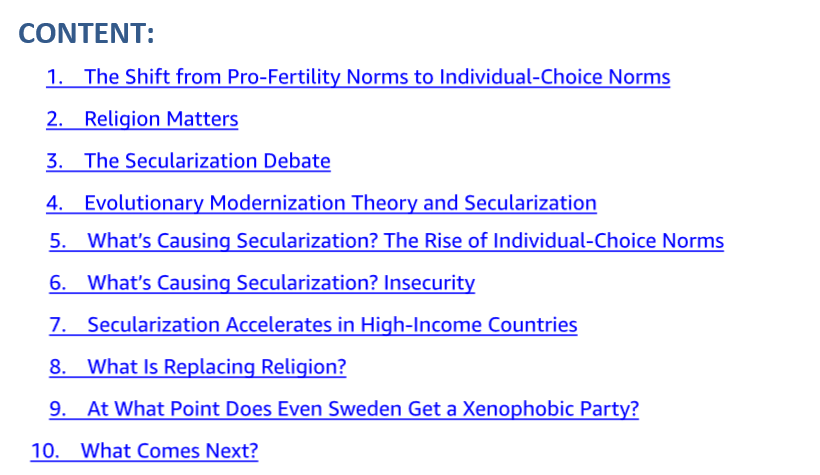
MY TAKE ON IT:
The continuing process of secularization of humanity is clearly connected to an increasing understanding of the world and accumulation of knowledge about the environment that allows much more effective use of resources. Basically, due to the development of science and technology human needs satisfaction, which used to be unreliable and therefore required help from some external, all-powerful, and conscious authority, now could be reliably satisfied without such help. Correspondingly the god(s) that represented such authority and had to be convinced to help either by prayers or gifts or adherence to some specific behavior, increasingly become redundant. Who needs to pray for rain if one has an irrigation system, fertilizers, and other technology? This pretty much explains the relationship between income, prosperity, and religiosity. Rich people do not need to pray for something they can just buy, be it food supplies for the next year or even a baby. One does not need to pray if food can be reliably obtained in the local supermarket, while a fertility clinic provides a much better probability of having a baby than just praying. Interestingly enough, when society falls apart, so the local supermarket is empty or too expensive, there are no jobs available, and people feel powerless, the secular attitude goes away and religiosity comes back in force, as it happened in Eastern Europe after the failure of communism. So, the future of religiosity depends on the future of prosperity. The prosperous people hardly need the god(s), while people living in misery need help from somebody, or, at least assurance that they will be somehow compensated in the future, either by getting to paradise or by living in the bright communist future.
20231029 – The American Dream is Not Dead
MAIN IDEA:
This book first defines the American Dream mainly via its economic component based on polls:” Ninety-four percent of respondents reported that having a successful career was essential or important to their own view of the Dream. Eighty-eight percent reported the same about having a better quality of life than their parents.” It also stresses the realistic character of this dream and its basis in typical middle-class values:” If you work hard and play by the rules, you can get ahead. Your effort will be rewarded. America is a place where you can build a better life for yourself and, in an economic sense, where your children will be better off than you. And in America, going from rags to riches is still possible.”
The statements above are based on statistical data such as these:


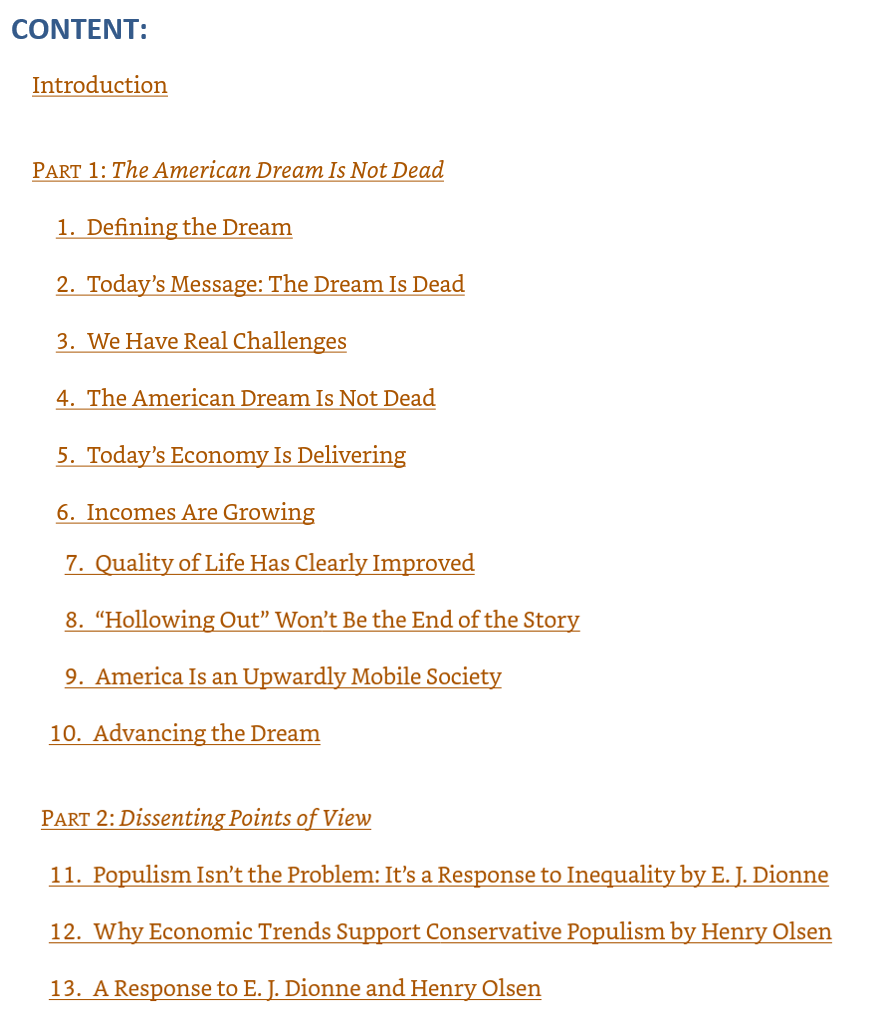
MY TAKE ON IT:
This nice little optimistic book provides quite a few factoids in support of this optimism. Compared to typical cataloging of what is wrong with America, it is a really enjoyable staff. However, I would not be overly optimistic because the future now is not what it used to be, just as Yogi Berra once said. The future will be built on AI technology that makes human labor redundant for producing goods and services. Actually, I am optimistic about the long run: something like 50-70 years during which humans will finally understand that the meaning of life is not in producing goods and services. It is also not in consuming them. It is in enjoying life while having all necessary good and services available with minimal effort. The switch from a survival way of life to an enjoyment way of life will be a complex process, requiring a complete change in the structure of societies, their values, and processes. It will not be simple and easy, but it will happen anyway.
20231022 – Ages of American Capitalism
MAIN IDEA:
This book is about the history of the American economy, which developed via various forms of capitalism. Unlike the usual approach, the author clearly defines what he means by capitalism and presents three theses that express the book’s main ideas, around which the author builds logical, historical, and statistical support. These theses are:
Thesis #1: Rather than a physical factor of production, a thing, capital is a process. Specifically, capital is the process through which a legal asset is invested with pecuniary value, in light of its capacity to yield a future pecuniary profit.
Thesis #2: Capital is defined by the quest for a future pecuniary profit. Without capital’s habitual quest for pecuniary gain, there is no capitalism. But the profit motive of capitalists has never been enough to drive economic history, not even the history of capitalism.
Thesis #3: The history of capitalism is a never-ending conflict between the short-term propensity to hoard and the long-term ability and inducement to invest. This conflict holds the key to explaining many of the dynamics of capitalism over time, including its periods of long-term economic development and growth, and its repeating booms and busts.
MY TAKE ON IT:
As much as I appreciate the huge amount of information collected for this book and the presentation of historical data, the author’s approach seems to me not sufficiently explanatory. In my opinion, not only capitalism but any economic system is not just an abstract process when something happens with “legal assets.” It is rather the process of relationship between people that includes resource allocation to individuals, the establishment of the lines of control and subordination between these individuals, and actions of individuals directed at the satisfaction of their psychological needs via the application of these resources. The pecuniary gain does not differentiate capitalism from other systems. After all, a bureaucrat in a socialist system clearly obtains pecuniary gains while moving up the hierarchy when each higher position provides better living conditions and more power over others than any super capitalist could ever obtain. The key feature of capitalism that differentiates it from all other systems is the formal resource allocation to individuals and clearly defined entities as property protected by the state. The distributed resources allow for independent decision-making and resource application via a competitive market, which results in the superior economic performance of such a society. This superiority was demonstrated by American society during its existence both internally in economic, political, and, eventually, military competition within the United States between North and South when the Northern society with a higher level of resource distribution outcompeted the South where a significant part of the population – slaves were deprived of agency and used by masters just as other resources. Such superiority was also demonstrated via external competition with multiple socialist and semi-socialist societies in which resources were concentrated in the hands of a bureaucratic hierarchy with top-down decision-making, and the majority of the population was deprived of agency, sometimes to the same level as slaves.
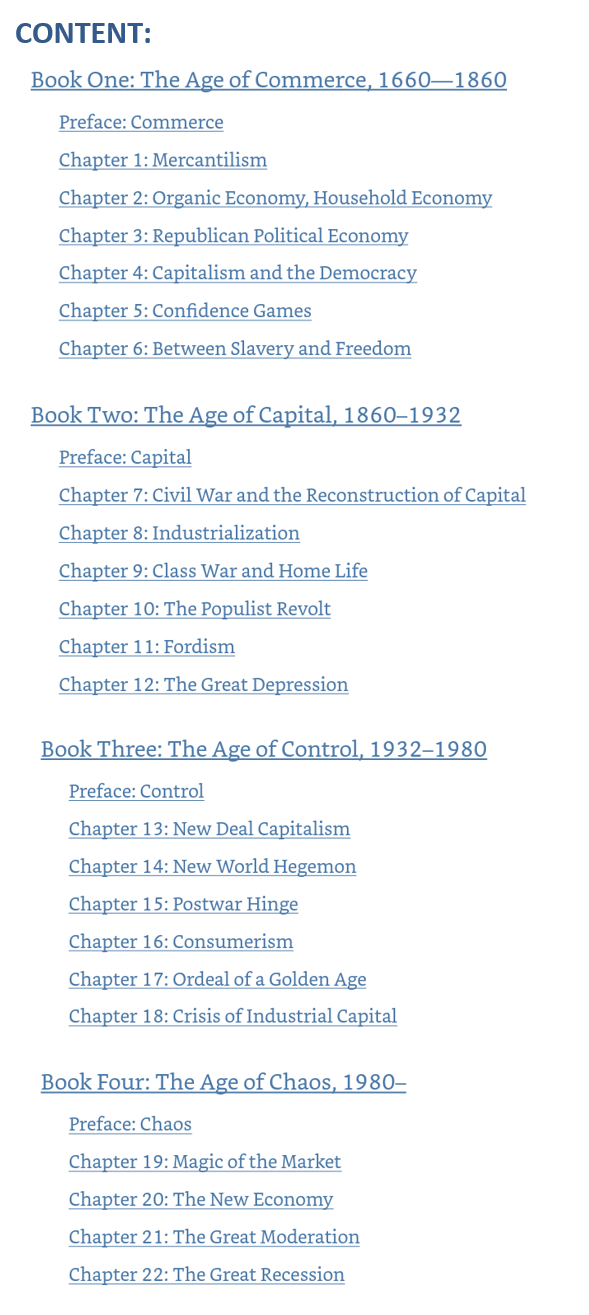
I would suggest looking at the history of economic development of the United States from the point of view of what kind of resources were used, how they were allocated to individuals, and how economic performance was impacted by the ability of individuals to use their agency applying these resources in their own interest. From this point of view, I would look at the following stages of development:
- The main resource is land, which is pretty much available to everybody, creating a country of farmers and small business owners who were dominant in the North and plantation masters and slaves who were dominant in the South. This period lasted from the 1600s to the early 1900s. It did not end at the end of the Civil War, which just somewhat changed the relations between slaves and masters in the South, but not core economic processes. It lasted until the end of the frontier and mass industrialization, when farmers’ productivity became too high, pushing the population out of this economic activity.
- During the second stage, the main resource is human capital. This stage started in the late 1800s and is still ongoing. During this stage, the majority of the population can obtain sufficient resources via small businesses producing goods and services or as highly qualified, productive individuals capable of moving between big businesses as valuable self-controlled resources. However, a small but growing share of the population that possessed too little human capital to obtain sufficient resources on the open market had to resort to violent means to obtain such resources. For the uneducated and unconnected part of this population, such means were unionization and support of political parties that promoted welfare, meaning resource transfer from productive individuals to non-productive with the use of government violence. For the educated and connected part of this population, such means were the growth of government and the transfer of as many goods and services from the market to government control. The growth of government meant the increase of bureaucracy, which provided highly profitable places for educated and connected individuals.
- We are now moving into the third stage when the share of the population with high levels of human capital is decreasing due to automatization. With the implementation of Artificial Intelligence, this share could eventually get very close to 0. The future offers one of two possible developments: one is the bureaucratization of society when people fight for places in the hierarchy and do make-believe work that nobody needs. The other one would be to recognize the common immaterial inheritance of humanity: knowledge, know-how, and such as equally belonging to everybody. Consequently, it could be recognized as individual unalienable property, subject to regular compensation in the form of periodic trade of rights between owners of automated material productive resources and individuals who have little to no such material resources. The first method – complete bureaucratization of society would lead to misery due to the loss of agency and the constant fight for a place in the hierarchy. The second method – complete proprietization would lead to everybody having independent means and therefore free to use the agency in pursuit of happiness.
20231015 – Superabundance

MAIN IDEA:
This book promotes the idea that humanity has now achieved superabundance. the authors define it this way:” When the abundance of resources grows at a faster rate than population increases, we call that relationship “superabundance.” To support this idea, the authors provide statistical data about resource availability from history and its progress till our time. Unlike most economists and historians, they look at real resource availability as expressed in the amount of resources available per unit of time spent to acquire these resources. Here is a nice graphic representation at the high level:
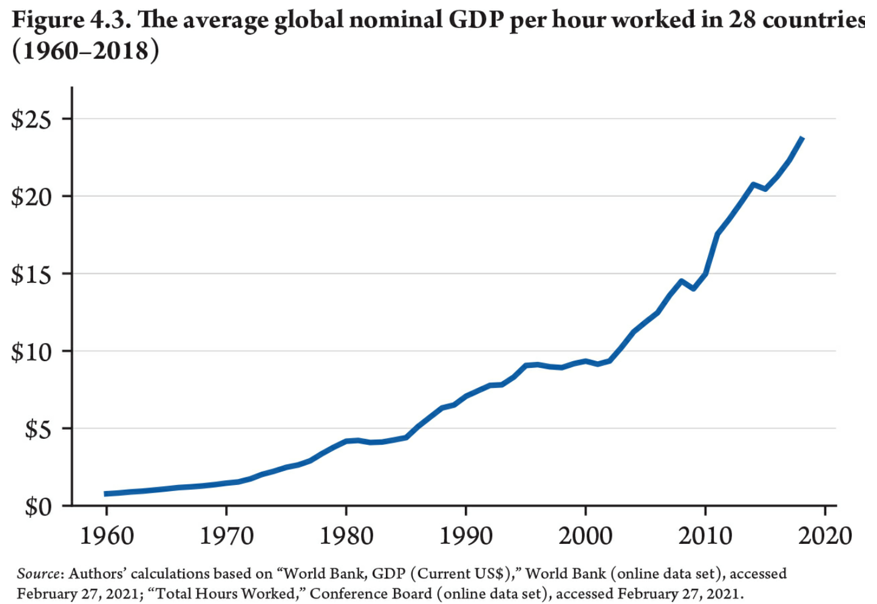
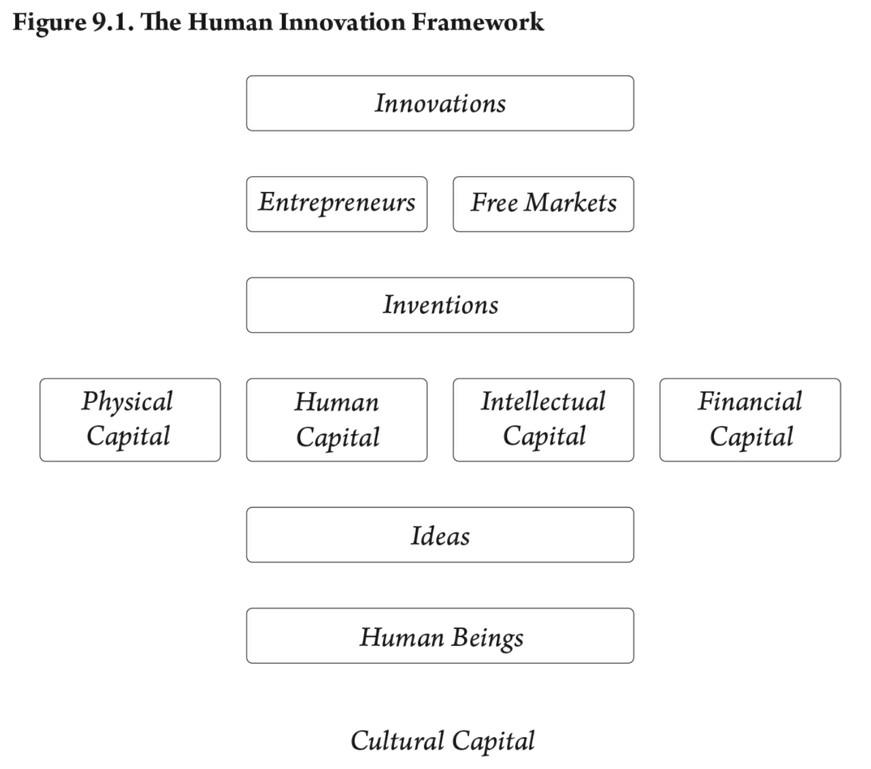
This book is the most detailed scientific analysis of humanity’s economic development since the beginning of industrialization when the civilized part of humanity broke out of the Malthusian trap by moving to more or less democratic capitalism. The authors convincingly reject the ideas of popular and well-paid doomsayers and provide data-based support for the ideas of Julian Simon that the only scarce resources are productive and innovative humans. The authors provide the framework that includes key components of the superabundance development:
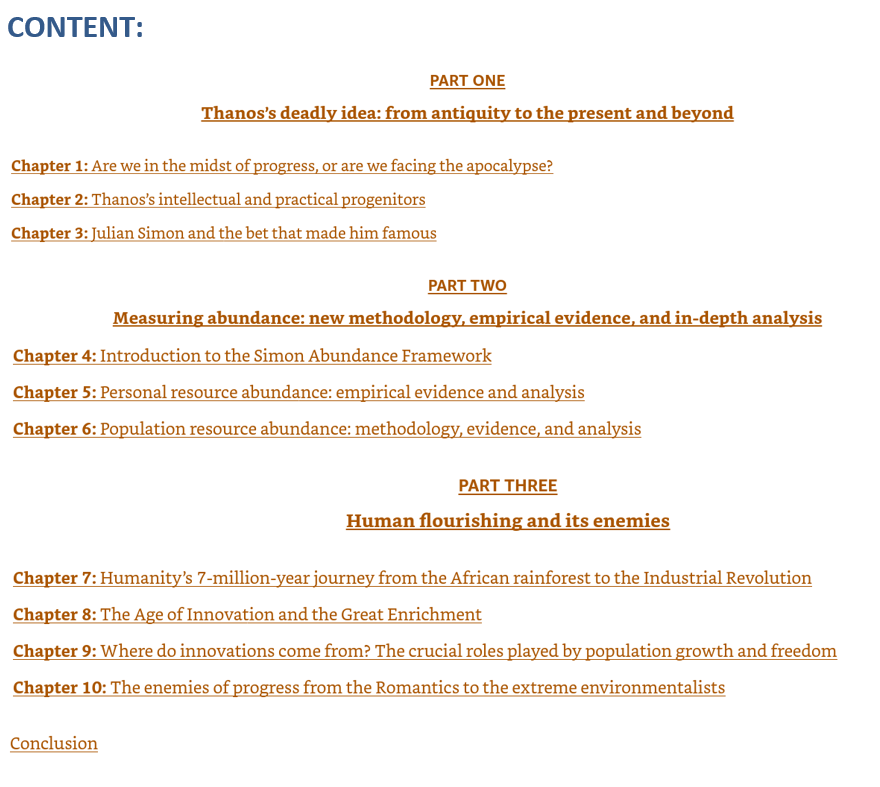
MY TAKE ON IT:
I agree entirely with the authors of this book, and I have been a big fan of Julian Simon ever since I first learned about his work some 25 or 30 years ago. The only point I would like to make regarding this book is that it is mainly directed to the past and present, while humanity is now approaching the point when AI is making the industrial society of the last 300 years outdated. I think material abundance is here to stay, and the world population is becoming stable and well-provided with the necessities of life. However, I think that the inevitable obsolescence of the need for human labor would cause massive disruption and revolutionary changes in the structure of society. The result would be one of two outcomes. It could be a totalitarian society with massive suppression of individual freedoms with the subordination of individuals to the will of others above them in some hierarchical structure. Alternatively, it could be some form of free, but not necessarily democratic, society where individuals have the resources to pursue their happiness any way they want without regard to others as long as they do not invade the personal space of these others. We currently have two samples of these two types of society. The prototype of a future totalitarian option could be contemporary China, where people are more or less satisfied materially but strictly subordinated to the communist party hierarchy. The prototype of a future free society option could be America of XVIII-XIX centuries before the closure of the frontier when everybody could get property on land. The totalitarian option would be pretty bad because it inevitably includes continuing the fight for power and place at the top of the hierarchy. The second option would be much better. However, it would require implementing property rights on something that would provide individuals with sufficient resources. In my opinion, it could be the formalization of the common inheritance of knowledge accumulated by humanity as property equally belonging to all and a subject for compensation from individuals who use more of it to those who use less. It would require some suppression of individuals whose pursuit of happiness requires control over others. Still, it would be much less violent than a constant power struggle in a totalitarian society.
20231007 – The Gift of Violence

MAIN IDEA:
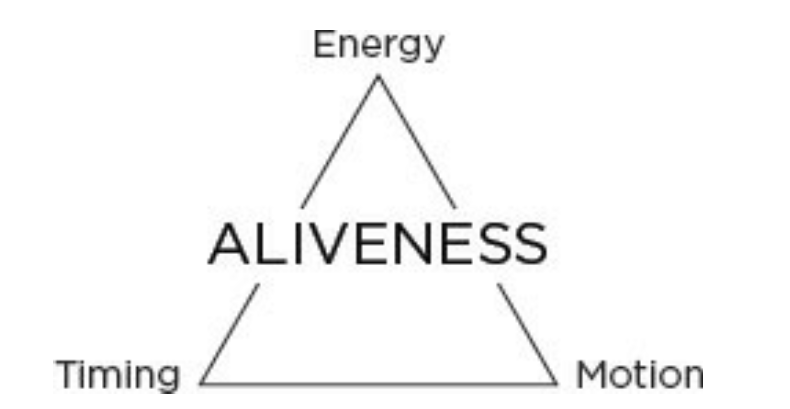
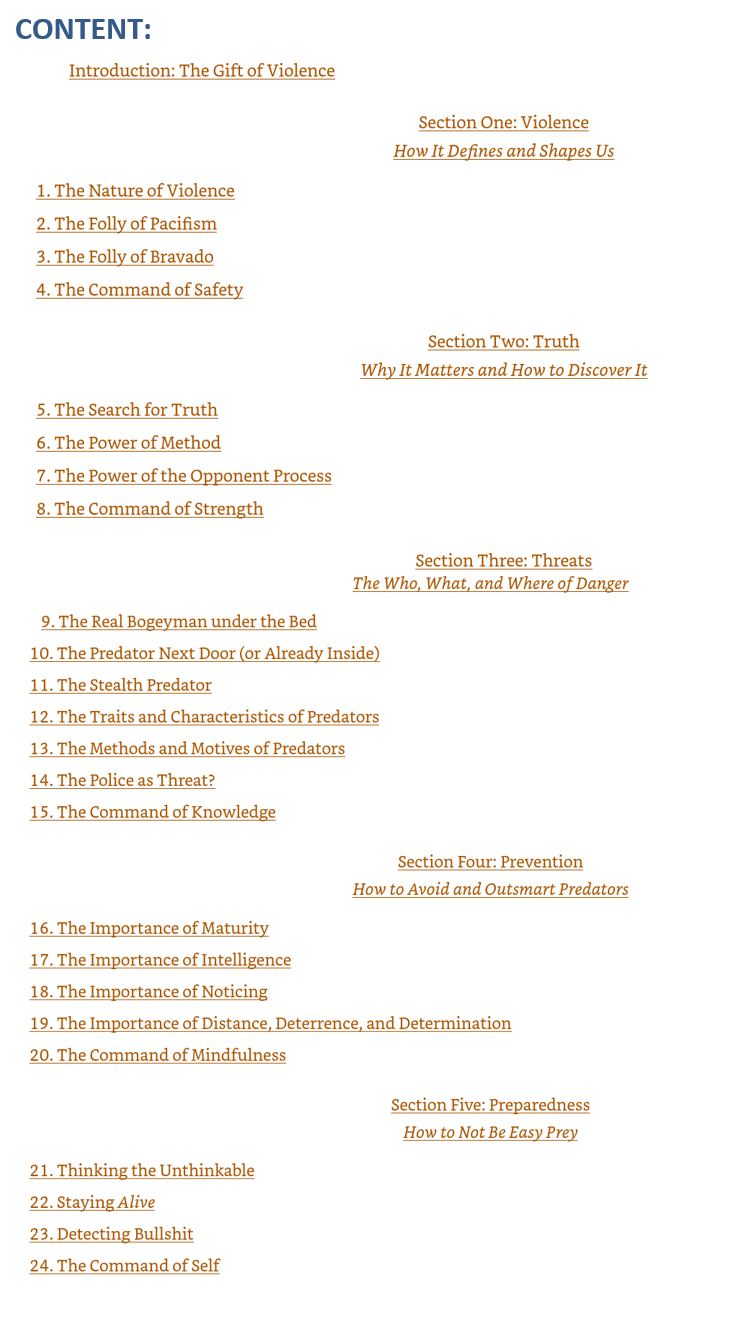
This book by the martial arts professional is about violence, its use, and its usefulness. It is not about self-defense techniques; here is how the author defines it for a reader:” Your goal should be to understand violence as it actually is—so that you can manage its role in your life. This will require analytical thought, not emotion. One of the largest impediments to solving much of the violence around us is our inability to see it as it is rather than how we would like it to be. This can lead to a failure to notice when it is near or to recognize it when it is already upon us, and trigger a refusal to take decisive action when we are no longer in a position to deny it. The final part of this equation—decisive action—is the least understood and, as a consequence, the most fetishized.” I also like the author’s definition of his objective in writing this book:” My overriding goal is to help good people become more dangerous to bad people.” The author presents a nice diagram demonstrating the key elements of defense and discusses at length their meaning and implementation:
The author also reviews quite a few myths related to violence that create illusions about its use, general occurrence, and methods of preparedness.
MY TAKE ON IT:
As far as I am concerned, violence, until very recently, was a normal form of interaction between people belonging to different coalitions within a group or competing groups. This understanding refers not only to humans but also to all primates. There is not much to discuss here, except for the fact that one and only one reliable method to prevent or stop violence is the ability to inflict such a level of violence on the potential or active initiator of violence that he stops either because of being incapacitated or forced to retreat.
There are, however, two very human-specific features. One is the ability to create organized hierarchical groups capable of not only interfering right away but also inflicting severe levels of violence on the initiator in the future without limits as retaliation. Another is the use of technology that makes the outcome unpredictable and potentially deadly for the aggressor.
Whether an aggressor is some semi-conscious bum on drags or the Russian army initiating aggression against Ukraine, the law of unintended consequences can always produce unexpected outcomes. A little old lady that the bum decided to rob and beat up may have a concealed firearm, and Ukrainians may decide to fight and get serious material support from the West. In either case, the aggressor’s perception of the victim’s limitation in the ability for self-defense caused the attack. If a little old lady openly carried a machine gun, the bum would not come close to her. Similarly, if Ukraine would not give up its nuclear weapons stupidly believing guarantees of the Budapest memorandum, it would be in peace.
Finally, from the point of view of individuals living in contemporary Western society, where levels of violence are generally low, the massive effort to prepare for violent encounters is just not cost-effective. Be careful to avoid the potential for such encounters and, just in case, having tools for inflicting violence, such as guns handy, would be enough.
20231001 – The Death of Expertise
MAIN IDEA:
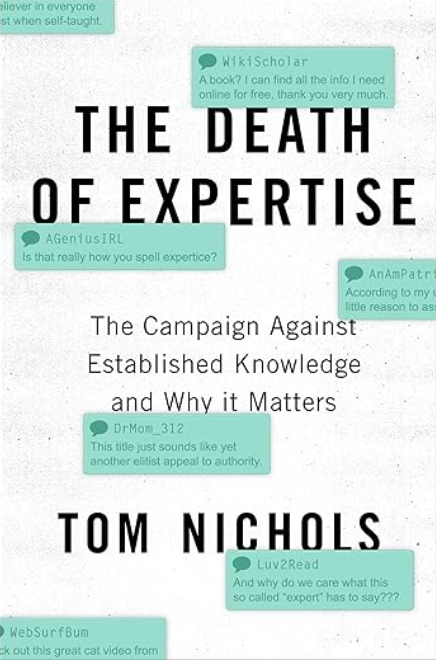
This book is about a very important cultural development: loss of trust in experts, their knowledge, the validity of their advice, and the honesty of their intentions. Here is the author’s description of this development: “Never have so many people had so much access to so much knowledge and yet have been so resistant to learning anything. In the United States and other developed nations, otherwise intelligent people denigrate intellectual achievement and reject the advice of experts. Not only do increasing numbers of laypeople lack basic knowledge, they reject fundamental rules of evidence and refuse to learn how to make a logical argument. In doing so, they risk throwing away centuries of accumulated knowledge and undermining the practices and habits that allow us to develop new knowledge.”
Consequently, the nature of this book the author describes in this way:” Americans now believe that having equal rights in a political system also means that each person’s opinion about anything must be accepted as equal to anyone else’s. This is the credo of a fair number of people despite being obvious nonsense. It is a flat assertion of actual equality that is always illogical, sometimes funny, and often dangerous. This book, then, is about expertise. Or, more accurately, it is about the relationship between experts and citizens in a democracy, why that relationship is collapsing, and what all of us, citizens and experts, might do about it.”
The author concludes, “The relationship between experts and citizens, like almost all relationships in a democracy, is built on trust. When that trust collapses, experts and laypeople become warring factions. And when that happens, democracy itself can enter a death spiral that presents an immediate danger of decay either into rule by the mob or toward elitist technocracy. Both are authoritarian outcomes, and both threaten the United States today. This is why the collapse of the relationship between experts and citizens is a dysfunction of democracy itself. The abysmal literacy, both political and general, of the American public is the foundation for all of these problems.”
At the end of the book, the author discusses the “revolt of the experts” and offers his advice:” Experts need to remember, always, that they are the servants and not the masters of a democratic society and a republican government. If citizens, however, are to be the masters, they must equip themselves not just with education, but with the kind of civic virtue that keeps them involved in the running of their own country. Laypeople cannot do without experts, and they must accept this reality without rancor. Experts, likewise, must accept that their advice, which might seem obvious and right to them, will not always be taken in a democracy that may not value the same things they do. Otherwise, when democracy is understood as an unending demand for unearned respect for unfounded opinions, anything and everything becomes possible, including the end of democracy and republican government itself.”

MY TAKE ON IT:
There are many reasons that trust in experts, and their advice is at its lowest level ever. For more knowledgeable people, it could be the research results of Philip Tetlock that clearly demonstrated a deficiency of expert advice in politics and international relations. For less knowledgeable but thinking people, it is probably an amazingly consistent failure of the “experts in economics” to predict recessions or “climate scientists” to predict next year’s weather. Finally, massive operations to extract resources from the population under the false pretense of “Global Warming,” the moniker which had to be changed to “Climate Change” since no significant warming occurred if one looks at the temperature charts instead of experts provided BS. I do not think that the loss of trust could be possibly restored without significant changes in the process of obtaining and evaluating expertise. If instead of defining expertise as the accumulation of degrees and peer-reviewed publications, expertise is defined by a track record of correct predictions of future events, then and only then will the trust in expert advice be restored. It would also help if instead of financing by the government that violently extracts resources from taxpayers, the financing would be provided by individuals and businesses that are interested in expert opinions. If such entities depend for their well-being on the correctness of the experts’ advice, they will find many ways to make sure that experts are selected based on real expertise, not formalities.
20230924 – True Age

MAIN IDEA:
The author’s main point in this book is that there is an essential difference between chronological and biological age. The chronological age is easily defined by dates and moves in one direction when every second an organism becomes one second older and never it becomes one second younger. Contrary to this, biological age is defined by the condition of an organism relative to the typical condition for organisms of the same chronological age and can move in both directions.
Since the condition of an organism, at least to some extent, is defined by its behavior, it is possible to become a bit younger biologically by behaving correctly. So, the author allocates a big part of this book to describing proper behavior and discussing how one can implement it. The author also presents some relevant research results and discusses methods of identifying biological age, which opens the possibility of controlling the aging process, albeit in a limited way.
MY TAKE ON IT:
The most interesting part of this book for me is the information about research results and practical implementation of tools for defining biological age by collecting biomaterials in a way similar to DNA analysis. I will probably try this Elysium test at some point. The book’s advice on maintaining a younger biological age is pretty standard and consistent with typical recommendations: control weight, diet, and exercise.
20230917 – The Individualists
MAIN IDEA:
This book is about the history and content of libertarianism. The authors trace its origin to XIX century America, which started as a movement for freedom against slavery. Later, it developed into a mainly anti-socialist ideology, championing individual freedom against all forms of suppression of individuals in the name of the collective. Here is how the authors characterize this movement:
” Taken to their logical conclusion, libertarian principles entail that most existing political and economic institutions are deeply unjust. Libertarianism thus counsels not gradualist reform but a sweeping revolution. The system of welfare—whether social or corporate—is to be abolished. Unjustly acquired property is to be returned to its rightful owner. Restrictions on freedoms of movement and labor must be swept away. Militarism, in which states tax citizens to prepare to fight other states, is intolerable.
In terms of its theoretical foundations, libertarianism is uncompromising in its radicalism. In practice, however, not all libertarians were comfortable embracing the wholesale upheaval of existing institutions—and privileges. From its beginning, then, libertarianism has attracted a mix of radical and reactionary elements: those who were eager to follow the dictates of libertarian justice wherever they might lead, and those who saw in libertarianism a rationale for defending the status quo against change. The tension between progressive and reactionary elements, a tension within the very soul of libertarianism, is the major theme of this book.”
The author also offers a precise formulation of the intention of this book:” This book is a history of libertarian ideas. It offers neither a history of libertarian politics nor a history of the libertarian movement.1 It is an intellectual history. Further, this book offers an intellectual history of libertarianism and not a philosophical defense.”
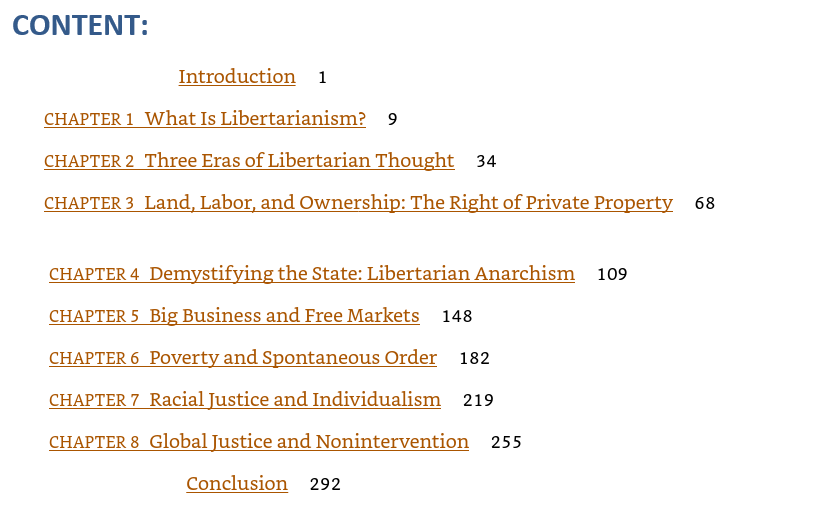
Finally, the authors describe their understanding of the nature of libertarianism in this way:” As we see it, libertarianism cannot be defined by any one set of necessary and sufficient conditions. Instead, libertarianism is best understood as a cluster concept. We see libertarianism as a distinctive combination of six key commitments: property rights, negative liberty, individualism, free markets, a skepticism of authority, and a belief in the explanatory and normative significance of spontaneous order. Chapter 1 introduces each of these six concepts, shows how libertarians interpret them, and explains how, when brought together into an integrated set, they form a distinct and recognizably libertarian approach.”
MY TAKE ON IT:
I consider myself a libertarian, and it is nice to see such a detailed analysis of the nature and historical development of libertarian ideas. However, libertarianism had never attracted the mass following that could be converted into electoral success, and consequently, libertarian participation in American politics is kind of a joke. I think the reason for this comes from human nature to support movements that bring or at least promise to bring some tangible benefits to the people. Since libertarianism promotes freedom based on property, for most people with no property to speak about there is little value in such abstract freedom. Therefore, these ideas are alien and could even be considered hostile to non-propertied people. It is possible to change this if the common informational inheritance of humanity: concepts, knowledge, and know-how is recognized as a formal property belonging to everybody equally, even if it is applied and benefited from by individuals depending on their individual abilities and circumstances, which means highly unequally. Such recognition would lead to the requirement for more effective users to compensate ineffective users of the common inheritance. It would be no different than three people commonly owning a car, with one using it four days per week, one for two days, and one only for one day. Obviously, two guys who use the car less would demand compensation. As soon as a property in common inheritance is recognized as unalienable and a compensation mechanism established, everybody would become supporters of property rights so that libertarian ideas would become viable drivers of electoral politics and, probably, even dominant ideas of society.
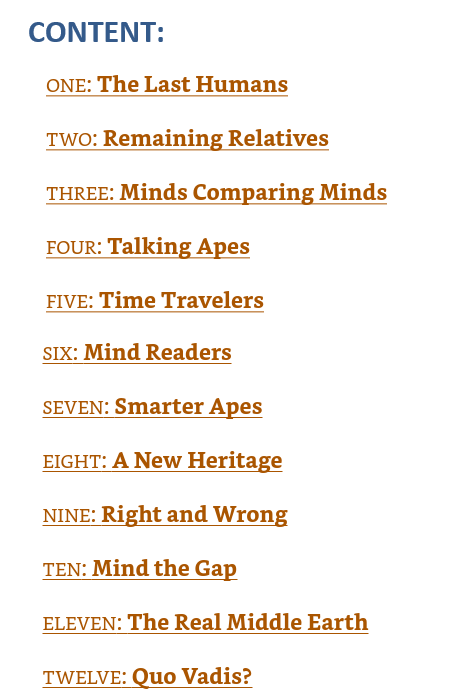
20230910 Suddendorf, Thomas – The Gap
MAIN IDEA:
This book explores the gap between humans and other animals. It rejects the dualistic approach and looks at the gap from the scientific point of view, which it defines this way:” Yet modern science has established that the mind is inextricably intertwined with the body. Lesions to your brain, say, from a tumor or a stroke, have predictable effects on your mind. For example, a lesion in the temporal lobes just behind your ear can destroy your ability to comprehend language. A subdiscipline of modern psychological science called “embodied cognition” examines more subtle links, showing that people’s mental experiences and judgments change when their bodies are slightly manipulated.”
MY TAKE ON IT:
The very interesting part for me is the detailed and careful approach to comparing the human brain to other animals’ brains, demonstrating the human brain’s comparative excess for satisfying the typical needs of an organism’s survival.

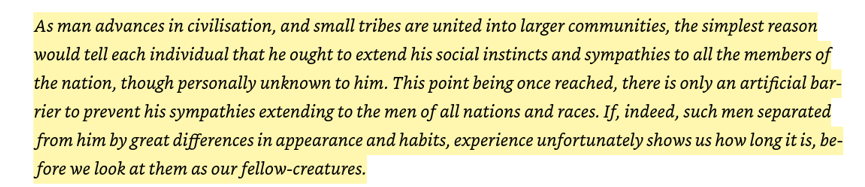
So, like many others, I agree that human specificity comes from super complex human socialization and the need to reconcile individual survival and DNA evolution with group survival and cultural evolution. With the development of technology, which provides abundant goods and services, individual survival is guaranteed, while competition(war) between groups becomes exceedingly dangerous, potentially threatening the destruction of the species.
We seem to be approaching the point when humanity must become civilized or die. Here is Darwin’s quote referring to this:”
20230903 – Spin Dictators
MAIN IDEA:
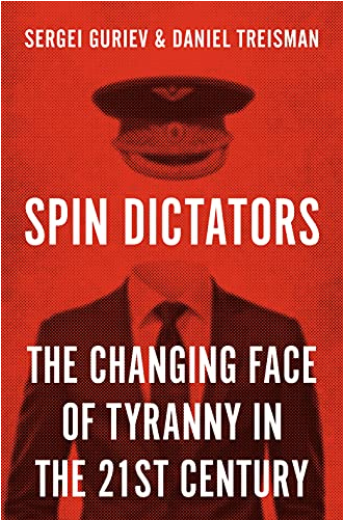
This book explores the massive changes that occurred over the last century in such traditional human endeavors as the capture of dictatorial power and control over people. The main difference is the methodology of dictatorship’s processes, from ones based on fear and direct violence to ones based on spin. The authors provided a handy comparative table of the use of the main features of these two methods:


MY TAKE ON IT:
I do not think that spin dictatorship is something really new. I suggest it is a well-known phenomenon, which is most recently called democracy. The power is always applied by a hierarchy of people who comply with orders depending on their beliefs and perception of reality. The only way to achieve such compliance is to use spin, a necessary part of every human culture. This spin applied to reality to form human beliefs in “us” being good guys and “them” being the bad ones, our leaders wise and honest while theirs just plain evil. The “them” could be anything from the other political party in democracies to hidden “enemies of the people” in totalitarian regimes to witches in medieval societies.
The popular variation that has a history of especially effective use in Russia is the idea of the leader (czar, general secretary, or president) being perfect in his thoughts and actions, so everything good in life comes from him. At the same time, people at lower levels of the hierarchy are stupid and evil, so everything wrong comes from them.
The authors end on an optimistic note that spin dictators are not that powerful after all:” In more developed, highly educated societies, what holds back aspiring spin dictators, we have argued, is the resistance of networks of lawyers, judges, civil servants, journalists, activists, and opposition politicians. Such leaders survive for a while, lowering the tone and eroding their country’s reputation. But so far they have all been voted out of office to face possible corruption prosecutions.” I do not think that the optimism based on these types of people is justified because all of them are parts of ruling hierarchies, whether it is one openly dictatorial, as is typical for Russia, or one of a few semi-competing / semi-cooperating hierarchies as it is usual in Western democracies. I am also optimistic, but my optimism is derived from my belief in two forces: one is the culturally defined psychological need for the majority of people to be free from the control of others, and another one is: the certainty of the constant competition of aspiring dictators between themselves, which periodically opens the gate for change when dictatorship weakens, and people driven by the need to be free improve the system.
20230827 – Money for Nothing
MAIN IDEA:
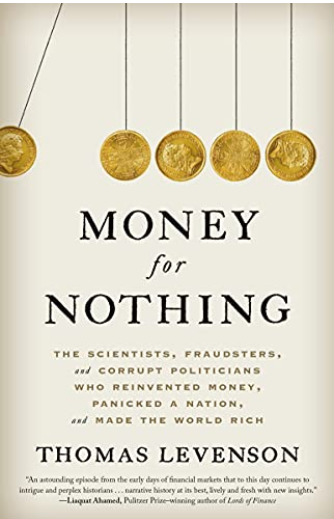
This book is a detailed history of: “THE CATASTROPHE NOW known as the South Sea Bubble is on record as the first and in many ways the archetypal stock market crash and fraud. What happened then and what the British state did in response both have a direct connection to what has occurred (and may soon come again) in the financial life of the twenty-first century.” The author links it to the general development of enlightenment and the discovery of the scientific method as a tool that allows predicting future events based on current data. Consequently, the book shows how an attempt to apply this method in its simple mechanical form to a more complex world of finance led to unpredictable and unpleasant events. Despite this, progress did occur, and here is the author’s statement recognizing it:” The various breakthroughs behind the new forms of money and credit that Britain exploited for its ends weren’t either. But the cultural changes that flowed from the eruption of natural philosophers’ habits of mind—the way many people came to incorporate the values of empiricism, of experiment and the importance of measurement and calculation—had a profound effect on British civic life. What animated people and events in London, that is, was the eagerness, almost urgency, to apply emerging ways of thinking to everyday human experience.”

MY TAKE ON IT:
This book is an excellent illustration of the need to understand the nature of intellectual tools so one can apply them when there is a good fit for the means and the problem they are supposed to resolve. By now, it should be clear that “good” ideas such as a planned economy or controlling climate by limiting CO2 emissions or equalizing rewards between high achievers and non-achievers lead to disastrous consequences, often causing misery and even deaths on the mass scale. So, instead of great global projects like Mao’s great leap forward or Stalin’s collectivization, or the most recent reincarnation: fighting Covid via suppression of freedoms and destruction of the economy, I would recommend applying something that Lenin called “crawling empiricism,” meaning slow and careful movement ahead while continuously collecting and analyzing results before expanding the scale of any idea’s implementation.
20230820 – The Road to Unfreedom
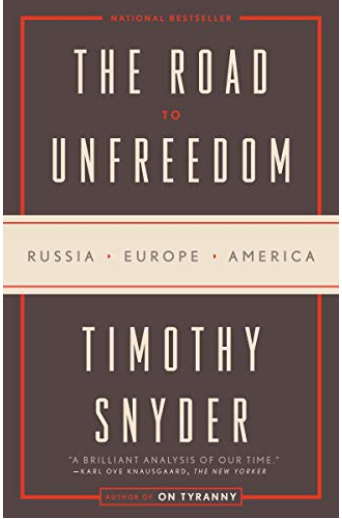
MAIN IDEA:
The main idea here is about two types of politics: one of inevitability and another one of eternity. The first relates to the notion of the “end of history” with the final victory of liberal democracy over its authoritarian competition. This politic failed. Per the author:” The collapse of the politics of inevitability ushers in another experience of time: the politics of eternity. Whereas inevitability promises a better future for everyone, eternity places one nation at the center of a cyclical story of victimhood. Time is no longer a line into the future, but a circle that endlessly returns the same threats from the past. Within inevitability, no one is responsible because we all know that the details will sort themselves out for the better; within eternity, no one is responsible because we all know that the enemy is coming no matter what we do. Eternity politicians spread the conviction that government cannot aid society as a whole, but can only guard against threats. Progress gives way to doom.
In power, eternity politicians manufacture crisis and manipulate the resultant emotion. To distract from their inability or unwillingness to reform, eternity politicians instruct their citizens to experience elation and outrage at short intervals, drowning the future in the present. In foreign policy, eternity politicians belittle and undo the achievements of countries that might seem like models to their own citizens. Using technology to transmit political fiction, both at home and abroad, eternity politicians deny truth and seek to reduce life to spectacle and feeling”.
The author then applies this framework to the contemporary realities of European and American politics. Here is the author’s description of the book’s structure: “Each chapter focuses upon a particular event and a particular year—the return of totalitarian thought (2011); the collapse of democratic politics in Russia (2012); the Russian assault upon the European Union (2013); the revolution in Ukraine and the subsequent Russian invasion (2014); the spread of political fiction in Russia, Europe, and America (2015); and the election and presidency of Donald Trump (2016–).”

MY TAKE ON IT:
This book provides a lovely review of the inherently totalitarian thinking of Russian ideologues of the XXth century, such as Ilyin, who created a philosophical foundation for contemporary Russian totalitarian nationalism, which finally expressed itself via direct military aggression against Ukraine after for years expressing itself via social, political, and communicational attack against Europe and USA. I believe the author is correct regarding the philosophy, ideology, and description of Russian aggression. However, his mixing of this ideology with Trump and anti-elitist movements in Europe demonstrates nothing more than typical leftist academicians’ lack of knowledge and understanding of their vast differences. Putin’s Russia is traditionally a fascistic state with territorial aggression, conquest, and claim of superiority over other countries. Its aggression was caused by the firm belief in its national superiority and the apparent reality of material inferiority in all essential areas, such as wealth, technology, and even military power. The same applies to contemporary China.
The anti-elitist movements, Trump included, are internal movements within democratic societies produced by the refusal of the middle class of these societies to submit to the dictates of their own elite, which is increasingly becoming a part of the global elite that gets rich via globalization. This process deprives these middle classes of the wealth created by the combination of hard work and belonging to populations of well-developed countries. The substitution of well-paying jobs that moved externally to relatively poor countries with low wages and internally to the legal, semi-legal, and illegal immigrants, with welfare checks supplemented by expressions of contempt for their culture, seems way too much for them to bear.
The proper way to deal with non-elite resurrection is to recognize and restore national unity by moving the production of goods and services back to developed countries and limiting immigration to individuals who clearly demonstrate intention and effort to become productive and loyal citizens of these countries.
There is a straightforward solution to the idea that it would not be possible for developed countries to compete on price with poor countries. Just make one very brief law: “All goods and services sold within the developed country X should be produced with full compliance with all environmental, labor, and other regulations of the country X, however idiotic these regulations are. The first violation of this law is punishable by confiscation of 50% of individual assets of the violator, the second by confiscating whatever assets left”.
As to the Russian and Chinese aggression, the proper way to deal with it is by cutting them off from contemporary technology, depriving them of the ability to obtain serious military power. In addition, democracies should initiate a massive attack on the ideology of these regimes in defense of the human rights of people in these countries, creating internal conditions for their change into somewhat more civilized entities.
20230813 – The Self Explained

MAIN IDEA:
This book is about a human individual as a cultural entity and an object of research. The author defines it this way:” The human self is a cultural solution to natural problems: how to survive and reproduce. Humankind has succeeded very well at both of those criteria by means of a highly unusual strategy: culture. The self is a vital tool by which each human animal participates in culture. You can’t get the full benefits of culture without a self. That in turn requires a brain that can understand and perform its roles in the social system—in other words, a brain that can create a self. That’s what enables humans to create culture and reap its benefits, including better survival and reproduction.”
The author looks at the “self” from several different points of view, such as its Evolutionary roots defined by human nature as a group member. So, evolution shapes the individual self by the need to survive within a group, which is done by playing one of many various roles within the group, communicating and cooperating with others, and complying with many rules that define the group’s culture and morality.

MY TAKE ON IT:
I think a detailed description of the human self and its relationship with other selves as a member of the group presented here is excellent, and the results of experimental research well support it. I am somewhat puzzled by the usual declarations about enormous complexities and the impossibility of understanding such things as a conscience, self, and general human behavior. As everything else related to reality, unlike purely academic or religious approach that often defines the reality of existence, the individual self, and its needs and functionality is easily understood at the high level of principles but contains a nearly infinite variety of details that makes it almost impossible to predict or control. Such a high-level principle is the duality of human nature caused by the simple fact that survival depends on combining two processes: individual survival and group survival. The details of these two processes are complex and inevitably result in benefits or costs to others. And, because they are not easily controlled from the outside, everybody should support creating and maintaining such an environment that any individual would perceive peaceful cooperation with others and maximum freedom for everybody as the preferable pattern of behavior. The alternative to freedom that always include attempts to control others is the source of many bad things in life, such as violence and whatnot.
20230806 – The Life after Capitalism

MAIN IDEA:
This book states that humanity has already moved beyond the classical capitalism of Adam Smith to the new economic system when governments and their regulations severely restrict markets. This new economic system also characterizes by the switch of primary human efforts from material production to information processing. The book defines it by four propositions:
- Wealth is knowledge.
- Growth is learning.
- Information is surprise.
- Money is time.
In the end, after going into details of each proposition, the book offers a concise formulation of the new system and its “Do and Don’ts.”


MY TAKE ON IT:
I also believe that information and knowledge became much more critical than material production, providing this material production is continuously maintained at the necessary level, including reserve capacities. However, I would note that not only does material production become automated and eventually will not need human efforts except for high-level decision-making, but the same relates to information processing and the generation of new knowledge. This development makes human capital outdated, and the most important task for humanity in the next 100 years or so is to find a way to develop a new economic and societal system that would support the human pursuit of happiness. Since the very foundation of human society – activities in creating and distributing resources, including information and knowledge, becomes redundant, people will have to develop new ways to be happy. It is not a simple and easy process, and the most dangerous development I could think about is that humanity will fail to restrict those individuals for whom happiness comes from control over others. Such failure would lead to practically unlimited totalitarianism. It is somewhat similar to the growth in productivity during recent centuries when food acquisition in industrial society became much more manageable than for hunter-gatherers, resulting in using the newly available human resources to initiate territorial or ideological conquest wars with massive armies fighting regardless of agricultural seasons.
20230730 – Civil War by Other Means

MAIN IDEA:
This book is about the aftermath of the Civil War. It provides historical data about people and events that followed the war in such a way as to demonstrate how exactly it happened that after the military victory and its formal political affirmation in the 13th, 14th, and 15th constitutional amendments, the South actually won peace. This cultural and political victory after the war was military loss was demonstrated by the transformation of rebel losers into the heroes fighting for the “noble Lost Cause” and the Union winners into insignificant participants, at best or even into villains at worst. It was also demonstrated in legislative and judicial forms by establishing racial segregation. Finally, an essential part of this Southern Victory of the peace was the rehabilitation of the Southern leaders at all levels and their return to power by the late 1870s.
MY TAKE ON IT:
This book is an excellent example of how complicated change is in society and its culture and how difficult it is to impose something on people if they do not want it in a somewhat democratic republic such as the USA. The truth is that American society, despite its political novelty, was still a pretty much traditional society and, like all conventional societies, had racism and class stratification deeply embedded in its culture, therefore requiring generational changes that took about a hundred years. An interesting fact that the author does not mention, but I think was significant, is that U.S. Grant suggested a much better road for development as the president at the time. It included the creation of a black majority state by including Haiti in the USA. Such a state would open an opportunity for black Americans to control their fate by moving away and depriving the South of their labor and input. The result would be a dramatic economic impact on the lives of white Southerners, forcing them to choose between racism and economic well-being. It would become inevitable because assuring economic well-being would require providing sufficiently better conditions for black labor than it could find in a black-majority state. Typically, such a choice results in a preference for well-being so that the racists who wanted prosperity would suppress their racism in a much shorter period than it happened and with much less pain and suffering than it caused.
20230723 – Liberalism and it’s Discontents
MAIN IDEA:
This book aims to defend “classical liberalism,” which the author understands as “the doctrine that first emerged in the second half of the seventeenth century that argued for the limitation of the powers of governments through law and ultimately constitutions, creating institutions protecting the rights of individuals living under their jurisdiction.”
The book reviews the history of liberalism, its foundational ideas, current condition, and challenges. It goes through such ideological developments as critical theories, especially critical race theory, various forms of identity politics, attacks against rationality, and the very foundation of Western society.
The book also looks at several alternatives: a conservative offer based on community and religious morality, a nationalist offer, also communalist, but based more on ethnic and cultural community. It accuses conservatives of authoritarian inclinations but describes leftist alternatives in such a way:” A more likely scenario for a progressive post-liberal society would be one which saw a vast intensification of existing trends. Considerations of race, gender, gender preference, and other identity categories would be injected into every sphere of everyday life, and would become the primary considerations for hiring, promotion, access to health, education, and other sectors.” In the economic area, the old ideas of socialism seem to have little support even among the left, so the alternative looks like this:” The government would provide generous social services, pay for higher education, fund health care, guarantee jobs and minimum incomes, regulate if not nationalize the financial system, and massively shift investment towards preventing climate change. All of this would be paid for by equally massive new taxes on the wealthy, or, as per modern monetary policy, through the time-tested printing mechanism.”
Finally, the author offers his own solution to the crisis of liberalism:” The urgent issue for liberal states does not have to do with the size or scope of government, which the left and right have been fighting over for decades. The issue rather is the quality of government. There is no way around the need for state capacity—that is, a government that has sufficient human and material resources to provide necessary services to its population. A modern state needs to be impersonal, meaning that it seeks to relate to citizens on an equal and uniform basis, and not on the basis of personal, political, or family ties to politicians wielding power at a given moment. Modern states have to deal with a whole range of complex policy issues, from macroeconomic policy to health to electromagnetic spectrum regulation and weather forecasting, and they need access to well-educated professionals with a strong sense of public purpose if they are to do their jobs well.

MY TAKE ON IT:
I fully agree that classical liberal ideas and their practical implementation in contemporary Western societies are in crisis. However, I disagree that it is the crises of left-right confrontation or cultural contradictions caused by globalization and the growing population diversity. I see the main cause in the underlying development of resources generating and distribution methods. The essential characteristic of these methods up until recently was the need to work for a living for the vast majority of the population. I mean productive work that creates goods and services necessary for survival, whether hunting and gathering in early stages or industrial agriculture and manufacturing in the later stages. The current level of productivity is such that just a few hours of work per year produce an abundance of food, so one person could feed hundreds. The same relates to manufacturing goods and services. So, over the last hundred years, most of the population has become redundant. This redundancy significantly decreases human needs in each other.
The super simple example: if there are only two people and one growing the apples and another growing the oranges, they need and have to tolerate each other if they want to eat both apples and oranges. The bulk of their activity would be directed at production, while distribution would be settled via trade with a ratio defined by their relative productivity. However, suppose machines are growing both: apples, and oranges. In that case, the bulk of activities will shift to distribution. Since resources are always limited, the bulk of activity would move from struggling with the environment to produce more to struggling between people to get more. Correspondingly, the distribution ratio could not be based any more on relative productivity; it will have to be based on something else, which could be an identity, whether racial or cultural or sexual or whatnot. Obviously, it is on condition that somebody else with a gun would prevent these two people from fighting each other with sticks and stones. This other guy with a gun, let us call him the government, will enforce the distribution according to some type of “justice.” And, since “justice” is always in the eyes of the beholder, the authoritarian form of government becomes a necessity reversing society back to a situation when a man with a gun was needed to ensure that producers were robbed moderately enough to survive and keep producing.
I see a much better solution in creating formal property rights on all resources for everybody, albeit in such a form that it would be unequal depending on individual abilities to do something, even if nobody else requires it. I also think that people could defend such property rights only if they were all armed, making violations extraordinarily costly or even deadly for the violators.
20230716 – The Russian Revolution
MAIN IDEA:
This book is a very unusual history book about the Russian Revolution because it breaks away from a typical narrative of the inevitability of this revolution. The author provides convincing evidence based on newly available data demonstrating that the Marxist deterministic interpretations of this event are way too far from reality. In reality, it was a close affair in which a small group of revolutionaries supported by German General staff and intelligence that provided money and other help could use internal divisions in Russian society to take power and keep it for 70 years using mass violence and propaganda. The author’s summary is:” After a quarter-century of exhilarating discoveries from the archives, it is time to take stock of what we have learned. Russia in the last days of the tsars was a land of contradictions, of great wealth and extreme poverty and the myriad social and ethnic tensions of a vast multiethnic empire; but there was nothing inevitable about the collapse of the regime in 1917. Nearly torn asunder by the revolution of 1905, which came in the wake of a humiliating defeat in the Russo-Japanese War, the Russian Empire made a remarkable recovery over the following decade, owing to the tsar’s concessions that allowed the creation of the Duma, the formation of labor unions, and the far-sighted land reforms of Peter Stolypin. The tragedy of Russian liberalism is that it was the country’s most dedicated reformers and constitutionalists who, by embracing the fashionable ideas of pan-Slavism, convinced Nicholas II that he needed to mobilize in July 1914 to appease public opinion—and then spent the war plotting against him anyway, in spite of his foolish decision to follow their advice. It was the tsar’s fateful decision to go to war, despite the pointed warnings of Rasputin and other conservative monarchist advisers he usually trusted more than the liberals, which brought an end to an era of great economic and social progress in Russia, and ultimately cost him his throne. In this way an empire founded on the autocratic principle foundered on the feeble will to power of its last autocrat, who lacked the courage of his own convictions. Once he had the upper hand, Lenin would not make the same mistake.”

MY TAKE ON IT:
I think the real reasons were only partially fundamental, mainly due to overall tensions in Russian society resulting from rapid industrialization changes that existed everywhere in the world. The particular Russian case was that it had the combination of a general rejection of the regime by the middle to upper-class educated elite, which was looking up to the elite of Western societies, displacement of people, economic and psychological tensions of the war, and massive financial and other help from hostile power (Germany) aimed to undermine country’s military effort. This story has an essential lesson because it looks a lot like what we see now in USA and other advanced Western countries. There are increasing social tensions due to economic changes of globalization, automation, and poorly controlled immigration. There is a massive rejection of societal norms and mores by an educated elite, which, quite similar to the Russian intellectual elite of the early XX century, wants to remake society along Marxist ideas of super big government. In the dreams of this elite, which includes mainly educational, governmental, and corporate bureaucracy, such a remake would put society under the control of “experts” and free them from dependency on the middle class of entrepreneurs, small business owners, professionals, and their elected representatives.
At this point, we do not have a well-organized group of professional revolutionaries, and the Chinese communist party is not as effective as the German General staff of WWI. Even more important is that the democratic form of Western societies allows this elite periodically win elections, take control of the government, and consequently demonstrate its fundamental incompetence. The USA now conducts this kind of testing in California, where the elite has nearly absolute power, and in Florida, where the middle class has control over state power, even if it is heavily restricted by federal government bureaucracy from the top, local bureaucracy from the bottom and corporate bureaucracy from all sides. The results are pretty obvious, but we’ll see if it will be enough to activate the political participation of the middle class or if people need more pain and suffering to get triggered.
20230709 – The Price of Time

MAIN IDEA:
This book is mainly about the time value of money and its accounting representation by the interest rate on loans. The author reviews the history of the money credit, starting with Babylon and all the way until our time. Special attention is allocated to using credit as an instrument of power. For the part of the book about our time, the author reviewed in some detail the Chinese “financial repression” when the Communist Party used artificially depressed interest rates on households’ deposits to transfer resources to a government-controlled part of the economy. In conclusion, the author refers to Hayek’s “Road to Serfdom” and demonstrates how this road often includes financial methods in addition to trivial for communist regimes’ concentration camps and killings. The author stresses the change that occurred in the process of moving from XX to XXI century:”… our central planning hasn’t so far involved the nationalization of industries, large-scale public investment, the regulation of prices and incomes, high levels of taxation, rationing, or other wartime measures. Instead, central planning in the twenty-first century has involved manipulating the most important price in a market-based economy, the universal price, namely the rate of interest. Interest lies at the heart of capitalism. Interest rates are the traffic signals that guide the market economy, writes James Grant. Turn off those signals and pile-ups occur. If money is provided too cheaply, the market’s steering mechanism breaks down”
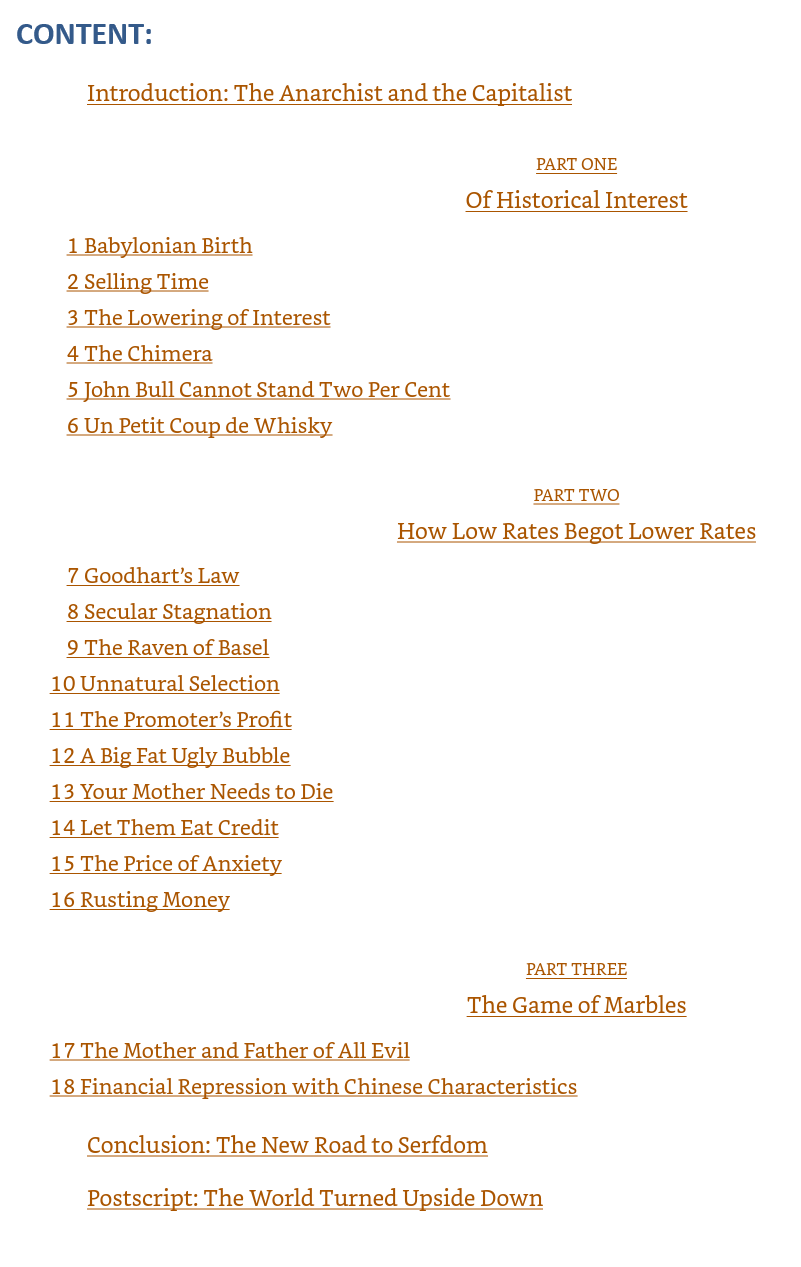
MY TAKE ON IT:
It is a good review of the history of interest rates and overall finance as a resource allocation tool. In my opinion, the essential thing to understand is that the current trend of building the Road to Serfdom via financial manipulation is a simple consequence of economic and human disasters that occurred in countries that implemented any form of socialism, whether it was the Soviet or Chinese or European style. As a practical idea, socialism/communism lost its attractiveness for anybody who is even slightly knowledgeable of history. However, the government-dependent “intellectuals,” either bureaucrats, pseudo-educators, or statist politicians continue to seek ways to implement this “good” idea that somehow was consistently implemented poorly. I do not doubt that an attempt to implement it via finance will be a fiasco. It may not be as bloody as such attempts of the XXth century, but it will still cause much pain and suffering.
20230702 – Big Fat Surprise

MAIN IDEA:
This book seems to be about fat, but it is really not. It is more about government science, which is not science, but rather the method of transferring public money to government scientists. The author reviews the history of how fat became something bad and how the government created the fat-free industry, making many people rich at the expense of making many people sick.
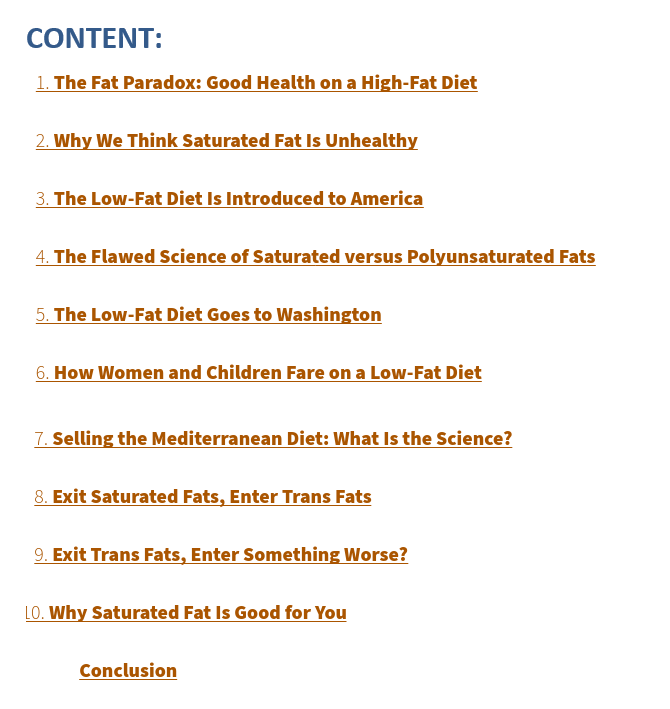
MY TAKE ON IT:
As a history of mass deception, I think this book is very educational and nicely demonstrates the methods and means of such campaigns. The critical points of the process are:
- Pseudo-scientific studies in which the results are predefined and data massaged until they fit into the required framework.
- Suppression of any contrarian views with personal attacks and the use of all means available from label to government power
- Use of mass media to create a narrative that supports whatever is promoted.
The sad results of such science conversion into an ideological tool are recommendations and, recently, even the use of government force that cause considerable damage to the people. These results are pretty obvious. One need only look at any photo or documentary from the 1950s and 1960s to see how fit most people were at the time. Now just look around, and you will see how many people become fat. So the main inference is not to trust government science unthinkingly but rather do your own check on any ideas promoted.
20230625 – The Next American Economy

MAIN IDEA:
This book is about the current ideological crisis of the market economy caused by such failures as the financial crisis of 2008, the negative impact of globalization on the working and lower middle class of the developed Western world, and the rise of China, which seems to be demonstrating the economic superiority of the combination of the totalitarian political system with limited economic freedom. The author believes that all this causes the growth of economic nationalism and populism, as represented by Trump’s presidency. Here is how the author defines the objectives of this book:” Recognizing this underscores the need to persuade Americans that markets aren’t just about economic growth. They can also help express and bolster an understanding of America as a commercial republic. This is an ideal of a republican form of political community that integrates a strong case for economic liberty into a vision of America as a free and commercially orientated sovereign nation in a world in which other sovereign nations are pursuing what they regard as their national interests. It is also the ideal which, I believe, represents that the surest political underpinning for an American economy that takes free markets and their institutional supports seriously. As readers will discover, it brings together an understanding of the strong empirical case for free markets and limited government, a commitment to the moral habits associated with commercial society, the conviction that these are good for Americans as a sovereign nation, and the argument that this is ultimately faithful to the principles which were given powerful expression in America during the Founding period.”

MY TAKE ON IT:
I think that the contemporary crisis is not something new but rather the continuation of the ongoing struggle within capitalism between owners of material property and production controllers (capitalists and managers), controllers of political power (bureaucrats, politicians, and state handouts-dependent intelligentsia), and owners of human capital (labor sellers). The most recent temporary settlement between these groups established after WWII is obviously crumbling. The crisis occurred due to the two developments.
The first and obvious development is the temporary, even if the painful, process of devaluation of labor in developed Western countries due to the massive addition of cheap labor either via globalization of trade with undeveloped and totalitarian worlds or opening borders to massive migration (legal and illegal) of people. This process is already coming to an end in the first because the compensation levels in the undeveloped world raised high enough to make production overseas a lot less profitable and in the second because the leaders of undeveloped and totalitarian worlds decided that they strong enough to expand their power over the whole world via economic, ideological, and political subversion – mainly Chinese way, or direct military aggression – mostly Russian way. Fortunately, as it usually happens with totalitarians, the habit of being protected from contrarian views made them prone to mistakes of overestimation of their abilities. The most critical error is their contempt for the elite of the Western democracies. The totalitarians are absolutely correct when they think this Western elite is corrupted and dishonest. However, they are wrong, believing that this elite is stupid and, in Lenin’s words, “will sell us the rope we will hang them with.” The selling of rope is ending, and totalitarians might be surprised to find this rope around their own neck. That is what seems to be happening with Putin and the Russo-Ukrainian war.
The second and less obvious development that led to the current crisis is the permanent disappearance of need in human labor of any type due to complete production automation. The substitution of human mental labor will happen similarly to what already happened with human manual labor over the last 200 years. The latter process caused the creation of unions, socialist and communist parties, and overall ideological struggles of the XIX and XX centuries. It was resolved by the rise of the value of human capital via massive expansion and professionalization of information processing in the form of science, education, engineering, and real healthcare (instead of bloodletting and other similar services). As for a significant share of the population incapable or unwilling to develop human capital, the solution was provided via welfare, drugs, and pop culture. Unfortunately, AI automation makes the solution’s first part outdated. Nobody will need the services of a doctor or engineer, or programmer if AI could do it much faster, better, and cheaper.
I think that the eventual resolution of the crisis will come in the form of the expansion of the private property to the whole population so everyone will be the owner of some property sufficient to obtain resources not only for everyday survival but also for the pursuit of happiness in market independent activities in science, art, gossip, and what not. The way to do it is to recognize that all goods and services are produced using common inheritance of knowledge and know-how. This common inheritance belongs equally to all, and when some people use it to control the production of goods and services, they should pay a royalty to people who are not productive. I suggested the process of how to do it in this essay: https://www.amazon.com/OWNERSHIP-versus-HIERARCHY-Choice-Dominant-ebook/dp/B09KMBP6JG/ref=sr_1_5?crid=MVDILQ3H4Q4X&keywords=branzburg&qid=1685799822&sprefix=branzburg%2Caps%2C114&sr=8-5
20230618 – The Primacy of Doubt
MAIN IDEA:
This book is about the chaos and unpredictability of the future. The two most important ideas in this book are the idea that “the butterfly effect is profoundly intermittent” and the second is that the way to handle this unpredictability is to run multiple models of the future and assembly “what is called an “ensemble prediction.” The author provides examples of this process in various areas, from weather forecasts to economic projections. Finally, the author suggests a general way of achieving the necessary diversity of models required to cover a variety of future outcomes. The author characterizes his approach this way:” I challenge this consensus view of quantum uncertainty using ideas based around the geometry of chaos.”
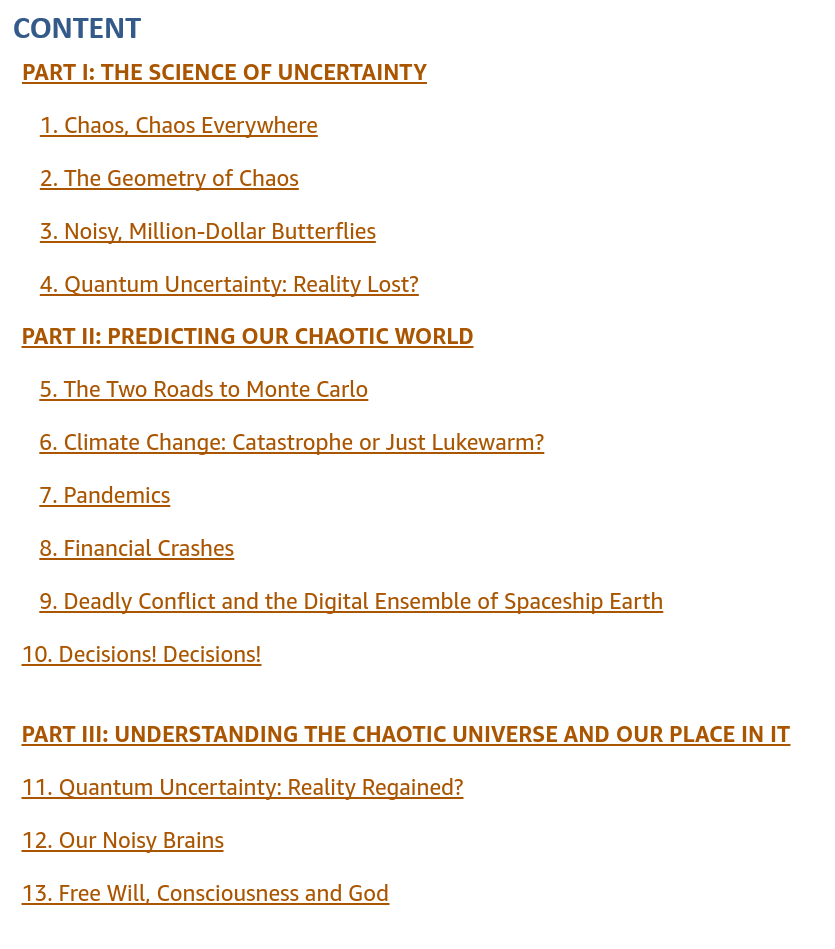
MY TAKE ON IT:
It is interesting to discuss future predictability in multiple areas including climate, pandemics, economics, etc. I generally agree that various models covering a range of future parameters are much better than one rigid model that tries to explain everything and predict the future in some detail. It is also quite apparent that using noise in initial parameters is a decent way to achieve the necessary diversity of results. However, I think a relatively close cluster of effects is bound to miss severe outliers. And, since outliers make the difference, the future with significant dramatic changes will always remain unpredictable. That is the reason to avoid the prediction of such dramatic events and concentrate on what humans can predict at least somewhat reliably: small changes that incremental actions could correct.
A good example would be global warming. Neither claims of alarmists that colossal change is already at the gates nor wholesale rejection of change are supported by data, especially if wide-ranged data distortion aimed to get grants and promote one’s career, are considered. The reasonable approach would be to limit CO2 emissions not as an emergency measure but as long-term objective, parts of building a human-controlled global sustainable environment while assuring economic growth that would provide enough wealth to handle changes as needed. In short, the chaos and unpredictability make it imperative to be cautious and implement change incrementally, preferably on a small scale so, to avoid such cataclysmic events as building communism, socialism, national socialism, big imperial entities, and so on: all being “good ideas” that never work in reality.
20230611 – The Secret World

MAIN IDEA:
This book about history is somewhat unusual. It is not that much about events development as about specific activities: spying, intelligence collection, and subversion. Since any competitive human activity includes a match between shield and sword, the book also has a history of the other side: counterintelligence, security measures, and counter-terrorism. The idea is not only to demonstrate how it worked over centuries but also to show how often it was ignored.
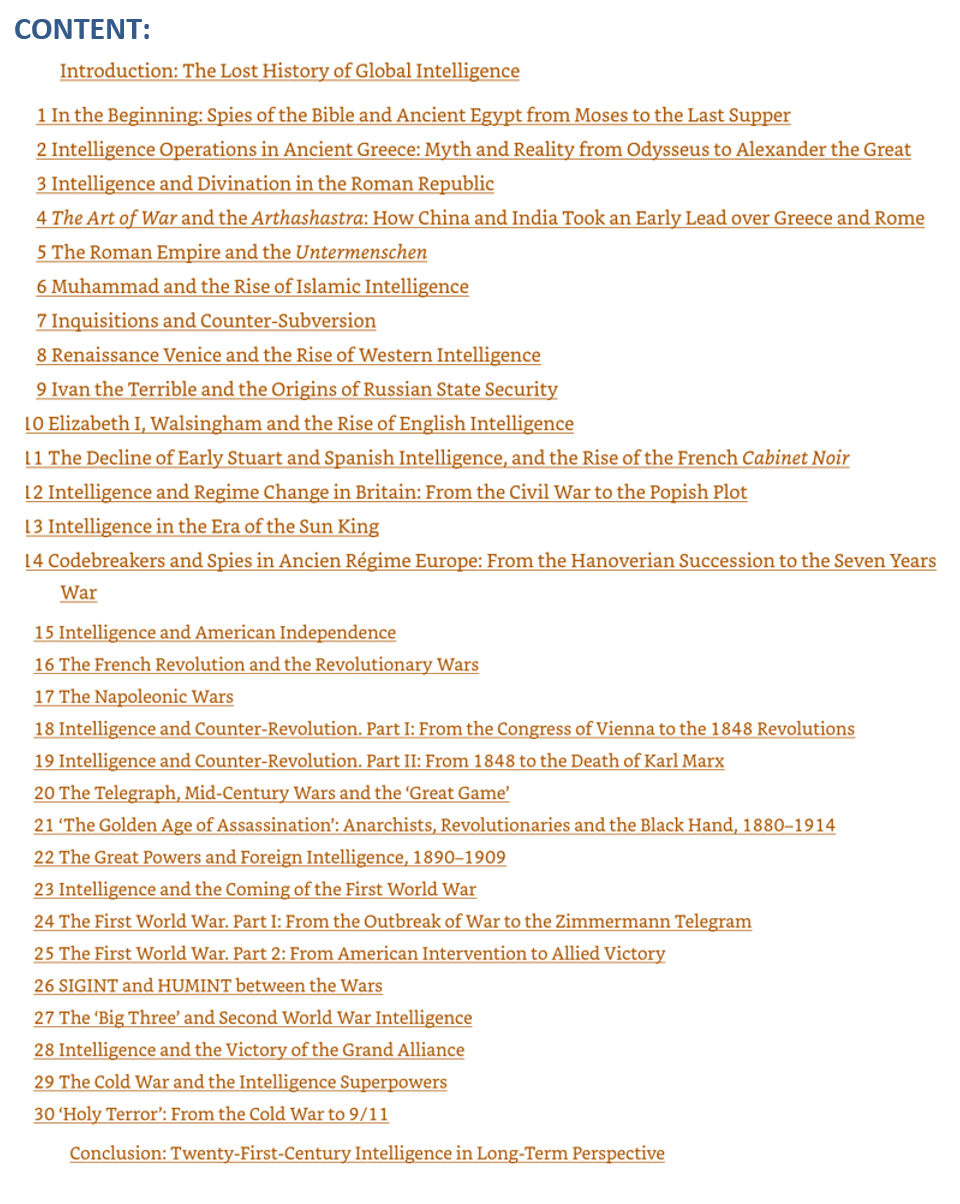
MY TAKE ON IT:
In my opinion, the role of intelligence as information acquisition is often overestimated, while the role of intelligence as a tool of effective information analysis is often understated. Especially poorly understood is the role of general data analysis and leadership decision-making that could prevent the disclosure of secrets and successes of terrorism and sabotage. There are vast numbers of examples of the intellectual failure of leaders to implement preventive security measures or ignoring valuable intelligence about the enemy’s actions. Two of the most consequential cases in the last hundred years come to mind: Stalin’s failure on June 22nd, 1941, and American leadership’s failure on September 11th, 2001. In either case, the failure resulted from an intellectual deficiency of leadership.
In Stalin’s case, the rigidity of planning when conviction that Hitler would not fight on two fronts simultaneously led to ignoring all signs that an attack was imminent. Stalin failed to understand that Hitler’s correct evaluation of the UK’s inability to maintain active fighting at the moment and the USA politically restrained by isolationists from entry into WWII, the preventive attack on USSR was the only chance to avoid such a situation. The war was imminent, with Stalin’s USSR actively preparing for the attack and concentrating troops at the border. Whether this attack would come just a few days or weeks after June 22nd or sometime in 1942, Stalin’s intention to move the communist revolution ahead using Red Army tanks was not in doubt.
In the case of American leadership in 2001, it was the plain bureaucratic failure when compliance with norms, regulations, and political considerations was by far more important than providing security for the country. The reasons for failure that leaders later came up with, including such justifications as “failure of imagination,” sounds quite ridiculous. They could just watch Hollywood movies, some of which included plots with terrorists capturing an airline plane and intending to use this plane as a weapon in populated areas. Some measures that would prevent September 11th were just fortifying doors to the pilot cabin and not complying with any terrorist demands. It is precisely what Israel did after several attacks in the 1970s, and it worked. Moreover, I believe American Airlines intended to fortify doors and advertise higher security but dropped this idea because a few hundred dollars per plane would cost too much.
Anyway, to have good intelligence and consequently know the plans of one’s adversary is nice, but to have leaders with brains in good working conditions is by far more critical.
20230604 – Bad Medicine

MAIN IDEA:
In this book, the author reviews the history of medicine as a profession and very convincingly demonstrates how far away from science were typical methods of treatments and even overall approaches to all kinds of medical problems. For the first few thousand years of documented medical treatments, doctors killed by far more people than they healed. The author also describes real progress in medicine achieved in the last 150 and how it really helps in healing. Here is how the author presents his conclusions: “Before 1865 all medicine was bad medicine, that is to say, it did far more harm than good. But 1865 did not usher in a new era of good medicine. For the three paradoxes of progress—ineffectual progress, immoral progress, progress postponed—are still at work. They may not work quite as powerfully now as they did before 1865, but they work more powerfully than we are prepared to acknowledge. There has been progress; but not nearly as much as most of us believe.”

MY TAKE ON IT:
I think that the author’s approach and conclusions are very valid. Yes, there is real progress and medicine, so lots of people did not die from appendix or smallpox. However, this progress is much more limited, and many treatments are still pretty much in the dark ages: relying on authority instead of factual data, treating patients with the primary objective of making money, rather than making patients healthy, and so on. It is probably inevitable as long as doctors depend on the money flow from patients either directly or indirectly via the government. Actually, consciously or unconsciously, but doctors have to aim to keep patients in a condition somewhere between being healthy or being dead. Neither healthy nor dead people produce income for doctors. I have experience with two organizational forms of medicine: Soviet 100% government care and American somewhat private healthcare. This experience demonstrates that in the Soviet form when doctors depend on government salary, the objective moves a bit closer to a patient being dead, albeit doctors’ humanity and character somewhat tempered it. The American form has more space for this humanity because there are no Soviet-style directives like not treating anybody older than 60. After all, it is a waste of resources. However, the use of the medical treatment as a money pump is very pervasive. In short, one has to remember that there is always a conflict of interests between doctor and patient: the doctor needs the patient to be moderately sick and pay lots of money, while the patient wants to be healthy and pay as little as possible. On the bright side, they both want to prevent the patient from being dead.
20230528 – Against Democracy

MAIN IDEA:
The author of this book argues that representative Democracy with equal rights for all is significantly flawed and does not work that well. The examples are Trump, Brexit, and the overall quality of political power used in democratic societies. The author defines the leading cause of this as the participation of too many people in voting and decision-making. The author places all people into the specter, from “Hobbits” to “Hooligans,” with “Vulcans” somewhere in between. “Hobbits” – low-information individuals that are easily manipulated and incapable of participating in decision-making. “Hooligans” – high-information, but firmly committed to some ideology and prejudices individuals, which are incapable of sober and responsible decision making because of it. Finally: “Vulcans are an ideal type—perfectly rational, high-information thinkers with no inappropriate loyalty to their beliefs.”. So, to remedy the flows of Democracy, the author suggests switching to another form of society, called Epistocraticy. The author defines it this way: “Epistocratic forms of government retain most of the normal features of republican representative government. Political power is widespread rather than concentrated in the hands of the few. Powers are separated. There are checks and balances. But, by law, epistocracies do not automatically distribute fundamental political power evenly. Rather, by law, in some way or other, more competent or knowledgeable citizens have slightly more political power than less competent or knowledgeable citizens.”
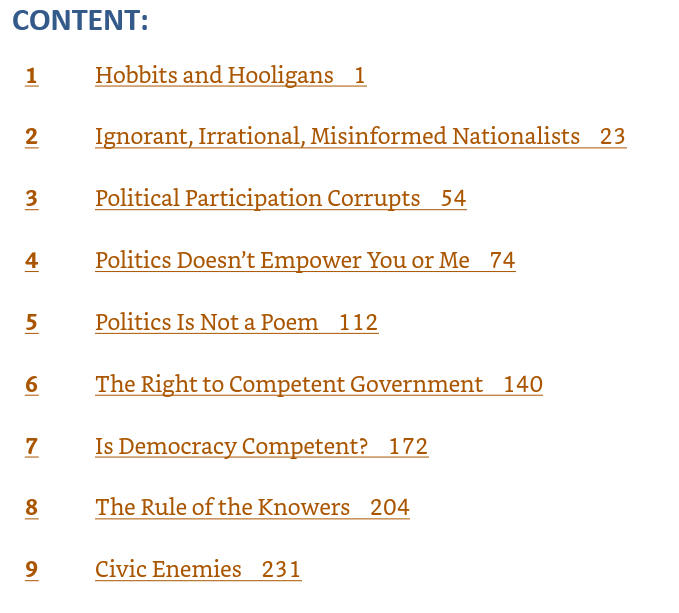
MY TAKE ON IT:
From the guardians of Plato’s “Republic” to the present-day elitist thinkers, the societal elite always promotes the idea that regular people cannot maintain the effective functioning of society and therefore need leaders who would be in control and ensure such effective functioning. Implemented in many forms, from God-anointed kings to Dear Leaders and General secretaries, it always leads to the misery and suffering of regular people from wars, economic disasters, and whatnot. I think the very approach to the problem of power as being dependent on the quality of people in power is incorrect. The problem is not in the quality of people, but in the power structure. Any society where power is concentrated on the top and distributed down according to the wishes of those at the top will always work poorly. The reason is simple: human ability is limited, and people’s variety of needs and wants are infinite. Therefore, no solution to any problem could be satisfactory for everybody, even if it is satisfactory for the majority. So, the real key is also simple: the power should go from the bottom up, decreasing its scope at every level. Here is how it could work:
- Everything related to the individual and having little impact on others should be decided by the individual using whatever resources this individual has as private property. It includes the ability to move this body to any place in space not occupied or controlled by others, the production and consumption of any form of information, the use of any substances, and so on.
- Everything related to a group of individuals and having little impact on other groups should be decided by members of this group, with consequences of the decision equally applied to all. The hierarchy of such groups could be multilayered from family to local powers to the world as a whole, with a constant decrease in the scope for higher levels of hierarchy. Unreconcilable contradictions between group members should be decided by the ability of individuals or smaller minority groups to move out and take resources of their property with them.
The key feature of this solution is private property; therefore, all resources should be the property of individuals. In case when some resources are not divisible, the exit of individuals from any group should include such compensation that would be considered just.
In short, normal people do not need the elite, so individuals who make decisions for a group should always be in this position for a limited time and deprived of any possibility of extracting more benefits from these decisions than other group members. How individuals get into this position, whether via majority vote, random assignment by lottery, getting through complex examinations, and so on, is not that important. The power flow from the bottom up, limitations of power at each level, and regular change of individuals in control are the only fundamental tools to ensure the effective functioning of a society.
20230521 – The Hour Between Dog and Wolf

MAIN IDEA:
This book combines the author’s experience as a trader routinely experiencing stress and his interest in the biology of stress. The main point is that it is a complex chain of multiple feedbacks between high stress environment and its impact on body that results in specific behavior, which in turn causes environmental changes. Here is one of the author’s main points:” Normally stress is a nasty experience, but not at low levels. At low levels it thrills. A nonthreatening stressor or challenge, like a sporting match, a fast drive, or an exciting market, releases cortisol, and in combination with dopamine, one of the most addictive drugs known to the human brain, it delivers a narcotic hit, a rush, a flow that convinces traders there is no other job in the world.”

MY TAKE ON IT:
This book is one more book that confirms my understanding of the wholeness of mind/body when everything is interconnected and works as one complex system. The working of this system includes:
- Receiving multiple signals from the external environment and internals of the body
- Building a distorted image of the situation in such a way that it optimizes body functions to support actions necessary for survival
- Implementing these actions on the environment
- Analyzing results and going back to a.
One of the most interesting parts of this book for me was describing some of the body parameters such as heart rate variability, that I was unfamiliar with. Another example of helpful information from this book is the graph of feedback loops timing between the brain and other parts of the body:

20230514 – Human Compatible

MAIN IDEA:
This book is about intelligence. It explores the idea of intelligence in humans and machines. The main point is that humans must find a way to control AI, even when it acquires superior functionality in processing existing information and generating new one, such as ideas, technology, and art.

MY TAKE ON IT:
This book is a pretty good presentation of the concept of intelligence as a more or less abstract idea. It also includes detailed descriptions of current debates and provides some suggestions for dealing with AI. I think the whole problem is a bit overblown because of the dominant concept of humans as purely biological objects as we are now and have always been. However, if one looks at a human as a self-directing information-processing object deeply embedded into the network of interactions with other humans, the problem kind of disappears. Humans are all different from each other in their DNA, cultural background, and behavior. So, why is it a problem if humans create a silicon-based self-directing information-processing object with all human characteristics except for the biological base? I do not think it will happen because nobody needs it, maybe except for some controlled experimentation. Beyond that, AI will be used as all other machines: to process materials and information to satisfy biological humans’ material and intellectual needs. The key here is the notion of SELF, which no AI computer could obtain without being “raised” in the same way as human beings are. Surely, it could be done much faster, but the nature of the process has to be the same.
20230507 – How the War was Won
MAIN IDEA:
This book about WWII is highly unusual. Unlike nearly 99% of books about this war that focuses on battles and outcomes of these battles: their winners and losers, this book focuses on munitions production and logistics. The author points out that the munitions production and, even more critical, logistics led to the Allies’ victory and the defeat of Nazi Germany and Japan. The author reassesses the distribution of the credit for victory between the USSR and the Western Allies. USSR fought most battles, lost by far more people. It killed more soldiers than the USA and Britain. But the USA and Britain caused much more destruction and disruption to Germany’s and Japan’s abilities to produce munitions, deliver them to the battlefield, and use them effectively. The bottom line is that many more munitions were not produced or never used in the battle than were lost in battles.

MY TAKE O IT:
I always found it strange that many people manage to ignore the realities of industrialized war. After all, neither morale of troops nor their number could do much if the enemy had more munitions. The quality of munitions obviously also should be accounted for, so the accurate comparison must include all factors, including those not evident. For example, suppose the final battle ended with X1 soldiers in psychological condition X2 with X3 munitions winning against Y1 soldiers in psychological state Y2 with Y3 munitions. In that case, it always means that the totality of X is more than the totality of Y. So, in WWII, the effort of the Western Allies led to much higher levels of diminishing the fighting ability of the Axis than the Soviet effort. One example of invisibility would be the impact of a failed air raid by Allie’s bombers against a German production facility that could not cause any material damage whatsoever. It may show no killed or wounded personnel or destroyed building, but it kept workers of this facility spent time hiding in shelters rather than producing munitions. The result would be some munitions never made due to the waste of time that is not different from being destroyed on the battlefield. In either case, these munitions do not exist after the action, whether the action was a battle or failed air raid. The failure to understand the need for a holistic approach to force estimations led to many shortcomings of aggressors who counted only the visible components of the force potential. The ongoing demonstration of such oversight is the Russian-Ukrainian war currently underway.
20230430 – Language vs Reality

MAIN IDEA:
The main point of this book is that human language serves not as much as an instrument of accumulation and transfer of information but rather as a tool of social organization, which is necessary to coordinate the actions of groups of human individuals. From this point of view, the linguistic and ideological representation of reality has only tangible relation to the reality of the environment because this representation must be limited to the technical capacity of the human brain. The book describes how it is done and scientific experiments that demonstrate this process. It also provides some interesting examples from comparing different languages, proving how human perception of reality depends on the language. Finally, it reflects the manipulation of people applied by using “the power of framing, stories, and narratives in persuasion, sense making, and social cohesion.”

MY TAKE ON IT:
This book is quite a helpful tool for anybody who wants to be at least somewhat free and independent because it nicely demonstrates how others manipulate us all. This manipulation starts from birth and ends only at the point of death. It is done via language structure and use, the control of information flows, and the framing of individual mindset during culture acquisition and throughout the lifetime. From my experience, I could say that the ability to recognize such manipulation and act accordingly could be a defining factor in the quality of an individual’s life and even its quantity.
20230423 – Stolen Focus

MAIN IDEA:
This book is about human focus, which is the human ability and even the need to concentrate narrowly on some informational process, whether reading, problem analysis, communication with others, etc. The focus also means excluding everything else that is not in focus from human perception and thoughts, as if it just does not exist. The book discusses at length the necessity of focus for being productive in any area of human activity and technology that distract people from applying it effectively. The author also discusses the consequences of this distraction, which include the inability to deal with complex problems and adherence to simplistic solutions. Eventually, this inability to focus on effective problem solutions causes stress, illness, and a general failure to have a good life. In conclusion, the author offers six behavioral changes that could help manage attention and control focus.
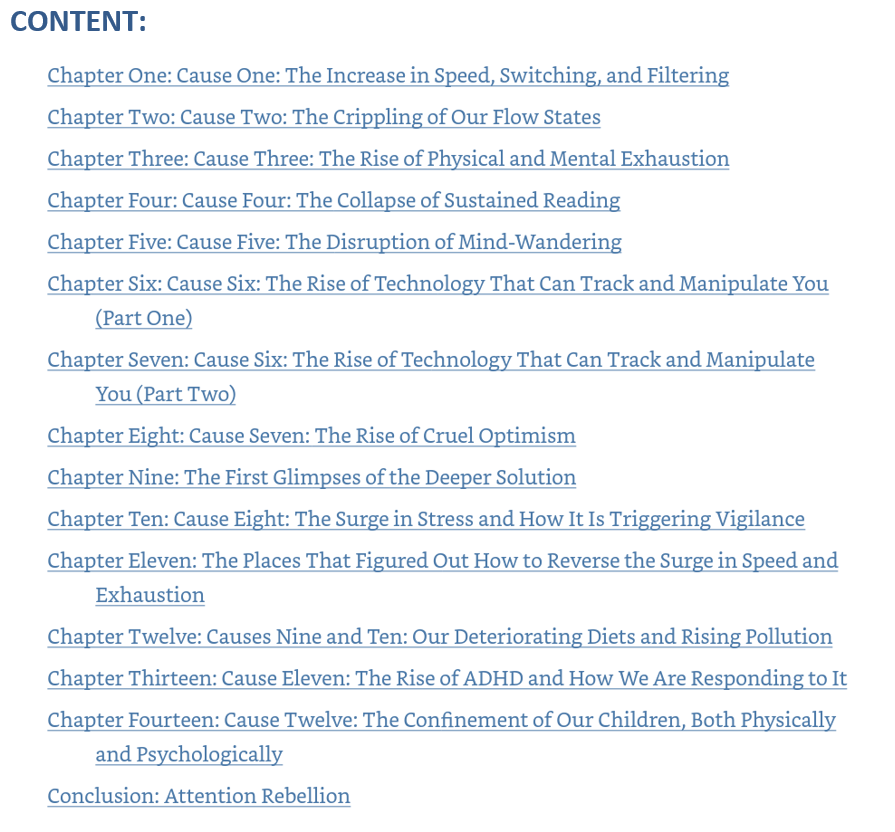
MY TAKE ON IT:
It is a good review of the problem, with many references to psychological research and books. For me, the problem does not look too tricky to resolve, probably because I grew up in an environment where the primary news source was radio and one TV program, computers were mainframes not accessible to people, and books were available only within limits established by the totalitarian government. This was the environment of severe informational deprivation combined with the massive overflow of propaganda and disinformation in all forms conceivable. But on the other hand, this environment provided good training for setting up filters to select what makes sense and what does not, which tools help get things done, and which mainly distract one from doing this. So, I think the distraction problem will be resolved via training in setting similar filters from early childhood. In addition, such training should develop skills in consciously deciding what one wants to achieve, what information one needs for this, and which tools are best; after that, one can just cut off all this noise and even forget about its existence.
20230416 – Stalin’s War

MAIN IDEA:
The book is about the History of WWII. Unlike the thousands of other books about this period in History, this book offers a reality check on what then happened and how it happened. The typical narrative is that it was a good war in which forces of democracy and freedom fought and won over forces of Nazis’ totalitarian dictatorship, aggression, and genocide. This typical narrative also misses a small, inconvenient, but essential fact that on the side of democracy and freedom was the Communist totalitarian dictatorship of the Soviet Union that was as aggressive and genocidal as Nazis, if not more so. It also misses another inconvenient fact that in the first two years of WWII, from September 1939 to June 1941, totalitarian Germany and the totalitarian Soviet Union were allies, actively supporting each other politically and economically. They even had a formal diplomatic agreement with the secret protocol specifying details of the attack of this totalitarian alliance against Poland and the territorial division of this country. Finally, this book very convincingly demonstrates how the Roosevelt administration in the USA spared no effort to support the Soviet Union. It worked hard, bleaching out its image from all traces of seas of blood of its millions of victims, and successfully turned this monster of the country from a technological weakling into technologically advanced military power.

MY TAKE ON IT:
In my opinion, this book should be required reading for any individual involved in the politics of democratic societies. Not only it provides in great detail information about History, but it also demonstrates how much distortion of History in service of the ideology of socialism impacts the actions of individuals in control and how it results in huge costs that people have to pay as a result of these actions. It is not only people under Soviet dictatorship who suffered these costs by having miserable lives of economic and intellectual deprivations. It was also the people of democratic states who had to suffer a decrease in well-being resulting from vast amounts of resources of these states directed to support the growing power of the USSR during WWII and then to maintain substantial military expenses to contain it. I would suggest looking at two historical events to demonstrate how they happened. One is from WWII – the Warsaw uprising again Nazis in 1944, and another is Russia’s current aggression against Ukraine.
The first event was when Stalin rejected all requests of the USA and UK to help the Polish resistance and allowed Nazis to destroy thousands of people, which could become an obstacle to his plans of control over Poland. It is described in chapter 30 of this book. It clearly demonstrates the ideological and moral weakness of the Western leadership of the time. Just imagine that instead of timidly asking for help, Roosevelt demanded it and warned that refusal to help Poland meant immediately suspending all lend-lease supplies. Stalin would have no choice but to comply because, without tremendous material support from the USA, Red Army would not be able to fight. The result of such assertiveness in this and similar cases would be the democratic Easter Europe, significantly diminished abilities of the USSR to initiate and conduct Cold War, and much better lives that generations of people elsewhere would have in the second part of the XXth century.
The second event, even if it started 77 years after WWII, is directly related to this war and its History distortion. Russian dictator Putin and other members of the contemporary Russian elite grew up in an environment where the USSR’s role in WWII was glorified, its material and military achievements magnified beyond any reasonable relation to factual reality, and the role of Western allies diminished to insignificance. This distortion became an inseparable part of these peoples’ worldviews. It also created the foundation for their strong belief in the superiority of their people and, therefore, Russian ability to generate military power superior to anything that could be generated by the West, despite the West’s enormous economic and technological superiority. Such belief will sustain Russian aggression as long as the West allows it by pretending that it does not happen before February 2022 and not providing sufficient weapons to Ukraine to win quickly.
If Western leaders truly learned the History of WWII, they would understand that choice is not fight or not fight. The option is what price to pay. Admission of Ukraine to NATO on February 21st of 2022 would save hundreds of billions of dollars and hundreds of thousands of lives. Correspondingly, the suspension of military support to Ukraine, if it happens, will lead not to peace but to spending trillions of dollars and millions of lives due to the expansion of this war. It remains to be seen what road they will choose.
20230409 – Not Born Yesterday
MAIN IDEA:
The author explicitly defines his intention in writing this book as rejecting the idea that regular people are too gullible and are an easy mark for cheating and manipulation by politicians, businesses, and other crooks. “The goal of this book is to show this is all wrong. We don’t credulously accept whatever we’re told—even if those views are supported by the majority of the population, or by prestigious, charismatic individuals. On the contrary, we are skilled at figuring out who to trust and what to believe, and, if anything, we’re too hard rather than too easy to influence.”
MY TAKE ON IT:
I think that the majority of people are gullible and often allow others to manipulate them to act against their own interests. There are quite a few reasons for that; the main probably is the cost of resources and attention that are required to resist. It is not the cost per se but a rather typical human inability to compare the cost of paying attention to the cost of not paying it. A typical example would be something like “global warming” manipulated into “climate change” when it became obvious that temperature is not going up that much. The cost of resisting this ideology, such as conflict with its noisy supporters, is very real and immediate.
In contrast, the cost of letting the supporters of this religion have their way in the legislature, culture, and other areas is remote and not obvious. This cost will come in price increases for energy, and consequently everything else, inability to do things that used to be trivial, suppression of speech, and an overall decrease in quality of life. Eventually, with the expansion of these costs, it will become intolerable and inevitably lead to fighting back. In a working democracy, it is a bit less difficult than in a dictatorship, but the price of this gullibility will still be pretty high.
20230402 – The Myth of American Inequality
MAIN IDEA:
This book is about widely spread misconceptions regarding enormous and still growing inequality in America. The authors use government statistics to demonstrate, and quite convincingly at that, that it is not the case. The point they make is that government transfers pretty much-eliminated poverty. Furthermore, the calculations demonstrate that government expenses on the poor, if counted as income, would firmly put these poor into the middle class. Here is a lovely table summarizing this point:
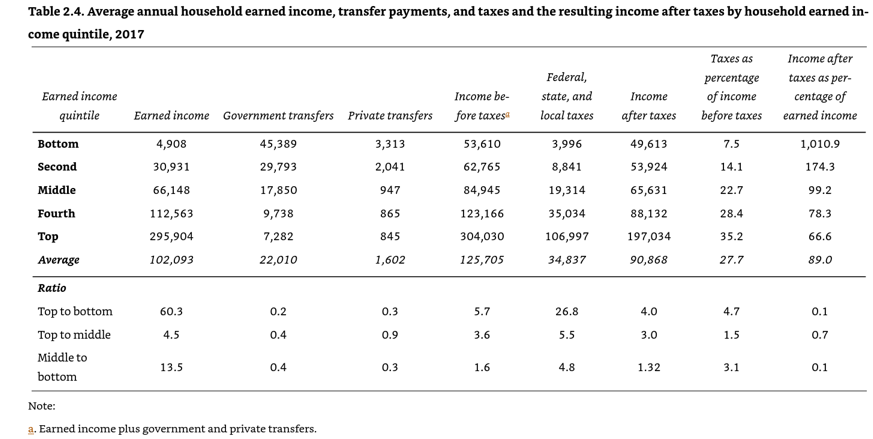
The authors also look at consumption and conclude that the poor in America consumes so much of everything that they hardly should be considered poor by comparing them with the poor in most other countries.
The authors also discuss inequality, the Gini coefficient, and how leftist economists manipulate data to arrive to preset conclusions. Finally, the authors demonstrate that, far from being stagnant, America has made significant progress, and the contemporary poor are much wealthier than the real poor in the 1960s.
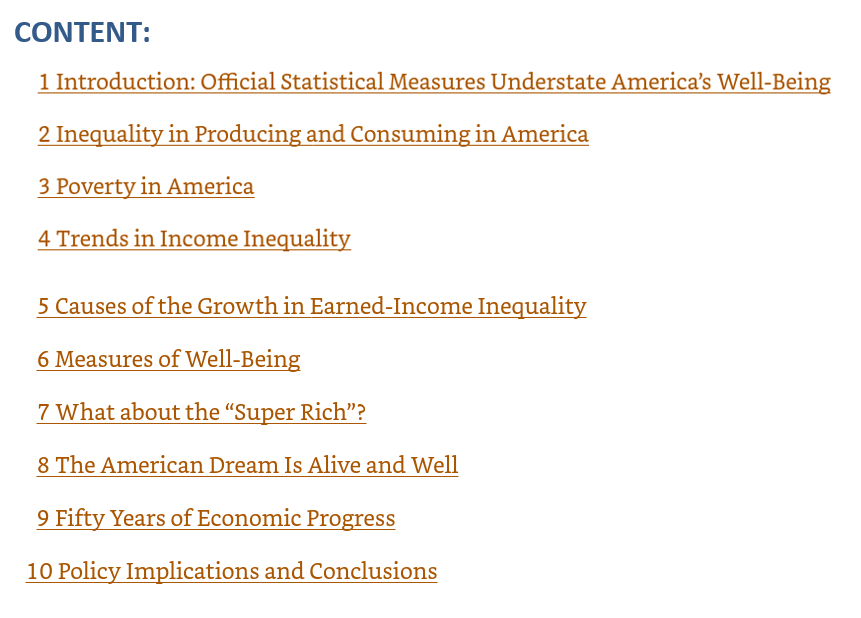
MY TAKE ON IT:
It is a very interesting book with lots of excellent and relevant statistics. I believe that material well-being becomes secondary after people achieve some level of satisfaction with material needs. The problem becomes not economic but rather psychological. To achieve an acceptable level of self-esteem, a human need to be self-sufficient and effective in obtaining resources from the environment. Handouts and transfers of resources from others prevent such achievement. Hence, people try to compensate for this by the demand to increase transfers to the resource availability level of really self-sufficient people. The hope is that such an achievement of false equality would make the feeling of inadequacy disappear. An even more critical factor is the powerful forces of bureaucracy and government-supported layers of society that control resource transfers from productive people to unproductive, directing a significant share, if not the most, of resources to themselves. These forces include the teachers that produce illiterates after 12 years of schooling and paper pushers that make any business spend extraordinary time and effort complying with meaningless regulations. They also include politicians that create these regulations. Together with other members of the parasitic part of society, they represent a powerful force that would make the “struggle for equality” continue forever, regardless of actual resource availability for everybody in society.
Moreover, with the approaching switch of a large part of the production of goods and services to automatic, AI-based processes, the number of people that cannot compete will grow, increasing the power of the parasitic part of society. This change could lead to an increase in the hierarchical structure of government expanding to include these people directly as educated bureaucrats doing meaningless “work” or indirectly as uneducated “poor” living off government transfers. The alternative to this unified hierarchy would be resource distribution via individual ownership covering the totality of the population and totality of available resources and designed to make such ownership permanent while dynamically adjusting it depending on individual actions and their success or failure. In my essay, I proposed a process for doing just this.
20230326 – The Extended Mind

MAIN IDEA:
In this book, the author argues that the usual perception of the brain as the sole organ where thinking occurs is incorrect. The author discusses the familiar analogies of a brain as a muscle or computer, which she believes are inaccurate. The author defines her position here:” For one thing: thought happens not only inside the skull but out in the world, too; it’s an act of continuous assembly and reassembly that draws on resources external to the brain. For another: the kinds of materials available to “think with” affect the nature and quality of the thought that can be produced. And last: the capacity to think well—that is, to be intelligent—is not a fixed property of the individual but rather a shifting state that is dependent on access to extra-neural resources and the knowledge of how to use them.” Another essential point that the author makes is that humans now have powerful tools for information processing, such as computers, that increase the processing power of the human mind, making it evident that it becomes an extended entity, most of which resides outside of the human head.
CONTENT:
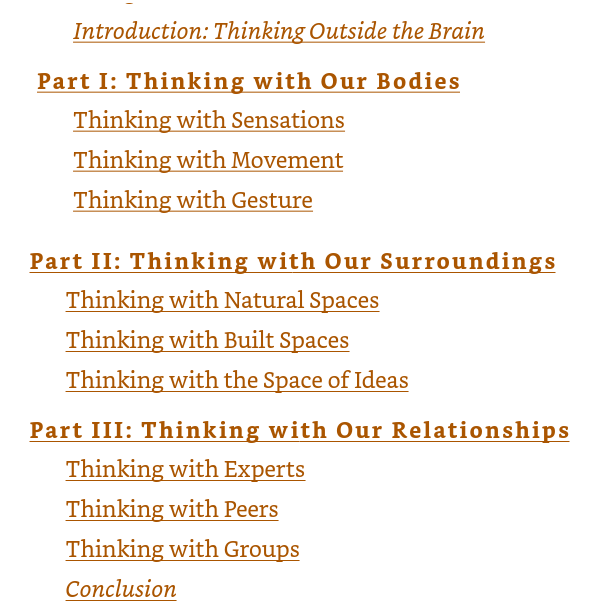
MY TAKE ON IT:
I think that idea of an extended mind is somewhat trivial. It was so long before computers were invented, and it is doubtful that anybody would argue that the concept of the duality of body and mind applies anywhere outside of philosophical discussions. However, the quality of the brain is the most important factor defining the quality of the mind. Based on a lot of research, I am pretty sure that the quality of the individual mind is highly inheritable. Hence, the idea that everybody could achieve anything if a proper environment is provided just by putting in 10,000 hours of practice is just not supported by human experience. However, the mode of application of the mind to a variety of problems is highly dependent on available tools, making the individual ability to use tools effectively much more critical than the ability to do a task without tools. For example, the prodigy capable of doing complex calculations in the head could be easily outclassed by any person with a calculator. This reality makes the whole idea of dividing people into more and less intelligent somewhat outdated. Instead, the division should be between individuals capable of achieving results in some specific area and those who cannot do it. The significant thing is that since just about any area of activity is complex and tools dependent, it is not possible to design tests that would perfectly predict individual performance. So, the best way would be to stop trying select people upfront and provide everybody with resources and access to the ability to act. Based on these actions’ results, only after that decide who should get the extended opportunity.
20230319 – The Neuroscience of Intelligence

MAIN IDEA:
This book is pretty much a scientific report on contemporary knowledge about human intelligence. It is not ideological and, based on recent technological achievements such as functional MRI, allows a look inside the brain when it is working, creating images of the process. The author provides such a definition of his effort:” Three laws govern this book: (1) no story about the brain is simple; (2) no one study is definitive; (3) it takes many years to sort out conflicting and inconsistent findings and establish a compelling weight of evidence.”

MY TAKE ON IT:
For me, this book provides a nice confirmation for my understanding of human intelligence as a tool, evolutionary developed for survival. Therefore, it presents a sufficiently broad set of characteristics that make individuals intellectually different. It contradicts the contemporary dominant pseudo-egalitarian ideology that demands equality of results and acceptance of scientifically unsupported claims of the infinite malleability of humans that would allow anybody to achieve anything. In my opinion, the diversity of human intellect is not a bug but an essential feature that increases the probability of adjustment to a rapidly changing environment. After all, in some cases, the group is better off if it includes Einstein. Still, in other situations, it is better off if it includes people on the other side of the intellectual spectrum.
20230312 – Taxes Have Consequences
MAIN IDEA:
This book is a pretty much detailed history of taxation in the USA in the XXth and the first 20 years of the XXIst centuries. It provides a thorough examination of taxes and their effectiveness or lack thereof. The author’s name is well known because it relates to the famous “Laffer curve.” He convincingly demonstrates that the tax rates, more often than not, are just political games that have little impact on what people at the top pay because these people have access to a great many loopholes and a massive industry of legal tax evasion. In addition to a laundry list of tax evasion methods, the author demonstrates how high taxes produce a negative impact on the economy by diverting efforts of the most productive people of the society away from active efforts to create more ideas, inventions, goods, and services to not less vigorous, demanding, but economically non-productive activity of saving what they already have from taxes.


MY TAKE ON IT:
Probably the most interesting point that the author makes is that actual tax rates for the rich remain the same regardless of the declarative tax rates. I always enjoy seeing this graph, which so nicely demonstrates how taxes work:

I think that the problem is not really with taxes and their rates. The problem is with the use of the state by the elite in control. Is it used as a valuable tool for prosperity or as a mechanism that negatively impacts the population’s life? I believe that the simple rule is this: a state is a machine of violence, and as such, it should be used exclusively for the prevention of violence, its suppression if prevention fails, and for retaliation against individuals that use it. All other uses of this machine always have one and only one main cause: the poor functional design of processes used for the generation and allocation of resources in the society, including non-material resources such as respect of individuals to each other and prestige of individuals in the eyes of others.
20230305 – How the Body Knows it’s Mind

MAIN IDEA:
This book is about complex processes outside the human mind that broadly define what is happening inside of this mind. These processes occur outside the brain in different human body parts. In addition, many processes occur outside the body, such as interactions with others and the environment. All these processes have some impact on the brain’s work, resulting in specific functions of the mind and, eventually, human actions.

MY TAKE ON IT:
This book is a good review of the different interfaces between the human body and the human mind. It is well documented, and I believe it generally correctly represents such interfaces and how they work. However, the most interesting part is probably about using these interfaces to achieve some preferable condition of mind that could not be consciously achieved by just being willing to do it. The simplest example would be to change one’s emotional state by consciously imitating external manifestations of such a state. In short, the simple mechanical process of smiling, even when sad, makes the person less sad and more open to a brighter side of life.
Similarly, bodily mimicking another person could be a way to understand this person’s condition better. In short, the brain is not a separate, isolated place where the mind resides. It is instead a part of the whole body, and conditions of the entire body define states of the mind.
20230226 – The Network State
MAIN IDEA:
The author possesses highly developed communication skills, so he provides multiple definitions of the book’s central concepts in such a way that each definition expands on the previous from one sentence to the essay. For example, here is the second level of complexity definition:” A network state is a social network with a moral innovation, a sense of national consciousness, a recognized founder, a capacity for collective action, an in-person level of civility, an integrated cryptocurrency, a consensual government limited by a social smart contract, an archipelago of crowdfunded physical territories, a virtual capital, and an on-chain census that proves a large enough population, income, and real-estate footprint to attain a measure of diplomatic recognition”.
The author then proceeds to look in detail at this concept from all conceivable angles.
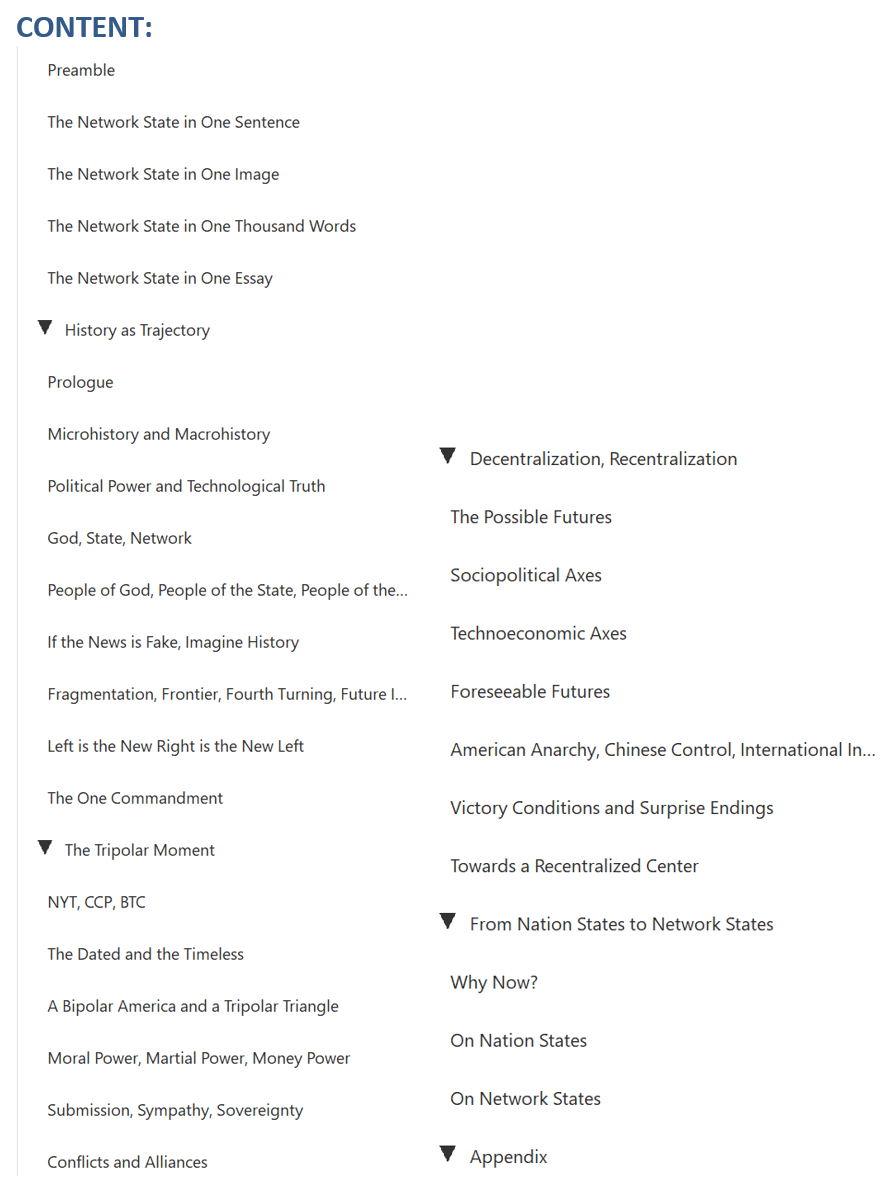
MY TAKE ON IT:
I think that all this is a nice exercise in the philosophy of the nation and state. Still, by its very definition, the network state could not possibly exist because it is distributed in space with nodes (individuals) of its network connected via communication channels. The state, whether small or big, requires the concentration of its members in close proximity because the state is always about violence and force. It could exist only on two conditions:
- There are people who are ready to kill and die for it
- These people are so close to each other that they are strong enough to suppress or eliminate all and any groups of individuals who for one reason or another do not want to accept the existence of the such state.
The world is divided between states, and history demonstrated that these states were created only by one of two processes: dissolution of bigger states due to the internal contradiction between groups of approximately equal power or as a result of merging smaller groups, usually when one conquers others. So the idea that any ruling hierarchy of any state would tolerate any individual living on their territory who profess loyalty to some distributed network state seems to me contradicts the whole history of humanity from it being divided into small bands with a few hundred members controlling a few square miles of territory to contemporary superstates with billions of people. So this nice dream is just a dream and nothing more than that.
20230219 – The World Before Us
MAIN IDEA:
The author’s description of the content of this book:” This book explores the Palaeolithic era (or Old Stone Age), a key phase of late human evolution from roughly 300,000 to 40,000 years ago; a period when we, Homo sapiens, became us. This area of research has changed dramatically over the last couple of decades, and what we know now about our own deep past is very different from what we once thought “. The recent critical findings that occurred due to discoveries in the Denisovan cave and technological breakthroughs that led to decoding ancient DNA samples prompted considerable changes in our understanding of human evolution. It turned out to be much more complex and interesting than people thought. It included multiple human species, previously unimaginable routes, timings of migrations, interbreeding, and many other complex occurrences. It is also a brief but excellent review of new technological advancements that allow the development of this new understanding. These technologies come from multiple areas, from satellite imaging to the biological processing of fossilized material.

MY TAKE ON IT:
Back just a few decades ago, it would be inconceivable to believe that DNA could be extracted and decoded from organic residues created long ago. Similarly, it would be hard to imagine that images from the satellite could lead to archeological discoveries. From my point of view, the new findings demonstrate that human evolution was not a straightforward process as people thought back in the 1970s but rather a complex and convoluted process with setbacks, the division of species into subspecies, and their merging back together. It also causes territorial expansion of humans and then contraction. However, all this does not change the main point of the human species’ development via evolution. It just demonstrates that the understanding of evolution as a directional process is plainly incorrect. The actual process is basically adjustable, so it is not from simple to complex or from lowly amoebas to noble humans. It is just an adjustment to various environmental niches that sometimes includes movement from simple organisms to more complicated, but sometimes from more complex to something simpler but better adjusted to environmental change. Amoebas are still existing in their niches and seem to be doing great. I hope the same can be said about humans for a long, long time in the future.
20230212 -Searching for a Memory
MAIN IDEA:
The main point of this book is that memory is not a passive process of retrieving information from a warehouse of information, but rather an active process of constructing the image of the past based on the condition of neural networks in the human brain. This condition changes dynamically, strongly impacting the results of this construction. The author provides a good metaphor for memory as a telescope pointed at the time. The author expands on this idea by discussing historical examples, experimental data from the use of technology, and referring to the usual behavior analysis methodology of people with damaged brains.

MY TAKE ON IT:
Like everything else in the human body, the brain’s work that generates memories is defined by evolutionary development. However, evolution is about survival and reproduction, not about the search for the truth and factually correct representation of events. So, the process of memory construction necessarily includes mainly unconscious adjustments to whatever relevant neural networks produce to the main objective of survival. The interesting part is that, being social animal, humans actually need both: truths about the past, which is necessary to provide effective interaction with the environment, and lies, which is required to maintain social cohesiveness. We are now at a very interesting point in human history when the demand for truth becomes more important than the demand for lies, whether these lies are noble or not, because technology has achieved such a level when denial of reality makes human survival questionable. A good example was the recent Covid pandemic, when usual bureaucratic manipulations and suppression of the factual data in the name of pseudo-science prevented effective handling of the epidemic, causing enormous economic and psychological damage to the population. Whether humanity can mature to the point when it can effectively handle memories and data soon enough to survive remains to be seen.
20230205 – The Great Demographic Illusion
MAIN IDEA:
The content of this book should put to rest both weird ideas that were derived from changing demography of the USA:
- Democrats hope that America is becoming a “minority/majority country,” meaning they will be in power forever
- Non-elite whites fear that they will become a minority and be treated as inferiors, which is already often the case implemented by the elite via affirmative action programs.
The author provides several arguments falsifying both these ideas. The main argument is that ethno/racial divisions are not really that rigid. The history of America demonstrated that people considered non-white and inferior such as Jews and Irish in the XIX century, became as white as they got by the second half of the XX century. Another point is that, since we all belong to one human species and therefore can interbreed, it’s what Americans do on a vast scale. There is explosive growth in multiracial and multiethnic children that makes all racist ideas plainly meaningless. The same history demonstrates that the newly arrived ethnic and racial groups change their political affiliation over time when their social and economic position rises to mainstream levels. Finally, the author discusses how government demographic statistics manipulate data to fit the dominant narrative and how it hinders the transfer of immigrants of diverse backgrounds into regular Americans, commonly occurring within 2-3 generations.
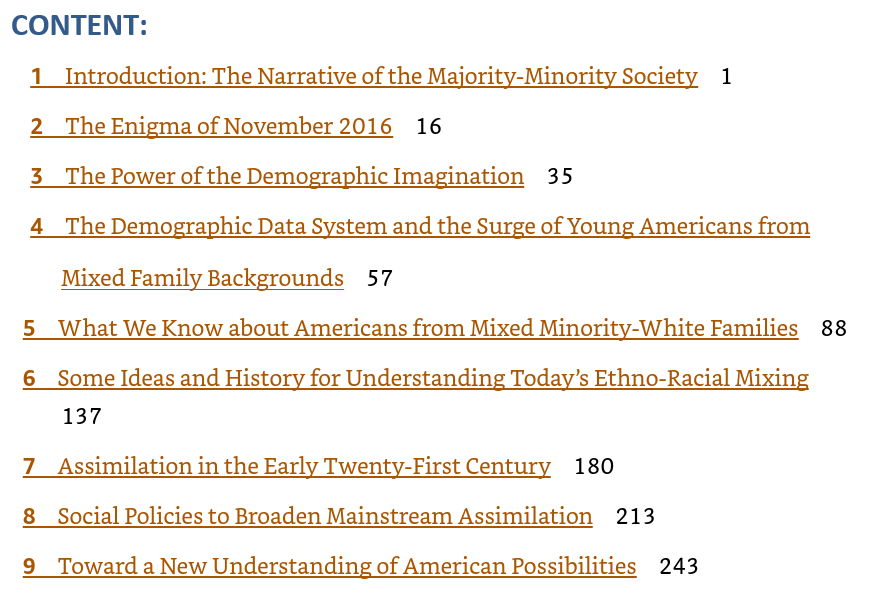
MY TAKE ON IT:
I think that all issues related to “race relations”, “majority/minority struggle for dominance”, “affirmative actions”, and so on are the product of the elite. The elite tries to maintain their status by dividing the non-elite population and busying them with intergroup fights. These fights leave no time and resources for the battle to assure meritocracy and alignment of elite interests with the general population’s interests. A good example would be “free trade” and “environment protection”. Currently, the elite’s interests are linked to their possession of assets, either capitalistic – control over businesses, or socialistic- a good position in a governmental or quasi-governmental hierarchy, such as a governmental bureaucrat or a university professor. Correspondingly these interests include a high return on material assets or a high level of virtue signaling by supporting strict environmental regulation. Both are satisfied by moving production to a third-world country where labor is cheap and ecological law is either non-existent or not enforced. This shift is clearly against the interest of non-elite, for which more affordable consumer goods do not compensate for job loss. Correspondingly, the worst nightmare for the elite would be concrete political action of non-elite demanding that all goods and services sold in the USA would be produced in full compliance with US laws. Obviously, the necessity to pay the American minimum wage and comply with US environmental regulations, however idiotic, anywhere in the world where goods are produced for US consumers would make the US the most efficient place to produce these goods and services. Alternatively, they will force US regulations to change if goods and services cannot be created under such conditions. The division of non-elite into racial and ethnic groups and their incitement to fight each other reliably distracts non-elites of all races from fighting for their common interests.
20230129 – The Journey of Humanity

MAIN IDEA:
This book proposes the unified growth theory that the author defines this way: “Unified growth theory captures the journey of humanity over the entire course of history, since the emergence of Homo sapiens in Africa nearly 300,000 years ago. It identifies and traces the forces that governed the process of development during the Malthusian epoch, eventually triggering the phase transition in which the human species escaped from this poverty trap into an era of sustained economic growth. These insights are essential for understanding the growth process in its entirety, the hurdles faced by poorer economies today in their transition from stagnation to growth, the origins of the great divergence in the wealth of nations in the past centuries, and the fingerprints of the ancient past in the fate of nations.” The author also links it to the math theory describing processes in complex non-linear systems. The author describes it this way:” The conceptual framework I devised in the past few decades to address this conundrum was inspired by insights from the mathematical field of bifurcation theory, which demonstrate how, beyond a certain threshold, minor alterations in a single factor may generate a sudden and dramatic transformation in the behavior of complex dynamical systems (as is the case when heat crosses a threshold and transforms water from liquid to gas).[3] In particular, this research has focused on identifying the cogs that were whirring invisibly beneath the surface, wheels of change that were turning relentlessly throughout the epoch of the Malthusian equilibrium but which ultimately broke its hold and led to the emergence of modern growth – much like the rising temperatures in the kettle.” Finally, the “wheels of change”, defined as population size and population composition. The population composition here means the difference between resource allocation to the quantity of people in the next generation or the quality of these people. The author’s explanation of humanity’s and its resources explosive growth during the last few centuries is the switch from quantity to quality in this composition. The book describes in detail how this change occurred in the past and continues in the present.

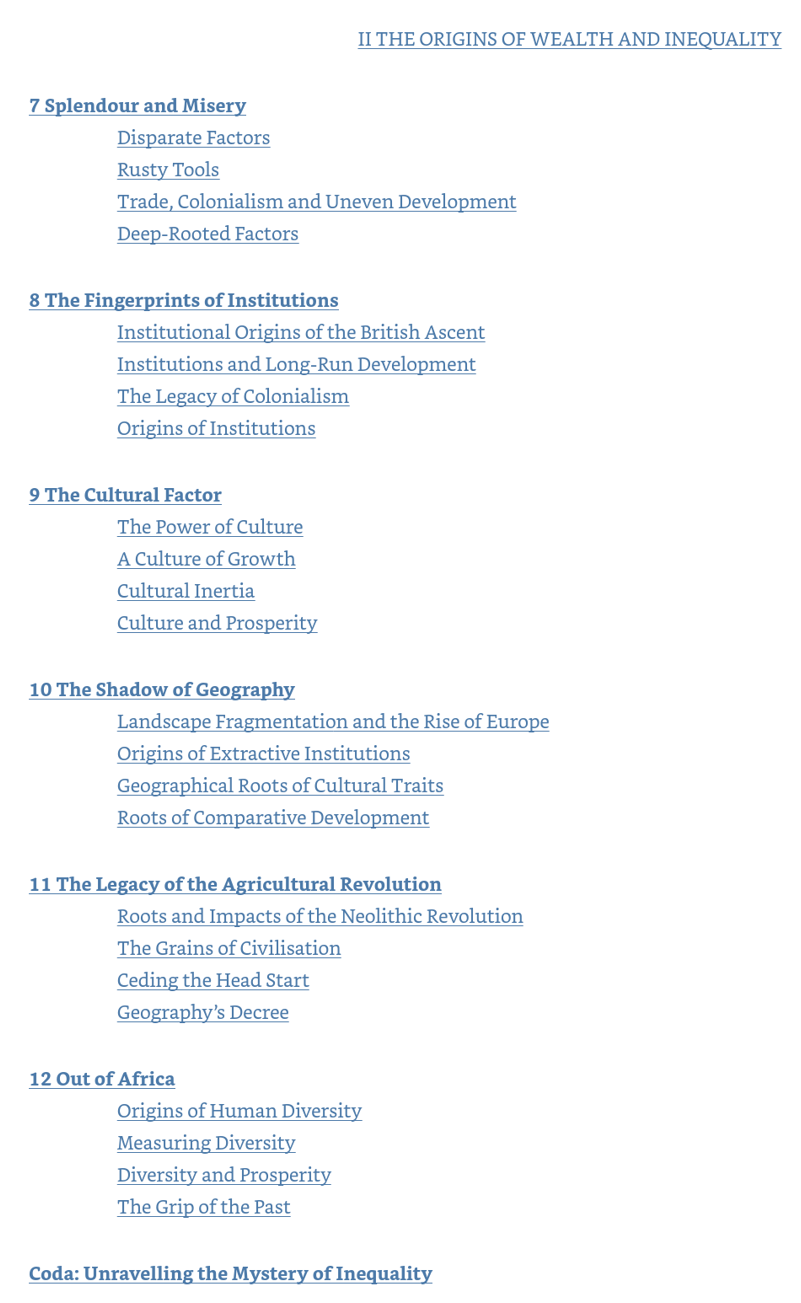
MY TAKE ON IT:
This review nicely presents the logic and history of human development. I agree that the transfer from quantity to quality in forming the next generation is the driver of the acquisition of new technology, which leads to increased productivity, eventually resulting in a massive increase in the quality and quantity of human lives. However, my own understanding of the overall development, past, present, and future of humanity is based on the notion of the duality of human nature. On the one hand, it is defined by the individual need to survive, while on the other hand, by the need to ensure the survival of the group this individual belongs to. Consequently, the struggle for resources, material and psychological, such as prestige, between individuals within a group and the battle between the groups drives all processes and the overall development of humanity.
I see it as the sequence of five stages of humanity’s development:
- The long process of biological evolution took a few million years and produced contemporary humans as creatures qualitatively different from all other animals. This difference comes from the human ability effectively obtain, accumulate, and transfer complex information not only between individuals but also between generations of individuals. This feature of humans allowed a cumulative increase of knowledge, skills, and processes, which put humans out of complete dependency on the environment. It also turned them into hunter-gatherers with languages, cultures, religions, and traditions.
- Starting some 200,000 years ago, humans began expanding throughout the planet. The process was driven by many small wars between groups for more productive land. The losing group would leave, searching for another place to settle. Since the process was slow, on average a fraction of a mile per year, there was enough time for a bit of biological evolutionary adjustments, such as skin color depending on the amount of sunlight and development of the multitude of different cultures and people. During this long process, there was no need for an increase in productivity, except for accommodation in a slightly different environment. This stage of development was mainly completed when human hunter-gatherers populated the whole planet.
- The next stage started about 10,000 years ago. I would define it as Militaristic agriculture. Anthropological and archeological research shows that the switch to agriculture significantly decreased the quality of human lives. Unlike remnants of hunter-gatherers’ healthy bodies, agriculturalists’ remnants show signs of massive wear and tear, hard work, and diseases. However, agriculture provided a much higher population density and a larger, better-armed military. It also created the condition of using forced labor either as slavery or some process of limiting choice for people to either work under the control of others or get physically punished or deprived of resources. Generally, any military confrontation between hunter-gatherers and agriculturalists ended with the defeat and retreat of hunter-gatherers. This stage is still ongoing in some places where leaders and populations are stuck in an ideological and cultural dead end, incapable of understanding the meaningless of territorial acquisition and subjugation of other people when technology and trade made land and manual labor into commodities. During this stage, humanity also developed two main methods of interaction and cooperation between people: Hierarchy and Ownership. The Hierarchy is based on concentrating resources in one place and controlling from the top down, usually using violence and deception on a mass scale. Ownership means distributing resources between owners with exchange and cooperation mainly voluntarily, albeit with a good portion of fraud.
- The next stage – Industrialization started just a few hundred years ago. It led to the implementation of machines that significantly amplified human efforts in the process of generation and management of resources. Initially, this applied mainly to manual efforts and later to data management. This amplification produced a foundation for ideologies of freedom and democracy that supported a massive increase in owners’ productivity and created prosperity in societies where Ownership was, if not dominant, then at least significant. Due to the power of technology, societies with the dominance of Hierarchy mainly lost their ability to conduct profitable wars when victory could bring wealth, slaves, and moral satisfaction. WWI and WWII clearly demonstrated this. So contemporary Hierarchies are left with somewhat limited abilities to rob their own population via taxes and regulations. The current process features constant struggle in each country between Hierarchy and Owners. When the Owners win, the economy prospers, but because all humans are different, this prosperity is always unequal, causing unsatisfied individuals to explode the society with some kind of revolution. After that inevitably comes Hierarchy that concentrates resources, eliminates Owners, sometimes physically, which causes economic decline and general misery. Over time this misery causes the collapse of society with the restoration of some form of Ownership that once again produces prosperity and resentment from insufficiently prosperous people. Then cycle repeats in a somewhat different form.
- We are now at the beginning of a new stage of human development when machines and computers are increasingly capable of completely substituting human efforts in all areas, including the effort of highly qualified professionals. This new situation would inevitably lead to the complete restructuring of human society. As during the previous 10,000 years, it could be built either on the dominance of Hierarchy or dominance of Ownership. I believe that the latter outcome is much better than the former, and I wrote and published on Amazon a small essay describing how it could be done: https://www.amazon.com/OWNERSHIP-versus-HIERARCHY-Choice-Dominant-ebook/dp/B09KMBP6JG/ref=sr_1_5?crid=3NYE5ONTXE27G
20230122 – Conservatism A Rediscovery
MAIN IDEA:
The author is practically the founder of the new and powerful movement of National Conservatism, so the book explains what it is. The book also presents the author’s vision of how the new political paradigm of National Conservatism could substitute the currently dominant political paradigm of liberalism. Here is how the author presents the key points of these two paradigms:
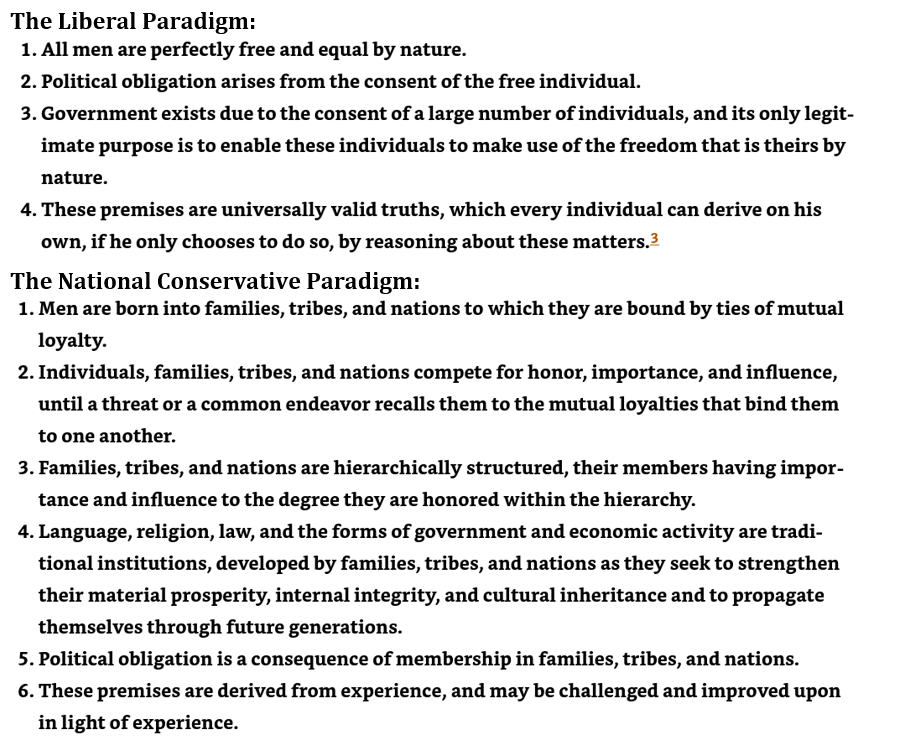
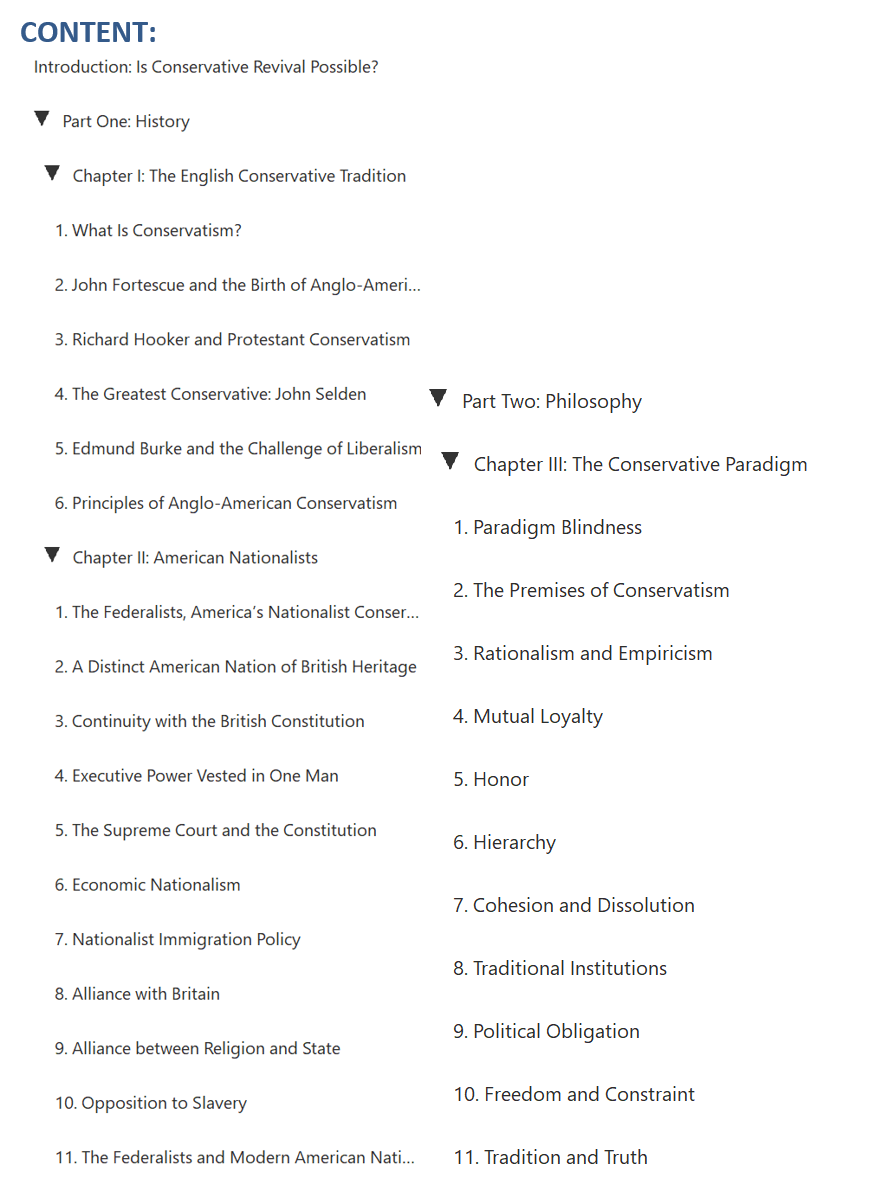
MY TAKE ON IT:
I find both political paradigms presented by the author as alternatives not utterly consistent with reality. The Liberal paradigm is obviously unrealistic. First, individuals and even the same individual in different points of life have different objectives and abilities to achieve these objectives. Also, nobody asked individual’s consent to existing norms and rules of any society ever existed. On the contrary, any society, even the most liberal, uses coercion to enforce individual compliance with these rules. The National Conservative paradigm seems more realistic, but it is so much looking back in time that it does not notice that all this changed. People are not born into some relatively isolated family, tribe, or nation. They are born into a world where information, ideas, cultural patterns, and symbols from multiple political and cultural environments surround an individual. From all this, an individual picks and chooses whatever seems to be most beneficial for this individual’s well-being, which to a significant extent, is defined by the approval of other individuals in a close group. This circumstance undermined previously existing hierarchies, and there is no way back. Humanity is moving to one unified society because technology removed old restrictions of distances, languages, and other walls that separated people into subgroups such as nations and tribes. However, such a unified society could exist within a wide range of arrangements. The range could be from one unified hierarchy with top-down totalitarian control to a society where individual freedom is limited only when it interferes with the freedom of others. The voluntary sorting of people into political, philosophical, and cultural groups of compatible individuals would resolve this limitation. Ironically, being the currently dominant group, the “Liberals” are pushing toward top-down hierarchical control, while the “Conservatives” promote individual freedom. I guess this struggle between paradigms will continue for a while, so the “interesting times” will probably last for a few decades more.
20230115 – The Psychology of Totalitarianism
MAIN IDEA:
This book is about the psychological foundation of totalitarianism that the author calls “Mass formation”. The author is looking:” to understand the shocking behaviors of a “totalitarized” population, including an exaggerated willingness of individuals to sacrifice their own personal interests out of solidarity with the collective (i.e., the masses), a profound intolerance of dissident voices, and pronounced susceptibility to pseudo-scientific indoctrination and propaganda. Mass formation is, in essence, a kind of group hypnosis that destroys individuals’ ethical self-awareness and robs them of their ability to think critically. This process is insidious in nature; populations fall prey to it unsuspectingly.” The author links this process to fear that creates a scary event like a pandemic when losing control over their lives prompts people to seek external force to remove this fear and restore control. Since gods, ancestors, and other supernatural powers disappeared from human beliefs and were substituted by reason, people expect possessors of such reason – experts and government to resolve all problems. The author sees the source of totalitarianism in this:” Totalitarianism is not a historical coincidence. In the final analysis, it is the logical consequence of mechanistic thinking and the delusional belief in the omnipotence of human rationality. As such, totalitarianism is the defining feature of the Enlightenment tradition.” Here is the author’s recommendation for avoiding this outcome:” The fundamental task facing us as individuals and as a society is to construct a new view of man and the world, to find a new foundation for our identity, to formulate new principles for living together with others, and to reappraise a timely human capacity—speaking the truth.”
MY TAKE ON IT:
In my opinion, this approach makes a lot of sense, except for the spiritual part, the author’s attempt to link it all to quantum mechanics, and his rejection of human intellect as “the guiding principle in life and society.”. I do not think the enlightenment and its promotion of human reason have anything to do with totalitarianism. Totalitarianism comes from a completely different source. It is based on the rejection of human reason as an attribute of every human individual. It believes that only some humans, experts, and politicians, possess superior reason and, therefore, should have the power to coerce others to submit to their will. The solution to the problem of mass formation and totalitarianism is in resource distribution between people as much as possible and elimination of coercion, including governmental force, from human lives. This solution would allow all individuals to build their lives as they wish, rather than being a subject of manipulation and coercion to be used to meet somebody’s objectives.
20230108 – The Case Against Reality
MAIN IDEA:
The main point that the author makes in this book is that humans do not really perceive the external world as an objective reality. Evolution formed human perception not based on the search for truth but on survival. The author even presents the formal definition of this idea:” “Fitness-Beats-Truth” (FBT) theorem, which states that evolution by natural selection does not favor true perceptions—it routinely drives them to extinction. Instead, natural selection favors perceptions that hide the truth and guide useful action.” After this very realistic and reasonable approach, the author deviates into the less reasonable discussion of the unreality of spacetime, the primacy of consciousness over matter, which he bases on some particulars of quantum mechanics and other fashionable stuff. Finally, the author presents the idea of conscious realism and defines its ambition and objectives this way:” Conscious realism makes a bold claim: consciousness, not spacetime and its objects, is fundamental reality and is properly described as a network of conscious agents. To earn its keep, conscious realism must do serious work ahead. It must ground a theory of quantum gravity, explain the emergence of our spacetime interface and its objects, explain the appearance of Darwinian evolution within that interface, and explain the evolutionary emergence of human psychology.
MY TAKE ON IT:
I wholeheartedly agree with the FBT theorem and find many examples of its application presented in this book quite interesting. However, in more complex situations that humanity encountered a few hundred years ago when it achieved limits of expansion within the natural environment, a more sophisticated approach had to be developed in order to overcome the Malthusian trap. This approach is called science, and it allows for overcoming human perception faults by implementing multiple sensor technologies and automated analysis of results. Consequently, science allows indirect perception of objective reality by putting human subjective perception out of the processing loop. However, I think it is just a misnomer to seek the existence of consciousness outside of the human head, either at the quantum level or as a product of social networks. The quantum part is mainly a meaningless exercise in complex mathematical modeling. At the same time, social consciousness is just an expression of refusal to accept the complexity of interaction between a multitude of human individuals, each of which thinks and acts in some distinctive way and, therefore, cannot be managed without direct violence of force or indirect violence of resource denial. Finally, the author’s discussion of religion and science leads to a typical attempt to combine two separate and incompatible approaches to modeling human life and the universe around it in some kind of all-inclusive intellectual construct. I think that it is just not needed. Humans are pretty capable of living with two separate models in their heads at the same time, using whichever better fit to support their needs at the moment. So, there is no problem with scientists effectively working with materials dated in millions of years and believing in the Bible that defines the universe’s age as 6,000 years. It creates cognitive dissonance only if one needs consistency between models. However, if one looks at these models just as a tool of life, then he would use science to do what it is good at: predict what will happen in the future based on conditions observable now while using religion to connect with others, overcome life’s challenges, and obtain the support of a cohesive group of co-believers.
20230101 Plomin, Robert – Blueprint

MAIN IDEA:
This book is about DNA and its impact on who we are as persons. It goes beyond the usual discussion on nature vs. nurture, stressing an essential point of feedback between these two factors: our nurture, or, in other words, the process of interaction with the environment , is defined by our nature. It is demonstrated very nicely by research on twins. Another interesting point is that there is hardly such a thing as gene/feature direct correlation. Any particular feature of a person is defined by a multitude of minor variations in many, often thousands of genes.
Yet another point is that human features are varied within ranges, so it is hard to define what is normal and what is not. The other, somewhat surprising, point is that many identifiable parameters of the environment, such as parents, school, and so on, have minimal impact on a person’s development, so everything is defined by the combination of DNA and unpredictable peculiarities of the environment. The final and astonishing point is that the role of DNA is increasing with age rather than decreasing, which one would expect because of increased exposure to the environment over the years.
CONTENT:
MY TAKE ON IT:
I like the logic and presentation of this book. However, quite a few new research results and corresponding points are somewhat surprising to me, even if the moment I read about them these points become evident. One such point is the strong feedback connection between DNA and the environment. A simple example would be the naturally cautious person would never go into dangerous places where he would encounter a highly impactful experience that would become an essential part of the nurture of a less cautious person who went to such a place. In short, this book made me slightly change my understanding of DNA vs. Environment from 50/50 to something more like 70/30, but with high levels of non-linearity, making any such breakdown meaningless. In short, human personality is complex and develops in a chaotic environment, so, despite the important or maybe even dominant role of DNA, it remains unpredictable and, quite possibly, will always remain so.
 Equal Rights Libertarian